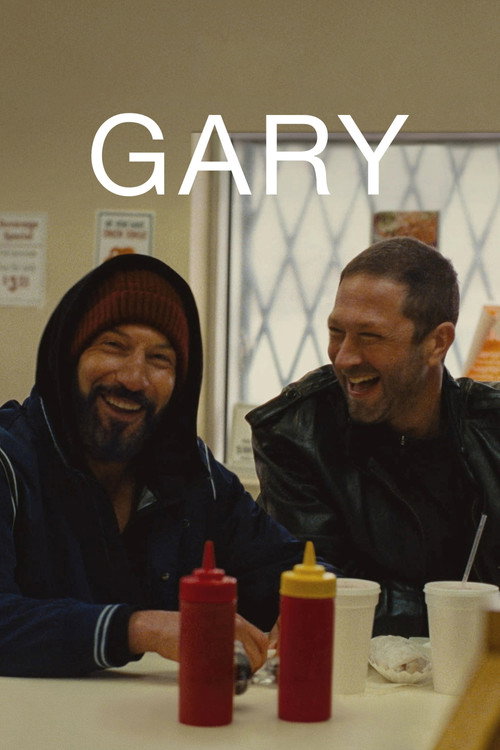
Gary
2026 · Christopher Storer
For when you want a hangout movie with an actual heart — funny company for the evening that leaves you thinking about your own oldest friendships. Comfort viewing with a little grit, not a challenge.
What it's about
Two colleagues are sent to Gary, Indiana on a work errand that should be simple and isn't. The road trip keeps throwing local characters and small-town detours at them, and the assignment slowly becomes the least important thing happening. What it's really following is the friendship — how two people who know each other through work hold up when they're stuck together far from home.
The experience
Loose, talky, and warm with an undertow — the comedy comes from awkward encounters and dead time rather than jokes, and the drama sneaks in through the pauses. It ambles, then lands something true when you're not braced for it.
The craft
This is the first feature from Christopher Storer, the creator and principal director of The Bear, and it carries that pedigree's fingerprints: character revealed through work, rhythm built from overlapping ordinary talk, humor and hurt sharing the same scene. A two-hander lives or dies on writing and timing, and that's exactly the territory Storer's television work has mastered.
Why it matters
It's the moment a defining television voice of the 2020s steps to the big screen — a feature début that also extends the world of The Bear backward, which makes it a marker of how prestige TV and film now feed each other.
Snapshot
A two-hander about colleagues sent out of their element, Gary is the feature directorial début of Christopher Storer, the creator and principal director of FX's The Bear — and it arrives with the particular problem that attends any dossier written at the moment of release: the durable record does not yet exist. There is no settled critical consensus, no verified commercial performance, no body of secondary literature, and no way to distinguish, from outside the production, which of its formal choices were authored and which were accidents of a schedule. What follows is therefore a prospective account. It is anchored in what is firmly established — Storer's body of work, his standing collaborators, the genre lineage the premise plainly occupies, and the industrial moment that produced it — and it flags inference as inference wherever the film itself is the subject. Pre-release trade reporting in 2025 attached Adam Sandler and Jeremy Allen White to the two central roles; casting announcements are provisional until final credits confirm them, and nothing below depends on that pairing being right, though the argument is richer if it is.
The premise, as publicly summarized, is spare to the point of being a structural diagram: two friends, a work trip, a place that is not theirs, a series of local encounters, and a friendship that comes back altered. That is one of the oldest load-bearing shapes in American screen comedy, and Storer is a filmmaker whose entire prior reputation rests on applying unusually severe realist technique to material that could be played for sitcom.
Industry & production
Gary belongs to a clearly legible industrial cycle: the migration of television-formed auteurs into theatrical features. The 2010s and 2020s reversed the older prestige gradient in which film directors condescended to television; the writer-director-showrunner became the dominant American authorial unit, and the feature became the second act. Storer's case is unusually pure. He came up directing stand-up and concert-format comedy specials — most consequentially Bo Burnham: Make Happy (2016) — produced Burnham's Eighth Grade (2018), directed for Ramy, and then created The Bear (2022– ), which won consecutive Emmys for Outstanding Comedy Series and won Storer personally in both the writing and directing categories. He arrived at features with more demonstrated command of long-form craft than most first-time feature directors possess, and with a proven crew.
The financing and distribution particulars — production companies, budget, distributor, release pattern — are the sort of thing that pre-release coverage reports inconsistently and that I will not assert. What can be said with confidence is the structural squeeze the film enters: the adult mid-budget comedy-drama, the exact register Gary occupies, is the most endangered theatrical category of the post-2020 American industry. It was largely absorbed by streaming in the late 2010s, and its theatrical viability now depends almost entirely on star leverage and awards positioning. A star-driven two-hander from a television auteur is precisely the vehicle by which studios have tried to re-establish that category, and it is also the vehicle most likely to be quietly redirected to a platform.
The production context is also post-strike. The 2023 WGA and SAG-AFTRA work stoppages compressed schedules, reordered the 2024–2026 release calendar, and made shorter, location-contained, small-cast projects strategically attractive. A road-shaped two-hander is a schedule-efficient film.
Technology
Nothing about Gary's specific capture format, lens package, or post pipeline should be stated as fact here; those details are usually confirmed only by trade craft coverage after release. What can be described is the toolset Storer's established practice depends on, because that practice is itself technologically conditioned.
The Bear's method — sustained handheld takes in cramped practical locations, actors working without marks, overlapping dialogue captured live — is only economical because of three converging developments: small-bodied large-sensor digital cameras with unlimited effective take length; high-sensitivity sensors that permit shooting to practical and available light in real interiors; and multi-channel radio-mic capture with post-production isolation, which allows a director to let six people talk at once and still recover a usable line. The show's single-take episode "Review" (season two of this technique's history is instructive: it runs roughly eighteen minutes as one apparent shot) is a digital-era artifact. It could have been staged on film only as a stunt; on digital it is a working method.
The forward-looking question for a feature is whether Storer scales that apparatus up or deliberately abandons it. Features afford controlled lighting, wider anamorphic formats, and photochemical capture — tools that would flatly contradict the aesthetic he is known for. A road picture also introduces exteriors, landscape, and daylight, which is the one condition under which his cramped-interior grammar has never been stress-tested.
Technique
Cinematography
Storer's principal collaborator is Andrew Wehde, who established The Bear's visual signature: handheld long lenses worked close, focus hunting slightly behind the actor rather than anticipating them, frames that crop bodies at the shoulder and let the significant action fall to the edge or out of frame entirely. The camera behaves as an occupant of the room rather than its author. Crucially, this is paired with a countervailing habit — periodic, rigorously composed static inserts (hands, tickets, surfaces) cut in at a rhythm that borrows from documentary and from the food-media grammar of the 2010s. The style's power comes from the oscillation, not the handheld alone.
A displacement narrative offers an obvious formal opportunity: the unfamiliar place can be shot with a stability and breadth the protagonists' home register lacks, so that landscape reads as estrangement. Whether Gary takes it is not something to assert in advance.
Editing
Joanna Naugle's cutting on The Bear is the least imitable part of the house style and the most important. Its logic is not continuity but pressure: overlapping dialogue is cut across rather than between speakers; reaction shots arrive fractionally late; sequences accelerate to near-subliminal montage under stress and then stall into real-time duration without transition. The show's characteristic effect — the sensation of being harried — is an editorial effect first and a performance effect second.
The structural risk in translating this to a feature is well known and worth naming plainly: television's episodic engine supplies renewable crisis, while a 100-minute road narrative supplies only one arc. Anxiety-rhythm editing without escalating stakes reads as mannerism. This is the most consequential craft question the film faces.
Mise-en-scène / staging
Storer stages in depth and in clutter. Rooms are dressed to a density that reads as lived-in rather than designed; blocking is continuous, with actors crossing and re-crossing the lens; conversations happen while work is being done, almost never in repose. The dominant convention he refuses is the shot-reverse-shot conversation played at rest. The transposition to a work trip is natural — cars, motels, function rooms, and unfamiliar workplaces are all environments where dialogue must be conducted while something else is going on.
Sound
The Bear's sound work is its most aggressive formal element: layered kitchen ambience mixed near the threshold of dialogue intelligibility, ticket printers and burner ignitions used as percussive motifs, and — at moments of panic — a subjective collapse of the mix into compression and ringing. The show also substitutes curated needle-drops for orchestral scoring, drawing heavily on a Chicago-inflected alt-rock canon (Wilco, R.E.M., Sufjan Stevens' "Chicago," the recurring detonation of Refused's "New Noise"), with music supervision doing the structural work a composer would traditionally do. Whether Gary carries a credited composer, and who that is, is exactly the sort of detail I will not invent; it is worth noting only that a scored feature would mark a real departure from Storer's established practice, and that regional music selection is one of the sharpest tools available to a film about outsiders in a small town.
Performance
The house method is recognizable: rehearsal-light, overlap-tolerant, weighted toward actors who can sustain long takes without landing jokes. Storer's casting instinct has consistently favored dramatic weight in comic performers and comic timing in dramatic ones. If the reported pairing holds, Gary extends the most durable of recent American casting arguments — that Adam Sandler's naturalism, disciplined by a director who will not cut away to the joke, produces performances of genuine severity. That line runs through Punch-Drunk Love (2002), Funny People (2009), The Meyerowitz Stories (2017), Uncut Gems (2019), and Hustle (2022), and it is by now an established critical fact rather than a novelty.
Narrative & dramatic mode
The film's mode is picaresque: a journey structure in which episodic encounters with "local personalities" replace causal plotting, and change registers in the travelers rather than in events. This is a comic architecture of great antiquity and considerable difficulty, because its episodes must be funny in themselves while accumulating toward something. The tonal register — simultaneously comic and unsparing, refusing to resolve into either — is the contemporary dramedy proper, and Storer is one of its most conspicuous current practitioners. The Bear's Emmy classification as a comedy provoked a genuine industry argument about category, which is itself evidence of how illegible the mode has become to older taxonomies. Listing Gary as "Drama, Comedy" is not a hedge; it is an accurate description of a form.
Genre & cycle
Three lineages converge. The buddy road picture, in its American vernacular: Planes, Trains and Automobiles (1987), Midnight Run (1988), Sideways (2004), Due Date (2010). The work-trip film, in which labor supplies both pretext and subject: Barry Levinson's Tin Men (1987) and Diner (1982), Michael Winterbottom's The Trip (2010), and — the closest structural analogue to this premise — Bill Forsyth's Local Hero (1983), in which a company man dispatched to a village is disarmed by it. And the male-friendship drama at its most searching: Cassavetes' Husbands (1970), Elaine May's Mikey and Nicky (1976).
There is also an internal precedent worth noting: The Bear's "Forks," in which a character is sent to an unfamiliar workplace and reconstituted by it, is the same story engine at episode scale.
Authorship & method
Storer's authorship is defined less by recurring imagery than by a consistent procedure: put people in a room where work must be done, refuse to relieve the pressure, and let feeling surface as interruption. His Chicago-area background is the acknowledged ground of The Bear, and his collaborative habits are stable and familial in structure — his sister, the chef Courtney Storer, served as culinary producer on the series, and the core creative team has largely carried across seasons. On The Bear he shares showrunning with Joanna Calo, and the writing has been a room effort; the extent to which Gary's screenplay is solely his is a credit question best resolved by the credits themselves.
The key collaborators to watch are Wehde (image), Naugle (rhythm), and whoever handles music — the three people through whom Storer's television style is actually executed. If those names carry over, Gary is best read as an extension of a working method; if they do not, it is a genuine experiment.
Movement / national cinema
"National cinema" sits awkwardly on a streaming-era American product, but a tradition is nonetheless identifiable: the American realist strain that runs from Cassavetes through the independent cinema of the 1970s, is renewed by mumblecore's low-budget naturalism in the 2000s, and reaches its current high-pressure form in the Safdie brothers — with whom Storer shares both a sensibility and, via Sandler, a lead. What distinguishes the present phase is that this style is now financed by television and executed at television scale, which is why its practitioners arrive at features already fully formed.
Era / period
Gary is a product of the mid-2020s: a contracting streaming market, a hollowed-out theatrical middle, post-strike production discipline, and a star system in which television credibility converts to film financing rather than the reverse. It also belongs to a durable American subject — work as the last remaining container for adult male intimacy — at a moment when the nature of work itself is the culture's central anxiety.
Themes
The visible thematic material: friendship conducted through labor rather than declared; competence and its humiliations; displacement, and the comedy and cruelty of the metropolitan eye turned on a small town (a dynamic that cuts both ways in the best films of this kind); and the recurring Storer subject of grief and obligation carried silently inside professional routine. The synopsis' phrase "new perspectives on their friendship" implies the genre's oldest mechanism — that people only learn what they are to each other once removed from the system that organized them.
Reception, canon & influence
Reception. There is none to report. Any account of Gary's critical standing at this date would be fabrication, and this dossier declines to supply one.
Backward. The influences that can be responsibly named are the ones listed above: the Hughes–Levinson tradition of American work comedy; Local Hero and Sideways for the displacement picaresque; Cassavetes and May for friendship as an unresolvable argument; the Safdies for tempo and for the Sandler precedent; and Storer's own television practice, which is the most proximate influence of all.
Forward. Too early, necessarily — but the stakes are identifiable. If the film works, it strengthens the case that television-formed realist craft transfers intact to features and accelerates the pipeline that carries showrunners into theatrical filmmaking. If it does not, the failure will most likely be diagnosed at the structural joint this dossier has flagged twice: an anxiety grammar built for renewable episodic crisis, asked to carry a single ninety-minute arc. That question — not the casting, not the premise — is what Gary will be argued about.
Reception
How Gary was received, from release to now →
Influences: the films it descends from and the films it influenced
- Planes, Trains and Automobiles (1987) — The two-hander road architecture Gary runs on is Hughes's: an antagonistic pair locked in shared transit, comic humiliation escalating set-piece by set-piece until a single late confession retroactively reframes the trip — and it is the template for casting a broad comic star (Candy) and withholding the joke at the end.
- Tin Men (1987) — Levinson's aluminum-siding salesmen establish the American work-comedy grammar: characters talk shop in cars, diners and on doorsteps while the job continues around them, so exposition arrives as trade jargon and pitch patter rather than as scene-setting.
- Diner (1982) — The precedent for Naugle's overlapping-dialogue cutting — scenes entered and exited mid-thought, talk allowed to go nowhere, and cuts that land on the second speaker's interruption rather than on the first speaker's period.
- Local Hero (1983) — Forsyth's corporate errand dissolving into drift supplies the displacement picaresque: the assignment is never abandoned, only quietly outlasted, which is how an episodic road structure keeps a work spine underneath it.
- Mikey and Nicky (1976) — May shot two men arguing across one night with multiple cameras on long lenses at enormous ratios so performance was caught rather than staged — the direct precedent for Wehde's compressed handheld two-shots and for a friendship the cutting refuses to resolve.
- Husbands (1970) — Long-take naturalism in which the camera holds a scene past the point of comfort and the actors' negotiation of the dead air becomes the content, rather than coverage looking for the line that ends the scene.
- Midnight Run (1988) — Brest's job-as-plot buddy picture: the errand's logistics — transit, deadlines, expense money, a boss on the phone — generate every scene, so the relationship develops entirely inside procedural problem-solving.
- Punch-Drunk Love (2002) — The original recalibration of the Sandler persona and the source of the subjective mix collapse: score and treated sound swell over and bury the room tone at the moment of panic, so the mix reports the character's interior instead of the space.
- The Meyerowitz Stories (New and Selected) (2017) — Baumbach cuts Sandler's lines off mid-sentence with hard amputating edits, so the character's aggression registers as interruption and thwarted speech rather than as delivered performance.
- Good Time (2017) — The anxiety tempo Gary inherits: long-lens handheld that crowds faces out of their context, wall-to-wall synth pressure used as scoring rather than punctuation, and scenes entered when the crisis is already underway.
- Uncut Gems (2019) — The immediate Sandler precedent and the model for overlapping-dialogue cutting — voices layered so speakers step on each other and the mix decides what is audible, dramatizing divided attention instead of delivering information.
- The Bear (2022) — Storer's own method transferred whole: static macro inserts of hands and objects punctuating handheld long-lens coverage, dialogue conducted during uninterrupted labor, and needle-drops deployed as scoring cues rather than as source music.
- In the Loop (2009) — The proof case for television-formed realist craft transferring intact to a feature: two cameras on long lenses shooting overlapping work talk on a work trip, cut for interruption density rather than for clean exchange.
- The Trip (2010) — A two-hander work-trip picaresque assembled from improvised meal-table talk against static insert cutaways of food being prepared — the same alternation of labor detail and loose conversation, with the job as the only structure.
- Theater Camp (2023) — Cut by Joanna Naugle: comic scenes built from overlapping takes with reactions arriving a beat late, the collaborator link through which Gary's rhythm is actually executed.
- Hustle (2022) — Sandler in a work-procedural register — scouting as labor — shot handheld on long lenses in real venues, with the emotional information delivered while the job is visibly being done rather than in scenes set aside for it.
- Between the Temples (2024) — Zoom-driven long-lens handheld and cutting on anxious, overlapping talk, holding a mismatched two-hander's discomfort instead of relieving it with a reaction shot.
Similar films
- The Ballad of Wallis Island (2025) — same viewing thread
- People We Meet on Vacation (2026) — shared sensibility
- Twinless (2025) — shared sensibility
- Columbus (2017) — shared sensibility
- The Long Walk (2025) — shared sensibility
- Homebound (2025) — shared sensibility
- Palm Springs (2020) — shared sensibility
- A Man Called Otto (2022) — shared sensibility
All the films related to Gary →
Watch it with: curated runs of related films
- Sweet Melancholy in Small Towns — A run of deadpan, bittersweet comedies where oddballs chase modest dreams in overlooked backwaters — a Welsh island, a desert junction, a Rust Belt errand, a Pennsylvania basement — and the ache underneath keeps showing through the jokes.