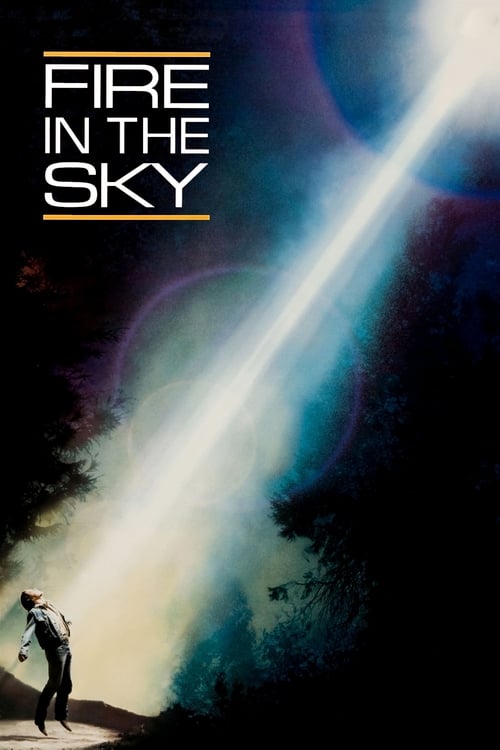
Fire in the Sky
1993 · Rob Lieberman
When you're craving a real scare with a slow fuse, or you're in an X-Files frame of mind and want the case that feels uncomfortably plausible. Comfort viewing it is not — that ship sequence sticks.
What it's about
In November 1975, a crew of Arizona loggers comes back to their small town with an impossible story: their friend Travis Walton was struck down by a light from a hovering craft and is simply gone. With no body and no better explanation, the town treats it as murder, and the men face polygraphs, reporters, and neighbors who think they killed their friend. It's drawn from one of the most famous abduction claims in American UFO lore.
The experience
For most of its run it's a sober, simmering small-town drama about guilt and suspicion — then it detonates into one of the most genuinely terrifying abduction sequences ever filmed. That late stretch is nightmare fuel people remember for decades.
Performances
Robert Patrick, fresh off his icy Terminator turn, is the surprise here — raw and sympathetic as the crew boss carrying the town's suspicion, and D.B. Sweeney makes Travis's ordeal feel painfully human.
The craft
The film's masterstroke is structural: it withholds the abduction until a long flashback near the end, so the horror lands after an hour of earned realism. The ship interior — organic, sticky, wrong in every detail — remains a landmark of practical effects design, and it hits hardest on a big screen in the dark.
Why it matters
Its abduction sequence became the visual template for how pop culture imagines alien abduction, traumatizing a generation of 90s viewers and feeding directly into the decade's UFO obsession.
Snapshot
Fire in the Sky is a Paramount release from March 1993 based on one of the best-known alien abduction claims in American UFO lore. On 5 November 1975, logger Travis Walton went missing in the Apache-Sitgreaves National Forest in northeastern Arizona. His six co-workers said a light from a hovering craft had struck him down. Walton was gone for five days. In that time the crew came under suspicion of murder, and the case drew polygraph examiners, tabloid reporters and debunkers. The film is adapted from Walton's memoir The Walton Experience (1978), and for most of its running time it is a small-town drama about guilt, suspicion and a community turning on outsiders. Then, in a long flashback near the end, it becomes one of the most graphic abduction sequences put on film. The tension between those two films, a sober procedural about whether to believe someone and a nightmarish body-horror set piece, is what makes it interesting. It is also why its influence on the 1990s abduction imagination reaches well beyond its modest standing as a studio picture.
Industry & production
The film was produced by Joe Wizan and Todd Black for Paramount Pictures. Tracy Tormé wrote the screenplay. He had already written the CBS miniseries Intruders (1992), drawn from abduction researcher Budd Hopkins's work, and was an established figure in genre television, including Star Trek: The Next Generation. Rob Lieberman came to the project mainly from television and features of modest scale. Fire in the Sky was a mid-budget studio picture, not a tentpole. It was sold on the true-story premise and on the promise of its abduction sequence.
The Arizona story was largely shot in Oregon, which stood in for the timber country of the Mogollon Rim. Its pine forests and logging towns gave the production the working-class milieu it needed.
The most consequential production decision concerned the abduction itself. Walton's account of the inside of the craft, as told in his book and in interviews, is comparatively clinical: a waking in a room, small figures, a taller human-looking figure, and a confused escape. The filmmakers replaced this with an invented, much more horrific sequence of membranes, cocoons and invasive procedures. Tormé and others connected with the film have said publicly that the studio wanted something more visceral than Walton's narrative supplied. Walton himself has said the onscreen version is not what he reported. The film is therefore "based on a true story" in a specific and limited sense. The investigation, the crew's ordeal and the town's reaction follow the record more closely than the event at the centre of it.
Technology
The film's technical ambitions sit almost entirely in its last act. Industrial Light & Magic supplied visual effects for the craft and the abduction environment. These mix practical construction, miniatures and early-1990s optical and digital compositing. The interior of the ship was built largely as a physical environment, with organic textures, wet surfaces and mechanical restraints, and puppeteered or prosthetic alien figures. That suits the film's tactile horror. The sequence works through the actor's body being handled and violated, not through spectacle.
The opening encounter in the forest uses light as its main effect. A glowing craft and a blast of energy throw Walton through the air. This is restrained by the standards of the time, and the restraint helps: the event is seen in fragments, through the crew's panic, so the audience is placed in the same doubt as the townspeople who later question what happened. The record on how exactly the creature effects were credited and divided among vendors is less widely documented than the ILM attribution, and I won't specify it further here.
Technique
Cinematography
Bill Pope, later famous for The Matrix (1999) and Sam Raimi's Spider-Man sequels, shot the film. He gives the two halves distinct visual registers. The town and forest sequences use naturalistic, often overcast light, the muted greens and browns of logging country, and wide frames that set the men against vast stands of timber. The landscape feels indifferent and enclosing. The night encounter relies on a single overwhelming source. The craft's light floods the frame and bleaches faces, which turns the scene into an experience of exposure and confusion. Inside the ship, Pope moves to sickly, saturated, claustrophobic lighting with tight framings and close-ups of skin, eyes and restraints. It is a deliberate break from the earlier realism.
Editing
Steve Mirkovich edited the film. Its most important structural choice is withholding. The abduction is shown only partially at first, through the crew's flight from the scene. The full experience aboard the ship is held back until Walton recovers the memory late in the film. This turns the middle stretch into a mystery about credibility, not a creature feature. When the flashback finally comes, it is cut as a sustained, escalating ordeal. Its fragmentary transitions mirror the return of traumatic memory. The cutting in the town sections is conventional and character-centred, built around interrogations, meetings and confrontations.
Mise-en-scène / staging
The production design sets 1970s blue-collar Arizona life (pickup trucks, a diner, a small-town church, cramped homes, the sheriff's office) against the biological strangeness of the ship. Most of the film is staged in social spaces where the crew are watched and judged: a town meeting, a lie-detector room, a bar. These scenes keep returning to the men as a group. They are physically huddled together and visually set apart from the community. Inside the ship, staging becomes a matter of immobilisation. Walton is wrapped, pinned and probed, and the camera stays on his helplessness. The images of a body encased in a membrane and a probe moving toward the eye have become the film's best-remembered compositions.
Sound
Mark Isham's score is mostly restrained. It favours atmospheric, melancholy textures over the bombast of standard science-fiction scoring. In the town sections it supports grief and unease without telegraphing horror. The abduction sequence depends heavily on sound design: wet organic noises, mechanical whirring, distorted breathing and the muffled, panicked sounds of a man who cannot scream properly. These carry much of the sequence's power to disturb. In the forest encounter, the sudden roar and crackle of the craft against the quiet woods makes the event feel like a violent rupture.
Performance
D.B. Sweeney plays Travis Walton. He is absent for much of the film, so his performance is concentrated in the bookends and the abduction flashback. There his physically committed portrayal of terror is central to the sequence's effect. The film's real dramatic centre is Robert Patrick as Mike Rogers, the crew foreman and Walton's friend. He spends the film carrying guilt for driving away from the scene. Patrick was then best known as the T-1000 in Terminator 2: Judgment Day (1991), and here he plays a decent, tormented working man. The ensemble includes Craig Sheffer as the volatile Allan Dallis, Peter Berg as David Whitlock, Henry Thomas as Greg Hayes, and Bradley Gregg. Their group dynamics of loyalty, fear and resentment hold the middle of the film together. James Garner plays Lt. Frank Watters, a state investigator who doubts the crew's story. He brings sceptical gravity and a measured authority. Noble Willingham as the local sheriff and Kathleen Wilhoite as Rogers's wife fill out the community.
Narrative & dramatic mode
The narrative is built in three movements. First come the event and the crew's frantic return to town. Next comes the investigation, in which the absence of a body and the crew's implausible story make them murder suspects. Last are Walton's reappearance and the recovered memory of the abduction. For most of its length the film is a drama of testimony. Its question is less "are aliens real?" than "what happens to people when no one believes them?" The lie-detector tests, the press attention and the town's hostility make up a study of social credibility.
This mode is unusual for the abduction subgenre, which usually centres the abductee. Here Walton is largely an absence, a missing body around which suspicion gathers. That is why the late turn into horror works as a revelation and also feels like a rupture. The film moves from realist melodrama into a subjective nightmare, then closes with a coda about the lasting cost to the friendships. The ending deliberately leaves the factual question unresolved within the fiction's world, even as the flashback seems to confirm Walton's experience for the viewer. A closing title note about the polygraph results also frames the film within the documented case.
Genre & cycle
Fire in the Sky belongs to the abduction narrative, a subgenre with a recognisable lineage in American film and television:
- The UFO Incident (1975), the TV film about Betty and Barney Hill.
- Close Encounters of the Third Kind (1977), which put abduction into a wondrous, near-religious frame.
- Communion (1989), adapted from Whitley Strieber's memoir.
- Intruders (1992), Tormé's own miniseries, which dramatised the hypnotic-regression model of abduction research.
Within this cycle the film tilts sharply toward horror. It treats abduction as violation, not contact or transcendence. It also overlaps with the "true story" small-town drama and the police procedural. The film arrived just before the abduction narrative and government-conspiracy themes became central to 1990s popular culture. The X-Files premiered on Fox in September 1993, six months after the film's release.
Authorship & method
Rob Lieberman is not usually discussed as a strong auteur, and Fire in the Sky is better understood as a collaborative studio work than as a personal statement. His contribution shows mainly in his handling of the ensemble and the film's patient, actor-centred middle section.
Tracy Tormé is arguably the film's key authorial voice. He had a long-standing interest in UFO subjects and had already worked on Intruders. He shaped the script as a drama about belief and social consequence, though the abduction sequence departed from Walton's account under studio pressure. Tormé later co-created the television series Sliders (1995).
Bill Pope's cinematography gives the film a visual intelligence beyond its budget class. In hindsight it anticipates his later skill at shifting registers between the mundane and the uncanny. Mark Isham, a prolific film composer with a jazz background, provides a score of quiet unease. Steve Mirkovich's editing manages the film's difficult structure of withholding and revelation. Producers Joe Wizan and Todd Black brought the project to Paramount as a commercially minded true-story genre picture.
Movement / national cinema
The film is a product of the mainstream Hollywood studio system of the early 1990s. It belongs to no film movement. Its American-ness is thematic as well as industrial. Its setting is rural Western working-class life: loggers on government contracts, small-town churches and diners, a sheriff and a state investigator. These ground the abduction story in a vernacular Americana that sets it apart from more cosmopolitan or suburban treatments of UFO material, such as Spielberg's. The film sits at the junction of the studio genre picture and the "based on a true story" format that television movies of the period used heavily.
Era / period
Released in March 1993, Fire in the Sky arrived as public interest in alien abduction was rising. Budd Hopkins's books, Strieber's Communion, David Jacobs's work and growing media coverage had made the abduction narrative, with its grey aliens, missing time, medical examination and recovered memory, a familiar cultural script by the early 1990s. Walton's case had been revisited in UFO literature and on television. The film's period setting in 1975 places the story in the post-Watergate atmosphere of distrust, where institutions such as police, press and polygraph examiners claim authority over truth but can't settle the matter. In its own moment, the film's mix of paranoia, unbelieved testimony and bodily intrusion anticipated the decade's preoccupations. Those preoccupations soon found fuller form in The X-Files and Dark Skies (1996).
Themes
- Belief and credibility. At its core the film asks what it costs to tell a truth no one will accept. The crew are tested, interrogated, shunned and accused of murder. In the film's world, testimony is socially dangerous.
- Guilt and male friendship. Mike Rogers's guilt over leaving Walton behind is the film's emotional engine. The film is unusually attentive to working-class male bonds and how they strain under suspicion.
- Community and scapegoating. The town's turn against the crew, tied to the men's own marginality and to a pre-existing romantic tension involving Walton and Rogers's family, shows how communities need explanations and find culprits.
- Bodily violation and trauma. The abduction sequence frames contact with the unknown as invasion of the body, and memory as a wound that returns. That fits the period's broader cultural link between abduction narratives and discussions of trauma and recovered memory.
- Institutional uncertainty. Polygraphs, investigators and the press all fail to produce certainty. The film is ambivalent about whether truth can be established at all.
Reception, canon & influence
Critical reception. Contemporary reviews were mixed. Critics generally praised the ensemble, especially Robert Patrick, along with the grounded early sections and the effectiveness of the abduction sequence. Many objected to the film's uneven structure and to the jarring shift between its realist and horror halves. The film did modest business in theatres and was not a major hit. I won't cite specific grosses here. Its reputation grew on home video and television, where the abduction sequence in particular gained a lasting cult standing.
Discussion of the film has also been shaped by the controversy over the real case. Skeptics, most prominently UFO debunker Philip J. Klass, argued that the Walton incident was a hoax, pointing among other things to the crew's contract troubles with the Forest Service. Walton and the crew members have maintained their account over the decades. The film itself declines to settle the matter, but its invented abduction sequence has complicated its status as a "true story" adaptation. Walton has acknowledged that the onscreen ship sequence differs substantially from his testimony.
Influences on the film. The film draws on:
- The documentary and tabloid record of the 1975 case and Walton's own memoir.
- The abduction iconography popularised by Hopkins and Strieber, and earlier by the Betty and Barney Hill case.
- Close Encounters of the Third Kind, whose image of blinding light in a rural night sky it echoes, and Communion, for the abductee's psychological ordeal.
- Tormé's own Intruders.
- In its ship sequence, the organic, biomechanical body horror associated with Alien (1979) and its successors.
Legacy. Fire in the Sky is widely cited, in retrospectives and by viewers who saw it young, as one of the most frightening abduction sequences in film. Its imagery of medical restraint, membrane and invasive procedure fed into the visual vocabulary of 1990s and 2000s abduction media. It is often mentioned alongside The X-Files, Dark Skies and Steven Spielberg's miniseries Taken (2002). Later works such as The Fourth Kind (2009) and Dark Skies (2013) carry on its approach of presenting abduction as horror under a "true events" frame. The film also renewed public attention to the Walton case. Walton's memoir was reissued under the film's title, and the case has stayed a fixture of UFO documentaries and paranormal television.
Critically, it holds a minor but secure place as a cult genre film. It is valued less as a coherent whole than for its unusually serious portrait of disbelief in a small community and for a final act that, whatever its fidelity to the record, shaped how popular culture pictured what happens inside the ship.
Influences: the films it descends from and the films it influenced
- The UFO Incident (1975) — This TV dramatisation of the Betty and Barney Hill case set the template that Fire in the Sky inverts. It made the abduction a buried memory, released in fragmentary flashback inserts during hypnotic regression, and kept the main drama on how believable the couple's testimony was rather than on spectacle.
- Close Encounters of the Third Kind (1977) — Fire in the Sky borrows two things from it. One is the overexposed light flooding into an ordinary rural night, coming from a single unseen source above and bleaching faces and vehicles. The other is the blue-collar witness whose encounter cuts him off from his family and town.
- Picnic at Hanging Rock (1975) — Weir built a film around an absent protagonist: a disappearance that is never explained turns the survivors into objects of community suspicion and police questioning. Fire in the Sky's middle act runs on the same mechanism, with Travis gone and the crew interrogated in his place.
- Alien (1979) — The ship interior in Fire in the Sky takes its look from Giger and Scott's biomechanical design: wet, ribbed, membranous surfaces that make the craft feel like a body rather than a machine. ILM built Fire in the Sky's version as practical sets and puppetry.
- Communion (1989) — Communion treats abduction as a psychological ordeal, with an ordinary man unravelling in his domestic life. It cuts to clinical-procedure memories only in bursts, through therapy, and Fire in the Sky splits its own structure along the same line between home-life breakdown and procedure memories.
- Intruders (1992) — Tracy Tormé's own miniseries, drawn from Budd Hopkins' casework, worked out the procedure-table imagery and the regression-flashback structure. Tormé then carried both straight into the Fire in the Sky script.
- Dark Skies (1996) — The series reused Fire in the Sky's imagery of the immobilised, probed body and its flashes of medical restraint. It also kept the early film's dramatic engine, ordinary Americans whose accounts the authorities won't credit.
- The Matrix (1999) — Bill Pope shot both films, and the awakening in the pod reuses Fire in the Sky's membrane-cocoon image: a naked body helpless in organic fluid, tubes forced in. Pope also kept his two-register lighting, setting a mundane world against a lurid, unnatural one.
- Taken (2002) — Taken spreads Fire in the Sky's drama of the stigmatised abductee across generations. It keeps the flashbacks of being frozen on the table in white light, and shows how abduction ruins working-class families from the inside.
- The Fourth Kind (2009) — It takes Fire in the Sky's 'true events' frame to an extreme with supposedly archival footage and split-screen re-enactment. As in Fire in the Sky, the abduction stays a buried memory reached through regression and staged as bodily horror on the subject.
- Dark Skies (2013) — Stewart's film keeps the domestic drama of a strained family that no one believes. Its abduction scenes stay off-screen and fragmentary, carried by missing time, marks on the body and sudden stillness of the body, in the line of Fire in the Sky.
- The Vast of Night (2019) — It turns small-town UFO lore into extended oral testimony played out in real time. Witnesses on the margins, a Black veteran and an elderly woman, give accounts whose credibility hinges on the listener, and a single blinding light source floods the climax.
- Nope (2022) — Peele films an abduction from inside the creature's wet, fleshy interior, a direct heir to Fire in the Sky's organic ship. He pairs it with working-class ranch Americana and a story built on proving the sighting to people who don't believe it.
- No One Will Save You (2023) — Duffield's film has almost no dialogue and leans on organic, tactile sound. It stages abduction as invasive body horror, with the heroine paralysed, levitated and colonised, and brings Fire in the Sky's procedure imagery to a lone outcast doubted by her own community.
- The X-Files (1993) — The X-Files premiered months after Fire in the Sky and leaned on the same restraint-table abduction flashbacks. It also posed abductee testimony against official disbelief and filmed it in a single-source, flashlight-and-floodlight look for a rural night.
- Signs (2002) — Signs builds dread by holding back the aliens and keeping the camera on a rural family under siege. Like Fire in the Sky's middle act, it puts the horror into what the characters can't see and into the faith or disbelief of a small community.
- Lake Mungo (2008) — Lake Mungo is a pure drama of testimony around an absent protagonist. Family and townspeople reconstruct a vanished person's experience from accounts that contradict each other, so the audience keeps weighing how credible the witnesses are, much as Fire in the Sky handles its crew.
- Under the Skin (2013) — Glazer's black-void harvesting chamber descends from Fire in the Sky's organic-membrane imprisonment. Bodies hang paralysed in viscous fluid while a cold, impersonal process works on them, and sound design does much of the work.
Similar films
- Close Encounters of the Third Kind (1977) — influence & lineage
- Signs (2002) — influence & lineage
- Alien (1979) — influence & lineage
- Twin Peaks: Fire Walk with Me (1992) — shared sensibility
- The Thing (1982) — shared sensibility
- The Blair Witch Project (1999) — shared sensibility
- Invasion of the Body Snatchers (1956) — shared sensibility
- October Sky (1999) — shared sensibility