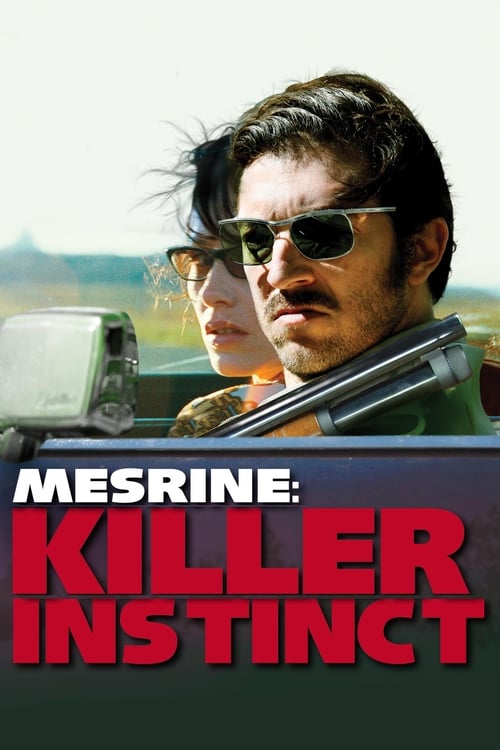
Mesrine: Killer Instinct
2008 · Jean-François Richet
For when you want a big, propulsive crime saga — the kind of true-story gangster movie you put on when you have an appetite for scope and swagger. Pairs naturally with its sequel for a full-evening double bill.
What it's about
The rise of Jacques Mesrine, the real-life gangster who became France's public enemy number one: home from the Algerian War, he's pulled into the neon glamour of 1960s Paris crime under an old-school mob mentor, and climbs from petty jobs to robbery, kidnapping, and audacious prison breaks across France and Canada. It's the first half of a two-film portrait of a man addicted to his own legend.
The experience
Fast, brutal, and magnetic — a period gangster epic that moves like a getaway car, jumping cities and years without letting the tension slack. It seduces you with the outlaw's charisma while never hiding what he actually does to people.
Performances
Vincent Cassel is ferocious as Mesrine — vain, funny, terrifying, often within the same scene — in a career-defining, César-winning turn; Gérard Depardieu brings heavy, watchful menace as his underworld mentor.
The craft
Jean-François Richet mounts the '60s and '70s with saturated period texture and stages the robberies, escapes, and shootouts with punishing physicality — the violence lands hard rather than cool. The structure is bold too, opening at the end and building the legend backward, and the scale rewards a big screen.
Why it matters
With its companion film, it was the most ambitious French crime production of its era — a national box-office event that reasserted France's claim on the gangster epic and cemented Cassel as its star.
Snapshot
The first panel of a boldly conceived diptych, Mesrine: Killer Instinct (L'instinct de mort) opens with an ending: the 1979 police ambush that killed Jacques Mesrine in a hail of bullets on the Porte de Clignancourt. From that prologue, the film then spirals backward and forward through the making of a criminal legend — Mesrine's working-class Paris upbringing, his psychological scarring in the Algerian War, his seduction by a criminal underworld mentored by the old-guard French mobster Guido, and his escalating transatlantic career of robbery, kidnapping, and prison breaks. Together with its companion film L'ennemi public n°1 (released the same month), Killer Instinct constitutes the most ambitious French crime production of the 2000s: a visceral, period-saturated gangster epic that reasserted the commercial and artistic ambitions of French popular cinema while placing Vincent Cassel among the foremost screen actors of his generation. The film is grounded in Mesrine's own prison memoir, also titled L'instinct de mort (1977), giving the production an uncomfortable intimacy with its subject's self-mythology.
Industry & production
The project was backed by Pathé, one of the foundational studios of French cinema, which committed to a significant budget — the two films were shot back-to-back and together represented one of the costlier French productions of the decade, though precise figures have not been uniformly reported in accessible sources and are worth treating with caution. Producer Thomas Langmann, son of the legendary Claude Berri, was the driving commercial force behind the greenlight. The decision to adapt Mesrine's story was less a discovery than a long-deferred obligation: Mesrine had been a tabloid fixture and near-folkloric figure in France since the 1970s, and his memoir had circulated widely. The formal challenge was turning an episodic, self-glorifying life narrative into a dramatically coherent two-part structure without simply producing a television miniseries. Richet and screenwriter Abdel Raouf Dafri solved this by treating the two films as genuinely distinct dramatic objects — Killer Instinct covering roughly 1959 to 1972, focused on formation and escalation, and Public Enemy #1 covering the final volatile decade leading to his killing.
The casting of Vincent Cassel was decisive: no other French actor of his generation carried the combination of working-class credibility, menace, volatility, and charisma that the role required. Cassel's preparation involved considerable physical transformation across both films, cycling through different ages and body weights. The supporting cast includes Cécile de France as Sofia Jeannin, Mesrine's companion during his Canadian years, and Gilles Lellouche as his associate Paul; Gérard Depardieu plays Guido, the old-school crime boss whose mentorship propels Mesrine's early career, in a piece of casting that freights the generational dynamic with the weight of French cinema's own history.
Technology
Both Mesrine films were shot on 35mm film — a deliberate fidelity to the period aesthetic, though one that by 2008 was already becoming a self-conscious choice rather than a default. Shooting on location in Paris was logistically complex, requiring period redressing of streets, vehicles, and storefronts across multiple decades of the 1960s and 1970s. The production team also reconstructed elements of Montreal and Quebec for the Canadian sequences, blending location work with dressed sets. The film does not make conspicuous use of digital effects for period recreation; the emphasis is on practical costume, production design, and camera choices to achieve period texture. The two films were edited simultaneously over a long post-production period, maintaining tonal and rhythmic consistency across the diptych as a whole.
Technique
Cinematography
Robert Gantz served as director of photography on both films, bringing an approach that balances the immersive grain of 1970s crime cinema with contemporary widescreen dynamism. The cinematography resists the sepia nostalgia of the heritage film tradition — the images are bright, saturated, sometimes harsh, aligned with the energy of a man who never seemed to recede into history. Wide-angle lenses and proximity to performers give the violence an unsettling immediacy, while the more expansive Canadian wilderness sequences open the frame to a different register of dread. Handheld work is used selectively and purposefully during action sequences rather than as a default stylistic tic; the camera earns its agitation.
Editing
The editing sustains a pace unusual for a French production — propulsive without sacrificing period atmosphere. The non-linear framing device (beginning with Mesrine's death) is folded back into an otherwise chronological progression, creating a structure in which the audience always knows how the story ends but remains in suspense about the texture and causality of each step toward that ending. Scene transitions between episodes of Mesrine's life are handled with the confidence of a film comfortable with ellipsis: years collapse, geographies shift, and the viewer is trusted to reorient. The cumulative effect is closer to the episodic momentum of GoodFellas than to the stately progression of a conventional biopic.
Mise-en-scène / staging
Richet stages violence with a directness that refuses both glamorization and moralistic distancing: the robberies are efficient and frightening, the beatings brutal, the consequences quick and ugly. The contrast between Mesrine's theatrical self-presentation — his love of performance, disguise, provocation — and the banal brutality of what he actually does is embedded in the staging rather than announced in dialogue. The Algeria sequences at the film's opening are shot in a deliberately dirtier, more disorienting register than the Parisian sequences that follow, establishing a causal chain between colonial violence and domestic criminality that the film refuses to make too schematic. The casting of period-appropriate interiors, cars, and clothing is meticulous without becoming museum-like.
Sound
The film makes extensive use of period source music — French pop, chanson, and early rock — which functions less as nostalgic wallpaper than as a marker of the aspirational energies that Mesrine is pursuing. The score composition (precise attribution to individual composers across both films is not uniformly documented in accessible sources) complements rather than leads the dramatic rhythm. The sonic texture of violence — gunshots reported in real time, without the amplified aesthetic of Hollywood action — reinforces the unglamorous physicality of the criminal world even as the narrative threatens to mythologize it.
Performance
Cassel's performance is the film's engine and its central argument. He plays Mesrine as a man for whom violence is never purely instrumental — it is expressive, theatrical, an identity. The physicality is extraordinary: Cassel moves through the film with the coiled readiness of a man who is always performing for an audience even when alone. What prevents the performance from becoming mere star turn is Cassel's refusal to sentimentalize or explain: Mesrine's charm is legible and his brutality is legible, but their coexistence is presented as fact rather than puzzle. Cécile de France brings a complementary alertness to Sofia — she sees exactly who Mesrine is and chooses him anyway, a choice the film treats with respect rather than pity.
Narrative & dramatic mode
The film operates in a mode that might be called the picaresque crime biopic: a sequence of episodic criminal adventures loosely organized around a protagonist's rise, with the biographical facts providing the scaffolding but dramatic invention governing the texture. The source material — Mesrine's own memoir — is itself a work of self-mythology, and Richet and Dafri are alert to this: the film is partly about how a man constructs his own legend even as he lives it. The in medias res opening, showing the killing before the life, transforms the entire biographical narrative into an exercise in retrospective inevitability while sustaining local dramatic tension. This structural choice echoes the American crime film tradition (the prologue deaths of Bonnie and Clyde, the ironic distance of GoodFellas' retrospective voiceover) while grounding the device in the specific historical record of Mesrine's actual end.
Genre & cycle
Killer Instinct sits at the intersection of several genre traditions. It is heir to the French polar — the tradition of hardboiled crime cinema running from the poetic realism of Marcel Carné through Jean-Pierre Melville's austere gangster films to the more kinetic popular crime films of the 1970s and 1980s. It also engages directly with the American gangster biopic as refined by Bonnie and Clyde (1967) and GoodFellas (1990): the charismatic outlaw, the episodic structure, the complicity of the audience in enjoying the criminal's energy before the accounting arrives. The film is importantly not a Melvillian exercise in style and abstraction — it is warmer, more sociologically grounded, more interested in Mesrine's formation than in an existential cipher. Within European cinema of the 2000s, the two-part prestige biopic had established precedents in Che (Soderbergh, 2008) and, at a more intimate scale, various television co-productions; the Mesrine diptych represents the most commercially successful realization of this format in French cinema. The film also participates in a cycle of French productions in the late 2000s that revisited the political turbulence and countercultural energies of the 1960s and 1970s with ambivalence rather than nostalgia.
Authorship & method
Jean-François Richet came to the Mesrine project with a biography unusual among French directors of prestige crime films. His debut features — État des lieux (1995) and Ma 6-T va crack-er (1997) — were raw, semi-documentary portraits of the French banlieue, made with limited resources and a social realist urgency. His pivot to Hollywood for the Assault on Precinct 13 remake (2005) demonstrated a command of genre mechanics and production scale that his earlier work had not required. The Mesrine project synthesized these two registers: the sociological grounding and period specificity of the earlier French work, combined with the pacing and formal confidence of the American assignment. Richet has spoken in interviews about his admiration for the American crime film tradition — Scorsese above all — while insisting on the French social particularity of Mesrine's story.
Screenwriter Abdel Raouf Dafri, a French-Algerian writer whose career gained significant momentum with these films, brought to the script an understanding of the Algeria-to-Paris trajectory that is central to the first film's argument. His screenplay condenses and reorganizes Mesrine's memoir into dramatically efficient episodes while preserving the logic of the self-mythologizing voice. Dafri went on to further significant French crime writing, confirming the importance of the Mesrine project as a launching platform. The collaboration between Richet and Dafri across both films represents one of the more productive director-writer partnerships in French popular cinema of the period.
Movement / national cinema
The film belongs to a renewed confidence in French popular genre cinema in the 2000s — a moment when the perceived gap between French art cinema and French commercial cinema had narrowed enough for productions like Mesrine to claim serious critical attention without sacrificing box-office ambition. French crime cinema in this period was reasserting itself after a long fallow stretch: the Melville tradition had no obvious heirs through much of the 1980s and 1990s, and the polar had largely migrated to television. Richet's diptych, along with contemporaneous work by directors like Nicolas Winding Refn (working in Denmark) and a handful of French directors working in the thriller mode, constituted something like a revival of confidence in the authored popular crime film. The film's French-language international success — it was released in multiple markets with the English-language titles under which it became known — also marked a moment in which French cinema demonstrated it could compete in the gangster biopic form without simply imitating Hollywood.
Era / period
The production sits in 2008 French cinema at a transitional moment: Pathé and other major French studios were investing in larger-scale commercial productions following the success of films like The Da Vinci Code's French theatrical run and a general re-expansion of European commercial ambition. The same year, the French industry was engaged in ongoing debates about digital versus celluloid, about the relationship between cinematic and television production scales, and about the future of the distinctively French exception culturelle model of cultural subsidy. The Mesrine project represented an argument — made through commercial and critical results rather than polemics — that French cinema could sustain a genuinely popular genre cinema without abandoning authorial identity.
Themes
The film's dominant thematic concern is the relationship between institutional violence and individual criminality. The Algerian War sequences are not decorative — they establish that Mesrine was trained in and traumatized by state-sanctioned killing before he turned those capacities against the state itself. The film stops well short of exculpating Mesrine on these grounds (his pleasure in violence is too evident) but it insists on the causal chain. Guido's mentorship adds a second axis: the generational transmission of criminal knowledge, the seductions of masculine fraternity, the way a particular image of competent toughness is offered as an alternative to the wage economy of postwar France. Mesrine's relationship to celebrity and self-presentation is a running subtheme — he courts journalists, writes a memoir, engineers his own legend — and the film is throughout aware that it is itself participating in that legend-making even as it attempts to ground it in historical fact. The instability of masculine identity, the performance of toughness as psychological armor, and the seductive glamour of transgression in a conformist social order are consistent preoccupations that connect Killer Instinct to the broader tradition of the French crime film.
Reception, canon & influence
Mesrine: Killer Instinct and its companion piece Public Enemy #1 were released consecutively in France in October 2008, becoming major commercial successes. Vincent Cassel won the César Award for Best Actor — one of the most widely anticipated awards in French cinema that year — and the films collectively received further César recognition. Critical reception in France was enthusiastic, with most reviewers acknowledging the scale and ambition of the project even when registering reservations about the self-mythologizing tendency of the source material. International reception was also strong: Anglophone critics, particularly in the United Kingdom and North America, were struck by the films' formal confidence and Cassel's performance, and the diptych became one of the higher-profile subtitled releases of 2009 in English-language markets.
The films' backward influences are clearly legible: the debt to GoodFellas in structure, voiceover, and the moral ambiguity of charismatic criminality is acknowledged; Bonnie and Clyde's fatalist romanticism and in-medias-res structure are in the genealogy; the Melville tradition of the French gangster film provides the national context. The Quebec sequences draw on a different set of references — the cold geography and institutional brutality of Canadian prison films — that give Killer Instinct a rougher textural register than its more glamorous Parisian sequences.
The forward legacy of the Mesrine diptych operates primarily on French popular cinema. It demonstrated that the polar tradition could be revived and expanded at genuine commercial scale, and it contributed to a climate in which directors like Jacques Audiard continued to receive substantial backing for crime-adjacent projects. The films consolidated Cassel's position as the premier French actor for volatile, physically demanding material, directly enabling his international career expansion in the years that followed. For French cinema broadly, the Mesrine diptych stands as evidence that the period crime biopic — long considered an Anglo-American or Italian specialty — could be successfully naturalized in the French context, drawing on both the distinctly French social history and the global language of the gangster genre, without losing its national specificity in the translation.
A Deleuzian reading
The film starts with him already dead.
The full Deleuzian reading of Mesrine: Killer Instinct →
Reception
A two-part event release in France in 2008, it was a domestic box-office hit and swept the acting/directing Césars; abroad it arrived a year later to strong reviews and has settled in as the modern French gangster benchmark — still weirdly underseen outside France.
How Mesrine: Killer Instinct was received, from release to now →
Influences: the films it descends from and the films it influenced
- GoodFellas (1990) — Richet lifts Scorsese's in-medias-res freeze-frame prologue and return-to-origins structure, plus the protagonist voiceover that constructs self-mythology while the camera simultaneously glamorizes and ironizes criminal violence.
- Bonnie and Clyde (1967) — Penn's fatalist prologue strategy — flashing forward to the ambush death before reversing to origins — gives Mesrine's opening gunfight its structural logic: the ending is known before the biography begins.
- Le Samouraï (1967) — Melville establishes the French polar's moral grammar — the criminal whose personal code grants existential coherence against a corrupt institutional order — which Richet inherits as the genre's baseline ethical logic before destabilizing it through colonial origins.
- The Battle of Algiers (1966) — Pontecorvo's docufiction grammar of colonial institutional violence — grainy handheld direct proximity to bodies under state coercion — informs Richet's Algerian sequences, establishing how French military brutality transforms colonial subjects into career criminals.
- Raging Bull (1980) — De Niro's decade-spanning bodily transformation established the actor-as-physical-project model of performance that Cassel directly inherits for Mesrine's weight gain, aging, and physique shifts across the diptych's chronological span.
- Heat (1995) — Mann's downtown LA shootout set the standard for acoustically precise, unglamourized firearms reproduction — the dry percussive crack of real gunfire over Hollywood's romanticized ballistics — against which Richet calibrates Mesrine's gunfight sound design.
- Dog Day Afternoon (1975) — Lumet's documentary-adjacent handheld grammar applied to a real criminal who performs his legend for media cameras directly prefigures Mesrine's bank-robbing staged for photographers — the criminal as conscious media producer of his own outlaw mythology.
- Borsalino (1970) — Deray established the French period crime biopic as prestige star vehicle — the gangster naturalized into period setting with major stars carrying commercial weight — creating the national template Richet reclaims and socially inflects with banlieue-era documentary texture.
- Un prophète (2009) — Audiard extends Richet's colonial-register-contrast — the North African-to-French-prison trajectory as the crucible of criminal formation — using the same 35mm grain, handheld proximity, and unglamourized institutional violence Mesrine established as the visual grammar for French cinema's engagement with colonial history.
- Carlos (2010) — Assayas directly extends the Mesrine format into a three-part theatrical/television hybrid — the French-produced prestige biopic of the international political criminal across decades — deploying period source music, physical-transformation performance, and the multi-part episode structure that Richet's commercial success proved viable.
- La French (2014) — Jimenez inherits Richet's synthesis of social-realist grounding with genre polish, applying it to the 1970s Marseilles drug trade: 35mm-grain aesthetics, period source music, unglamourized violence, and the French polar protagonist coded as the institutional state's mirror image rather than an aberration from it.
- Animal Kingdom (2010) — Michôd extends Richet's unglamourized criminal-milieu grammar — wide-angle proximity, non-theatrical violence, the criminal family as slow-revealed social ecosystem — into an Australian context, with Jacki Weaver's performance of domestic lethal ordinariness as the antipodal counterpart to Cassel's theatrical volatility.
- The Baader Meinhof Complex (2008) — Direct contemporary parallel: the European political-criminal biopic as prestige two-part diptych, with the self-mythologizing charismatic outlaw requiring two feature-length episodes to contain, and period source music anchoring each phase of a decade-spanning criminal career.
- Gomorrah (2008) — Garrone and Richet converge in the same release year on the European counter-movement to Hollywood crime glamour: 35mm grain, wide-angle proximity to non-theatrical violence, the criminal milieu rendered as unglamourized social ecology rather than individual pathology.
- The Assassination of Jesse James by the Coward Robert Ford (2007) — Dominik foregrounds the criminal's conscious construction of his own folk legend — the ironic gap between Jesse's performed identity and his private erosion — paralleling Mesrine's theatrical self-presentation for press cameras during actual bank robberies.
- Hunger (2008) — McQueen and Richet share a commitment to the political criminal's body as primary formal argument: durational close-ups of corporeal endurance and Cassel's physical transformation both make the actor's physique the vehicle for political-historical meaning rather than dialogue or narration.
Similar films
- A Prophet (2009) — influence & lineage
- Le Samouraï (1967) — influence & lineage
- The Battle of Algiers (1966) — influence & lineage
- Carlos (2010) — influence & lineage
- Mesrine: Public Enemy #1 (2008) — shared sensibility
- Le Deuxième Souffle (1966) — shared sensibility
- La Haine (1995) — shared sensibility
- Le Cercle Rouge (1970) — shared sensibility