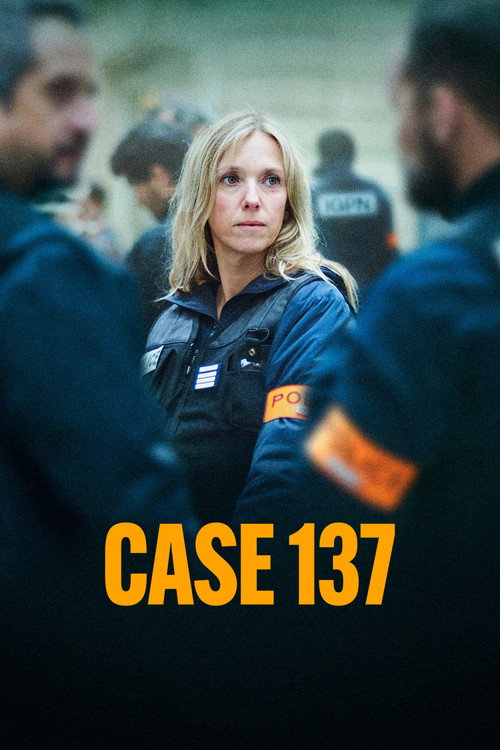
Case 137
2025 · Dominik Moll
For when you're in the mood for a smart, grown-up thriller with real-world weight — something that grips you and gives you an argument to have afterward. A challenge watch, but a compulsively watchable one.
What it's about
Stéphanie is an investigator with the IGPN — the French police force that polices the police. Her file: a young man gravely injured by a crowd-control round during a chaotic yellow-vest demonstration in Paris, a case that looks closed, with no officer identified and no misconduct established. Then she discovers the victim comes from her own hometown, and the routine dossier stops being routine.
The experience
Tense in the way of a great procedural — the suspense comes from interviews, footage, and files rather than chases, and it keeps tightening as the institutional pressure mounts. It's absorbing, sober, and quietly angry, and it makes you think about who watches the watchers.
Performances
Léa Drucker anchors the film as Stéphanie — restrained, precise work that lets you read conflict and conscience in an investigator whose job requires showing neither.
The craft
Dominik Moll builds suspense out of procedure itself: depositions, video evidence, the grinding mechanics of an internal-affairs inquiry, all staged with documentary-level attention to how the system actually works. The screenplay's rigor is the special effect.
Why it matters
It joins the wave of French cinema reckoning with the policing of the yellow-vest protests, and confirms Moll's late-career turn into one of France's sharpest makers of morally serious crime films.
Snapshot
Dossier 137 — released internationally as Case 137 — is Dominik Moll's second consecutive film built around a police investigation, and his first to turn the procedural apparatus back on the police themselves. Léa Drucker plays Stéphanie, an investigator with the IGPN, the Inspection générale de la Police nationale, the body French vernacular calls la police des polices. Her file concerns a young man gravely injured during a gilets jaunes demonstration in Paris in 2019, struck in the head by a round from an LBD — the 40mm lanceur de balles de défense whose use during the yellow-vest protests produced one of the most heavily documented injury records in modern French crowd policing. The dossier appears closed: no identified officer, no established misconduct. Then Stéphanie recognises the victim's home address as her own, a town in the deindustrialised east she left to become a functionary of the state in Paris.
The film premiered in Competition at the Cannes Film Festival in May 2025 and took no prize in a year whose Palme went to Jafar Panahi's It Was Just an Accident. It was subsequently selected as France's entry for the Academy Award for Best International Feature. It arrives from the team behind La nuit du 12 (The Night of the 12th, 2022), which swept six Césars and established Moll, at sixty, as French cinema's most disciplined maker of institutional tragedy.
Industry & production
Moll's position in the French system is unusual: a director with an arthouse pedigree and a genre instinct, working at mid-budget scale with the same small circle of collaborators across two decades. Dossier 137 is a French production made in the production culture that produced La nuit du 12 — a Paris-based independent house, CNC support, a Competition slot at Cannes secured before release, a French theatrical opening in late 2025. It is not an expensive film, and the economy is visible and deliberate: offices, corridors, apartments, a motorway, a provincial town.
The industrial interest of the project lies in what it declines. The dominant commercial French police film of the past decade — Cédric Jimenez's BAC Nord (2020) is the emblematic case, a substantial box-office success — is made with, and largely from the point of view of, working police, and depends on the access and sympathy that stance affords. A film centred on the IGPN sits on the other side of that arrangement. French productions routinely obtain police cooperation for location and procedural authenticity; a film whose subject is the internal investigation of police violence occupies a more delicate position with the institutions it depicts. Moll and his co-writer Gilles Marchand built the film, as they had built La nuit du 12, on procedural research rather than on the dramatisation of a named victim: the case is a composite, invented in its particulars and exact in its machinery. That choice is both an aesthetic and a legal one, and it is the reason the film can say what it says.
The wider frame is documentary and journalistic rather than cinematic. Between November 2018 and mid-2019 the gilets jaunes demonstrations generated an extraordinary volume of citizen-recorded footage of crowd-control weapons in use; the journalist David Dufresne's crowdsourced tally of reported injuries, published as a running public ledger, became the reference document of the period and the basis of his film Un pays qui se tient sage (The Monopoly of Violence, 2020). The gap between the number of IGPN investigations opened in that period and the number of prosecutions that followed is the fact the film is built on. I would rather not attach figures to that gap here than attach the wrong ones; the pattern is the point, and the pattern is well established in the public record.
Technology
Case 137 is a film about a weapon and about cameras, and it treats both as technologies with specific properties.
The LBD 40 — a shoulder-fired 40mm launcher of Swiss manufacture, adopted by French police as a "sub-lethal" alternative to firearms — is a device whose entire justification rests on a rule of use: aimed at the torso or limbs, at a stated minimum distance, never at the head. Its deployment into dense, mobile, tear-gassed crowds is the condition under which that rule fails. The film's investigation is in large part a technical reconstruction of a ballistic event: where the shooter stood, at what elevation, through what intervening bodies, with what visibility.
The counter-technology is the smartphone. The gilets jaunes were the first mass French protest movement filmed comprehensively from inside itself, by participants, at eye level, in vertical format, and distributed immediately. The film's evidentiary material is therefore not police record but public record: phone clips, live streams, footage pulled from social platforms, and municipal video-protection feeds from a centre de supervision urbaine. Each carries a different grammar of legibility — the phone clip is close, shaky, occluded and unhelpfully brief; the surveillance feed is wide, high, colour-poor and pitiless about geometry while useless about faces.
The film's real technical subject is the insufficiency of these images. Compression artefacts, rolling-shutter smear, frame rate, the moment the operator turns away, the helmet visor that reflects rather than reveals — the investigation keeps hitting the physical limits of the recording, not the limits of the investigator. There is a production irony worth naming: every degraded image in the film is a fabricated artefact, authored at considerable trouble to look unauthored. Making convincing bad video is a craft discipline of its own, and the film depends on it entirely.
Technique
Cinematography
Moll has worked with Patrick Ghiringhelli since Seules les bêtes (Only the Animals, 2019), and the collaboration's signature — cool, wide, natural-source-biased, allergic to emphasis — is the film's visual argument. The investigative present is photographed with a stability that verges on affectlessness: level horizons, held frames, available light in offices and stairwells, a palette drained toward grey-blue and institutional beige. The demonstration material, by contrast, exists only as playback — smaller, dirtier, of another image order entirely. The film almost never dramatises the riot directly; it makes the audience watch it the way Stéphanie watches it, on a monitor, scrubbing back.
The visual method is essentially subtractive. Where a conventional thriller would move the camera to signal discovery, this one holds, and lets a face change. The effect is that the few moments of instability register as violence.
Editing
The cutting follows the shape of the work rather than the shape of a plot. Scenes are largely interviews and viewings; they run to their natural end rather than to their informational payload, and they accumulate. The film's most characteristic gesture is repetition: the same fragment of footage examined again, with new context, yielding a different meaning — a structure lifted from investigative practice and, cinematically, from Fincher's Zodiac (2007), a touchstone Moll has openly acknowledged for La nuit du 12. Re-viewing replaces revelation. The edit withholds the reaction shot often enough that when it finally supplies one, it lands as a verdict.
Mise-en-scène / staging
The film is organised as a diptych of worlds, and the staging keeps them formally distinct. Paris is the IGPN's interiors: partitioned offices, meeting rooms, screens, badge readers, the corridor as the principal architectural unit. The victim's town in the east is domestic and horizontal: kitchens, a hospital room, a street of low houses, the motorway that connects and separates. Stéphanie moves between them, and the film stages her as slightly wrong in both — too Parisian at home, too provincial at work. Her class trajectory is written into blocking and costume rather than into dialogue.
Interviews are staged with an almost theatrical fixity: two people, a table, a recorder. What varies is who is permitted to occupy the frame's centre, and the film is precise about that.
Sound
Sound is where the film's two orders collide most forcefully. The demonstration reaches us as compressed phone audio — clipped, peaking, the crowd noise a solid wall, the reports of grenades and launchers indistinguishable from each other. The offices are close to silent: keyboards, ventilation, the small mechanical sound of a file being handled. Moll's team won a César for sound on La nuit du 12, and the same attention to rooms as acoustic objects governs here. Score is used sparingly, as pressure rather than as feeling — a continuation of the restrained, textural approach Olivier Marguerit brought to the previous two Moll features.
Performance
Léa Drucker gives the film its centre with a performance almost entirely built from withholding. Drucker — a César winner for Xavier Legrand's Jusqu'à la garde (Custody, 2017), and lately the lead of Catherine Breillat's L'été dernier (2023) — is an actor with unusual command of the unexpressed; here she plays a woman whose professional competence consists precisely in not reacting, and the drama is what leaks through that. The reading is procedural rather than psychological: she listens, she writes, she does not console.
Around her the film casts for ordinariness. Guslagie Malanda, whose extraordinary stillness anchored Alice Diop's Saint Omer (2022), appears in a role that turns on what a person is willing to say aloud; Solàn Machado-Graner, the son in Anatomy of a Fall (2023), brings the film's adolescent register. The officers under investigation are not played as monsters, which is the film's hardest and most consequential casting decision.
Narrative & dramatic mode
This is a moral procedural, not a mystery. The genre engine of investigation is retained — file, witnesses, timeline, identification — but detached from the genre's usual reward. As in La nuit du 12, where a femicide investigation ran to exhaustion without a culprit, the question the film asks is not who did it but what an institution is capable of establishing, and what it does with what it establishes. The two are not the same, and the distance between them is the drama.
The personal complication — the victim is from Stéphanie's home town — is used with notable discipline. It could have been a device for melodramatic compromise; instead it functions as an epistemological problem. Proximity gives her access no neutral investigator would have, and simultaneously destroys the fiction of her neutrality. The film is honest enough to leave that trade unresolved.
The dramatic mode is therefore closer to the tragedy of the functionary than to the thriller: a competent person doing her job correctly inside a system whose correct functioning produces an unjust result.
Genre & cycle
Case 137 sits in a specific French lineage of police films made against the police romance: Maurice Pialat's Police (1985), Bertrand Tavernier's L.627 (1992) — the founding modern text of French procedural disillusion — and Xavier Beauvois's Le Petit Lieutenant (2005). Internationally it belongs to the tradition of the cinema d'inchiesta: Francesco Rosi's Salvatore Giuliano (1962) and Cadaveri eccellenti (1976), Elio Petri's Indagine su un cittadino al di sopra di ogni sospetto (1970), Costa-Gavras's Z (1969) — films that use the form of an inquiry to indict a state. Corneliu Porumboiu's Politist, adjectiv (2009) is the closest contemporary relative in method: bureaucracy filmed at its own tempo, with the moral crisis arriving as a semantic dispute.
Within France it also belongs to a live post-2018 cycle on policing and the image: Ladj Ly's Les Misérables (2019), whose entire plot turns on a drone's recording of an LBD injury; Dufresne's Un pays qui se tient sage (2020); Romain Gavras's Athena (2022); and, from the opposite political position, BAC Nord. Case 137 is the cycle's most institutional entry — the one that goes inside the oversight body rather than the street or the commissariat.
Authorship & method
Moll, born in Germany in 1962 to a French mother and educated at City College of New York and at IDHEC, made his reputation with Harry, un ami qui vous veut du bien (2000), a Chabrolian-Hitchcockian thriller that won Césars including best director and best actor for Sergi López. The films that followed — Lemming (2005), Le Moine (2011), Des nouvelles de la planète Mars (2016) — were received unevenly; the late-career consolidation came with Only the Animals (2019) and La nuit du 12 (2022), adapted from Pauline Guéna's reportage 18.3 — Une année à la PJ, which won six Césars including best film and best director.
The constant across twenty-five years is Gilles Marchand, Moll's co-writer since Harry. Marchand's own credits supply the crucial genealogical clue: he co-wrote Laurent Cantet's Ressources humaines (1999) and L'Emploi du temps (2001), two of the defining French films about work, institutions and the identities they issue. Case 137 is legible as Cantet material run through a genre chassis — the office as moral arena, the job description as a trap.
The method the pair have arrived at is documentary-derived fiction: extensive procedural research, invented particulars, refusal of the true-crime contract. It licenses accuracy about systems without the false authority of claiming to report a specific case.
The key craft collaborators continue from the previous two films — Ghiringhelli's photography, Laurent Rouan's editing, Marguerit's score — and the continuity matters: this is a house style, developed across three features, of understatement as ethical position.
Movement / national cinema
The film belongs to no movement in the manifesto sense, but it is unmistakably a product of a particular moment in French national cinema: the post-gilets jaunes, post-loi sécurité globale reckoning with state force. The 2020–21 legislative fight over Article 24 — the proposed restriction on disseminating images of police officers, withdrawn after mass protest and a constitutional ruling — made the filming of police a national political question, not a subcultural one. The killing of Nahel Merzouk in Nanterre in June 2023, known to the public because a bystander filmed it, confirmed the terms. A film about whether a video can establish what happened is, in France in 2025, a film about the central civic argument of the preceding seven years.
Formally, its affiliations run to the Dardenne brothers' moral realism — the protagonist followed through an impossible obligation — and to the observational, institution-facing French realism of Cantet and, more distantly, Frederick Wiseman's grammar of the workplace.
Era / period
The film's action is set in 2019 and the film was made and released in 2025, and the six-year gap is structural rather than incidental. The period setting permits the historical record to be closed — the demonstrations happened, the injuries were counted, the investigations concluded — so the film can be about consequences rather than about events. It also allows a very exact class portrait: the gilets jaunes were a movement of the peripheral, motorised, deindustrialised France of small eastern and central towns, and the film's home-town material locates its victim precisely in that geography. Stéphanie's biography — that town to the Paris civil service — is the period's other great subject, the scholarship-winner who ends up administering the place she escaped.
Themes
The governing theme is the difference between truth and what can be established. The film takes seriously that an honest investigator, working honestly, can produce a file that is accurate and unjust, and it refuses the consolation of a corrupt villain who would make the failure personal rather than structural.
Beneath that: the epistemology of the image, and its limits — the modern faith that if something was filmed it is known, tested against the grain and compression of actual footage. Class shame and class return. The ethics of the functionary — the question of what a person owes an institution that has made her, versus what she owes the people she came from. Motherhood, used not as softening but as the site where Stéphanie's professional detachment becomes untenable. And the particular French question of the state's monopoly on legitimate violence, inherited directly, and in Dufresne's case explicitly, from Weber.
Reception, canon & influence
Critical reception at Cannes and on French release was strong and broadly consistent: praise for Drucker's controlled central performance, for the film's refusal of editorialising, and for Moll's continued command of a form he has largely made his own; the recurring reservation was that the same restraint keeps the film cool, and that its schematic clarity — the investigator from the victim's town — is its one concession to construction. It took no Cannes prize, and France's selection of it as the country's Academy Award submission is the clearest available index of its domestic standing. Award outcomes beyond that selection are recent enough that I would rather leave them to the record than summarise them from memory.
Backward. The film's debts are legible and largely avowed. Zodiac for the structure of exhausted re-examination; All the President's Men (1976) for the dignity of paperwork; Rosi and Petri for the inquiry as political form; L.627 and Le Petit Lieutenant for the French deglamourised police film; Police, Adjective for the moral weight of procedure filmed in real time; Les Misérables and Un pays qui se tient sage for the specific proposition that the LBD and the smartphone are the two defining technologies of contemporary French protest. Its most direct ancestor, though, is Moll's own La nuit du 12: same team, same form, the investigation turned from a crime the police could not solve to a crime the police committed.
Forward. It is too early to claim a legacy, and I will not manufacture one. What can be said is that the film consolidates a genuinely new position in the French police film — the internal-affairs procedural as a vehicle for institutional critique rather than for corruption melodrama — and that its method, documentary-grounded fiction with invented particulars, offers a repeatable model for filmmakers wanting to address politically live police cases without the liabilities and the bad faith of dramatised true crime. Whether anything follows from that will be visible in four or five years, not now.
Reception
Premiered in Competition at Cannes 2025 to strong reviews and an eight-minute ovation, then left the Croisette empty-handed — only for France to catch up with it months later: eight César nominations and Best Actress wins for Léa Drucker at both the Lumières and the 2026 Césars.
How Case 137 was received, from release to now →
Influences: the films it descends from and the films it influenced
- La nuit du 12 (2022) — Carries over the identical craft unit — Ghiringhelli's locked-off frames, Laurent Rouan's cutting, Marguerit's sparse score — and reuses the interrogation table shot as a flat two-hander with the investigator's reaction withheld from the cut, now turned from a crime police cannot solve onto one they committed.
- Ressources humaines (1999) — Gilles Marchand's own script model: the institution filmed as a paper hierarchy where a job title and a form to be filled in are the instruments of harm, and the protagonist's loyalty is split by the office she is seated in.
- L'Emploi du temps (2001) — Marchand and Cantet's study of a man sustained by the bureaucratic description of a job he no longer holds supplies the premise that an institutional role is a trap outliving the person performing it, played in near-silent offices and corridor waiting rather than confrontation.
- Zodiac (2007) — The structure of exhausted re-examination — a case advanced only by re-reading files and re-screening the same evidence, time passing as attrition rather than momentum, the procedural dead end treated as the actual subject.
- All the President's Men (1976) — The dignity of paperwork: Pakula and Willis shooting archive requests, phone calls and cross-referencing in wide, static, deep-focus frames under flat office light, making documentation itself the visual event.
- Salvatore Giuliano (1962) — The founding grammar of cinema d'inchiesta — a death reconstructed from contradictory official testimony, the victim kept largely off-screen, the state's account treated as a text to be cross-examined rather than dramatised.
- Investigation of a Citizen Above Suspicion (1970) — Petri's device of the police force investigating itself, with impunity staged as procedure: an inquiry structurally incapable of arriving at its own culprit, which is the mechanism Moll films straight rather than satirically.
- L.627 (1992) — The deglamourised French police film — broken equipment, requisition forms, dead hours and squad-room admin filmed as the substance of the job — an anti-thriller tempo inherited wholesale.
- Le Petit Lieutenant (2005) — Beauvois's model of the commanding officer played without heroics and of police work rendered as shift rotations, canteen talk and administrative friction in available light, the register Drucker's investigator works in.
- Police, Adjective (2009) — Procedure filmed at its real duration — stakeouts and report-writing in long static takes — so that the moral question is finally settled by the wording of a text; the tactic of letting a definition or a form carry the ethical argument.
- Caché (2005) — The locked-off frame revealed as a recording, and the scrubbing, pausing and re-watching of low-grade video as the film's central scene — surveillance imagery that indicts without ever yielding the proof it appears to promise.
- Les Misérables (2019) — Establishes the LBD round and the amateur capture of its aftermath as the paired technologies of French policing on screen, with the entire plot pivoting on physical possession of a piece of footage.
- Roubaix, une lumière (2019) — The extended interrogation two-hander in which a confession is produced by patient restatement of small inconsistencies, in near-real time under flat institutional light, is the same scene-building method applied to a different chair at the table.
- BAC Nord (2020) — Stages the identical IGPN custody and interrogation apparatus from the opposite ideological seat — internal affairs as persecution rather than inquiry — using handheld immersion exactly where Moll uses locked-off distance.
- Saint Omer (2022) — Frontal, locked-off testimony held far past comfort with the reaction shot systematically withheld, placing the spectator in the institution's chair instead of instructing them how to feel about what is said.
- Anatomy of a Fall (2023) — Builds its case on a degraded recording replayed and re-interpreted inside an institutional setting, where compressed audio and its transcription become the contested evidence — the French procedural of interpretation rather than of discovery.
Similar films
- Anatomy of a Fall (2023) — influence & lineage
- Caché (2005) — influence & lineage
- The Rip (2026) — same viewing thread
- Two Prosecutors (2025) — shared sensibility
- A Place for Her (2026) — shared sensibility
- It Was Just an Accident (2025) — shared sensibility
- Tuner (2026) — shared sensibility
- La Haine (1995) — shared sensibility
All the films related to Case 137 →
Watch it with: curated runs of related films
- Undercover and Underworld — A run of cops, criminals, and the moles planted between them — watch these back-to-back for how loyalty curdles into betrayal across one corrupt city after another, from the Boston docks to Hong Kong to Marseille-by-way-of-New-York.