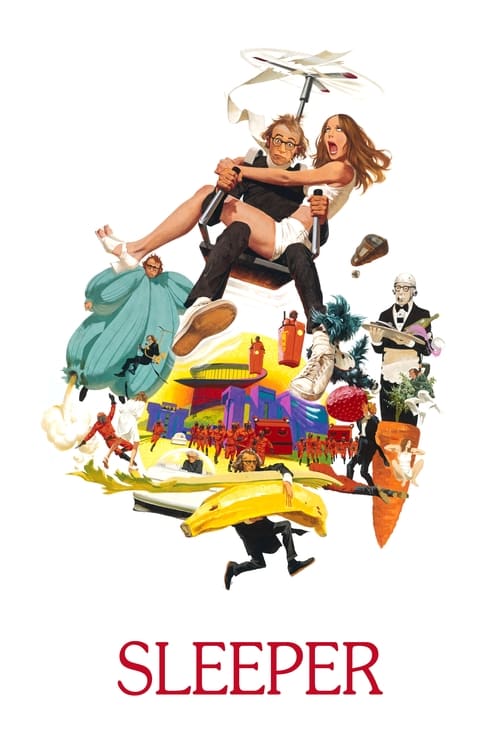
Sleeper
1973 · Woody Allen
When you need a good laugh, full stop — an easy, buoyant comfort watch for a night when the world feels heavy and you'd like the future to be ridiculous instead of frightening.
What it's about
Miles Monroe, a neurotic Greenwich Village health-food store owner, goes in for minor surgery in 1973 and wakes up two hundred years later — defrosted by rebel scientists who need him to help overthrow a sterile, gadget-happy totalitarian America. Mistaken identities, robot disguises, a giant banana peel, and a reluctant romance with a shallow society poet ensue as the world's least likely revolutionary goes on the run.
The experience
Fast, silly, and relentlessly inventive — a joke-a-minute chase where verbal one-liners collide with full-body slapstick. It's pure pleasure, the kind of comedy where you're laughing at a sight gag before the last one has finished landing.
Performances
Woody Allen turns himself into a genuine physical clown here — flailing, inflating, impersonating a robot butler with total commitment — and Diane Keaton matches him beat for beat, her daffy timing turning a vain futurist poet into a great comic partner.
The craft
This is silent-comedy craft revived in color: gags built with props, machines, and bodies in the tradition of Chaplin and Keaton, staged against gleaming white futurist sets and driven by a bouncing New Orleans jazz score. The engineering of the set pieces — every contraption a punchline — is a joy in itself.
Why it matters
The film where Allen's early 'funny movies' peaked as pure filmmaking, proving dystopian satire could run on slapstick — and a template for science-fiction comedy ever since.
Snapshot
Sleeper is Woody Allen's fourth feature as director and the film in which his comedy of physical mishap and verbal anxiety crystallized into a fully realized formal project. A Greenwich Village health-food merchant, Miles Monroe, enters a hospital for a routine ulcer operation in 1973, dies on the table, and is frozen and revived two hundred years later by underground scientists in a totalitarian America. The premise yokes two old traditions — the Rip Van Winkle sleeper-wakes story and the dystopian satire of Wells, Huxley, and Orwell — to the engine of silent slapstick. The result is the closest Allen ever came to a sustained homage to Chaplin, Keaton, and Harold Lloyd, structured as a chase across a sterile future and carried by sight gags, props, and an unusually athletic physical performance from a director not previously known for one. It is also the film that consolidated his partnership with Diane Keaton (their second together after Play It Again, Sam) and inaugurated the screenwriting collaboration with Marshall Brickman that would shortly produce Annie Hall and Manhattan. Among the "early, funny ones" — to borrow the phrase Allen would later put in the mouths of aliens in Stardust Memories — Sleeper is frequently regarded as the most controlled and most cinematically ambitious.
Industry & production
Sleeper was produced by Jack Rollins and Charles H. Joffe, Allen's longtime managers and producing team, and released by United Artists, the studio that had backed Bananas (1971) and Everything You Always Wanted to Know About Sex (1972) and that gave Allen the comparatively rare arrangement of creative autonomy in exchange for modest budgets. The picture belongs to the period before Allen's contract moved to United Artists' successor arrangements and eventually to Orion; in the early 1970s he was building, film by film, a reputation as a reliable comedy brand whose pictures returned a profit against low costs.
The production was shot largely in and around Colorado, with the futuristic architecture supplied by real Modernist and Brutalist buildings in the Denver and Boulder area — most famously private residences and institutional structures whose curved concrete and sculptural forms could stand in for the year 2173 without elaborate set construction. This location strategy is itself a production fact worth noting: rather than build expensive science-fiction sets, Allen and his collaborators found a future already standing in American Modernist architecture, a choice that gives the film its distinctive clean-lined, sun-bright look and kept costs contained. The shoot was reportedly arduous and protracted, in part because of the demands of the physical comedy and the special-effects rigs, and post-production was extended. I should flag that precise budget and box-office figures for the film are not something I can cite reliably from memory; the record I can vouch for is that it was a commercial success consistent with Allen's UA pictures of the era, not that it returned any specific sum.
Technology
The film's technological texture is double: the diegetic gadgetry of the imagined future and the practical effects machinery used to put it on screen. Allen's future is a comedy of malfunctioning and over-rationalized technology — domestic robots, instant-meal devices, the "Orgasmatron" cubicle that delivers sexual gratification mechanically, and the "Orb," a hand-passed sphere that induces a narcotic glow. The gags depend on physical, in-camera effects rather than optical trickery: rigged props, oversized vegetables grown by the future's chemical agriculture (a giant banana peel, celery and a strawberry wielded as objects), and mechanical costumes, most memorably the inflating "hydrovac suit" that swells into a balloon and the silver robot servants whose stiff carriage Allen mimics when he disguises himself as one.
The most discussed technical apparatus is the flying device sequences and the various pratfall rigs, but the signature is the way the film embraces low-tech solutions to depict high-tech subjects — wires, undercranking, and bladder effects in the tradition of silent comedy. The score, too, is a kind of technological statement in reverse: against a sci-fi setting one expects synthesized futurism, Allen instead recorded vintage New Orleans jazz, foregrounding analog, hand-played music as the human counterweight to the chrome.
Technique
Cinematography
The film was photographed by David M. Walsh in color and widescreen, and its visual signature is brightness and clarity rather than the shadowy menace usual to dystopian science fiction. The future is shot in hard daylight and clean whites, the Colorado high-altitude sun lending the architecture a glare that makes the regime look antiseptic rather than gothic. Walsh stages the comedy in wide and full shots that keep Allen's whole body in frame — the indispensable grammar of physical comedy, since a gag cut too tight loses its geography. The camera tends to hold and observe, giving the slapstick room to read, in deliberate contrast to the close-coverage cutting that dominates dialogue comedy.
Editing
Sleeper was edited by Ralph Rosenblum, the veteran cutter whose collaboration with Allen across this period — and especially on the troubled post-production of Annie Hall — is among the best-documented editor-director relationships in American comedy, thanks in large part to Rosenblum's own memoir. On Sleeper the editorial task was the timing of sight gags, where the precise length of a held shot and the placement of a cut determine whether a fall is funny. The film's rhythm honors silent-comedy principle: let the action play, cut on the beat of the joke's completion. Several chase passages are cut and even scored in a manner evoking speeded-up silent farce.
Mise-en-scène / staging
Production design renders 2173 as a world of curved white surfaces, sparse furnishings, and sculptural objects, exploiting the found Modernist locations. The staging repeatedly isolates Allen's anxious, dark-haired, bespectacled figure against blank pale backgrounds, a visual joke in itself — the nervous twentieth-century Jewish New Yorker as a smudge on the clean canvas of the future. Props are staged for slapstick legibility: the giant produce, the robot-dog "Rags," the Orgasmatron, each introduced with enough clarity that its later comic payoff lands. The famous extended set-piece in which Miles, hidden among a field of enormous vegetables, slips and rides a banana peel exemplifies the staging logic — a single sustained location, a single oversized prop, a body in motion.
Sound
The most important sound decision is musical (see Authorship), but the film's sound design also leans on the conventions of silent comedy translated into a sound film: the score frequently carries sequences that play almost wordlessly, functioning as accompaniment in the manner of a silent-era pit band. Dialogue is built around Allen's nasal, stammering verbal persona, which provides an ironic counterpoint to the wordless physical passages — the film oscillates between mute slapstick and torrents of neurotic one-liners.
Performance
Sleeper is, by Allen's own framing, his most physically demanding performance. Where his earlier screen self was primarily a verbal comedian, here he undertakes sustained Keaton-and-Chaplin-style business: impersonating a domestic robot (a full-body act of stiff mimicry, including a beauty-parlor sequence), dangling from heights, sliding, falling, and manipulating recalcitrant props. Diane Keaton plays Luna Schlosser, a vapid society poet of the future who is radicalized over the course of the film; the role gives Keaton room for the dithery, charming comic timing that Annie Hall would soon make iconic, and includes a celebrated sequence in which the two of them improvise an impersonation of Marlon Brando's Stanley Kowalski and Blanche DuBois from A Streetcar Named Desire. The chemistry between Allen and Keaton — verbal, slightly competitive, affectionate — is one of the film's durable pleasures.
Narrative & dramatic mode
The narrative mode is picaresque comic adventure organized as a chase. Miles is revived, immediately becomes a fugitive from the secret police, is captured and "reprogrammed" by the state, is re-captured and de-programmed by the rebels, and is drawn into a plot to infiltrate the regime's inner sanctum, where the dictator — the "Leader" — survives only as a nose, the rest of him destroyed in a bombing, awaiting cloning. The plot is frankly a clothesline on which to hang set-pieces, and the film knows it; the dramatic stakes (totalitarian oppression, revolution) are sincere enough to motivate the action but are continually punctured by Miles's cowardice and self-interest. The emotional through-line is the romance with Luna, and the film closes on a note of comic realism about love and politics alike: Miles declares his faith in neither science nor the new revolutionary leadership but only in "sex and death," a line that distills the picture's mixture of farce and existential shrug.
Genre & cycle
Sleeper sits at the intersection of two genres it simultaneously serves and parodies: dystopian science fiction and silent slapstick comedy. As science fiction it draws on the dystopian satirical tradition — the awakened sleeper of H. G. Wells's When the Sleeper Wakes, the conformist hedonism of Huxley's Brave New World, the surveillance state of Orwell's 1984, and the consumerist comedy of THX-and-after early-'70s sci-fi. As comedy it belongs to the lineage of physical farce, and it arrived in a brief cycle of early-1970s genre-parody comedies. It is useful to place it beside Mel Brooks's contemporaneous run (Blazing Saddles and Young Frankenstein both 1974): both Brooks and Allen were Jewish-American comedians mining classic Hollywood genres for parody in these years, though Allen's sensibility is more melancholic and more cinephilic, Brooks's more anarchic and vaudevillian.
Authorship & method
Allen directed, co-wrote, and starred. The screenplay was written with Marshall Brickman, the first of their collaborations; their method, by Brickman's later accounts, involved long walks and conversation, generating the verbal wit and structural shape that would reach its peak in Annie Hall (1977) and Manhattan (1979). Sleeper is thus a hinge in Allen's authorship: still committed to the gag-driven comedy of the United Artists years, but built with the writing partner who would help him toward character and feeling.
The cinematographer was David M. Walsh. The editor was Ralph Rosenblum, whose shaping of Allen's films in this period was formative and who has written candidly about the collaborative labor of finding a comedy's final form in the cutting room. The most personally authored technical element is the music: Allen, a lifelong amateur New Orleans jazz clarinetist, performed on the soundtrack with the Preservation Hall Jazz Band and the New Orleans Funeral and Ragtime Orchestra, scoring his vision of the future with the traditional jazz he loved. The decision is a signature of Allen-the-author — using a forty-year-old musical idiom to underscore a story set two centuries hence, asserting old human pleasures against the regime's sterility, and folding his off-screen identity (the clarinettist) into the film (Miles plays clarinet). It is a rare case where the director's hobby is also a structural authorial statement.
Movement / national cinema
Sleeper is a product of American studio comedy in the early 1970s, the period sometimes bracketed within the "New Hollywood," though Allen sits aslant that movement. He shared the era's auteurist freedom — final cut, personal vision, a recognizable signature — but not its themes of violence, paranoia, and disillusioned masculinity. His national-cinema lineage runs instead back to the Jewish-American comic tradition of vaudeville, the Marx Brothers, Bob Hope (whose cowardly-romantic screen persona Allen openly admired and adapted), and the New York intellectual humor of the New Yorker and the stand-up clubs from which he emerged. Sleeper is simultaneously a homage to the international silent comedy of Chaplin and Keaton and a thoroughly New York, thoroughly American picture.
Era / period
The film is doubly periodized. It is set in 2173 but speaks entirely to 1973: its satire targets the anxieties and fashions of the early Nixon-era United States. There are gags predicated on the audience's present — a running joke in which future historians ask Miles to identify artifacts of the 1970s (and he supplies absurd or pointed interpretations, including a celebrated bit about Howard Cosell as an instrument of state torture), a sly thread about the destruction caused when "a man named Albert Shanker got hold of a nuclear warhead," and the recurring suggestion that the catastrophe separating the two eras was both nuclear and faintly ridiculous. The health-food premise satirizes the era's countercultural wellness fads by having future science declare that steak, cream pies, and hot fudge are the truly healthful foods — a joke aimed squarely at 1973's nutritional pieties. Sleeper is, in short, a time-capsule comedy whose future is a mirror for its present.
Themes
Beneath the slapstick the film carries Allen's perennial preoccupations in compact form. Totalitarianism and conformity: the regime demands sameness, and the comedy of Miles impersonating a robot literalizes the dystopian fear of the human reduced to machine. The unreliability of progress and ideology: Miles trusts neither the old science nor the new revolution, and the film ends by predicting the rebels will become as corrupt as the regime they replace — a skeptic's view of politics. Sex and death as the only durable human constants, named explicitly in the closing exchange and embodied in the comic technologies of the Orgasmatron and the cloning plot. The self as anxious anachronism: Miles is a neurotic out of his time, and the film mines the comedy and pathos of a man who belongs to no era — a theme Allen would deepen across his career. And culture against sterility: jazz, sexuality, individual cowardice, and love are the messy human values that the clean white future has tried and failed to engineer away.
Reception, canon & influence
Sleeper was warmly received on release and is generally counted among the strongest of Allen's pre-Annie Hall comedies; critics singled out its tighter construction and its successful revival of silent-comedy technique within a sound, color, science-fiction frame. I'll note candidly that I can't reproduce specific contemporary review quotations or award outcomes with confidence, so I won't attribute particular notices; what is securely established is the film's lasting reputation as a high point of "early, funny" Allen and a touchstone of intelligent genre parody.
Influences on the film (backward): the physical comedy of Charlie Chaplin (especially Modern Times, whose man-versus-machine factory comedy Sleeper echoes), Buster Keaton (the unsmiling body in motion against an indifferent world), and Harold Lloyd (the perilous mechanical set-pieces); the dystopian literary satire of Wells, Huxley, and Orwell; the cowardly-lover screen persona of Bob Hope; and the New Orleans jazz tradition Allen embedded in the score. The Rip Van Winkle / Sleeper Wakes device supplies the structure.
Legacy (forward): within Allen's own filmography, Sleeper is the proving ground for the Brickman writing partnership and the Keaton on-screen partnership that flowered immediately afterward in Love and Death (1975) and Annie Hall (1977), and it stands as the most fully achieved of his purely comic, gag-centered films before he turned toward character drama. More broadly it helped sustain the early-'70s vogue for affectionate genre parody and demonstrated that science fiction could be a vehicle for sophisticated comedy of ideas. Its imagined gadgets entered popular shorthand — the "Orgasmatron" in particular became a widely cited cultural reference for mechanized pleasure. The film endures as the definitive example of Woody Allen as a physical comedian, a register he largely set aside afterward, making Sleeper a singular document of what his comedy could do with the body as well as the voice.
A Deleuzian reading
Miles Monroe, two hundred years out of his own century and already running from the secret police, hides in a field of the future's chemically swollen vegetables.
The full Deleuzian reading of Sleeper →
Reception
A critical and commercial hit in 1973, it's since become the poster child of Woody Allen's 'early, funny ones' — the exact films the aliens beg for in Stardust Memories — though like everything Allen, it's now watched under the long shadow of its maker.
How Sleeper was received, from release to now →
Influences: the films it descends from and the films it influenced
- Modern Times (1936) — Sleeper revives Chaplin's man-fed-into-the-machine factory slapstick — the body overwhelmed by conveyor-belt automation — in its giant-produce harvest and malfunctioning-appliance gags.
- The General (1926) — Allen borrows Keaton's deadpan, unsmiling body in precise physical peril among indifferent runaway machinery, playing endangerment straight rather than mugging.
- Safety Last! (1923) — Lloyd's perilous mechanical set-piece (the clock-face dangle) is the template for Sleeper's out-of-control hydro-vac suit and rooftop hardware mishaps.
- Sherlock Jr. (1924) — Keaton's in-camera practical trick effects and body-versus-apparatus illusions model Sleeper's commitment to staging its future tech as real, photographable gags.
- À Nous la Liberté (1931) — Clair's satirical assembly-line automation comedy and speeded-up farce of mechanized labor prefigure Sleeper's undercranked chase-and-factory sequences.
- Duck Soup (1933) — The Marx Brothers' anarchic fusion of rapid verbal wit and physical chaos aimed at an absurd totalitarian state supplies Sleeper's comedy-of-ideas-plus-pratfall register.
- The Paleface (1948) — Bob Hope's cowardly-braggart reluctant-hero persona is the direct model for Miles Monroe's nervous, wisecracking-in-the-face-of-danger screen character.
- Metropolis (1927) — Lang's monumental dystopian production-design vocabulary is the genre target Sleeper parodies through its sleek-but-sterile future architecture.
- Things to Come (1936) — The Wellsian managed-future society and its totalitarian-conformity design give Sleeper the specific science-fiction-of-ideas tradition it satirizes.
- Love and Death (1975) — Immediately extends Sleeper's Keaton-on-screen partnership and silent-comedy physical staging, carrying the gag-centered method one film further.
- Annie Hall (1977) — The Brickman writing partnership that Sleeper proved out matures here into character-driven construction, with Sleeper as its structural proving ground.
- Brazil (1985) — Gilliam fuses physical slapstick and malfunctioning gadgetry with a totalitarian-bureaucratic dystopia, descending from Sleeper's demonstration that comic mishap can carry serious dystopian satire.
- Playtime (1967) — Tati stages comedy in found/built modernist architecture with the human body dwarfed by sterile high-key spaces and oversized design — Sleeper's exact spatial-comedy strategy.
- THX 1138 (1971) — A near-contemporary sterile white high-key future of enforced conformity; Sleeper shares the blank-modernist daylight aesthetic and uses it for laughs instead of dread.
- A Clockwork Orange (1971) — Kubrick shoots real brutalist/modernist buildings as a found near-future dystopia — the same use of existing radical architecture as ready-made set that Sleeper exploits.
- Bananas (1971) — Allen's own earlier picaresque political-revolution chase farce establishes the gag-density and satirical-takeover structure Sleeper refines into tighter form.
Similar films
- Sherlock Jr. (1924) — influence & lineage · same viewing thread
- Annie Hall (1977) — influence & lineage
- Modern Times (1936) — influence & lineage
- Brazil (1985) — influence & lineage
- Metropolis (1927) — influence & lineage
- A Clockwork Orange (1971) — influence & lineage
- PlayTime (1967) — influence & lineage · same viewing thread
- Pee-wee's Big Adventure (1985) — same viewing thread
All the films related to Sleeper →
Watch it with: curated runs of related films
- Sight Gags and Soft Hearts — Watch these when you want comedy built from movement, timing, and architecture rather than punchlines — a gentle soul politely adrift in a bustling, beautifully machined world.