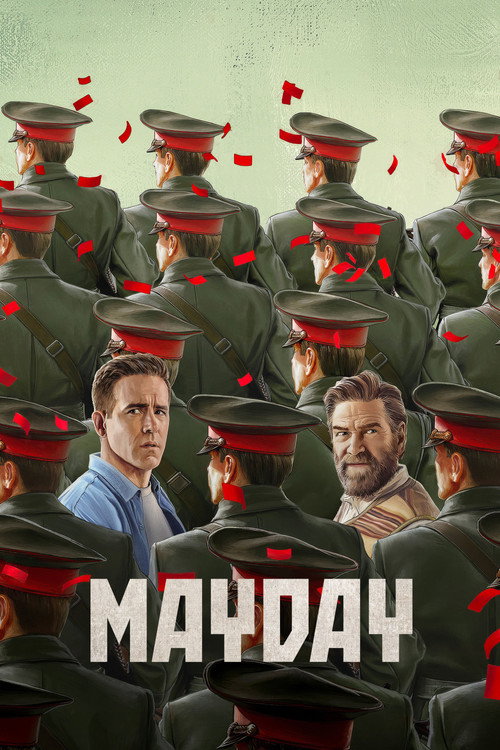
Mayday
2026 · Jonathan Goldstein
For a Friday night when you want pure entertainment — explosions, odd-couple chemistry, and laughs — without switching your brain fully off. Comfort viewing with a swagger.
What it's about
At the height of the Cold War, a U.S. Navy pilot on a top-secret mission is shot down behind enemy lines — and his only way out is an alliance with an eccentric ex-KGB agent who may or may not be trustworthy. Two men from opposite sides of the Iron Curtain, stuck with each other, bickering their way toward the border. Enemies by training, partners by necessity.
The experience
A playful, banter-driven ride with real action muscle — the fun runs on friction between the straight-arrow pilot and his wildcard Soviet counterpart, with a bitter edge under the jokes. It moves fast and doesn't ask much of you except to enjoy the company.
The craft
Jonathan Goldstein directs a premise with very few moving parts and a long, proud pedigree — the enemies-forced-together survival story — and the craft lies in tone and tempo: keeping the comedy and the danger in balance so neither deflates the other. The Cold War setting supplies period style and set-piece scale built for a big screen.
Why it matters
A revival of the two-hander action-comedy in its classic Cold War configuration — the buddy movie's oldest trick, enemies who need each other, brought back for a new audience.
Snapshot
Mayday is a Cold War action-comedy built on one of the oldest and most reliable armatures in the genre: two men from opposite sides of a hostile border, thrown together by a downed aircraft, who must cooperate to survive. A U.S. Navy pilot on a classified mission goes down behind enemy lines; his survival depends on an alliance with an eccentric ex-KGB officer. The premise is a machine with very few moving parts and a long service history — Boorman's Hell in the Pacific (1968) stripped it to two men and no shared language; Wolfgang Petersen's Enemy Mine (1985) moved it to another planet; Walter Hill's Red Heat (1988) and Nicholas Meyer's Company Business (1991) played it for glasnost-era friction and rue. What distinguishes any given instance is tone, tempo and casting, not architecture.
The director credit is where the file gets interesting. Jonathan Goldstein's entire directing career to date has been conducted in partnership with John Francis Daley: Vacation (2015), Game Night (2018) and Dungeons & Dragons: Honor Among Thieves (2023), all of which they co-wrote and co-directed, on top of a screenwriting run that includes Horrible Bosses (2011), The Incredible Burt Wonderstone (2013), Horrible Bosses 2 (2014) and a shared credit on Spider-Man: Homecoming (2017). A solo Goldstein feature would be a genuine departure. Registry entries routinely record one name where a partnership is in play, however, and I cannot establish from the available record whether Mayday is a solo credit, an incompletely captured joint one, or a re-teaming. The atlas flags the ambiguity rather than resolving it.
That caveat extends further, and it should be stated once, plainly, at the top. This dossier's evidentiary base closes before Mayday's own record forms. Cast, below-the-line credits, budget, running time, release pattern, box office and critical reception are not available to me, and I will not manufacture them. What follows is therefore a study of the film's inheritances — the traditions it draws on, the industrial conditions it was made under, the technical problems its premise obliges it to solve — with the shot-level and reception-level account deferred until the record exists.
Industry & production
The most consequential fact about Mayday is categorical rather than textual: in the mid-2020s the original, mid-budget, star-driven studio comedy is close to an endangered form, and an action-comedy is the surviving mutation. The theatrical comedy market that sustained Horrible Bosses and Vacation — R-rated, adult, modestly budgeted, opening wide against nothing in particular — contracted sharply after 2016 and did not recover after the pandemic. Comedy migrated to streaming, where it is cheap, plentiful and largely invisible. What studios still commission for theatres are hybrids: comedies with a second engine that can be sold in a trailer as spectacle. The Fall Guy (2024) is the clearest recent case — a genuinely funny film sold, and financed, on stunt work.
Goldstein and Daley's own trajectory maps this pressure exactly. Vacation was a legacy-IP comedy. Game Night, their critical high point, was an original comedy whose premise smuggled in thriller mechanics and a chase grammar; it performed respectably rather than spectacularly, and its afterlife as a widely admired film has outstripped its opening weekend. Honor Among Thieves moved them into franchise-scale action filmmaking with a comic register intact, and taught them — expensively, in commercial terms — that tonal ingenuity does not by itself open a picture. They were attached to The Flash and left it. A Cold War action-comedy is a legible next move for filmmakers who have demonstrated they can hold comedy and set-piece construction in the same hand.
The specifics of financing, studio, shooting locations and schedule are not available to me. Two structural probabilities are worth noting as context rather than claim: period pictures of this kind are routinely shot in Hungary, the Czech Republic or Bulgaria, where surviving socialist-era architecture and production incentives coincide; and any film greenlit in this window was developed across the 2023 WGA and SAG-AFTRA strikes, which reshaped both the calendar and the contractual terms — particularly around artificial intelligence and digital likeness — under which American features are now made.
Technology
A film about a downed pilot in the Cold War inherits a specific technical burden, and the terms of that burden changed in 2022. Top Gun: Maverick reset industry expectations for aerial photography by putting IMAX-certified Sony Venice camera bodies inside operational F/A-18 cockpits and capturing sustained, high-G, in-aircraft performance rather than simulating it. The consequence for every subsequent aviation picture is that composited or gimbal-only cockpit work now reads as a choice, and often as a shortfall. A period film compounds the problem: the airframes a Cold War mission would require are largely museum pieces, flyable in small numbers at ruinous cost, so the sequence is almost always a negotiation between practical airframes, full-scale mock-ups on motion bases, and digital extension.
Set against that, the LED volume — the in-camera background stage popularized after The Mandalorian — has become the default solution for cockpit and vehicle interiors, and it is genuinely well suited to them: an enclosed space, a moving sky, interactive light on the actors' faces. Its known weakness is wide, deep exteriors, which is precisely what the film's behind-the-lines second act would need. Large-format digital capture (the ARRI Alexa 35 and the Sony Venice 2 are the working standard of the moment) has also made period work more available, because vintage or de-tuned glass in front of a modern sensor is now the cheapest reliable route to a 1960s or 1980s image.
None of this can be asserted of Mayday specifically. What can be said is that a film of this premise, made in this year, was choosing among these tools, and that the choice between practical aerial capture and volume-based simulation is the single technical decision that most determines whether the opening sequence carries weight.
Technique
Cinematography
The governing problem is tonal unity. A film that is both an aerial action picture and a two-hander comedy must find a single visual grammar that can hold a crash and a joke, and the usual failure mode is a film that looks like two films spliced together — muscular, desaturated action photography giving way to flat, bright comedy coverage.
Goldstein and Daley have solved a version of this before. Game Night built its look with cinematographer Barry Peterson around a conspicuous device: tilt-shift-inflected transitional shots that rendered suburban streets as board-game miniatures, a formal idea that stated the film's thesis without dialogue and unified an otherwise tonally volatile picture. Peterson also shot Honor Among Thieves. Whether he shot Mayday I cannot confirm, but the precedent matters: these are filmmakers who have shown a willingness to adopt an overt visual conceit rather than default to neutral comedy lighting, and the Cold War setting offers obvious candidates — the surveillance frame, the long lens, the grain and palette of period stock.
Editing
Comedy and action run on incompatible clocks. Comic timing depends on holding a shot past the point of comfort and on the pause before the reaction; action legibility depends on continuity of geography and on cuts that arrive on impact. A film that alternates between them either learns to cut on two rhythms or flattens into one. The premise here supplies a structural solution that the tradition has used repeatedly: once the two men are yoked together, the film becomes a walking picture, and the road structure lets comic scenes run at their own length between set-pieces rather than inside them. Midnight Run (1988) remains the reference case for exactly this — Martin Brest and his editors let the Grodin–De Niro scenes breathe for minutes at a stretch precisely because the pursuit plot guaranteed the next acceleration.
Mise-en-scène / staging
The behind-the-lines film is a geography film. Its meaning is carried by the distance between where the protagonist is and where safety is, and by the hostility of everything in between — a logic The Great Escape (1963) and Behind Enemy Lines (2001) both organize around. Cold War production design brings a second, ideological layer: the concrete plaza, the checkpoint, the kitchen with too few objects in it, the vast official interior scaled to humiliate the individual standing in it. Comedy in this setting has traditionally come from scale mismatch — Wilder's One, Two, Three (1961) ran its farce against the machinery of divided Berlin; Iannucci's The Death of Stalin (2017) staged terror in rooms that looked like offices.
Sound
Language is the film's most obvious untapped resource and its most obvious hazard. A Russian-speaking co-lead makes translation, mistranslation and the pilot's total dependence on his companion available as running comic and dramatic material — the device that carries Hell in the Pacific almost without dialogue at all. The hazard is that accent-comedy is a thin and dated register, and the difference between an "eccentric" characterization and a caricature is largely a matter of whether the script grants the Soviet character an interior life and a competence the American lacks.
On the music side, Goldstein and Daley's most distinctive prior choice was Cliff Martinez's synthesizer score for Game Night, which borrowed the pulse and menace of John Carpenter and played the comedy absolutely straight — a score that refused to tell the audience it was watching a comedy. Honor Among Thieves took the opposite path with Lorne Balfe's full orchestral adventure idiom. The composer on Mayday is not known to me; the two precedents mark the available range.
Performance
This is a two-hander, and two-handers live or die on casting chemistry, which no structural analysis can predict. The specific demand is asymmetry: the pilot is the straight man and the audience's proxy, competent within his domain and helpless outside it; the ex-KGB officer supplies knowledge, unpredictability and the comic engine. The tradition's best instances — Nolte and Murphy in 48 Hrs. (1982), De Niro and Grodin in Midnight Run, Gene Hackman and Mikhail Baryshnikov as the mismatched CIA and KGB veterans of Company Business — work because the ostensible comic relief is also the more experienced professional, so that the power relation inverts as the film proceeds.
Narrative & dramatic mode
The structure is the enforced alliance: two antagonists bound by circumstance, hostile at the outset, functional by the midpoint, loyal by the end. Its dramatic logic is conversion through proximity, and its reliable pleasure is watching mutual contempt get eroded by shared competence. The mode is comic rather than tragic, and it is worth naming the tradition it sets itself against. The great Cold War literary mode — le Carré's, above all — treats the two services as morally symmetrical and the individual as expendable to both, and ends in exhaustion. The action-comedy takes the same premise of symmetry and draws the opposite conclusion: if the two sides are mirror images, then the men in the field have more in common with each other than with the apparatuses that sent them. The Hunt for Red October (1990) and Bridge of Spies (2015) both turn on that recognition; so does the whole Boorman–Petersen line of stranded-enemies films.
One detail in the premise deserves attention, because it is doing more work than it appears to. "Ex-KGB" during the Cold War is a pointed construction. It does not describe a retiree; it describes a man purged, disgraced, defected or internally exiled — someone already estranged from his own service before the American arrives. That is a smart piece of engineering. It removes the need for the Soviet character to be persuaded out of his loyalties, supplies his eccentricity with a cause rather than leaving it a tic, and makes the alliance a meeting of two men who are both, in different ways, off the books.
Genre & cycle
Mayday sits at the intersection of two cycles. The first is the mismatched-buddy action comedy, invented in its modern form by 48 Hrs. and Beverly Hills Cop (1984), industrialized by Lethal Weapon (1987) and Rush Hour (1998), and revived as period pastiche by Shane Black in The Nice Guys (2016). The second is the Cold War revival that ran through the 2010s — Tinker Tailor Soldier Spy (2011), Bridge of Spies, Atomic Blonde (2017), The Courier (2020), and on television the six seasons of The Americans (2013–18) — and which established the era as a fully reactivated setting for popular drama.
Comic treatments of the Cold War form their own smaller, older line: Jewison's The Russians Are Coming, the Russians Are Coming (1966), Wilder's One, Two, Three, Landis's Spies Like Us (1985), Ronald Neame's Hopscotch (1980). What unites them is that the joke is almost never at the expense of the individual Russian; it is at the expense of the machinery on both sides. That is the tradition Mayday's premise places it in, and the standard against which its handling of its Soviet lead should be measured.
Authorship & method
Goldstein and Daley's authorship, as established across five directed and written features, has three consistent properties. First, a conviction that comedy is best generated by taking a genre structure entirely seriously and dropping ordinary people into it — Game Night's suburbanites are funny because the thriller around them is not kidding. Second, a taste for craft ambition inside comedy: the celebrated unbroken-take Fabergé egg sequence in Game Night is the clearest instance, a piece of choreography that would be at home in an action film. Third, an ensemble rather than a star-vehicle instinct, with jokes distributed across a cast rather than concentrated in a lead.
Daley's own background as a performer — Freaks and Geeks, Bones — informs the partnership's noted attentiveness to actors, and their screenwriting credits (Horrible Bosses, Spider-Man: Homecoming) show a facility for slotting comic voice into pre-existing genre machinery. Their key recurring technical collaborator across Game Night and Honor Among Thieves is cinematographer Barry Peterson. Composers have varied by register: Cliff Martinez on Game Night, Lorne Balfe on Honor Among Thieves. Whether any of these collaborators worked on Mayday, and who wrote it, I cannot establish, and the section is deliberately incomplete rather than filled by inference.
Movement / national cinema
Mayday belongs to the American studio comedy — a national form with a continuous history from the sound era, and one currently in a state of structural retreat from theatres. It also belongs, in all likelihood, to a second and less discussed formation: the European production-service economy. Since the 2000s, the Cold War on screen has largely been shot in the countries that lived it. Budapest, Prague, Sofia and the Baltic capitals supply surviving socialist-era architecture, crew depth, and tax incentives, and the visual vocabulary of the entire recent Cold War cycle is substantially a vocabulary of those cities standing in for Moscow, Leningrad and East Berlin. I cannot confirm where Mayday shot; I note the pattern because it shapes what these films look like as a group.
Era / period
Two eras are in play. The diegetic one is unspecified in the available synopsis — "the Cold War" spans four decades and several distinct iconographies, from the U-2 incident of 1960 through the détente years to the Able Archer crisis of 1983 — and I cannot date the setting from the record I have. The choice matters, because the early period supplies paranoia and an aviation-technology frontier, while the 1980s supplies a Soviet state visibly failing, which is friendlier to comedy and to the figure of the disillusioned officer.
The production era is 2026, and it is not a neutral vantage. The Cold War is now available as a setting in two incompatible ways at once: as a nostalgia object — analogue, legible, a world of two sides and clear stakes — and as direct allegory, since the return of open great-power confrontation after 2022 has made its vocabulary current again in a way it had not been for thirty years. A film that stages an American and a Russian discovering they are more alike than their governments is making a statement in 2026 that it would not have been making in 2006. Whether Mayday presses that reading or brackets it in favour of pure period pastiche is the most substantive open question in this file.
Reception, canon & influence
No critical record for Mayday is available to me, and I will not characterize a reception I have not seen. What can be traced with confidence are the lines running into the film.
Backward, four distinct inheritances converge. From the stranded-enemies film — Hell in the Pacific, Enemy Mine — comes the core situation and its central idea that survival dissolves ideology faster than argument does. From the Cold War odd-couple picture — Red Heat, Company Business, and behind them The Hunt for Red October's humane Soviet professional — comes the specific American/Russian pairing and the convention that the Soviet is the more competent of the two. From the mismatched-buddy comedy descending from 48 Hrs. and Midnight Run comes the scene-level rhythm: antagonism as the engine of dialogue, grudging respect as the arc. And from the downed-pilot film — Firefox (1982), Behind Enemy Lines, Top Gun: Maverick — comes the aerial opening, the geography of escape, and a set of technical expectations for cockpit photography that a 2026 film cannot ignore.
Forward, the honest answer is that a film's legacy cannot be assessed in the year of its release, and Mayday's is unwritten. The structural question is narrower and more answerable in time: whether an original, non-franchise, star-driven action-comedy can still perform theatrically at studio scale. Game Night is the case most often cited by people arguing that it can — a film whose reputation compounded steadily after a modest opening, and which is now routinely named as the last great American studio comedy of its kind. If Mayday joins it, the influence will be industrial before it is aesthetic: evidence, in a market that currently doubts it, that the form still has customers.
A Deleuzian reading
Two men handcuffed together, running, and one of them goes down.
The full Deleuzian reading of Mayday →
Reception
How Mayday was received, from release to now →
Influences: the films it descends from and the films it influenced
- Hell in the Pacific (1968) — The template for the stranded-enemies two-hander sustained without a shared language: Conrad Hall holds both men in one wide, deep-focus frame at opposite edges and leaves Mifune's Japanese untranslated, forcing blocking and behavior to carry every beat of exposition and negotiation.
- The Defiant Ones (1958) — The ur-text of enforced alliance as a staging constraint — the literal chain means neither actor can exit a shot or a decision alone, so every escape beat is choreographed as a two-body problem rather than cut between separate coverage.
- Enemy Mine (1985) — Builds the alliance's turning point out of a language-acquisition scene played at length — the pidgin is constructed on screen, so vocabulary itself becomes plot mechanism and the audience learns it in step with the characters.
- 48 Hrs. (1982) — Establishes the two-rhythm scene: Hill cuts comic exchanges at thriller tempo and makes antagonism the delivery vehicle for plot information, so the Nolte/Murphy insult volleys advance the case instead of pausing it.
- Midnight Run (1988) — The road-picture engine Mayday runs on — each leg downgrades the mode of transit (plane, train, bus, freight car), and every downgrade forces a new physical configuration for the pair, generating set pieces out of structure rather than incident.
- Red Heat (1988) — Fixes the American/Soviet pairing's comic polarity: Hill shoots the Russian's procedure absolutely straight and unsmiling and lets the American's reaction supply the joke, so competence sits with the foreign professional and the laugh comes from the local.
- Company Business (1991) — The exchange-gone-wrong premise that strands two purged officers — CIA and KGB — on the same westward road, with professional obsolescence rather than ideology supplying the men's mutual recognition.
- The Hunt for Red October (1990) — Its mid-sentence push-in that dissolves spoken Russian into English is the canonical formal solution to the language-barrier problem, and its humane, superior Soviet professional is the character type the American half of a Cold War pairing is now written against.
- Firefox (1982) — The behind-the-Iron-Curtain flight picture as a three-act geography — infiltration in disguise, theft, and a pursued run for a border — with Soviet interiors built on stages and in Vienna, the same by-proxy approach to socialist-era production design.
- One, Two, Three (1961) — Proof that Cold War hardware can be played at pure farce tempo: Wilder runs overlapping, machine-gun dialogue against real checkpoints and Party apparatchiks, treating ideology as material for verbal rhythm rather than as subject.
- Inglourious Basterds (2009) — Makes language competence itself the suspense-and-comedy mechanism — an accent, a wrong idiom, a hand signal held wrong — which is the only way a language-barrier gag can pay off dramatically instead of decoratively.
- Behind Enemy Lines (2001) — Codifies the downed-pilot escape grammar Mayday opens on: the eject, then a map-and-clock structure in which cutaways to trackers and extraction windows convert distance into a legible countdown.
- Game Night (2018) — The directors' own method text: Barry Peterson's tilt-shift board-game conceit as an overt visual signature, and the unbroken-take Fabergé egg pass — action-film choreography deployed inside a comedy, with the genre around the characters never kidding.
- Dungeons & Dragons: Honor Among Thieves (2023) — Same authorship, same discipline: practical creature work and a straight-faced Balfe adventure score played without a wink, with jokes distributed across an ensemble rather than concentrated in a lead.
- The Man from U.N.C.L.E. (2015) — The nearest contemporary handling of the CIA/KGB enforced pairing: Mathieson's period-glass, saturated stock look plus split-screen and multi-panel inserts that let Ritchie run two simultaneous operations without cross-cutting.
- Atomic Blonde (2017) — Treats 1989 Berlin as an avowed visual conceit — neon-and-cyan grading, needle-drop cutting, and the long-take stairwell fight — the same bet that a period Cold War setting can be stylized hard without deflating the physical stakes.
Similar films
- The Man from U.N.C.L.E. (2015) — influence & lineage
- Top Gun: Maverick (2022) — influence & lineage
- Atomic Blonde (2017) — influence & lineage
- Fail Safe (1964) — shared sensibility
- Seven Days in May (1964) — shared sensibility
- Dr. Strangelove or: How I Learned to Stop Worrying and Love the Bomb (1964) — shared sensibility
- Good Luck, Have Fun, Don't Die (2026) — shared sensibility
- Companion (2025) — shared sensibility