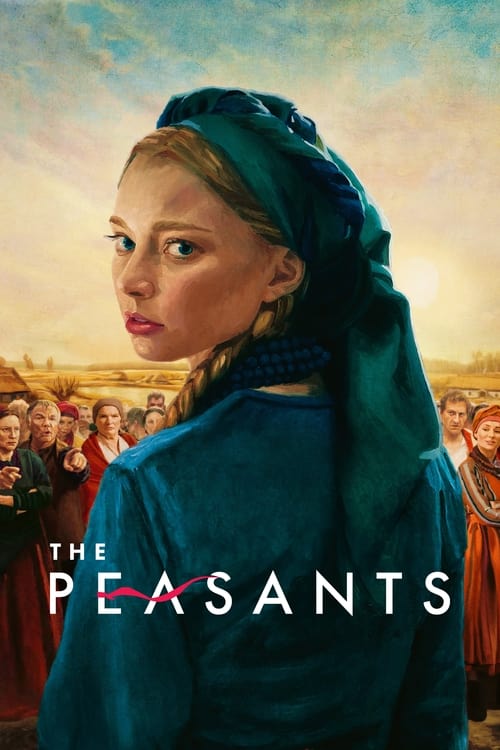
The Peasants
2023 · Hugh Welchman
For when you want to be visually overwhelmed and emotionally wrung out — a spectacle with a furious moral center. Choose it when you're up for a challenging watch about cruelty dressed in gorgeous clothes.
What it's about
In a 19th-century Polish village, Jagna — the most beautiful and most talked-about young woman in Lipce — is married off to a wealthy aging farmer while she loves his married son. Across four seasons of harvests, feasts, and gossip, the village's envy and appetite close in around her, and what began as a love triangle becomes a battle for her independence against an entire community. It's a story of desire, land, and the price a small world exacts from a woman who won't conform.
The experience
Lush and immersive, with a swelling folk score and images that pulse like living paintings — but underneath the beauty runs a hard, angry story that grows more harrowing as the seasons turn. It's ravishing and bruising at once.
The craft
Every frame was shot with live actors and then hand-painted in oils by teams of artists, so the film moves like a canvas come alive — wheat fields, dances, and snowstorms rendered in thick, breathing brushstrokes. The technique isn't a gimmick: the painted texture heightens both the sensual beauty and the violence, and it demands the biggest screen you can find.
Why it matters
Adapting Władysław Reymont's Nobel Prize–winning novel, the team behind painted animation's boldest experiments pushed the form to feature-epic scale and reignited conversation about a classic through a modern lens on how communities punish women.
Snapshot
The Peasants (Polish: Chłopi) is a painted-animation feature adapting Władysław Reymont's Nobel Prize–winning four-volume novel of the same name. Though the brief lists Hugh Welchman as sole director, the film is more accurately credited as the co-direction of DK Welchman (Dorota Kobiela) and Hugh Welchman, who also share the screenplay — the same partnership behind Loving Vincent (2017). Its story is deceptively simple and archetypally tragic: Jagna, the most beautiful young woman in the village of Lipce, is married off to the aging, land-rich widower Maciej Boryna while she loves — and is loved by — his married son Antek. What begins as a domestic triangle metastasizes into a study of communal cruelty, as the village turns Jagna into a scapegoat for its own appetites and anxieties. The film's signal achievement is formal: every frame is a hand-painted oil canvas, and the images are steeped in the palette and iconography of late-nineteenth-century Polish painting. It is at once a folk-tragedy, a feminist reframing of a canonical text, and a technological feat, and it stands as one of the most ambitious European animated features of its decade.
Industry & production
The film was produced by Hugh Welchman's BreakThru Films, the Warsaw- and London-based outfit that pioneered feature-length painted animation with Loving Vincent, in a Polish-Serbian-Lithuanian co-production drawing on public funding from the Polish Film Institute and regional partners, with international sales handled by New Europe Film Sales. Like its predecessor, The Peasants used an unusually staged, two-phase pipeline: a conventional live-action shoot with actors on sets and against green screen, followed by a labor-intensive painting phase in which artists worked over the footage frame by frame. Reporting on the production consistently cites more than 40,000 painted oil frames; figures for the number of painters vary across sources (some cite around 100–130 credited artists, others "over 200"), a discrepancy worth flagging rather than resolving falsely. The production was materially shaped by external history: a substantial share of the painting workforce was based in Ukraine, and the Russian invasion in February 2022 forced the evacuation and relocation of artists mid-production — a real-world rupture that pushed the completion of a film about a rural community's endurance. The premiere came at the Toronto International Film Festival in September 2023, followed by a festival run (AFI Fest, among others) and selection as Poland's official submission for the Academy Award for Best International Feature Film for that cycle.
Technology
The Peasants extends the proprietary painted-animation methodology BreakThru developed for Loving Vincent, and refines it. The core technology is not a rendering engine but a human-industrial workflow: live-action performance is captured, edited into a locked cut, and then used as the substrate for hand-painted animation, with each canvas photographed and sequenced back into motion. Where Loving Vincent pursued the thick impasto and swirling brushwork of a single painter, The Peasants had to synthesize the manner of many nineteenth-century Polish artists into a coherent moving surface, which demanded tighter reference control and color management across a distributed studio. Digital tools underpin the pipeline — editing, compositing, and the choreography of thousands of frames across a large, geographically dispersed team — but the defining "technology" remains the reconciliation of oil paint, an inherently static and idiosyncratic medium, with the temporal continuity of cinema. The persistent, low-frequency flicker of brushstrokes shifting frame to frame is not a defect but the signature of the process, and the film leans into it as an expressive texture.
Technique
Cinematography
The live-action photography was overseen by cinematographers including Radosław Ładczuk, Kamil Polak, and Szymon Kuriata, whose lighting and framing established the compositions that painters would later transcribe and transform. Because the final image is a painting, cinematography here operates in two registers: the photographic capture that fixes staging, lens perspective, and light, and the painterly "second exposure" that reinterprets that capture in oil. The film is organized around the four seasons of Reymont's novel, and its visual scheme shifts accordingly — golden harvest fields, the earth-brown interiors of the Boryna homestead, the blue-white severity of winter — with many shots explicitly quoting Young Poland canvases. Widely cited production accounts describe dozens of direct painting "quotations," a large number of them from Józef Chełmoński, with inspiration drawn from around thirty Polish painters overall; this pictorial sourcing is central to how the film's cinematography reads.
Editing
Editing in a painted-animation feature is a front-loaded discipline: the cut must be substantially locked before painting begins, because each frame carries an enormous labor cost and cannot be casually trimmed afterward. The film's rhythm alternates between slow, tableau-like passages that invite the eye to read the image as a painting and more propulsive sequences — dances, harvests, the gathering violence of the village — where montage and the shimmer of the medium amplify one another. The seasonal structure provides the macro-editing logic, dividing the tragedy into movements that track both the agricultural calendar and Jagna's deepening isolation.
Mise-en-scène / staging
The staging is built around the Polish village as a total social world: the church, the tavern, the fields, the Boryna farm, and the communal gatherings where reputations are made and destroyed. Costume, folk ornament, ritual (weddings, harvest customs, religious processions) and the choreography of crowds are foregrounded, and the painted surface heightens their density into something tapestry-like. The mise-en-scène deliberately blurs the line between ethnographic realism and painterly stylization — figures are recognizably embodied by actors, yet the world around them declares itself as art history rendered in motion.
Sound
Against the antique visual surface, the sound design and especially the music pull toward the contemporary and the visceral. The score is by Łukasz "L.U.C." Rostkowski, performing with his international Rebel Babel Film Orchestra, and it fuses Polish folk melody and traditional instrumentation with modern rhythmic and vocal arrangement. Notably, the recording incorporated a choir of Ukrainian refugees — again binding the film's making to the war unfolding during its production. The result is a soundtrack that refuses museum quietude, using folk material as a living, percussive, sometimes aggressive force that voices communal energy and menace alike.
Performance
Because the animation is painted directly over recorded acting, performance retains a physical fidelity unusual for animation: the actors' faces and gestures survive translation into paint. Kamila Urzędowska anchors the film as Jagna, giving the character a watchful interiority that resists the village's reduction of her to object of desire or scorn. Robert Gulaczyk — who played the title role in Loving Vincent — plays Antek, and Mirosław Baka is the patriarch Maciej Boryna, with a large supporting ensemble embodying the village. The painted layer abstracts the performances just enough to universalize them without erasing their human specificity.
Narrative & dramatic mode
The film's dramatic mode is folk tragedy shading into social realism. Its engine is not plot mechanics but the slow, inexorable tightening of a community's judgment around a single woman. Reymont's naturalist novel treated the village as an organism governed by land, seasons, appetite, and custom; the film preserves that determinism while sharpening the moral focus onto Jagna's lack of agency. Desire, property, and reputation are the tragic forces, and the seasonal cycle supplies a structure in which private passion is continually subordinated to collective survival and gossip. The narration is largely external and communal — we watch Jagna through the village's eyes as much as her own — which is precisely what makes her scapegoating so damning.
Genre & cycle
The Peasants sits at the intersection of several categories: adult animated feature, literary-historical costume drama, and folk tragedy. Within animation, it belongs to the small, recent cycle of painterly and craft-forward features aimed at adult audiences, and most directly to a "cycle of one" that BreakThru itself initiated — the feature-length oil-painting film, of which Loving Vincent is the first entry and The Peasants the second. It also participates in a broader contemporary wave of adaptations that revisit canonical national literature through a feminist or revisionist lens, reframing a woman traditionally read as temptress into a victim of patriarchal and communal violence.
Authorship & method
The authorship is fundamentally a partnership. DK Welchman (Dorota Kobiela), a painter and animator by training, is the driving creative vision behind BreakThru's painted-animation method; Hugh Welchman, a producer-director (an Oscar winner for the short Peter and the Wolf), is the industrial architect who makes such a method financeable and completable. The pair co-wrote and co-directed. Their method is the film's defining authorial signature: the fusion of live-action capture with a distributed painting studio, and the sourcing of a whole national art-historical tradition as visual reference. The composer Łukasz "L.U.C." Rostkowski is a genuine co-author of the film's affect, his folk-modernist score functioning as the emotional counter-voice to the historical images. The cinematographers (Ładczuk, Polak, Kuriata) and the small army of credited painters are constitutive collaborators in a work whose "look" is authored collectively as much as individually. The underlying literary author, Władysław Reymont, remains a shaping presence, and the adaptation's feminist recentering is itself an authorial statement about how his text should now be read.
Movement / national cinema
The film is emphatically a work of Polish national cinema, and more than that, an act of national self-portraiture. Its visual language is drawn from Młoda Polska (Young Poland), the turn-of-the-century Polish modernist movement, and from painters such as Chełmoński who mythologized rural Poland; Reymont's novel is itself a monument of Polish literary naturalism. In animating that tradition, the film participates in a long Polish investment in animation and painterly image-making, and in a national-cinema tendency to return to the peasantry and the land as sites of identity. At the same time, its co-production structure and international crew — Polish, Serbian, Lithuanian, with a large Ukrainian contingent — mark it as a transnational European production, and the wartime displacement of its artists folds contemporary Eastern European history into a story set more than a century earlier.
Era / period
The Peasants is set in the late nineteenth century in the fictional village of Lipce, in Russian-partitioned Poland, though the film keeps its politics local and elemental rather than foregrounding the partition. The era it depicts is one of subsistence agriculture, rigid custom, and a social order in which land ownership is the axis of all power — the material conditions that make Boryna's wealth and Jagna's marriageability legible. As a production of the early 2020s, the film belongs equally to its own moment: a period in which animation increasingly courted adult, arthouse, and awards audiences, and in which craft-intensive, "anti-CGI" aesthetics acquired renewed cultural value. Its making was inseparable from the outbreak of full-scale war in Ukraine in 2022.
Themes
The film's central theme is the position of a woman with desire and beauty but no power in a community organized to police both. Jagna's tragedy dramatizes scapegoating — the way a village exports its guilt, envy, and repression onto a convenient victim. Around this run the great naturalist themes of Reymont's novel: land as destiny; the tyranny of custom and reputation; the cyclical rhythm of the seasons as both livelihood and fate; the collision of private passion with collective survival. The adaptation's oil-painting form adds a meta-theme about art and memory — the film continually asks how a nation pictures its own past, quoting the very canvases that romanticized the peasantry even as its narrative exposes that world's cruelty. Beauty and violence are held in deliberate tension: the loveliness of the surface indicts the ugliness of the social order it depicts.
Reception, canon & influence
Critical reception was substantial and generally admiring, with near-universal acknowledgment of the film's technical audacity; a recurring critical debate concerned whether the constant painterly beauty of the surface risked aestheticizing or flattening the human drama, or whether it deepened it. Selection for TIFF, a wide festival run, and Poland's Oscar submission confirmed its standing as a prestige release, and it was frequently discussed alongside Loving Vincent as the maturation of a distinctive form.
Its backward-facing influences are unusually explicit: Reymont's novel as narrative source; the Young Poland painters — Chełmoński above all, plus a wide field of nineteenth-century Polish artists — as visual source; and BreakThru's own Loving Vincent as the direct methodological precursor. Polish folk music and ritual are woven through the score and staging.
Its forward influence is best understood as the consolidation of painted animation as a viable, repeatable feature form rather than a one-off novelty — a proof that the method could serve a wholly different subject, tone, and art-historical register than Loving Vincent. It strengthened the case for craft-forward, adult-oriented animation in the arthouse and awards space, and it stands as a reference point for adaptations that reinterpret canonical national literature through a woman's perspective. Because the film is recent, any longer-term legacy remains genuinely open, and the honest assessment is that its most durable contribution so far is demonstrating, a second time, that an entire feature can be lived through as moving paint.
Reception
A genuine box-office phenomenon in Poland on release — one of the country's biggest homegrown hits of 2023 — while international critics split between awe at the painted frames and shrugs at the melodrama underneath. Too recent for a reappraisal arc, but the 'visual triumph, uneven film' verdict has stuck.
How The Peasants was received, from release to now →
How to watch The Peasants: what to notice on a first viewing
- Watch the color shift with the seasons: gold, earth-brown, blue-white. The film's palette changes across the four seasons of the novel, harvest gold giving way to winter's cold blue-white severity. The land's calendar becomes the film's own clock, marking time as much as any dialogue does.
- Notice individual frames that look like specific paintings. Many shots directly quote Young Poland canvases, especially Józef Chełmoński's, with painters transcribing the live footage into oil frame by frame. You're watching a nation's own art history reused to tell its own story.
- Watch Jagna's face hold something back in crowded scenes. Urzędowska plays her with a watchful interiority that resists how the village keeps trying to read her as either temptress or victim. The performance survives translation into paint, so you're still watching an actor think, not just an illustration move.
- Listen for folk melody pushed into something percussive. Rostkowski's score fuses traditional Polish instrumentation with contemporary rhythm and vocal arrangement rather than staying in a museum register. The music refuses to let the painted surface feel like a static antique.
- Watch how crowded and choreographed the communal gatherings are. Weddings, harvest customs, and religious processions fill the frame with costume and ritual, staged with a tapestry-like density. The village itself is staged as a single organism, not a backdrop for individuals.
The whole guide to watching The Peasants, with the keys for a rewatch →
Influences: the films it descends from and the films it influenced
- Loving Vincent (2017) — The direct methodological parent: the same BreakThru pipeline of shooting live actors on green-screen/reference plates and then repainting every frame in oils by a distributed studio of easel painters.
- The Old Man and the Sea (1999) — Established the fully-painted-frame feature aesthetic by animating in wet oils smeared on glass, proving an entire film could be experienced as continuously moving paint rather than line-and-fill cels.
- Waking Life (2001) — Pioneered the feature-length live-action-to-painted-surface pipeline, capturing full human performances and then interpolating a hand-worked painterly layer over every rotoscoped frame.
- Snow White and the Seven Dwarfs (1937) — Originated rotoscoping human figures to lend animated bodies naturalistic weight, gesture and dance, the foundational technique behind Peasants' live-action-rotoscope capture of village movement.
- Chłopi (The Peasants) (1973) — The prior screen adaptation of the identical Reymont novel, already organizing the drama around the four-season macro-structure that Peasants inherits as its editing spine.
- The Wedding (Wesele) (1973) — Draws directly on the Młoda Polska source (Wyspiański) and stages folk ritual as a swirling, all-consuming total-village world — the same movement-lineage and communal choreography Peasants revives.
- Days of Heaven (1978) — Its magic-hour natural-light cinematography, explicitly keyed to painters like Wyeth and Hopper over an agrarian labor cycle, is the live-action model for Peasants' seasonal, painting-derived light on rural work.
- Undone (2019) — The closest technical heir: rotoscoped actor performances composited over hand-painted oil backgrounds, essentially industrializing the rotoscope-plus-oil-paint hybrid that Peasants scales to feature length.
- A Scanner Darkly (2006) — Extends rotoscope into faithful literary adaptation, using traced live-action performance to preserve actorly nuance beneath a stylized painted overlay — the same 'paint-preserved acting' logic Peasants applies to Reymont.
- The Promised Land (1975) — Another Reymont adaptation that composes 19th-century partitioned-Poland in painterly tableaux, modeling the practice of staging national history through the country's own art-historical image bank.
- Alois Nebel (2011) — A Central-European adult rotoscoped feature adapting a graphic-novel source in painterly monochrome, sharing the exact craft of tracing live performance into a stylized fine-art register for serious literary material.
- Waltz with Bashir (2008) — Legitimized the hand-crafted adult animated feature carrying grave historical-social subject matter into the awards/arthouse space, the same institutional lane Peasants' 'adult animated feature' occupies.
- Persepolis (2007) — Adapts a national literary/graphic source through a single unifying art-historical visual signature, demonstrating that a distinctive drawn style can reinterpret canonical national narrative for arthouse audiences.
- Wolfwalkers (2020) — Builds an entire feature's visual grammar out of a national art-historical tradition (illuminated manuscript and woodcut), paralleling Peasants' sourcing of Young Poland painting as the film's total look.
- The Congress (2013) — A literary adaptation (Stanisław Lem) that fuses live-action capture with a painterly animated world, sharing the hybrid live-action-plus-animation authorship at the heart of the Welchmans' method.
- In Waves (2026) — Painted-surface animation layered over live-action/3D underpinning, pushing the 2D-over-3D hybrid toward gallery-grade painterly texture in adult, festival-launched animation.
Similar films
- Loving Vincent (2017) — influence & lineage
- The Promised Land (2023) — shared sensibility
- Marketa Lazarová (1967) — shared sensibility
- November (2017) — shared sensibility
- Green Border (2023) — shared sensibility
- Shadows of Forgotten Ancestors (1965) — shared sensibility
- Portrait of a Lady on Fire (2019) — shared sensibility
- Guillermo del Toro's Pinocchio (2022) — shared sensibility
All the films related to The Peasants →
Watch it with: curated runs of related films
- The Countries We Carry — Watch these together when you want recent world cinema about heritage, exile, and family stretched across borders — each one a return to a homeland that no longer quite holds the people who left it.