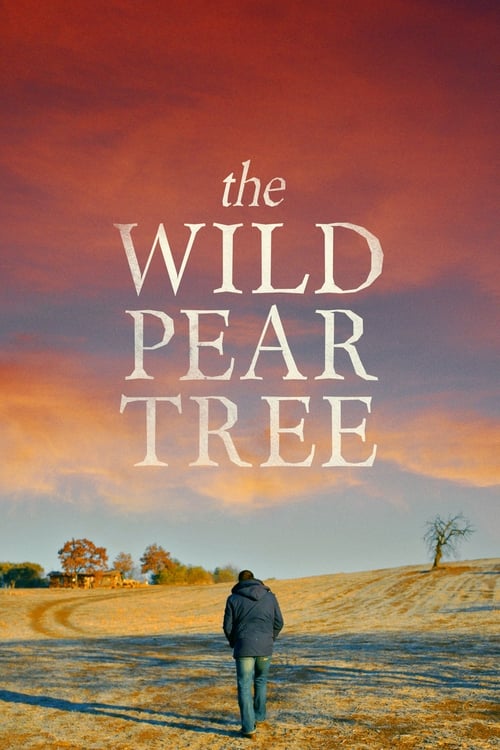
The Wild Pear Tree
2018 · Nuri Bilge Ceylan
For a patient, ruminative evening when you want a film to chew on for days — especially if you've ever gone home and found the person you least wanted to become waiting there. This is a challenge, not a comfort watch, and it rewards giving it your full attention.
What it's about
A young man fresh out of university comes home to his village in northwestern Turkey with a manuscript under his arm and no money to publish it. Sinan wants to be a writer; what he finds instead is his father — a rural schoolteacher hollowed out by a gambling habit — plus old friends who've moved on, local officials with polite excuses, and a hometown that has no use for his ambitions. Scraping together funds for the book becomes a slow reckoning with the man he blames for everything and is quietly turning into.
The experience
Long, talky, and strangely absorbing — three hours of arguments about faith, literature, and money that play out like verbal duels, broken up by wind-swept landscapes that give you room to breathe. It's prickly rather than warm; you spend much of it annoyed at Sinan and then blindsided by how much you feel for him.
Performances
Aydın Doğu Demirkol makes Sinan's arrogance genuinely abrasive without losing you, and the scenes between him and his father carry the whole film — irritation, shame, and love tangled so tightly you can't pull them apart.
The craft
Ceylan builds the film out of marathon conversations that walk and wander — a debate with two imams, a bruising encounter with a published novelist — each staged against the fields and small towns of Çanakkale. The landscape photography is expansive and painterly, turning provincial Turkey into something both beautiful and suffocating. It rewards a big screen and an unhurried night.
Why it matters
Coming right after Ceylan's Palme d'Or winner Winter Sleep, it confirmed him as world cinema's great chronicler of Turkish provincial life and of talkers who argue their way around their own hearts, and it premiered in competition at Cannes.
Snapshot
The Wild Pear Tree (Ahlat Ağacı) is Nuri Bilge Ceylan's eighth feature and the film he made directly after his Palme d'Or–winning Winter Sleep (2014). It follows Sinan (Aydın Doğu Demirkol), a freshly graduated aspiring writer who returns to his home region in the province of Çanakkale, in northwestern Turkey, hoping to publish a self-financed book of impressionistic prose while sliding into a slow reckoning with the father — a rural schoolteacher and compulsive gambler — whose failures he despises and, gradually, recognizes in himself. Running roughly three hours, built from long, argumentative conversations and expansive landscape, it is a portrait of a young man's disillusionment that widens into a meditation on inheritance, faith, provincial stagnation, and the vanity of the intellectual vocation. It premiered in competition at the 2018 Cannes Film Festival and became Turkey's official submission for the Academy Award for Best Foreign Language Film. Within Ceylan's body of work it is often read as a companion piece to Winter Sleep — both drawn from a Chekhovian well of talk, self-justification, and moral evasion — and as the culmination of his long return to the Anatolian and Aegean provinces of his own biography.
Industry & production
The film was a characteristically international art-cinema co-production, assembled across Turkish, French, German, and other European partners, with Ceylan's own Zeyno Film as the anchoring Turkish company alongside longtime collaborators and public funders including Eurimages, the Turkish Ministry of Culture, and European broadcasters. This financing model — pooling festival-facing European soft money with Turkish support — is the standard architecture that has sustained Ceylan's features since he moved from the self-funded, family-crewed intimacy of his early work toward larger productions. Production drew on the region around Çanakkale and the town of Çan, Ceylan's ancestral territory, lending the film the specificity of a director filming a landscape he knows personally rather than a generic "provincial" backdrop.
The commercial expectation for a Ceylan film is set by the festival economy rather than the box office: these are works that recoup through the prestige circuit, subsidy, and international arthouse distribution rather than mass theatrical returns. Precise budget and gross figures are not something I can state reliably here, and I will not invent them. What can be said is that the project carried the considerable weight of following a Palme d'Or, and that Ceylan responded not with a compression toward accessibility but with an even longer, more discursive film — a decision consistent with a director who has increasingly used his stature to protect duration and slowness.
Technology
The Wild Pear Tree is a digital film, made within the high-resolution digital-cinema workflow that Ceylan and his cinematographer adopted over the 2000s as they moved away from celluloid. Ceylan began his career as a photographer, and his features have always been technologically attentive to the image as a photographic object; the shift to large-sensor digital capture allowed the very long takes, low-light interiors, and wide tonal latitude that the film's structure depends on. The digital pipeline is essential to the movie's method: sequences run for many minutes, actors sustain unbroken argument across changing light, and exteriors are shot in the kind of overcast, diffuse Anatolian daylight and dusk that rewards a sensor's dynamic range. Rather than deploying technology for spectacle, the film uses it to extend the duration and fidelity of ordinary observation — a face held until it becomes uncomfortable, a walk through fields captured without cutting. Any specific camera-and-lens attribution beyond this general workflow I would be speculating on, so I flag it as uncertain rather than assert it.
Technique
Cinematography
The photography is credited to Gökhan Tiryaki, Ceylan's principal director of photography across the run of major films from Climates onward. Tiryaki's work here is defined by the long take and by a painter's attention to weather, foliage, and the fall of light. Landscape is not scenery but argument: the wind moving through poplar and pine, the ochre of plowed fields, the ancient contours of the Troad, all press the human dramas into a geological and seasonal scale. Interiors — the family house, the bookshop, a mosque courtyard — are lit with restraint, often keyed to available or naturalistic sources, so that faces emerge from soft gloom. The camera favors patient framing and slow reframing over showy movement; when it does move, it tends to accompany walking bodies through terrain. The overall effect is of a photographer who trusts the world to compose itself if held long enough.
Editing
Ceylan is, characteristically, closely involved in shaping the film's rhythm, and the editing philosophy is one of extension rather than compression. Scenes are permitted to run past the point where conventional cinema would cut, so that conversations acquire the drift, repetition, and dead air of real talk, and the viewer feels duration as a subject in itself. The cut is used less to accelerate than to juxtapose — moving between Sinan's encounters so that they rhyme and comment on one another. Notably, the film folds in dreamlike or hallucinatory passages that are not always marked off as such, and the editing allows reality and reverie to bleed together, a strategy that pays off in the closing movement.
Mise-en-scène / staging
The staging is built around the peripatetic dialogue: characters walk and talk, and the film's most celebrated passages are essentially mobile essays. Two set pieces are exemplary. In one, Sinan corners a successful older author (Süleyman) and their strolling conversation curdles from admiration into insult, laying bare the young writer's arrogance and envy. In another, Sinan falls in with two imams and debates faith, doubt, and hypocrisy across an orchard as they pilfer apples — a scene that stages theological argument as physical, ambulatory, human comedy. Ceylan choreographs bodies in landscape with great precision while keeping the manner unforced; the drama is in the drift of the walk and the shifting alignments of who agrees with whom.
Sound
The soundscape is predominantly naturalistic — wind, insects, dogs, the ambient noise of provincial life — and Ceylan generally eschews a wall-to-wall score in favor of these environmental textures, which deepen the sense of place. Music, when it appears, tends to arrive sparingly and with deliberate weight, and Ceylan has across his career favored pre-existing classical music over original scoring; I recall this film reserving such a musical gesture for a climactic passage, but I won't attribute a specific composition with confidence. The restraint of the sound design is itself expressive: the silences let the talk and the weather carry the film.
Performance
The film rests on Aydın Doğu Demirkol as Sinan, who must make a fundamentally unlikeable protagonist — supercilious, wounded, cruel to those who love him — compelling across three hours. His performance is all guardedness and suppressed contempt slowly eroding into something like grief. Opposite him, Murat Cemcir plays the father Idris, and the performance is the film's emotional pivot: a man whose warmth, evasiveness, and self-deceiving optimism make his gambling ruin both maddening and heartbreaking. The surrounding cast — the mother, the grandparents, old friends, the girl Hatice glimpsed in an early encounter — perform in Ceylan's naturalistic register, where acting reads as behavior rather than display.
Narrative & dramatic mode
The dramatic mode is discursive, episodic, and essayistic rather than plot-driven. Its engine is conversation: the film advances through a series of extended dialogues in which characters argue about literature, religion, love, money, and the worth of a life, and in which Sinan repeatedly exposes his own limitations by trying to expose others'. There is a through-line — the need to raise money to publish the book, the deteriorating situation of the father — but it functions as a loose armature on which to hang encounters. The register mixes bleak comedy with philosophical seriousness; scenes tilt from farce to devastation. Crucially, the narrative admits the oneiric: fantasies, imagined confrontations, and dream-images intrude without warning, so that the film's "realism" is porous. This culminates in an ending that turns on the well the father has spent years digging on the family's barren land, searching for water no one else believes is there — a labor that becomes the film's central metaphor for faith, folly, and the refusal to quit, and the ground on which father and son finally, wordlessly, meet.
Genre & cycle
Nominally a drama, the film belongs more precisely to the international art-cinema tradition of the long, contemplative character study — what critics have taken to calling "slow cinema" — and to the specific cycle of Turkish provincial films Ceylan has built over two decades. Within his own filmography it forms part of a loose Anatolian sequence — with Once Upon a Time in Anatolia (2011) and Winter Sleep (2014) — concerned with rural Turkey, masculine self-delusion, and the moral texture of talk. It also sits within a broader lineage of "return of the native" narratives: the educated young man who comes home to a province he has outgrown and cannot escape. It resists genre spectacle entirely; its pleasures are those of argument, landscape, and slow revelation.
Authorship & method
The film is unmistakably an auteur work, and Ceylan's method is collaborative within a tight circle. The screenplay is credited to Nuri Bilge Ceylan together with Ebru Ceylan — his wife and enduring writing partner — and Akın Aksu, whose own background and family are widely understood to have informed the material's provincial and religious textures. Ceylan's writing method characteristically draws on literary models: he has openly worked from Chekhov (Winter Sleep took explicit inspiration from Chekhov's stories) and from the Russian tradition of Dostoevsky, and The Wild Pear Tree's dialogic, morally searching structure extends that practice. His key craft collaborators recur: Gökhan Tiryaki on cinematography, and Ceylan's own hands-on involvement in the edit. Ceylan tends to avoid original scoring, preferring found classical music, which keeps musical authorship subordinate to image and word. The result is a cinema of authorship as accretion — the same region, the same preoccupations, the same collaborators, deepened film to film.
Movement / national cinema
The Wild Pear Tree is a landmark of contemporary Turkish national cinema and of Ceylan's singular position within it. Since Distant (2002) and Climates (2006), Ceylan has been the preeminent Turkish director on the world festival circuit, and his films have become the primary vehicle through which international art audiences encounter modern Turkey. The film participates in the global festival art-cinema movement — austere, long-form, festival-premiered — while remaining rooted in specifically Turkish material: the tension between Istanbul-educated ambition and Anatolian provincial life, the place of Islam in everyday argument, the economics of rural precarity, and the weight of a national landscape thick with history (the Troad, near the ground of ancient Troy and the Gallipoli peninsula). It is Turkish cinema addressed simultaneously to itself and to the world.
Era / period
The film is a product of the mid-to-late 2010s, made in the wake of the prestige and freedom afforded by the 2014 Palme d'Or, and it reflects a moment in which Ceylan could command long duration and slow rhythm without commercial compromise. Set contemporaneously, it registers the pressures of that period in Turkey — economic anxiety, the friction between secular and religious worldviews, the difficulty of the young in finding footing — though it filters them through the personal and the philosophical rather than the topical. It belongs to an era in which digital capture had fully enabled the long-take aesthetic, and in which "slow cinema" had become a recognized, critically legitimated mode on the festival circuit.
Themes
The film's governing theme is inheritance — the horror and inevitability of becoming one's father. Sinan defines himself against Idris's weakness, only to discover his own pride, cruelty, and capacity for self-deceiving faith mirror the father's. Around this pivot cluster its other concerns: the vanity and futility of the artistic vocation (a book no one will read, written by a man who cannot love the people around him); the gulf between intellectual ambition and provincial reality; faith and doubt, argued out in the extraordinary imam sequence; the moral economy of debt, gambling, and money; and the relationship between people and land — the barren family plot, the stubbornly dug well, the wild pear tree of the title, a misshapen, solitary, "different" tree that stands as an emblem for the odd, unaccommodated protagonist and perhaps for the artist as such. Underneath runs a melancholy about stagnation and escape, and a final, hard-won intimation of tenderness between father and son.
Reception, canon & influence
Critically, The Wild Pear Tree was received as a major, serious work by one of world cinema's most respected auteurs, admired for its writing, its performances, and the beauty and patience of its images, even as some viewers found its length and talkiness demanding. It played in competition at Cannes 2018 and was chosen as Turkey's submission for the Best Foreign Language Film Oscar, though — to the best of my knowledge — it did not secure a nomination, and I will not overstate its awards record beyond that.
The influences on the film run backward into literature more than cinema: the Chekhovian architecture of talk and moral evasion, the Dostoevskian intensity of self-examination, and, in cinematic terms, the lineage of Bergman (the searching dialogues, the father-son and faith motifs), Tarkovsky and Antonioni (landscape, duration, spiritual disquiet). Within Ceylan's own output it is continuous with Once Upon a Time in Anatolia and Winter Sleep, extending their provincial settings and their fascination with articulate, self-justifying men.
Its forward legacy is harder to measure at this remove and I won't overclaim it. What can be said is that the film consolidated Ceylan's stature as the defining figure of contemporary Turkish cinema and a reference point for a certain kind of literary, long-form art film — a body of work that continues to shape how international audiences and younger Turkish filmmakers understand the possibilities of slow, dialogue-driven, landscape-anchored cinema. As a canonical entry, it stands as one of the fullest statements of Ceylan's mature style, and one of the essential films for tracing the lines of influence between the Russian literary tradition and twenty-first-century world cinema.
Reception
It premiered in competition at Cannes 2018 to strong reviews but went home empty-handed — a snub many critics grumbled about, given Ceylan had won the Palme just four years earlier for Winter Sleep. Since then it's quietly climbed, with plenty of cinephiles now calling it his warmest and maybe his best film.
How The Wild Pear Tree was received, from release to now →
Influences: the films it descends from and the films it influenced
- Winter Light (1963) — Stages a crisis of faith as sustained verbal two-handers in which a clergyman's doubt is interrogated dialectically — the direct model for Ceylan's imam-debate scenes where belief is talked to exhaustion rather than dramatized.
- Wild Strawberries (1957) — Establishes the return-of-the-native journey whose realist surface is punctured by dream and memory that cut in without transitional marking — the oneiric-blending device Ceylan uses when Sinan's waking landscape dissolves into hallucination.
- The Mirror (1975) — Charges wind moving through fields and trees with interior psychic weight and fuses dream, memory and present into one continuous texture, the template for Ceylan's landscape-as-argument and unmarked oneiric passages.
- L'Avventura (1960) — Holds shots on terrain and architecture well past narrative necessity so that duration itself expresses moral drift, the durational grammar Ceylan inherits for reading character through landscape.
- Red Desert (1964) — Uses environment as an externalized diagnosis of a character's malaise, treating setting as an argument about the person — precisely Ceylan's use of the arid Çanakkale hinterland around Sinan.
- Landscape in the Mist (1988) — Builds narrative from peripatetic movement across landscape rendered in extended long takes, the walking-and-talking-through-terrain construction Ceylan adopts for his roaming dialogues.
- Distant (2002) — Ceylan's own establishment of static natural-light compositions and the self-justifying, provincially-alienated male protagonist that Sinan later inherits and amplifies.
- Climates (2006) — Marks Ceylan's shift to digital capture exploited for high-resolution long takes in natural light, the technological basis for the extended digital long-take cinematography Gökhan Tiryaki refines here.
- Once Upon a Time in Anatolia (2011) — Pioneers the nocturnal peripatetic-dialogue structure — articulate men circling moral evasion while crossing landscape over extended duration — that The Wild Pear Tree redeploys by daylight.
- Winter Sleep (2014) — Ceylan's explicit adaptation of Chekhov into long interior argument scenes, directly extending the Chekhovian architecture of talk and self-justification that structures Sinan's confrontations.
- Beyond the Hill (2012) — A younger Turkish filmmaker extending Ceylan's provincial landscape-anchored study of patriarchal self-justification, using terrain and off-screen threat as moral argument in the Ceylan mold.
- Sátántangó (1994) — Practices extreme extended-duration long takes over bleak natural-light rural terrain with naturalistic ambient sound, the parallel slow-cinema grammar Ceylan works in without Tarr's choreographed camera.
- Honey (2010) — A Turkish-national slow-cinema treatment of a provincial father-son bond told through natural light and layered forest ambience rather than score, sharing Ceylan's regional and sonic method.
- The Tree of Life (2011) — Advances an essayistic-discursive mode of father-son inheritance in which natural light and landscape function as the film's argument, a contemporaneous parallel to Ceylan's essayistic strand.
- L'Humanité (1999) — Anchors faith-and-doubt in a rural setting shot in natural light with non-professional, behaviorally naturalistic performance and durational stillness, a kindred austerity to Ceylan's.
- Old Joy (2006) — Constructs meaning almost entirely from a peripatetic conversation between two men walking through landscape under naturalistic ambience, the same walking-dialogue-as-form Ceylan favors.
Similar films
- Winter Sleep (2014) — influence & lineage · often watched together
- Once Upon a Time in Anatolia (2011) — influence & lineage
- The Tree of Life (2011) — influence & lineage
- Satantango (1994) — influence & lineage
- Red Desert (1964) — influence & lineage · often watched together
- The Tree of Wooden Clogs (1978) — often watched together
- The Turin Horse (2011) — shared sensibility
- My Father and My Son (2005) — shared sensibility