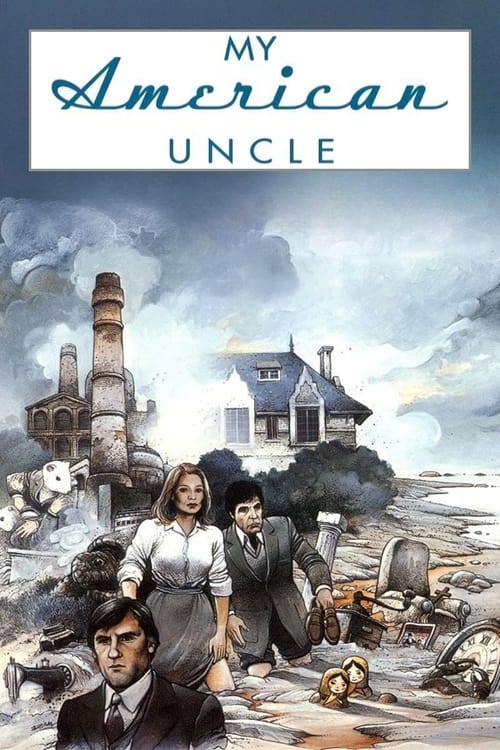
My American Uncle
1980 · Alain Resnais
For when you want a film to chew on for days — smart, dry, formally inventive, more stimulating than soothing. Perfect for a curious evening when you'd rather think and smile than swoon.
What it's about
Three ordinary French lives — a devout farm boy turned factory manager broken by a corporate reshuffle, a working-class woman who reinvents herself as an actress and stylist, and a bourgeois writer-politician tangled between ambition, family, and a mistress — are braided together with the on-camera lectures of real-life scientist Henri Laborit, who explains their loves, breakdowns, and betrayals as biology: reward, punishment, and what stress does to an animal that can't act.
The experience
Playful and unsettling in equal measure — a comedy of manners that keeps pulling back to show you the lab rat in every character, including yourself. It's witty, brisk, and it will quietly rearrange how you think about your own worst weeks.
Performances
Gérard Depardieu is quietly wrenching as a decent man ground down by forces he can't name, and Nicole Garcia gives the film its warmest, most self-possessed presence.
The craft
Resnais builds an essay-film disguised as a tragicomedy: fiction and lecture interleaved with surgical editing, so the science and the storytelling keep commenting on each other. Its structural daring is the show — a film where the form is the idea.
Why it matters
A celebrated late-career triumph for Resnais that proved intellectual cinema could be genuinely entertaining, and a model for every film since that mixes fiction with essay.
Snapshot
Mon oncle d'Amérique is Alain Resnais's essayistic tragicomedy of behavior, a film that braids three ordinary French lives around the biological theories of the physician and researcher Henri Laborit, who appears throughout as himself. René (Gérard Depardieu), a farm-raised Catholic who rises to factory management and is broken by a corporate reshuffle; Janine (Nicole Garcia), a working-class woman who reinvents herself as an actress and stylist before sacrificing her love affair; and Jean (Roger Pierre), a bourgeois writer-politician torn between ambition, family and a mistress — each is presented less as a psychological individual than as an organism responding to stimuli, reward, punishment and, above all, the inhibition of action under stress. Laborit's lectures on the reptilian brain, the limbic system and the physiology of anxiety are illustrated with laboratory rats and, wittily, with clips of the screen idols each character unconsciously imitates. Awarded the Grand Prize of the Jury at Cannes in 1980 and nominated for an Academy Award for its original screenplay, it stands as one of Resnais's most accessible and warmly received later works — a film about determinism that is nonetheless generous, funny and humane.
Industry & production
The film was produced within the French auteur-cinema system of the late 1970s, a period in which established New Wave-generation directors continued to secure financing for ambitious personal projects, often with television and state support. It reunited Resnais with a durable creative team — cinematographer Sacha Vierny and, on the page, screenwriter Jean Gruault — and paired him with rising and established acting talent. Depardieu, already a major star by 1980, anchors the commercial appeal; Nicole Garcia and the veteran comic actor Roger Pierre (better known for a comedy double-act than for dramatic film work) round out the trio. The conceptual gamble — a fiction film structured around a living scientist's theories, with that scientist delivering direct-to-camera exposition — was unusual, and the production's coherence owes much to Gruault's script and Resnais's long practice in fusing documentary and fiction. The film performed strongly on the festival and critical circuit, and the Cannes prize gave it international distribution beyond the usual art-house ceiling. Precise budget and box-office figures are not something I can attest to reliably here, and I will not invent them.
Technology
Technologically the film is conventional for a 1980 French production: 35mm color photography, standard optical and photochemical post-production, and location-plus-studio shooting. Its interest lies not in novel apparatus but in its incorporation of pre-existing material — archival clips from classic French cinema — and of quasi-documentary footage of laboratory experiments. The seams between these registers (fiction, film-clip, lab demonstration, lecture) are managed through editing and framing rather than through any special photographic technology. Resnais, who had begun in the cutting room and as a documentarist, treats the film print itself — the ability to quote and juxtapose existing images — as his primary "technology."
Technique
Cinematography
Sacha Vierny, Resnais's collaborator since Hiroshima mon amour (1959) and Last Year at Marienbad (1961), photographs the film with a clarity that deliberately resists expressionism. The fictional passages are lit and framed with a lucid, almost clinical evenness appropriate to a film that regards its characters as specimens; the compositions favour legibility over mood. This restraint is strategic: the more neutrally the human dramas are observed, the more forcefully Laborit's framing of them as biological events registers. Where earlier Resnais-Vierny work luxuriated in tracking movement and unstable space, here the camera is comparatively grounded, letting the film's disjunctions come from cutting rather than from the moving frame.
Editing
Editing is the film's governing art, as it is across Resnais's career. Working with editor Albert Jurgenson, Resnais interleaves four kinds of image — the three characters' stories, Laborit's lectures, laboratory footage of rats, and clips of movie stars — so that a human gesture rhymes with a rat pressing a lever or a screen hero's flourish. The montage is associative and argumentative: a cut can function as a thesis, proposing that a character's "choice" is a conditioned response. The film's biographical openings are themselves fragmented, assembling each life from short, discontinuous units of childhood, family and formation. This is Resnais's signature — memory and identity as montage — redeployed in the service of a behavioral argument rather than a psychological or historical one.
Mise-en-scène / staging
The staging alternates between the naturalistic (offices, farms, apartments, the textured worlds of factory management and provincial family life) and the frankly demonstrative (Laborit at his desk or in the lab, addressing the viewer). One of the film's boldest strokes of mise-en-scène is a recurring device in which characters, at moments of stress, are briefly shown wearing rats' heads or set against laboratory apparatus — a literalisation of Laborit's model that could be crude but is played with such deadpan economy that it becomes both funny and unsettling. The environments are chosen for their sociological specificity: the milieu of corporate restructuring, of the self-improving autodidact, of the political-literary bourgeoisie.
Sound
Sound is organized around Laborit's voice, which functions as the film's connective tissue — an expository, reasonable, faintly ironic narration that stitches the disparate materials together. The original score by Arié Dzierlatka supports rather than dominates. Crucially, the film also mobilizes the sound of old cinema through its clips, so that the characters' inner lives are partly voiced by borrowed dialogue and music from the films they love.
Performance
The performances negotiate a difficult tonal register: the actors must be fully embodied and sympathetic while the film's apparatus continually reframes them as automata. Depardieu gives René a wounded physical solidity, his decline from confidence to breakdown legible in posture and pace. Garcia's Janine carries the film's most explicit reflection on self-invention and sacrifice. Roger Pierre, cast against his comic reputation, lends Jean a self-regarding weariness. The trio's restraint is essential; overt theatricality would collapse the film's balance between empathy and analysis.
Narrative & dramatic mode
The film's mode is the essay-film crossed with the conte philosophique. It is not a documentary about Laborit, nor a straight triptych of melodramas, but a hybrid in which fiction serves as illustration for an argument and the argument, in turn, deepens the fiction. The three stories are structured to demonstrate Laborit's central concept — that when an organism can neither fight nor flee, the inhibition of action produces stress that turns inward and does biological damage. René's professional humiliation, Janine's renunciation and Jean's stalled ambition are each staged as instances of blocked action. The direct address, the intertitles of biological explanation, and the archival quotation all break the fictional frame in a controlled, Brechtian manner, keeping the viewer intellectually active rather than absorbed.
Genre & cycle
Nominally cataloged as comedy, drama and romance, the film in truth belongs to a small, distinctly Resnaisian genre: the philosophical-scientific fiction. It participates in a broader late-1970s European art-cinema interest in cognition, conditioning and the limits of free will, but it has few true companions. Within Resnais's own filmography it inaugurates a phase of playful, structurally experimental works that wear their intelligence more lightly than the austere modernism of Marienbad — a cycle that would continue in films like La vie est un roman (1983) and L'amour à mort (1984). The recurring metaphor of the "uncle from America" — the mythical rich relative whose return will rescue you — gives the film its title and its cycle-defining irony: the consoling illusion that some external deliverance will spare us the consequences of our conditioning.
Authorship & method
This is unmistakably a Resnais film, yet its authorship is genuinely collaborative and, unusually, shared with a scientist. Alain Resnais brings his lifelong preoccupations — memory, time, the montage of consciousness, the porous border between document and fiction — and his method of building meaning through juxtaposition. Screenwriter Jean Gruault, who also wrote for Truffaut and Rivette and would collaborate with Resnais again, supplied the human architecture that makes the theory dramatically inhabitable; the Academy Award nomination for original screenplay recognized precisely this feat of translation. Henri Laborit, whose real research on behavior and the inhibition of action furnishes the film's intellectual spine, is effectively a co-author, lending his voice, his ideas and his presence. Cinematographer Sacha Vierny and editor Albert Jurgenson realize the visual and rhythmic logic, while composer Arié Dzierlatka provides the score. The method is Resnais's constant one: take an external structuring system — here a scientific theory rather than a memory or a piece of music — and let it organize the film's form.
Movement / national cinema
Resnais emerged not from the Cahiers du cinéma critics-turned-directors (Truffaut, Godard, Chabrol) but from the so-called Left Bank group associated with Chris Marker and Agnès Varda — filmmakers more rooted in documentary, literature and the political left, more formally experimental, and older than the Cahiers cohort. Mon oncle d'Amérique is a late flowering of that sensibility within French national cinema: literary, essayistic, unafraid of ideas, and continuous with the intellectual documentary tradition (Resnais's own Nuit et brouillard, Toute la mémoire du monde) from which he came. It is a thoroughly French film in its milieux and its faith in the cinema of ideas.
Era / period
Made at the turn of the 1980s, the film registers the anxieties of its moment — corporate rationalization and the precarity of the salaried manager (René's storyline), the pressures of self-fashioning and social mobility (Janine), the compromises of the political-cultural class. It arrives two decades after the New Wave's rupture, at a point when its major figures were consolidating mature, idiosyncratic styles. The film's confidence that a mass audience might sit still for neurophysiology reflects a particular late-1970s European faith in the seriousness of cinema.
Themes
Its governing theme is determinism and the illusion of freedom: the proposition that human beings, believing themselves to be choosing, are largely running conditioned programs shaped by biology, upbringing and culture. From this flow the film's other concerns — stress and the inhibition of action as the physiological cost of powerlessness; social conditioning and hierarchy, with dominance and submission enacted in offices and families as in the rat cage; the mythologies we live by, embodied in the movie idols the characters imitate and in the fantasy of the American uncle; and, finally, a quiet humanism that survives the reductive thesis. For all its insistence that we are machines, the film ends on a note of ambiguity and compassion, refusing to let the theory foreclose the mystery of a life.
Reception, canon & influence
The film was among the most warmly received of Resnais's later career. Its Grand Prize of the Jury at the 1980 Cannes Film Festival, its FIPRESCI recognition, and its 1981 Academy Award nomination for Jean Gruault's screenplay marked it as a critical success that also reached beyond the festival circuit; contemporary critics tended to praise its wit and lucidity, admiring how it made difficult ideas cinematic and entertaining, though some found its schematic use of Laborit's theories reductive. Backward, the film draws on Resnais's own documentary and modernist lineage, on the essay-film tradition, on the Brechtian device of interrupted illusion, and — through its clips — on the golden age of French star cinema (Jean Gabin, Danielle Darrieux, Jean Marais function as the characters' internalized models; I state these associations as the film's own explicit citations). Its deepest intellectual debt is of course to Laborit's behavioral science. Forward, its most visible legacy is as a landmark of the essay-film and of the fiction/documentary hybrid, frequently cited when critics discuss cinema's capacity to think — a lineage that runs toward later intellectual hybrids by filmmakers who mix lecture, archive and drama. Within Resnais's oeuvre it confirmed the more playful, structurally inventive direction of his 1980s work. Its broader influence on subsequent narrative cinema is real but diffuse, more a matter of license and example than of direct imitation; the specific chains of influence beyond the essay-film tradition are genuinely difficult to document with precision, and I will not overstate them.
A Deleuzian reading
For a few seconds, a man in a suit has the head of a rat.
The full Deleuzian reading of My American Uncle →
Reception
A genuine hit in its day — Grand Prix at Cannes 1980, an Oscar nomination for its screenplay, and one of Resnais's biggest French box-office successes — it's since slipped into the shadow of Hiroshima mon amour and Marienbad, waiting on the reappraisal cinephiles keep promising it.
How My American Uncle was received, from release to now →
Influences: the films it descends from and the films it influenced
- Night and Fog (1955) — Resnais's own template of measured expository commentary laid over montaged archival footage — the essay-documentary method he transplants here into a fiction feature.
- Letter from Siberia (1957) — The Left Bank essay film's founding demonstration — the same shots re-narrated three ways to prove commentary determines meaning — supplies the Brechtian, image-versus-voice tension Resnais uses to frame Laborit's lectures.
- Hiroshima mon amour (1959) — Establishes Resnais's device of splicing documentary material into a fiction so the two registers interrogate each other, the exact seam My American Uncle widens with its scientific footage.
- Last Year at Marienbad (1961) — Introduces Resnais's signature of letting an external structuring system generate form rather than character psychology — here architecture and narration, later a behavioral theory.
- Kuhle Wampe (1932) — Brecht's cinema of interrupted illusion and thesis-driven construction, the didactic distanciation Resnais adopts when the rats-in-a-cage inserts break the drama to state its argument.
- Pépé le Moko (1937) — The archetypal Jean Gabin star persona that the film quotes as found footage — the internalized behavioral 'model' a character measures himself against, treating old star cinema as citable conditioning material.
- Sans Soleil (1983) — Extends the essay-film's thinking-through-montage — archive plus reflective first-person commentary weighing memory and conditioning — the lineage My American Uncle is repeatedly cited alongside.
- Same Old Song (1997) — Resnais reruns the exact 'internalized model' device within his own oeuvre, now having characters lip-sync fragments of pop records instead of quoting star-cinema clips as their behavioral scripts.
- The Thin Blue Line (1988) — A fiction/documentary hybrid that uses stylized reenactment and expository architecture to build an argument, formalizing the same porous border between document and staged illustration.
- Mindwalk (1990) — Dramatizes a living scientist's theory through characters who voice and embody it, the near-literal descendant of letting Henri Laborit's real research furnish a fiction's intellectual spine.
- Adaptation (2002) — Folds its own structuring intellectual system into the drama self-reflexively, extending Resnais's move of making the organizing theory a visible character in the film.
- The Pervert's Guide to Cinema (2006) — A real theorist's voice organizes film clips into a sustained argument, occupying precisely Laborit's structural function of an external expert whose commentary drives the montage.
- The Act of Killing (2012) — Deploys the Brechtian device of having subjects restage and perform their own behavior, exposing conditioned action as role — the confrontation of drama with its own mechanism that Resnais's rat-head inserts pioneered.
- F for Fake (1973) — A first-person essay built from playfully juxtaposed clips that dramatizes an abstract idea (authenticity) through montage rather than plot — the same lecture-as-cinema wit.
- The Falls (1980) — A feature organized as deadpan pseudo-scientific taxonomy, using expository narration and a mock-systematic structure to run fiction on the rails of a governing intellectual scheme.
- My Dinner with André (1981) — Makes abstract ideas dramatically inhabitable through performed talk alone, the same feat of translating theory into human, watchable conversation that earned Gruault's screenplay its nomination.
Similar films
- Hiroshima Mon Amour (1959) — influence & lineage
- The Act of Killing (2012) — influence & lineage · often watched together
- Synecdoche, New York (2008) — often watched together
- Mon Oncle (1958) — shared sensibility
- My Dinner with Andre (1981) — shared sensibility
- The Man Who Sleeps (1974) — shared sensibility
- Muriel, or the Time of Return (1963) — shared sensibility
- The Rules of the Game (1939) — shared sensibility