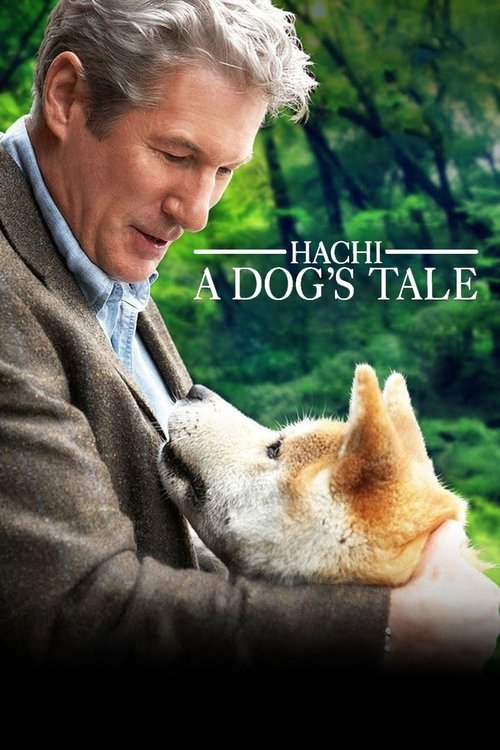
Hachi: A Dog's Tale
2009 · Lasse Hallström
When you need a good cry and want to earn it honestly — this is the one dog movie people warn each other about. Keep tissues within reach and don't watch it if you've just lost a pet.
What it's about
A music professor in a New England commuter town finds a lost Akita puppy at the train station and, over his wife's objections, keeps him. The dog, Hachi, grows into his constant companion, walking him to the station every morning and waiting at the same spot every evening for his return. It's drawn from the true story of Hachikō, the dog who kept a daily vigil at a Tokyo station in the 1920s and became a national legend in Japan.
The experience
Quiet, gentle, and almost dialogue-light for long stretches — the film asks you to watch a routine of small kindnesses build into something enormous. Then it breaks your heart, slowly and without a single cheap trick, and most people are wrecked by the end.
Performances
Richard Gere underplays beautifully as the professor, letting warmth do the work, and the Akitas playing Hachi give one of those animal performances that feels impossibly expressive.
The craft
Lasse Hallström shoots the seasons of a small station town with soft autumn light and keeps sentimentality on a tight leash — the restraint is the craft. Occasional low-angle shots from the dog's point of view quietly put you inside a mind that can't understand what's happened, only that waiting is right.
Why it matters
An American retelling of one of Japan's most beloved true stories that barely played in US theaters, then found an enormous global audience and settled into lists of the great tearjerkers — proof that a nearly wordless story of loyalty travels anywhere.
Snapshot
A Swedish director best known for a film called My Life as a Dog takes a Japanese national legend, transplants it to a New England commuter town, and makes an American family drama in which the protagonist never speaks, cannot understand what has happened to him, and is right to keep waiting anyway. Hachi: A Dog's Tale is a remake of Seijirō Kōyama's Hachikō Monogatari (1987), scripted by Kaneto Shindō, which itself dramatized the documented life of Hachikō, the Akita who met his owner Hidesaburō Ueno at Tokyo's Shibuya Station each evening and — after Ueno died suddenly at work in 1925 — continued to return to the station daily until his own death in 1935. The American version keeps the essential architecture (arrival, bond, sudden death, the vigil) and replaces the Shōwa-era Tokyo of the original with an autumnal, deliberately unplaced American town.
What makes the film worth an entry in an atlas of influence is not its ambition, which is modest, but its position: it sits at a junction where a Japanese folk legend, a European art-cinema humanist sensibility, and the collapsing American mid-budget theatrical market all intersect. It was, notoriously, released direct-to-video in the United States after playing theatrically abroad — and then acquired, through DVD, cable, and streaming, a popular audience vastly larger than most of that year's specialty releases. It is a minor film with an outsized afterlife.
Industry & production
The project originated outside the studio system as an independently financed international production, with Richard Gere attached both as star and producer; the American development is generally credited to producer Vicki Shigekuni Wong, who brought the Hachikō story forward as a property for English-language adaptation. Stephen P. Lindsey wrote the screenplay. Production took place in Rhode Island in 2008 — the commuter depot at Woonsocket standing in for the station that anchors the film, with additional work in and around Bristol and Providence — a location choice driven partly by state film incentives, which in the late 2000s were reshaping where mid-budget American dramas physically got made.
The release pattern is the most historically legible fact about the film. It premiered at the Seattle International Film Festival in June 2009 and opened theatrically in a number of foreign territories — most consequentially Japan, where it performed strongly on the strength of the source legend's domestic standing. In the United States it never received a wide theatrical release; it went to home video in 2010 through Stage 6 Films, Sony's label for titles routed around theaters. The overwhelming majority of its reported worldwide gross was earned outside North America, with Japan the dominant market. (Precise figures vary between trade sources and are not reliably reconciled; the directional fact — a foreign-earning film that skipped American theaters — is the one that matters.)
This is a case study in the 2008–2011 evaporation of the adult mid-budget drama. A film starring an Oscar-nominated actress and a former A-list leading man, directed by a two-time Best Director nominee, could not find an American theatrical berth. The film's subsequent life — perennial cable rotation, high streaming placement, an enormous vernacular reputation — happened entirely in the windows that were supposed to be secondary.
Technology
The record on the production's technical specifics is thin; press materials of the period gave little attention to format, and the film has never attracted the kind of technical documentation a prestige release accumulates. It belongs to the last substantial cohort of American mid-budget dramas finished through a photochemically originated, digitally graded pipeline, before digital capture became the default for this budget tier.
Two technological questions do bear on the film directly. The first is the color-managed rendering of canine subjectivity: the film periodically cuts to Hachi's point of view, which is graded to approximate dichromatic vision — reds and greens collapsed toward yellows and blues, contrast raised, detail softened. This is a digital-intermediate effect, and it is the film's only overtly modernist gesture. The second is the handling of the animal performer. Multiple Akitas played Hachi at different ages, coordinated by animal trainer Boone Narr; production accounts indicate that a Shiba Inu was used for the youngest puppy stage, because Akita puppies outgrow the size the scenes required, and that limited digital and puppet work covered shots no live animal could deliver. The film's realism is thus partly synthetic — a fact worth noting given that its emotional claim rests entirely on our belief that we are watching a real animal really wait.
Technique
Cinematography
Ron Fortunato shoots in a register of controlled warmth: available-light interiors, low-contrast daylight, a palette that moves from October ambers through winter blues as the vigil extends across years. The station is the film's organizing space, and Fortunato repeatedly frames it from the same handful of positions — the plaza, the platform, the doorway — so that the image itself becomes a repetition. The camera is patient, largely static or slowly tracking, with very little of the handheld coverage that had become standard for American drama in the period.
The most distinctive choice is height. A great deal of the film is shot at roughly a large dog's eye level, which flattens the adults into torsos and legs and makes the station look enormous. This is a real formal commitment, not an occasional flourish, and it does the work that voiceover would otherwise do: it establishes the dog as a subject with a viewpoint rather than a possession with a face.
Editing
Kristina Boden's cut is built on an ellipsis structure that is more rigorous than the film's genial surface suggests. The first act proceeds in ordinary scene-to-scene continuity; after Parker's death, the film abandons dramatic scene construction almost entirely and moves into a sequence of near-identical fragments separated by unmarked jumps of months and then years. Nothing announces the passage of time except the dog's coat, the weather, and the aging of the minor characters who feed him. The film's late passages are, formally, closer to structural documentary than to melodrama: variation on a fixed shot.
The one place the editing breaks its own discipline is the ending, which cross-cuts the dying dog's imagined reunion with a return to the earlier, warmer material. Whether this is a failure of nerve or the necessary release of the pressure the repetition has built is the honest critical question about the film.
Mise-en-scène / staging
The film builds a small, legible town — station, plaza, hot dog cart, butcher, bookshop — and then stages nearly everything in it. Ken (Cary-Hiroyuki Tagawa), Carl the stationmaster (Jason Alexander), and Jasjeet the vendor (Erick Avari) function as a chorus of witnesses; the town's slow accommodation of the dog's routine is the film's actual second-act plot. Hallström's staging is characteristically undemonstrative — actors seated, tasks in progress, conversation over work — and he resists the reverse-angle emphasis that would tell us when to feel something.
The domestic interiors are staged around thresholds: doors, porches, the gap under a gate. The station platform is a threshold too, and the film's spatial logic is that the dog spends the second half of his life in a place designed for departure and arrival, which for him now offers only the first.
Sound
Jan A. P. Kaczmarek's score — piano-led, with strings entering sparingly — is the most conspicuous element of the film's authorship and its most debated. Kaczmarek, who had won an Academy Award for Finding Neverland (2004), writes a theme that recurs across the vigil sequences, and the recurrence is structurally identical to the editing's repetition: the same phrase, slightly reharmonized, year after year. Critics who find the film manipulative are usually reacting to the score, which does at moments underline what the image has already established.
Against that, the film's sound design is disciplined and important. The station's mechanical vocabulary — bells, brakes, the announcement, the timetable's rhythm — becomes a secular liturgy, and the dog's behavior is legible only in relation to it. And the film makes one decisive negative choice: Hachi has no voice. There is no interior monologue, no anthropomorphic narration, no talking-animal conceit. In a decade when the commercially dominant dog films were narrated by their dogs, this refusal is the film's principal claim to seriousness.
Performance
Gere gives what is, by the standards of his stardom, an act of deliberate self-effacement: warm, unemphatic, played mostly in reaction. The role's dramatic problem is that its occupant must exit at the midpoint and remain felt as an absence, and Gere solves it by establishing a set of physical routines — the greeting, the walk, the game with the ball — that the film can afterward replay without him. Joan Allen, as Cate, carries the film's adult grief and is given the harder, less rewarded work of being the character who is right about practicalities and wrong about the dog. Tagawa's Ken supplies the film's connective tissue back to Japan, delivering its cultural exposition and its interpretive frame. Jason Alexander is cast productively against his television register.
The animal performance is, unavoidably, a construction — trained behavior, multiple dogs, editorial assembly. The film's achievement is that the construction reads as patience rather than as trick.
Narrative & dramatic mode
Hachi is melodrama in the precise sense, not the pejorative one. Peter Brooks's account of the mode in The Melodramatic Imagination (1976) identifies the mute protagonist as one of melodrama's constitutive figures — the character whose inability to speak forces moral meaning into gesture, tableau, and expressive excess. Hachi takes this literally. Its protagonist cannot be told what happened, cannot be argued out of his error, and cannot articulate his own state; everything must be carried by staging and by the camera's willingness to keep looking.
The film also runs on the temporal structure Linda Williams identified as melodrama's engine: the pathos of "too late." We know, and the dog does not, that the train will never again deliver Parker. Every subsequent shot of the dog looking at the door is generated by that asymmetry of knowledge. There is no suspense, no reversal, no revelation — the film discloses its ending in its premise and then makes us sit inside it. This is why the film is structurally closer to a lament than to a story, and why its second half deliberately renounces plot.
Genre & cycle
The film sits inside the animal melodrama, a durable Anglo-American family-film tradition that uses a creature's death to introduce children to mortality: Lassie Come Home (1943), Old Yeller (1957), Disney's Greyfriars Bobby (1961) — that last film being the closest generic ancestor, another true-story vigil at a dead master's grave. It arrives at a specific commercial moment: Marley & Me (2008) had just demonstrated that a mainstream studio dog picture could end in a dog's death and gross enormously, and the following decade produced a sustained cycle — The Art of Racing in the Rain (2019), A Dog's Way Home (2019), Dog (2022) — of which Hallström's own A Dog's Purpose (2017) is the most direct descendant.
Hachi is the cycle's austere outlier. It has no comedy, no romance subplot resolved by the animal, no narration, and no redemptive third act. Its nearest art-cinema relatives are the animal-as-witness films — Bresson's Au hasard Balthazar (1966), and the dog of De Sica's Umberto D. (1952) — though the film makes no claim to their formal rigor.
Authorship & method
Hallström's career divides cleanly: the Swedish period that produced My Life as a Dog (1985), the Miramax literary-adaptation run (What's Eating Gilbert Grape, The Cider House Rules, Chocolat, The Shipping News), and a late freelance phase of assignment work in which Hachi falls. His method is consistent across all three: ensemble-forward, low-affect, distrustful of emphasis, and interested in communities absorbing an anomaly. The connection to My Life as a Dog is more than titular — that film also concerns a protagonist who loses the thing he loves, is not told the truth about it, and copes through displacement and routine.
The key collaborators are worth naming as a set, because they explain the film's tonal split. Fortunato's photography and Boden's cutting pull toward observation and restraint; Kaczmarek's score pulls toward avowed emotion. Lindsey's screenplay supplies the classroom framing device — a grandson presenting Hachi as his hero — which externalizes the story as already-legend before it begins, a structural inheritance from the source material's status as national folklore rather than as news.
Movement / national cinema
The film is genuinely transnational rather than merely internationally financed: Japanese source, Japanese legend, Swedish director, American setting, independent international money, a release strategy in which the foreign market was primary and the domestic market secondary. Its central artistic problem is translation. What the 1987 Japanese film had — the specificity of Shōwa-era Tokyo, wartime and prewar privation, the historical texture of Ueno's world — the remake cannot use, and it substitutes a deliberately generic New England that belongs to no particular decade.
What it retains of Japan is displaced into two devices: the puppy's arrival in a shipping crate from a Japanese temple, which gives the animal a sacral provenance, and Ken, who explains Akita history and the concept of loyalty to the American characters and, transparently, to the audience. Scholarship on Hachikō — notably Aaron Herald Skabelund's Empire of Dogs (2011) — has documented how the dog was mobilized in 1930s Japan as an emblem of loyalty in an explicitly nationalist register. The American film strips that political history entirely, converting a state-adopted symbol of subject-loyalty into a private story about grief. That erasure is the most significant thing the remake does, and the film is silent about it.
Era / period
2009 is legible in the film's fate more than in its content. It was made as the American theatrical middle was disappearing, released into a home-video market that was itself about to be superseded by streaming, and became popular through channels the industry did not yet know how to value. Gere was in the phase of his career past studio leading-man work; Hallström was past the Weinstein-era prestige pipeline that had defined his American decade. Neither was making the film a major distributor wanted to open.
Its content, by contrast, is aggressively unperiodized. There are almost no markers placing the story in any particular year, which is a deliberate strategy for a folk tale but which also strips the material of the historical specificity that gave the Japanese original its weight.
Themes
Loyalty is the stated theme, but the film's actual subject is the asymmetry of knowledge between species — the impossibility of explaining death to a creature who has no concept of it, and the corresponding impossibility of knowing what the creature actually experiences. The film honors this by refusing to answer. It never tells us whether Hachi is grieving, hoping, or simply performing a habit whose reinforcement has been withdrawn, and its finest quality is that it treats all three readings as equally available.
Beneath that: ritual as a form of meaning-making, the commuter timetable as liturgy; the station as a threshold that once promised return; the household's ordinary friction over an animal it did not choose; and a quiet strand of outsider figures — the immigrant vendor, the Japanese colleague — who understand the dog's vigil earlier and better than the family does. The ending gestures toward reunion in a way that is religiously ambiguous by design, consistent with the Buddhist-inflected framing the temple crate establishes at the start.
Reception, canon & influence
Critical reception. The American critical record on Hachi is unusually thin, and honestly so: because the film bypassed U.S. theaters, most major outlets never assigned it. What criticism exists is mixed — approving of Hallström's restraint and Gere's underplaying, skeptical of the score and of the ending's retreat into consolation, and divided on whether the film's sentiment is earned by its formal patience or imposed by its music. Reception in Japan, where the legend is common cultural property, was substantially warmer and its box-office performance markedly stronger.
Influences on the film (backward). Directly and creditedly: Kōyama's Hachikō Monogatari (1987) and its screenplay by Kaneto Shindō — a figure whose own directorial work (Onibaba, 1964) sits at the opposite end of Japanese cinema's affective range. Beyond that, the Anglo-American loyal-animal tradition running from Lassie Come Home through Greyfriars Bobby, whose graveside-vigil structure Hachi reproduces almost exactly; the family-film mortality lesson of Old Yeller; and, in its formal patience and its refusal to grant the animal a voice, the art-cinema lineage of Bresson and De Sica.
Legacy (forward). The film's influence is popular rather than formal, and it is considerable. It became one of the most widely circulated "crying films" of the streaming era, with its final sequence living an independent life as clipped video — a genuine instance of a film's reputation being constituted by an excerpt. It substantially raised Western awareness of Hachikō himself, feeding tourism to the Shibuya statue (the 1948 replacement by Takeshi Ando for his father Teru Ando's 1934 original, melted down during the war) and to the University of Tokyo's 2015 sculpture depicting Ueno and the dog reunited.
Within the industry, it helped normalize the dog-death picture as a viable commercial form in the 2010s, a cycle Hallström himself rejoined with A Dog's Purpose (2017). And it extended the story's remake chain into a third national cinema: Xu Ang's Hachiko (2023) relocated the legend again, to Chongqing, and was a substantial Chinese hit. A Tokyo street dog of the 1920s has now been adapted into Japanese, American, and Chinese national idioms in turn — which is a more interesting piece of film history than the modest American film at its center, and which that film is largely responsible for setting in motion.
A Deleuzian reading
For most of this film the camera sits about two feet off the ground.
The full Deleuzian reading of Hachi: A Dog's Tale →
Reception
Sony dumped it straight to DVD in the US, where critics barely noticed it — then it quietly grossed over $40 million theatrically overseas and became one of the highest audience-rated films on IMDb and China's Douban, a genuine word-of-mouth phenomenon the American press never saw coming.
How Hachi: A Dog's Tale was received, from release to now →
How to watch Hachi: A Dog's Tale: what to notice on a first viewing
- Notice the camera sitting low, near a dog's eye level. Much of the film is shot from about two feet off the ground, so adults become legs and overcoats and the station looks enormous. The height gives Hachi a viewpoint instead of just a face to watch.
- Notice the camera return to the same few station spots. Fortunato frames the plaza, the platform, and the doorway from the same handful of positions throughout, so the image itself starts to repeat. The repetition becomes a rhythm you can feel building before you know what it's for.
- Listen for the total absence of a dog's inner voice. Unlike most dog movies of its decade, Hachi never narrates his own thoughts. The film gives you only what you can see him do. You're left to read his behavior instead of being told what it means.
- Watch Hachi's exact routine each time Parker comes home. The greeting, the walk, the game with the ball repeat in the same order and the same postures, a set of physical habits the film establishes early and precisely. These small repeated gestures are what the whole film will later ask you to remember.
- Notice how often doors, porches and gates frame the family scenes. Hallström keeps staging the household around thresholds, entrances and exits, rather than the middle of rooms, so arrival and departure are always the visible subject. The film is quietly training your eye on doorways before it needs you to watch one closely.
The whole guide to watching Hachi: A Dog's Tale, with the keys for a rewatch →
Influences: the films it descends from and the films it influenced
- Hachikō Monogatari (1987) — The credited source: Kaneto Shindō's screenplay establishes the decade-spanning elliptical structure in which the same station-arrival beat is restaged with only the light, the crowd and the dog's coat changed, and Hallström's film reproduces that repetition-as-clock almost setup for setup.
- Lassie Come Home (1943) — Codified multi-animal construction — Pal plus doubles and stand-ins cut together as one continuous canine performance — and the reaction-shot grammar (dog looks, cut to object, cut back) that lets an audience read intention without a line of narration.
- Greyfriars Bobby (1961) — Supplies the vigil architecture wholesale: dog outlives owner, fixes itself to a single civic location, and is fed in relay by tradespeople and officials until the town itself becomes the chorus that authenticates the loyalty.
- Old Yeller (1957) — Established the family-picture mortality contract — animal death staged at a child's eyeline and processed as instruction rather than horror — which is what licenses Hachi's classroom framing device to present a dead dog as a school assignment.
- Umberto D. (1952) — Available-light neorealist coverage in which the dog is the only witness to the human's private collapse; Flike's small physical refusals at the end are the model for staging an animal's body as the obstacle that blocks a human exit.
- Au Hasard Balthazar (1966) — The mute animal protagonist held as an impassive register — the camera never granted interior access, no voice, no anthropomorphic score cue — with the life told in hard elliptical jumps between episodes rather than a continuous arc.
- Tokyo Story (1953) — The repeated static framing of one station and one threshold across years, so that identical compositions do the work of a time card, and departures blocked in doorways where a figure waits after the other has gone.
- The Bear (1988) — Proved a feature could carry an animal lead assembled from multiple trained doubles and matched inserts, and pioneered dropping into a graded subjective animal POV as the substitute for the interior monologue the film refuses to write.
- Wolfen (1981) — The technical precedent for signaling non-human vision by color space rather than by cut — a sustained processed-image POV keyed to the animal's optics — which Hachi miniaturizes into its dichromatic blue-yellow dog's-eye inserts.
- My Life as a Dog (1985) — Hallström's own template: a protagonist who is never told the truth about what he lost and copes by displacement and daily routine, filmed in low-affect ensemble coverage that withholds the emphasis the material invites.
- Chocolat (2000) — The town-as-chorus staging method — a small community metabolizing an anomaly through a series of shop-doorway and threshold encounters, each recurring minor character advancing the collective verdict rather than a plot.
- Red Dog (2011) — Takes the framing device and makes it the film's engine — townspeople in a pub narrating the dog to a stranger — so the animal arrives already-legend, exactly the structural move Hachi's classroom prologue performs before its first scene.
- A Dog's Purpose (2017) — Hallström rejoins the cycle he helped restart and breaks his own governing rule, giving the dog a continuous first-person voiceover — a direct negative image of Hachi's refusal to narrate the animal.
- Hachiko (2023) — The third national remake, relocating the vigil to a Chongqing rail terminus and rebuilding the town-as-chorus out of a demolished-neighborhood community, proving the station-repetition structure survives translation independent of any single cultural setting.
- Finding Neverland (2004) — Jan A.P. Kaczmarek's scoring method transplanted intact: a piano-and-strings theme deliberately more avowed than the direction, entering under a withheld reveal to supply the emotion the blocking and cutting decline to state.
- Marley & Me (2008) — The other 2008 star-fronted mid-budget dog picture built from age-graded multi-dog casting, ending on a clinically restrained death scene that fixes the commercial template Hachi's release helped normalize.
- Wendy and Lucy (2008) — The same year's rigorous inverse — natural-light long takes, a dog defined by absence and a search, and a scoreless soundtrack of yard noise and trains, demonstrating the too-late pathos Hachi reaches with a cue and Reichardt reaches without one.
- White God (2014) — Extends the dog-eye-level camera into whole sequences shot at hip height with the animal's head as the frame's center of gravity, and builds its lead from two trained brothers cut as one, with no narration to speak for them.
Similar films
- Wendy and Lucy (2008) — influence & lineage · same viewing thread
- Tokyo Story (1953) — influence & lineage · often watched together
- My Life as a Dog (1985) — influence & lineage
- Isle of Dogs (2018) — shared sensibility
- The Boy and the Heron (2023) — shared sensibility
- Departures (2008) — shared sensibility
- Drive My Car (2021) — shared sensibility
- Stray Dog (1949) — shared sensibility
All the films related to Hachi: A Dog's Tale →
Watch it with: curated runs of related films
- Unlikely Companions, Gentle Roads — Watch these together for the way a mismatched pair — a yakuza and a lost boy, an old man on a lawnmower bound for his brother, a runaway kid and a grizzled uncle, two frontier drifters with a stolen cup of milk — becomes a whole small world; they rhyme on tenderness carried at walking pace.