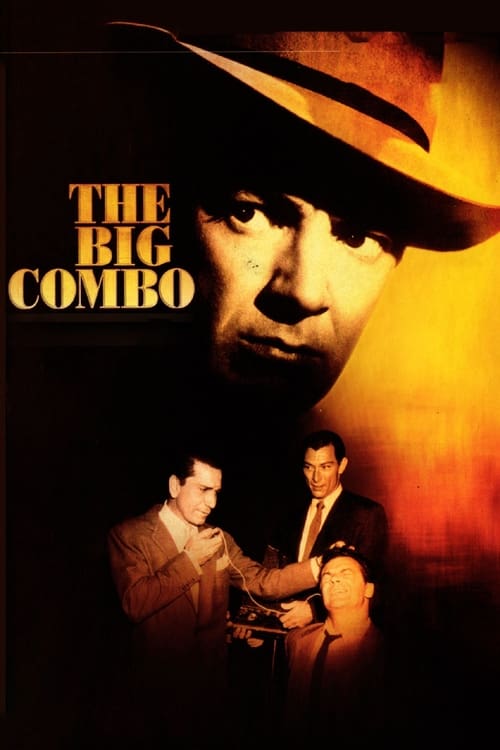
The Big Combo
1955 · Joseph H. Lewis
For a late-night noir mood — when you want stylish menace and moral rot rendered gorgeously, not a comfortable evening.
What it's about
Police Lieutenant Leonard Diamond has burned through department money and his own health pursuing Mr. Brown, a silky, sadistic syndicate boss the law can't touch — and his obsession is tangled up with Susan, the elegant, trapped woman Brown possesses and Diamond wants. The hunt runs through burlesque houses, antique shops, and interrogation rooms, getting uglier and more personal as it goes.
The experience
Dark, mean, and hypnotic — a crime picture where the cruelty is frank, the obsession is mutual, and nearly every frame is carved out of shadow. It has the feel of a fever running low and hot.
Performances
Richard Conte's Mr. Brown is one of the great screen gangsters: soft-spoken, articulate, and genuinely frightening, delivering his philosophy of power like a seduction. Cornel Wilde's Diamond matches him with hollow-eyed fixation.
The craft
Cinematographer John Alton pushes low-key black-and-white photography to its absolute limit — single light sources, silhouettes, fog, faces floating in darkness — turning a modest B-picture budget into some of the most striking images of the whole noir era. It also uses sound with startling cruelty and wit. This one genuinely rewards the biggest, darkest screen you can give it.
Why it matters
A late landmark of the classic noir cycle, it's become a touchstone for cinematographers and a standard example of how far style could carry a low-budget crime picture.
Snapshot
The Big Combo is the late-cycle American crime film pushed to its expressive limit: a modestly budgeted Allied Artists program picture that, under Joseph H. Lewis's direction and John Alton's camera, became one of the most extreme experiments in low-key black-and-white photography the studio system produced. Its plot is a familiar obsessional triangle — Police Lt. Leonard Diamond (Cornel Wilde) burning through department money and his own sanity in pursuit of syndicate boss Mr. Brown (Richard Conte), ostensibly for the good of the city, actually because Brown possesses Susan Lowell (Jean Wallace) and Diamond does not. What distinguishes the film is not the story but the intensity of its stylization and the frankness with which it treats sadism, sexual humiliation, and the erotic component of law enforcement. By 1955 the noir cycle was old enough to be self-aware, and The Big Combo belongs with Kiss Me Deadly of the same year among the films that took the idiom's conventions and turned the contrast up until the image nearly broke. It was received in its moment as an ordinary crime melodrama and has been revalued since as a major work of American genre cinema — a revaluation complicated, and also accelerated, by the fact that the film lapsed into the public domain and circulated for decades in wretched prints.
Industry & production
The film was made for Security Pictures and released through Allied Artists, the upmarket rebranding of Monogram Pictures that had taken effect in 1953. Allied Artists in these years was attempting to graduate from Poverty Row programmers to respectable A-negative pictures — an ambition that in the mid-fifties produced Invasion of the Body Snatchers and Friendly Persuasion alongside a continuing stream of low-budget genre product. The Big Combo sits precisely on that seam: it has real stars, a name composer, and an Oscar-winning cinematographer, but the schedule, sets, and production economics of a B picture.
Sidney Harmon produced; Philip Yordan wrote and was closely bound up with the production side, the two men being frequent partners in this period. Yordan is one of the genuinely unstable attributions in American screenwriting history — a prolific credited writer who is also known to have fronted for blacklisted colleagues and to have employed ghostwriters, so that a Yordan credit cannot be taken at face value. In the case of The Big Combo no specific ghost has been established; the honest statement is that the extent of Yordan's own hand here is unresolved, and readers should treat confident claims either way with caution.
Cornel Wilde and Jean Wallace, married since 1951, came to the project as a pair, and the film's marketable star capital rests on them. Wilde had been an A-list romantic lead a decade earlier (an Oscar nomination for A Song to Remember in 1945) and was by 1955 constructing a second career on the production side, which would culminate in his own direction of The Naked Prey a decade later. The casting of Brian Donlevy as Joe McClure, the deposed boss reduced to Brown's errand-runner, carries an accidental industrial poignancy: Donlevy had headlined Beau Geste and The Great McGinty, and the part asks him to embody obsolescence.
Production was largely stage-bound, with a limited number of exteriors — a constraint Lewis and Alton converted into an aesthetic principle. Where the semi-documentary noirs of the late forties had gone into real streets, The Big Combo retreats into abstraction: rooms defined by a single lamp, corridors that are mostly darkness, an ending staged in fog because fog is cheaper than a set.
Technology
The film was made at the moment of maximum industrial turbulence. CinemaScope had arrived in 1953, color was becoming the default for prestige product, and monochrome Academy-ratio filmmaking was being pushed down-market toward television-adjacent programmers. The Big Combo is black-and-white and is conventionally presented in the Academy ratio, though like most flat productions of 1955 it may have been composed with an eye to soft-matting at 1.85:1 in theaters — the exhibition record for a picture at this budget level is not firm, and the framing question remains genuinely open.
The critical enabling technology is less the camera than the lighting inventory and the negative stock. The faster panchromatic emulsions of the postwar decade gave cinematographers latitude to expose at very low light levels, and John Alton had built an entire method on that latitude, working with small, hard, tightly focused units rather than broad fill. His 1949 book Painting With Light — the first book on cinematography by a working Hollywood director of photography — argued for exactly this: fewer lamps, harder shadows, and a willingness to let large regions of the frame go to unrecoverable black. The Big Combo is the most uncompromising demonstration of that argument on film.
One further piece of period technology is embedded in the plot itself. Joe McClure's hearing aid is a body-worn unit with a cord and an earpiece, the standard consumer device of the early fifties, just before transistorized aids became widespread. The film treats it as an interface that can be attacked — a prosthesis through which sound can be forced in or cut off — and builds two of its most famous sequences on that premise.
Technique
Cinematography
Alton's work here is the film's principal claim on history. He lights faces from single low sources, drops backgrounds entirely, and repeatedly reduces actors to silhouettes read against a lighter plane. Interiors are constructed around one practical — a desk lamp, an overhead fixture in an interrogation room — with everything outside its throw simply absent. Compositions place heavy foreground objects in shadow to frame the action, deepening the sense that the camera is watching from concealment. The final sequence in the airport hangar, where two figures stand in fog cut by a searchlight beam, is a deliberate high-contrast set piece that openly recalls the ending of Casablanca while draining it of romance; it has become one of the most reproduced images in noir iconography.
The stylistic logic is not decorative. Darkness in this film functions as a moral and epistemological condition: characters are unreadable because they are unlit, and the police procedure at the story's center is precisely an effort to get information out of the black. Alton would work only a few more years, retiring from features after Elmer Gantry in 1960 and vanishing from the industry until his rediscovery by archivists and festivals in the 1990s.
Editing
Robert Eisen's cutting is classical and unshowy, which is consistent with Lewis's preferences: Lewis was a director who tended to solve scenes with camera movement and staging rather than with découpage, most famously in the single-take back-seat bank robbery of Gun Crazy (1950). The Big Combo holds shots longer than its budget class typically allowed and reserves cutting for two purposes — procedural compression, as when Diamond's search for the meaning of the name "Alicia" is condensed into brisk investigative passages, and censorship-driven ellipsis, where the cut away from an action is the action's whole meaning.
Mise-en-scène / staging
Rudi Feld's art direction gives the film a repertoire of near-empty spaces: a boxing arena's back corridors, an antique dealer's gallery, a rented room, a hotel bathroom. Lewis stages violence in these rooms with a chamber-drama intimacy that makes it feel domestic rather than spectacular. The film's most-discussed staging is the seduction scene in which Brown kisses Susan and the camera follows him downward out of frame as she reacts — an unmistakable depiction of oral sex achieved entirely by framing and performance, and one of the more audacious evasions of the Production Code in the studio era. The Code's supervision of the film is documented in general terms; the specific negotiation over this shot is the kind of detail that circulates in noir literature more confidently than the archival record supports, so it is better described as a survival than as a known victory.
Sound
The Big Combo is one of the American cinema's early sustained experiments in subjective sound. In the torture of Diamond, Brown's men jam McClure's hearing aid into the detective's ear and drive David Raksin's score through it at volume — the film's own music weaponized, non-diegetic scoring collapsed into a diegetic instrument of pain. Later, when Brown executes McClure with a machine gun, he first removes the hearing aid, and the soundtrack goes silent: we are placed inside a deaf man's experience of his own murder. Both sequences are conceptually ahead of their moment and remain the film's most-cited formal achievements.
Performance
Richard Conte plays Brown with a quiet, managerial calm — a criminal who talks like an executive and whose credo ("first is first and second is nobody") is the language of ambition rather than of vice. Wilde plays Diamond as visibly unwell: sweating, evasive, humiliated, less a hero than a man being consumed. Jean Wallace pitches Susan at a near-sedated flatness that some critics have read as a limitation of her range and others as the correct choice for a woman kept chemically and psychologically subdued. Lee Van Cleef and Earl Holliman, as the gunmen Fante and Mingo, build a two-hander of shared domesticity — they live together, work together, and Mingo's grief at Fante's death is the film's most emotionally direct moment — that later criticism has read, with good reason, as one of the clearest queer-coded couples in fifties Hollywood. Helen Walker, whose career had been damaged by the fallout of a 1946 automobile accident, appears late as the hidden wife Alicia, and the role's air of confinement resonates uncomfortably with her own trajectory.
Narrative & dramatic mode
The film's dramatic engine is not detection but obsession, and it says so out loud: Diamond's superior tells him plainly that his fixation on Brown is indistinguishable from wanting to be Brown, and Diamond's pursuit of a criminal case is inextricable from his pursuit of a woman. The nominal mystery — the meaning of the name "Alicia," which Susan murmurs while unconscious — resolves into a story of buried origin: Brown's power rests on the murder of his former boss, and the only witness is the wife he has kept institutionalized. The structure is thus a return of the repressed dressed as a police investigation. Dramatically, the mode is melodrama at high pressure rather than the cool ironic detachment of hard-boiled adaptation; Yordan's dialogue is aphoristic and blunt, and the film cares less about plausibility than about the erotic and status charge running between its three principals.
Genre & cycle
The Big Combo arrives at the end of the classical noir cycle, in the same year as Kiss Me Deadly and three years before Touch of Evil. It belongs to the syndicate-picture strain that dominated crime film after the Kefauver hearings of 1950–51 brought organized crime into American living rooms via television — a cycle including The Enforcer, The Racket, On the Waterfront, and The Phenix City Story. Its distinctive contribution is to strip the syndicate film of its civic-reform framing. There is no functioning institution here, no journalism and no reformed citizenry; the "combination" is simply a business with better resources than the police, and Brown's rhetoric of hierarchy and market position anticipates the corporate criminality of Point Blank and The Godfather more than it echoes the Prohibition gangster.
Authorship & method
Joseph H. Lewis is the exemplary case of the B-unit stylist: a director who worked almost entirely within low-budget genre assignments and whose visual invention — nicknamed "Wagon Wheel Joe" for his habit of shooting through foreground obstructions — outran his material. His significant films are My Name Is Julia Ross (1945), So Dark the Night (1946), Gun Crazy (1950), The Big Combo, and Terror in a Texas Town (1958), after which he moved to television Westerns. Andrew Sarris placed him in the "Expressive Esoterica" category in The American Cinema (1968), the classification that effectively defined his critical position: a director whose authorship is legible in style and staging rather than in themes he chose.
The collaboration is genuinely tripartite. Alton supplies the visual grammar; Raksin — composer of Laura (1944) and The Bad and the Beautiful (1952) — supplies a brass-forward, jazz-inflected small-ensemble score whose aggression is unusual for 1955 and whose title-sequence attack sets the film's tempo before a word is spoken. Robert Eisen's editing and Rudi Feld's art direction serve the same compression. Yordan's screenplay provides the obsessional architecture, with the caveat above about attribution.
Movement / national cinema
The film is American studio product, but its lineage runs through German Expressionism and the émigré cinematographers who carried that lighting vocabulary into Hollywood. Alton, Hungarian-born and trained partly in European and Latin American production before returning to the American industry, is a direct conduit for that transmission. The Big Combo also stands as evidence for the argument, made most influentially by French critics in the fifties and sixties, that the most vital American cinema was often found at the bottom of the budget scale rather than the top.
Era / period
1955 is a year of institutional strain: television has taken the habitual audience, the Paramount consent decrees have unbundled exhibition, widescreen and color are being deployed as differentiators, and the Production Code is beginning to fray under pressure that would culminate in its collapse the following decade. The Big Combo's sexual explicitness-by-implication, its sadism, and its refusal of institutional reassurance are legible as symptoms of that fraying. It is also a Cold War artifact in a diffuse way — a film about surveillance, informants, forced confession, and a state apparatus that behaves exactly like the criminal one it opposes.
Themes
Obsession as the true content of professional duty; the interpenetration of desire and violence; sexual humiliation as the currency of power. Brown's dominance over Susan is explicitly erotic and explicitly economic — he owns her the way he owns everything — and Diamond's counter-claim is not moral but competitive. Deafness and silence organize the film's thinking about knowledge: what can be heard, what can be shut off, who controls the channel. Class runs underneath everything: Susan is a woman of cultivated background who has fallen to a gangster; Brown is a self-made man whose only ideology is hierarchy. And in Fante and Mingo the film locates its one instance of unfeigned love, entirely outside the heterosexual triangle it ostensibly cares about, and destroys it.
Reception, canon & influence
Contemporary reception was unremarkable. Trade and daily notices generally treated it as a competent crime programmer with strong photography — the ordinary fate of an Allied Artists release in 1955 — and it did not register as an event. Its canonization came later, through the auteurist reassessment of American B cinema in the 1960s, Sarris's placement of Lewis, and the systematic mapping of film noir undertaken from the 1970s onward in reference works and retrospectives, where The Big Combo is consistently treated as a first-rank example of the cycle's terminal, mannerist phase. Its curatorial afterlife was distorted by copyright: the film fell into the public domain in the United States, which meant decades of dupey budget-label VHS and DVD editions that misrepresented Alton's photography almost completely, and which paradoxically kept the film in constant circulation. Restored editions released on Blu-ray in the 2010s substantially recovered the original tonal range and prompted a further round of reappraisal.
Looking backward, the film inherits from the Expressionist lighting tradition, from the syndicate cycle prompted by the Kefauver hearings, and from Lewis and Alton's own earlier work — Alton's late-forties collaborations with Anthony Mann on T-Men and Raw Deal are the direct technical precedent, and Gun Crazy the direct precedent for Lewis's fusion of eroticism and criminality.
Looking forward, its influence is real but diffuse, and worth stating carefully. It did not spawn imitators in its own moment. What it left behind is a set of images and devices that entered the common vocabulary: the fog-and-silhouette finale as a template for noir's visual signature; the subjective-sound murder as a precedent for later experiments in point-of-audition; the corporate gangster who speaks in the language of market position; and the queer-coded criminal pair, which has become a standing case study in scholarship on coding and censorship. For cinematographers in particular the film functions as a reference text — the practical companion to Painting With Light — and it is regularly cited in that capacity by practitioners and in film-school pedagogy. Claims that specific later filmmakers took direct instruction from it are common in popular writing and thin in the documentary record; the safer and still substantial claim is that The Big Combo helped fix what "noir" would come to look like once the term itself had become a style available for revival.
A Deleuzian reading
Mr.
The full Deleuzian reading of The Big Combo →
Reception
In 1955 it was just another Allied Artists B-picture, released to little fanfare; today it's canonized as one of the last great classic noirs, with John Alton's cinematography treated as the style's final word.
How The Big Combo was received, from release to now →
How to watch The Big Combo: what to notice on a first viewing
- Watch faces lit from a single source, the rest gone black. Alton builds each interior around one practical light, a desk lamp or overhead fixture, and lets everything outside its throw disappear entirely. The dark isn't empty. It's where the film keeps what it won't yet let you see.
- Notice dark objects sitting in the foreground of many shots. Lewis and Alton place unlit shapes between camera and actors, so you are always watching from inside some kind of concealment. You feel like you're spying on the story rather than simply seeing it.
- Watch how bare and empty each room the story visits is. Rudi Feld's sets strip rooms to almost nothing, back corridors, a gallery, a rented room, so the spaces never settle into a normal floor plan. The rooms stop feeling like places and start feeling like moods.
- Watch how calmly Conte delivers Brown's lines about business. Conte plays the gangster with a quiet, executive composure, talking about people the way a manager talks about market position. The calm is scarier than shouting would be. Cruelty here sounds like a policy.
- Listen for the brass-forward score before a word is even spoken. David Raksin's aggressive, jazz-inflected title music sets the film's tempo ahead of any dialogue or image doing the same work. The music tells you what kind of world this is before the story does.
The whole guide to watching The Big Combo, with the keys for a rewatch →
Influences: the films it descends from and the films it influenced
- M (1931) — Lang makes sound the sole carrier of identity — Lorre's Grieg whistle, the blind balloon-seller's ear as the detecting instrument — establishing the point-of-audition device Lewis inverts by stripping the track bare during the hearing-aid torture.
- The Maltese Falcon (1941) — Joel Cairo's perfumed calling card and Wilmer the 'gunsel' set the Code-era template for encoding deviance in wardrobe, scent, proxemics and slang rather than dialogue — the exact grammar Fante and Mingo complete by sharing one bedroom.
- Laura (1944) — David Raksin's own precedent for a theme that functions as the object of a character's fixation; for Lewis he re-tools it into a brass-forward small-combo attack whose diegetic playback is turned into a weapon against the ear.
- T-Men (1947) — John Alton's minimum-source method rehearsed whole — a single hard key, faces held half out of the light, the steam-room killing played at the black floor of the emulsion — the literal technical precedent for The Big Combo's exposure choices on fast panchromatic stock.
- He Walked by Night (1948) — Alton lights the storm-drain manhunt with nothing but flashlight cones raking fog and wet concrete, inventing the beam-in-atmosphere figure that Lewis and Alton restage as the airfield searchlight finale.
- Force of Evil (1948) — Polonsky has racketeers speak the language of consolidation, margins and merger, converting the gangster into a manager — the register Mr. Brown's 'first is first and second is nobody' turns into an executive credo.
- Gun Crazy (1950) — Lewis's own precedent for fusing erotic charge with criminal act and for playing long stretches unbroken from cramped, obstructed camera positions — a method he compresses here into two-hander chamber scenes.
- The Big Heat (1953) — The syndicate reorganized as a firm with lawyers, telephones and a boss in a suburban house, with its worst violence displaced offscreen or onto reaction shots so the Code passes it — the ellipsis-as-staging Lewis pushes further.
- Le Samouraï (1967) — Melville extends the silence-as-POV device to feature length — near-wordless chamber blocking, a room lit by one practical, Decaë's near-monochrome palette — and keeps the professional killer's affectlessness as the film's only interiority.
- Point Blank (1967) — The mob answers as 'the Organization,' with accountants and reporting lines, while Walker's echoing footsteps down the LAX corridor make an unbroken sound cue the carrier of subjective state — both devices inherited from Combo's managerial villain and audio subjectivity.
- The Conversation (1974) — Walter Murch builds the film around the listening prosthesis — Caul's headphones as the descendant of McClure's hearing aid — and delivers the murder itself only as a reconstructed, misread audio artifact.
- Blow Out (1981) — A killing that exists solely as a recorded waveform, with the soundtrack weaponized against its own protagonist — the fullest working-out of the subjective-sound murder Lewis staged by cutting the audio to Diamond's deafened ear.
- Blade Runner (1982) — Jordan Cronenweth reinstalls Alton's grammar as the default neo-noir look: hard searchlight shafts made visible by atmospheric smoke, venetian-blind slats across faces, interiors carried by one practical in frame.
- Kiss Me Deadly (1955) — Same terminal, mannerist phase of the cycle: wide-angle canted chamber compositions and sadism carried by offscreen sound — screams and pliers heard, not seen — so the soundtrack does the censored work.
- The Night of the Hunter (1955) — Stanley Cortez builds whole sequences from pure silhouette against a single source, proving alongside Alton that in 1955 an American film could still stage narrative information as black shape rather than lit face.
- Sweet Smell of Success (1957) — James Wong Howe lights power as an eroticized proprietary bond between men — nightclub practicals, deep-focus banquettes, faces raked from below — the same charge Lewis puts between Brown and his gunmen.
- Terror in a Texas Town (1958) — Lewis strips a genre to one duel and keeps shooting through foreground obstructions — the 'Wagon Wheel Joe' device of interposing objects between lens and actor, carried directly over from The Big Combo's chamber staging.
- Touch of Evil (1958) — Welles routes his climax through a wire recorder, so the confession reaches us as degraded, echoing point-of-audition sound, while Russell Metty lights the motel and bridge from single visible practicals.
Similar films
- Touch of Evil (1958) — influence & lineage
- Gun Crazy (1950) — influence & lineage
- The Big Heat (1953) — influence & lineage
- The Maltese Falcon (1941) — influence & lineage
- Laura (1944) — influence & lineage
- Le Samouraï (1967) — influence & lineage
- Kiss Me Deadly (1955) — influence & lineage
- Night and the City (1950) — shared sensibility