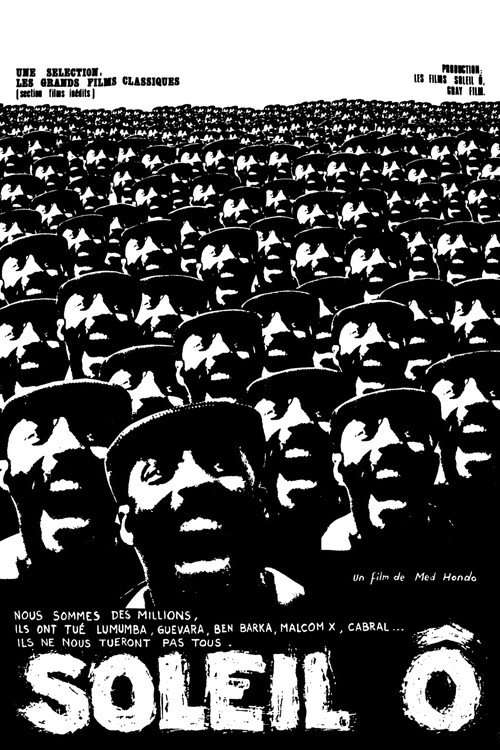
Soleil O
1973 · Med Hondo
When you want cinema that argues — a film with fire in it that will leave you thinking about who gets to belong and on what terms. A challenge in the best sense, and shorter and livelier than its reputation might suggest.
What it's about
A Mauritanian accountant arrives in Paris with flawless French and his qualifications in order, ready to work — and the city refuses him, not in one dramatic rejection but in an endless accumulation of polite smiles, closed doors, and small humiliations that function as walls. Med Hondo turns that experience into a furious formal collage: street scenes, dream sequences, animated caricature, songs, and direct address to the camera, all aimed at the gap between France's promises to its former colonies and what an African immigrant actually meets.
The experience
Electric and confrontational — angry, sardonically funny, and formally unpredictable, jumping styles the way its hero is jolted from hope to disillusionment. It doesn't let you settle into comfortable sympathy; it wants you provoked, and it succeeds.
The craft
Made in fragments over years on almost no money, and the poverty of means becomes a style: Hondo mixes documentary street shooting, staged tableaux, animation, and a biting voice-over into a film that behaves like a jazz composition — themes stated, broken, and reprised. Its inventiveness per frame puts lavish productions to shame.
Why it matters
Winner of the Golden Leopard at Locarno and a founding classic of African cinema, it announced Med Hondo as a major voice and became a rallying point for filmmakers taking on colonialism's afterlife; its restoration decades later introduced it to a new generation.
Snapshot
A Mauritanian accountant arrives in Paris with his qualifications in order and his French unimpeachable, and the city refuses him — not once, in a dramatic reversal, but continuously, in a grinding accumulation of small courtesies that function as walls. Med Hondo's first feature turns that refusal into a form. It is not a social-problem picture about racism; it is a film that dismantles the very grammar the social-problem picture would use, mixing allegorical tableau, animated caricature, sardonic voice-over, direct address, staged music, and documentary-inflected street shooting into an essayistic assault on French assimilationist ideology.
A note on the date: the film was shot in fragments across the late 1960s, completed around 1969, and premiered in 1970, where it took the Golden Leopard at Locarno. The 1973 date attached to many catalog records reflects its later commercial circulation rather than its making — a discrepancy that is itself a fact about the film's history, since Hondo's work moved through festivals, ciné-clubs, and militant screening circuits years before it reached anything like ordinary distribution.
Industry & production
Soleil Ô exists because Hondo paid for it himself, in installments. Born in Atar, Mauritania, in the mid-1930s, he trained in hotel work in Morocco and emigrated to France in 1959, taking the jobs the film depicts: kitchen work, dock work, agricultural labor. He studied acting with Françoise Rosay, and in 1966 co-founded the theater troupe Shango with the Guadeloupean actor Robert Liensol — an outgrowth of the earlier Griots company, the first significant Black theater collective in Paris — staging Césaire, Kateb Yacine, and other anticolonial writers for whom the French stage had no room. Hondo also became a prolific voice actor, and his dubbing income (he was, for decades, the French voice of several major Black American stars) was in effect the film's financing structure. Shooting proceeded whenever there was money, over roughly three years, with a cast drawn from the same Antillean and African theatrical milieu — Liensol in the lead, with performers including Théo Légitimus and Greg Germain commonly credited among the ensemble — and a crew working for little or nothing.
This was a deliberate refusal as much as a necessity. The dominant funding route for francophone African filmmakers in the 1960s ran through the French Ministry of Cooperation's Bureau du Cinéma, which supplied stock, equipment, and post-production in exchange for rights and, implicitly, a degree of tonal supervision. Hondo took none of it, producing through his own company, Grey Films. The corollary problem was distribution: West African exhibition was controlled by the French duopoly of COMACICO and SECMA until the nationalizations of the mid-1970s, so African films had no reliable path to African audiences. Hondo became the most vocal polemicist on this point — his essay "What is cinema for us?" argues that production without distribution is a form of self-deception — and he devoted much of his later career to pan-African film organization. Soleil Ô is the film that made him a figure in those debates, and it circulated accordingly: festivals, universities, immigrant-worker associations, militant collectives.
Technology
The film belongs squarely to the lightweight-equipment moment. Sixteen-millimetre black-and-white stock, portable cameras, and magnetic tape recording made a feature possible for a filmmaker with a day job — the same technological shift that underwrote cinéma vérité, the Newsreel collectives, and Latin American militant cinema. Hondo exploits the format's specific qualities rather than apologizing for them: the grain is heavy, the contrast is steep, the handheld work is frankly handheld. For festival exhibition the film was enlarged to 35mm, a blow-up that coarsens the image further and, on a large screen, gives the whites a blown, chalky quality that suits the material.
Sound was not recorded to the standard of a studio production, and much of the track is built in post — voice-over, music, effects, and dialogue assembled rather than captured. This is a limitation converted into method, discussed below.
The film's more recent technological history matters too. Prints deteriorated and Hondo's work fell into near-total unavailability for decades. A digital restoration completed in 2017 through Martin Scorsese's The Film Foundation and its World Cinema Project, with laboratory work in Bologna, returned Soleil Ô to circulation; it screened at Cannes Classics that year and was subsequently issued in the World Cinema Project's third box set. Practically all contemporary criticism of the film postdates that restoration — a fact worth holding in mind when reading its current reputation.
Technique
Cinematography
The photography, credited to François Catonné — later a mainstay of French commercial production — is stylistically bifurcated, and the split is the point. The allegorical sequences are composed, frontal, theatrically lit, staged against blank or abstracted backgrounds; the Paris material is loose, handheld, shot in real streets, cafés, employment offices, and worker hostels with available light and the incidental compositional accidents of documentary. The film keeps sliding between these registers without transition, so the viewer is never permitted to settle into either "this is a fable" or "this is life." High-contrast black-and-white does considerable ideological work: skin tones are rendered without the softening that a naturalistic gray scale would supply, and the graphic opposition of black and white figures within the frame is available as a compositional resource, deployed with obvious irony.
Editing
The cutting is the film's most radical element. Hondo works by collision rather than continuity: an animated title sequence gives way to a staged baptism, which gives way to a job interview, which gives way to a song, which gives way to a monologue delivered to camera. Episodes are serial rather than causal; the protagonist accumulates humiliations rather than progressing through a plot. Within scenes, jump cuts and repetitions break the illusion of continuous time, and refusals of employment are stacked in rhythmic series until the individual instance dissolves into a structure. The film's long, intermittent assembly — cut in pieces as material accrued over years — is legible in the result, and Hondo turned that condition into an aesthetic. Editing credits for the film circulate inconsistently across catalogs; what is clear is that the shaping intelligence was Hondo's, working close to the material over an extended period.
Mise-en-scène / staging
Hondo's theater background is everywhere. Several set pieces are frankly stage-derived: figures arranged in tableau, addressing the audience, performing a ritual whose meaning is announced rather than concealed. The opening movement is the clearest instance — African men baptized and renamed by white clergy, drilled in the catechism of colonial schooling with its notorious formula about "our ancestors the Gauls," then uniformed and set to killing one another in the service of France. It is played as pageant, not as drama, and it establishes the film's terms: what follows in modern Paris is the same operation continued by other means.
Against this, the Paris scenes stage racism as social choreography. The employer who is regretful; the dinner party where the protagonist is the evening's ornament and the conversation turns to Africa as a topic; the white woman for whom he is an experience rather than a person; the assimilated Black professional who declines fraternity. Hondo blocks these encounters so that politeness is visibly a mechanism — bodies angled away, thresholds not crossed, the smile maintained throughout.
Sound
The soundtrack is the film's most aggressive channel. The title comes from an old Antillean song of the Middle Passage, and choral music recurs as lament, commentary, and structural punctuation. Voice-over carries interior monologue in a tone that slides between reasonableness and fury, and the track is regularly desynchronized from the image — speech continuing over silent mouths, sound withheld where it is expected, ambient noise dropped out to leave a scene stranded. Percussion, screams, laughter, and fragments of pedagogy and officialese are layered without naturalistic hierarchy. The available credits assign the music to Georges Anderson, though below-the-line documentation on the film is uneven, and the score is in any case inseparable from Hondo's overall sound construction. The cumulative effect is closer to radio montage than to conventional film scoring: sound argues rather than accompanies.
Performance
Robert Liensol plays the protagonist — unnamed, which is exact — with a controlled, watchful stillness that anchors the film's tonal volatility. He rarely explodes; the explosions are given to the voice-over and the montage, while the body maintains the composure the situation demands, and the gap between the two is where the film's pain sits. The supporting ensemble, drawn from the Paris Black theater scene, plays in a broader, more presentational key, especially in the allegorical passages, where declamation is appropriate. White performers are frequently directed toward caricature — a choice that some critics have found crude and others have read as precise reversal of a century of cinematic practice.
Narrative & dramatic mode
There is a protagonist and there is a trajectory, but there is no plot in the conventional sense. The film is a picaresque of exclusion: an educated man moves through the institutions of the metropole — employment, housing, church, bedroom, salon, the street — and is refused by each in its own idiom. The dramatic mode is Brechtian: episodes are demonstrations, characters are positions as much as psychologies, songs and direct address interrupt identification, and the audience is invited to judge rather than to weep. Yet the film is not cold. Its final movement abandons argument for something like breakdown — the protagonist in flight through winter woods, a scream, and a montage of photographs of murdered anticolonial and Black revolutionary figures, Lumumba among them. Analysis gives way to elegy and to a threat.
Genre & cycle
Formally, Soleil Ô sits with the political essay film of the late 1960s. Thematically, it belongs to a small, crucial cycle: films about African migration to the former metropole, of which Ousmane Sembène's La Noire de… (1966) is the founding instance. Sembène's film concerns a Senegalese domestic worker destroyed by isolation on the Côte d'Azur; Hondo's concerns an educated man destroyed by a system that has use for his diploma only as evidence of its own generosity. The cycle continued in Paris with Sidney Sokhona's Nationalité: immigré (1975) and Safrana ou le droit à la parole (1978), films made from within the immigrant-hostel movement, and Hondo himself returned to the subject immediately in Les Bicots-nègres, vos voisins (1974). It is also, unmistakably, a satire — closer to the tradition of anticolonial pamphlet writing than to social realism.
Authorship & method
Hondo wrote, directed, and produced, and his authorship is of a kind that includes financing, casting from a company he had built, and fighting for exhibition afterward. The method was accumulative: shoot when funds permit, hold the whole in mind, cut toward an argument rather than a story. François Catonné's camerawork supplies the film's double visual register; the score credited to Georges Anderson supplies its choral spine; Robert Liensol supplies its center of gravity and, through the Shango troupe, much of its personnel. The absence of secure documentation for several technical credits is characteristic of independent African production of the period and is worth stating plainly rather than papering over.
Hondo's subsequent career clarifies the method. West Indies (1979) staged the entire history of Caribbean slavery and migration as a musical on a full-scale slave-ship set built inside a disused Paris factory. Sarraounia (1986), which won the top prize at FESPACO, reconstructed the Hausa queen's resistance to a French colonial column as historical epic. Across radically different scales, the constant is a refusal to accept inherited forms as neutral.
Movement / national cinema
The film is a foundational text of the first generation of African cinema — Sembène, Paulin Soumanou Vieyra, Oumarou Ganda, Souleymane Cissé, Djibril Diop Mambéty — and of the pan-African institutional project that ran alongside it: FESPACO, founded in Ouagadougou in 1969, and FEPACI, the pan-African filmmakers' federation founded the same year, whose debates over the political role of cinema culminated in the Algiers Charter of 1975. Hondo was among the most militant participants in those debates.
It is equally a text of Third Cinema, the tendency theorized by Fernando Solanas and Octavio Getino in 1969 against both Hollywood ("first cinema") and European auteurism ("second cinema"). And it is, awkwardly for French film history, a French film: made in France, in French, about France, by a filmmaker who lived there for sixty years. Its exclusion from most standard accounts of French cinema of the period is a fair index of the argument it makes.
Era / period
The film sits at the hinge between the independences of around 1960 and the disillusion that followed. In France it addresses a specific conjuncture: the recruitment of North and West African labor for postwar reconstruction, the shantytowns of the Paris periphery, the unprocessed aftermath of the Algerian War, and a republican universalism that promised assimilation while organizing exclusion. Made in the years around May 1968, it is notably unsentimental about the French left, whose theorists appear in the film as another group with prepared positions on the African question. Within a few years of its release, French immigration policy would tighten sharply and racist violence would become a visible public crisis — developments the film anticipates in structure if not in detail.
Reception, canon & influence
Contemporary reception was concentrated in festival and militant contexts rather than the commercial press: the Locarno Golden Leopard in 1970 gave it international standing, and it screened widely in ciné-clubs, universities, and activist circuits. It was recognized quickly by those attending to African and Third Cinema as a major work, and largely ignored by mainstream French criticism — a pattern Hondo commented on throughout his life. Substantial critical writing accumulated in African film scholarship from the 1980s onward, but the film's wider canonization is recent, driven by the 2017 restoration, the Criterion release, and the retrospectives that followed Hondo's death in 2019.
Backward, the film's sources are legible and acknowledged: Frantz Fanon above all — Black Skin, White Masks supplies the analysis of the colonized subject who has mastered the colonizer's language and finds that mastery is not the price of entry — along with Césaire's anticolonial polemic, from which Hondo takes both the moral vocabulary and a certain rhetorical ferocity, tempered by a materialist emphasis on labor that distances him from Négritude's cultural essentialism. Cinematically: Sembène's La Noire de… as direct precursor; Godard's Brechtian essay films of 1967–68 for the interruptive apparatus; the Latin American militant cinema of Solanas and Getino for the montage-as-argument; and, more combatively, Jean Rouch — Soleil Ô can be read as a rejoinder to the ethnographic gaze, appropriating the improvised first-person voice of Moi, un noir while relocating the camera's authority to the observed.
Forward, its legacy runs along several lines. Immediately, it authorized a body of French-based African and Antillean filmmaking, from Sokhona through to the later diasporic cinema of Alain Gomis, Mati Diop, and Alice Diop, whose essayistic documentary practice shares Hondo's conviction that form is where the politics lives. Its montage-based, archival, polemical essay mode has clear kinship with the Black British film workshops of the 1980s — Black Audio Film Collective and Sankofa — which developed in the same Third Cinema debates, though transmission there is best described as shared inheritance rather than documented influence. The same caution applies to the frequently drawn parallel with the LA Rebellion filmmakers: the affinities of method are real, the channels of contact less securely established.
The most durable influence may be institutional rather than stylistic. Hondo's insistence that African cinema's fundamental problem was ownership of distribution — argued from the position of a man who had financed a feature with his own voice and still could not get it shown where he wanted — set the terms for pan-African film policy debate for two decades. Soleil Ô is the film that earned him the standing to make that argument, and it remains the clearest statement of what he thought cinema was for: not representation of a condition, but the demolition of the forms that made the condition look natural.
A Deleuzian reading
A mouth is moving on screen and the sound has been taken away from it.
The full Deleuzian reading of Soleil O →
Reception
Barely screenable for decades outside militant-cinema circles, it went from scarce prints to rediscovered classic after the Film Foundation's World Cinema Project restored it in 2017 and Criterion put it in the Scorsese-curated World Cinema Project No. 3 box. Now it's routinely called one of the great debuts in African cinema.
How Soleil O was received, from release to now →
How to watch Soleil O: what to notice on a first viewing
- Watch the film jump between staged scenes and real Paris streets. Hondo cuts from frontal, theatrically lit allegorical tableaux straight into loose, handheld footage shot in real cafés and offices, with no transition preparing you for the switch. You are never allowed to settle into deciding whether this is a fable or a documentary.
- Listen for dialogue continuing over a mouth that has gone silent. Voice-over keeps running past the point where a speaking mouth stops moving on screen, and ambient sound sometimes drops out entirely to leave a scene stranded. The mismatch between what you hear and what you see is doing the film's argument, not just its mood.
- Watch bodies angle away from him while faces stay smiling. In scene after scene, Hondo blocks the French characters turned slightly away, or stopped at a threshold they never actually cross, while their courtesy never wavers. The politeness is doing the rejecting. It never has to say so out loud.
- Watch his body stay composed while the voice-over grows furious. Liensol keeps the protagonist's posture watchful and controlled scene after scene, letting the anger live entirely in the narration rather than in his face or hands. The gap between his calm body and his furious voice is where the film's pain actually sits.
The whole guide to watching Soleil O, with the keys for a rewatch →
Influences: the films it descends from and the films it influenced
- Les statues meurent aussi (1953) — Supplies the prosecutorial essay voice-over that cross-examines an image while it is still on screen rather than describing it — the rhetorical armature Hondo moves from museum objects to living migrant labor.
- Les maîtres fous (1955) — Hondo's white-caricature scenes invert Rouch's Hauka footage: instead of Africans filmed mimicking colonial officers, white actors perform racism as ritual social choreography, turning the ethnographic lens back on its own constituency.
- Afrique sur Seine (1955) — Establishes the device Soleil Ô weaponizes — the African newcomer's Paris itinerary carried by first-person post-synchronised commentary over silent observational footage — which Hondo keeps intact but loads with irony instead of courtesy.
- Moi, un noir (1958) — The improvised first-person track laid over mute footage of a migrant's daily rounds is the exact technical apparatus Hondo appropriates, relocating narrating authority from the ethnographer's informant to the film's own author.
- Oktyabr (October) (1928) — The 'Gods' sequence's intellectual montage — cutting emblems against each other until the concept they share collapses — is the operating logic of Soleil Ô's baptism-and-conscription passage, where cross, sword and uniform are intercut into a single proposition.
- La Noire de… (1966) — Direct precursor for the split between mute body and speaking track: the protagonist is silent in the employer's rooms and eloquent only on the post-synchronised soundtrack, so mastery of French becomes interior evidence rather than a means of exchange.
- La battaglia di Algeri (1966) — Grain as evidentiary claim — an image deliberately coarsened toward high-contrast newsreel so that staged reconstruction borrows documentary authority; Hondo's 16mm blow-up to 35mm exploits the same texture beneath openly theatrical blocking.
- Week End (1967) — The African and Arab garbage collectors delivering Third World political speeches straight to camera in a held tableau is the precise Brechtian mechanism — performer stepping out of fiction inside a fixed frame — that governs Soleil Ô's staged interludes.
- La hora de los hornos (1968) — Montage-as-argument organized into thesis blocks with title cards, quotation and rhythmic accumulation; Hondo's serial repetition of the job-interview refusal is built on this militant-cinema rhetoric of insistence rather than narrative progression.
- Nationalité: immigré (1975) — The closest documented heir: Sokhona restages his own foyer's rent strike with the residents playing themselves, extending Hondo's practice of making the immigrant worker's voice serve simultaneously as narration, testimony and formal structure.
- West Indies (1979) — Hondo drives his own theatrical-tableau method to its limit — four centuries of Caribbean slavery and migration performed as a musical on one full-scale slave-ship set — demonstrating that Soleil Ô's Brechtian frame was a chosen system, not a budget symptom.
- Handsworth Songs (1986) — Shared Third Cinema inheritance legible in method — archive footage cut against a choral, lament-based sound bed with an essay voice that refuses reportage — carrying Hondo's radio-montage grammar into British riot material.
- Bamako (2006) — Stages an entire juridical proceeding as a courtyard tableau, seizing the colonizer's institutional form and playing it as theater — the argumentative staging Hondo devised for the conversion and hiring scenes, scaled up to structural adjustment.
- Nous (2021) — Assembles the Paris periphery from discontinuous encounters strung along the RER B with no connecting narration, so that juxtaposition alone carries the claim about who the metropole counts — Hondo's conviction that the politics live in the cut.
- Dahomey (2024) — A post-synchronised voice speaks from inside an object across images it cannot see — the same body/voice split Hondo built for the migrant, transposed to a looted statue, in an incantatory choral register descended from Soleil Ô's Antillean lament.
- Sambizanga (1972) — Emerges from the same Paris-based Compagnie des Griots personnel pool as Hondo and Robert Liensol, and shares its casting method: trained Black stage actors directed toward frontal, withheld stillness instead of naturalist behavior.
- Touki Bouki (1973) — Arrives independently at the same desynchronised-sound grammar — slaughterhouse and ocean audio laid across images that do not contain them, emigration fantasy assembled by elliptical collision cuts — applied to departure where Hondo filmed arrival.
- Bush Mama (1979) — Constructs its track the way Soleil Ô does: welfare-office interrogations, radio bulletins and disembodied bureaucratic voices layered over unrelated images so that sound becomes the apparatus of coercion rather than the scene's ambience.
Similar films
- Black Girl (1966) — influence & lineage
- Touki Bouki (1973) — influence & lineage
- The Battle of Algiers (1966) — influence & lineage
- West Indies: The Fugitive Slaves of Liberty (1979) — shared sensibility
- Camp de Thiaroye (1988) — shared sensibility
- Souleymane's Story (2024) — shared sensibility
- La Haine (1995) — shared sensibility
- The 400 Blows (1959) — shared sensibility