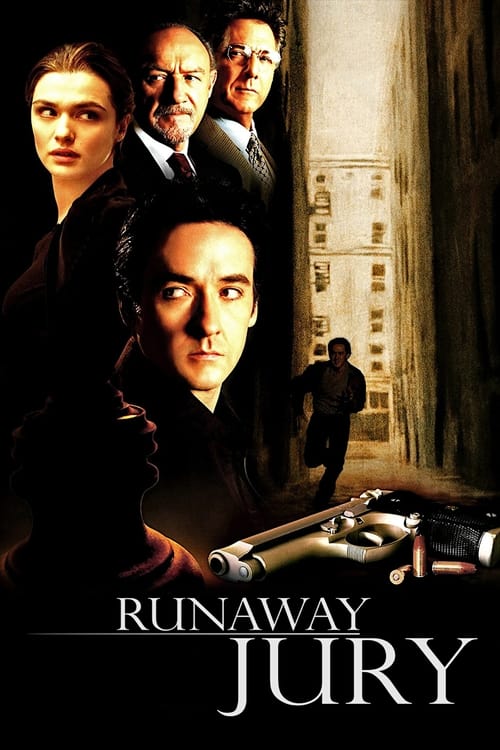
Runaway Jury
2003 · Gary Fleder
For a rainy-evening thriller when you want scheming, double-crosses, and heavyweight actors circling each other — comfort-food suspense with a conscience about big money and guns.
What it's about
After a workplace shooting in New Orleans, a widow sues the gun manufacturer, and the trial becomes a war fought over the twelve people in the jury box. On one side, a ruthless jury consultant who surveils, bribes, and blackmails his way toward a verdict; on the other, a juror and his girlfriend running their own mysterious con from inside the system, offering to sell the verdict to whichever side pays. Two star lawyers argue the case while the real game happens everywhere but the witness stand.
The experience
A slick, twisty cat-and-mouse thriller that moves fast and keeps you guessing about who's playing whom and why. It's tense in a fun, popcorn way — more chess match than gut-punch.
Performances
Gene Hackman is deliciously venal as the jury consultant, and his face-off with Dustin Hoffman — the only feature the two old friends ever made together — crackles. John Cusack and Rachel Weisz keep the con's motives teasingly opaque.
The craft
Fleder directs it like a heist picture wearing a courtroom drama's suit: surveillance vans, hidden cameras, and war-room screens turn jury selection into spycraft. The script tightens Grisham's doorstop novel into a clean two-hour machine, and steamy New Orleans gives it texture a generic courthouse wouldn't.
Why it matters
One of the last of the big star-driven Grisham adaptations that defined 1990s legal thrillers, remembered above all for finally putting Hackman and Hoffman in the same scene.
Snapshot
Runaway Jury is a glossy, star-laden legal thriller adapted from John Grisham's 1996 novel, built around a single audacious premise: that a modern jury trial is not a search for truth but an engineering problem, solvable by whoever controls the most information about the twelve people in the box. Gary Fleder directs a marquee cast — Gene Hackman, Dustin Hoffman, John Cusack, and Rachel Weisz — through a New Orleans courtroom drama in which a widow's wrongful-death suit against a gun manufacturer becomes the battlefield for two competing forms of manipulation: a ruthless jury consultant who buys and surveils his way to a verdict, and a juror-and-girlfriend team running their own con from inside the system. The film's most lasting claim on cultural memory is incidental to its plot: it marks the only feature in which Hackman and Hoffman — friends since their lean years as struggling actors in New York — appear together on screen. As a thriller it is efficient and handsomely mounted; as a piece of Grisham adaptation it is notable chiefly for the wholesale substitution of the gun industry for the novel's tobacco litigation, a change that reoriented the story's politics for a post-Columbine America.
Industry & production
The film was a major-studio commercial production of the early-2000s Grisham boom's late phase. By 2003 the Grisham legal-thriller cycle — The Firm, The Pelican Brief, The Client, A Time to Kill, The Rainmaker — was roughly a decade old and past its commercial peak, and Runaway Jury arrived as something of a coda to that run. It was produced through New Regency (Arnon Milchan's Regency Enterprises) with distribution by 20th Century Fox, and released in the United States in October 2003. The screenplay carries multiple credited writers — Brian Koppelman and David Levien (the Rounders team) along with Rick Cleveland and Matthew Chapman — a credit list that signals the long development and rewriting typical of star-driven studio adaptations of the period.
The central production decision, and the one most discussed, was the relocation of the litigation's target. Grisham's novel pits plaintiffs against a tobacco company in Biloxi, Mississippi; the film transplants the action to New Orleans and makes the defendant a firearms manufacturer. The change was widely read as an attempt to make the material more topical for an audience saturated with tobacco-settlement news and freshly attentive to gun litigation, though it also let the production sidestep terrain that The Insider (1999) had recently and definitively claimed for tobacco. New Orleans shooting put the real city — the French Quarter, the federal courthouse, the streetcars and humid light — directly into the frame, and the location work is one of the film's genuine assets. Precise budget and box-office figures should be treated with caution here; the film is generally understood to have been a moderately budgeted star vehicle that performed respectably without becoming a major hit, and I will not assign specific dollar figures I cannot verify.
Technology
Runaway Jury is, at the level of theme, a film about information technology and surveillance, and its production design leans hard into that. Rankin Fitch's operation is staged as a high-tech "war room" — banks of monitors, hidden cameras feeding live images of jurors' homes and the courtroom, real-time databases, and a team of analysts assembling psychological dossiers on each prospective juror. This depiction of the jury-consulting industry, with its profiling, behavioral prediction, and covert observation, is the film's most distinctive contribution to the legal-thriller vocabulary: it dramatizes the early-2000s anxiety that data and surveillance had made privacy, and by extension fair process, obsolete. Whether the film's portrait of jury science is accurate or sensationalized is a fair question — it plainly exaggerates the lawlessness for dramatic effect — but the imaginative content is firmly of its moment.
On the production side, the film was shot photochemically on 35mm, consistent with the practice of cinematographer Robert Elswit, who remained committed to film capture. There is no indication that Runaway Jury was a site of notable technical innovation in camera or post-production; its craft is in the polished application of mature studio technique rather than in any new tool.
Technique
Cinematography
The film's most significant below-the-line credit is its cinematographer, Robert Elswit — the longtime collaborator of Paul Thomas Anderson (Boogie Nights, Magnolia) who would win the Academy Award for There Will Be Blood four years later. Elswit gives Runaway Jury a controlled, classical sheen: warm New Orleans exteriors, the wet-street neon of the Quarter, and a courtroom rendered with clean, legible coverage. The visual scheme distinguishes the public theater of the trial from the private world of Fitch's surveillance bunker, the latter lit colder and tighter. It is professional, high-gloss studio photography rather than the more expressive work Elswit is best known for, but it is consistently well-judged.
Editing
The film is cut for the steady forward propulsion of the thriller, intercutting three arenas — the courtroom, Fitch's control room, and the streets where Marlee and the lawyers maneuver — so that the audience always holds more pieces of the puzzle than any single character. The editing's job is to manage a deliberately withheld central mystery (what Nicholas and Marlee actually want) while keeping the procedural machinery of voir dire and trial legible. Specific editorial authorship is a point where the public record is thinner than for the cast, and I'd rather flag that than overstate it.
Mise-en-scène / staging
Staging draws a sharp architectural contrast between two control rooms of justice: the open, performative space of the courtroom, where Rohr and the defense play to the jury, and the closed, screen-walled lair where Fitch privately conducts the real trial. The film repeatedly frames Fitch behind or among monitors, visually equating him with the surveillance apparatus he commands. New Orleans itself is staged as a character — its courthouse, bars, and streets giving the cat-and-mouse plot a tangible geography.
Sound
Christopher Young's score supplies the thriller's tension and momentum, leaning on the propulsive, suspense-oriented orchestration typical of the genre and of Young's broader career. The sound design otherwise serves clarity and pace — courtroom acoustics, the low hum of the surveillance room — without calling attention to itself.
Performance
Performance is where the film most clearly earns its reputation. Gene Hackman's Rankin Fitch is the engine: a study in cold, theatrical contempt, a man who treats democracy as a product to be assembled. Dustin Hoffman's Wendell Rohr is his moral counterweight, the believer in the system, and the film's much-noted single scene between the two — a charged confrontation in a courthouse men's room — is its marquee moment precisely because of the actors' offscreen history as old friends who had never shared the screen. John Cusack brings his characteristic ironic charm to Nicholas Easter, keeping the character's true agenda ambiguous, and Rachel Weisz plays Marlee with a cool resolve that anchors the film's late revelations. The supporting bench is deep with character actors filling out the jury and the legal teams.
Narrative & dramatic mode
The film operates in the mode of the puzzle-thriller wearing the clothes of a courtroom drama. Its narrative engine is dramatic irony layered over a withheld secret: the audience watches two manipulators (Fitch outside the box, Nicholas inside it) work the same jury toward opposite ends, while a third question — what Nicholas and Marlee are really after — is concealed until the late turn. This structure means the courtroom proceedings, normally the spine of a Grisham adaptation, function here largely as surface; the genuine action is the metagame of jury control happening around and beneath the trial. The result is a film more interested in con-artistry and reversal than in legal argument, with a third-act revelation that recasts the protagonists' motives in moral terms.
Genre & cycle
Runaway Jury sits at the intersection of two cycles: the Grisham legal-thriller adaptation that dominated mainstream American studio output from roughly 1993 onward, and the broader courtroom-drama tradition stretching back through The Verdict, …And Justice for All, and 12 Angry Men (the last an obvious ancestor for any jury-room story). Within the Grisham cycle it is a late entry, arriving as audience appetite for the formula had cooled, and it differentiates itself by foregrounding jury tampering and surveillance rather than the lone-idealist-lawyer-against-the-machine template of the earlier films. It also belongs to the early-2000s wave of paranoia thrillers preoccupied with data, profiling, and the erosion of privacy.
Authorship & method
Runaway Jury is best understood as a producer-and-star-driven studio production rather than an auteur work. Gary Fleder, its director, was by 2003 an established craftsman of polished commercial thrillers — Things to Do in Denver When You're Dead (1995), Kiss the Girls (1997), and Don't Say a Word (2001) — known for capable, actor-forward genre filmmaking rather than a strong personal signature. His method here is one of orchestration: marshaling a large ensemble of major stars and reliable character actors and keeping a multi-stranded plot clear and propulsive. The most authorial fingerprints arguably belong to the cinematographer, Robert Elswit, whose disciplined photography elevates the film's look, and to composer Christopher Young, a genre specialist who supplies its tension. The screenplay's multiple-writer credit (Koppelman, Levien, Cleveland, Chapman) reflects a collaborative, much-revised adaptation process and makes single-author claims about the script unsafe. The decisive creative act — swapping tobacco for guns — is best attributed to the production as a whole rather than any one named author.
Movement / national cinema
The film is squarely within mainstream Hollywood studio filmmaking and is not affiliated with any movement or art-cinema tendency. Its national-cinema interest, such as it is, lies in its strong rooting in New Orleans, which gives a familiar studio genre a specific American regional texture in the years before Hurricane Katrina would so dramatically alter the city's screen image.
Era / period
Runaway Jury is very much a product of the early-2000s American mainstream: a mid-budget, star-packed adult drama of a kind the studios still made regularly before such films were squeezed out by franchise economics over the following decade. Its preoccupations — surveillance, data profiling, the manipulability of public institutions — register the post-millennial, increasingly post-9/11 anxiety about who watches whom and how information confers power. The gun-litigation subject matter situates it precisely in the national argument of its moment.
Themes
The film's governing theme is the commodification of justice: the idea that a verdict can be bought, engineered, and stage-managed by those with money and information, and that the jury — the supposed conscience of the community — is the system's most exploitable component. Around this cluster several related concerns: surveillance and the death of privacy; the asymmetry of power between corporate defendants and individual plaintiffs; and the ethics of fighting corruption with corruption, since the protagonists ultimately beat Fitch at his own game by manipulating the jury themselves. The gun-industry framing layers a topical argument about corporate accountability over this structure, though the film is more comfortable as a thriller about manipulation than as a polemic, and its politics remain subordinate to its plotting.
Reception, canon & influence
Critical reception was broadly mixed-to-positive: reviewers tended to praise the cast — Hackman especially — and the efficient craftsmanship while noting that the film softened and simplified Grisham's source and that its courtroom plausibility was thin. The recurring point of interest in coverage, then and since, was the historic Hackman–Hoffman pairing and their single shared scene, which has become the film's most durable talking point. I'd characterize its standing as that of a well-made, watchable studio thriller rather than a canonical or landmark work.
Looking backward, the film's influences are clear: the Grisham adaptation cycle it caps, the jury-room tradition descending from 12 Angry Men, and the conspiracy/surveillance thriller's iconography of the control room. Looking forward, its direct cinematic legacy is modest — it did not found a cycle or a style. Its more interesting afterlife is thematic: its dramatization of jury consulting, behavioral profiling, and data-driven manipulation of legal outcomes anticipated a popular-culture preoccupation with surveillance and analytics that would only intensify, and the film is often cited in discussions of how movies have portrayed the jury-consulting industry. Where the documentary record on its production economics and below-the-line authorship is thinner than for its cast, I've flagged that rather than fill the gaps with invention.
A Deleuzian reading
Start with Rankin Fitch in front of his wall of screens.
The full Deleuzian reading of Runaway Jury →
Reception
A modest performer with decent reviews in 2003, it arrived just as the Grisham courtroom-thriller wave was ending — and it's since become a poster child for the 'mid-budget adult thriller Hollywood stopped making' conversation, warmly rewatched as comfort viewing.
How Runaway Jury was received, from release to now →
Influences: the films it descends from and the films it influenced
- 12 Angry Men (1957) — Establishes the deliberation-room-as-pressure-cooker template Runaway Jury inherits — a single juror reverse-engineering consensus through staged persuasion rather than evidence, the exact mechanic Cusack's planted juror weaponizes.
- Witness for the Prosecution (1957) — Pioneers the courtroom-as-puzzle-box that withholds its true configuration until a final reversal, the dramatic-irony architecture Runaway Jury borrows by letting us watch the manipulation the bench cannot see.
- The Conversation (1974) — Gives Hackman the surveillance-technician persona — the obsessive monitoring of unwitting subjects from a wired control room — that he essentially reprises as Rankin Fitch running profiles on jurors.
- The Parallax View (1974) — Codifies the behavioral-profiling-as-conspiracy device — a faceless firm screening and selecting people via psychological data — which Runaway Jury repurposes into Fitch's jury-consulting dossiers.
- All the President's Men (1976) — Sets the procedural grammar of cross-cutting between investigators assembling fragments, the multi-strand information-gathering rhythm Fleder uses to track parallel teams working the same jury.
- The Verdict (1982) — Models the lone-underdog-attorney-versus-institutional-machine courtroom drama, supplying the moral framework Runaway Jury inverts by making its 'heroes' beat corruption with corruption.
- JFK (1991) — Demonstrates multi-strand intercutting that braids surveillance, conspiracy mechanics, and courtroom rhetoric into one propulsive structure — the editing strategy Fleder adopts at studio-polish scale.
- The Firm (1993) — Launches the star-driven Grisham-adaptation template — glossy paranoia, an everyman trapped between two powerful institutions — that Runaway Jury caps a decade later.
- The Pelican Brief (1993) — Establishes the Grisham conspiracy-thriller mode where legal proceedings are shadowed by off-the-books surveillance and corporate hit-teams, the iconography Runaway Jury restages in its control room.
- Syriana (2005) — Extends Elswit's cool, institutional cinematography across a multi-strand systems-thriller about corporate manipulation of outcomes, scaling up the commodification-of-justice anxiety Runaway Jury voices.
- Michael Clayton (2007) — Shot by Elswit, it perfects the corporate-legal-thriller's fighting-corruption-with-corruption arc and surveillance dread, refining into auteur prestige the studio template Runaway Jury executed.
- The Lincoln Lawyer (2011) — Carries the slick, star-fronted legal-thriller-as-con-game forward, structuring its courtroom around a hidden manipulation the audience tracks ahead of the bench — Runaway Jury's dramatic-irony engine.
- A Time to Kill (1996) — A peer Grisham courtroom adaptation built on jury-emotion manipulation and Southern-courthouse staging, sharing the cycle's reliance on the closing-argument set piece.
- Enemy of the State (1998) — Has Hackman reprise his Harry Caul surveillance-expert role in a control room of monitors and data-tracking, the same post-Conversation iconography Runaway Jury maps onto jury consulting.
- The Insider (1999) — Dramatizes the exact tobacco-industry malfeasance Runaway Jury's source novel targeted before its gun-swap, pairing corporate surveillance of a whistleblower with the litigation-as-warfare framing.
- Magnolia (1999) — Robert Elswit's disciplined, controlled-contrast photography organizing dense multi-strand intercutting — the same cinematographer's hand that 'elevates the look' of Runaway Jury per the dossier.
Similar films
- 12 Angry Men (1957) — influence & lineage
- The Verdict (1982) — influence & lineage
- The Insider (1999) — influence & lineage
- Michael Clayton (2007) — influence & lineage
- A Few Good Men (1992) — shared sensibility
- Pulp Fiction (1994) — shared sensibility
- American Hustle (2013) — shared sensibility
- The Asphalt Jungle (1950) — shared sensibility