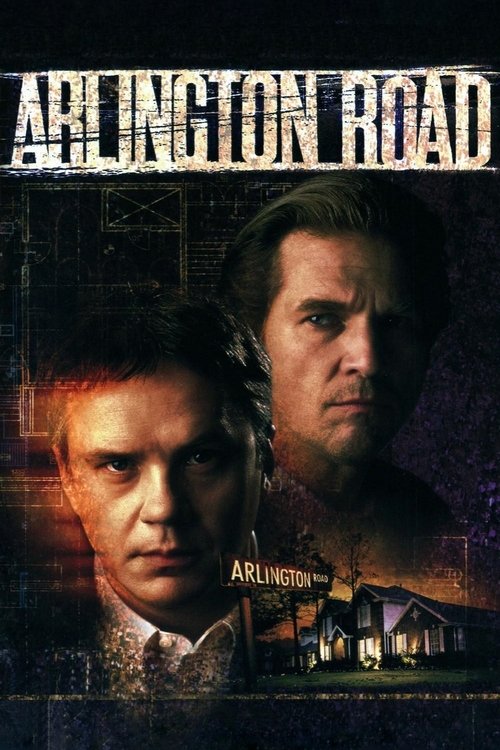
Arlington Road
1999 · Mark Pellington
For when you want a grown-up suspense film that trusts you to sweat the details — a tense, talky nail-biter rather than comfort viewing. Expect to finish it rattled, not reassured.
What it's about
A widowed history professor in suburban Washington, D.C. teaches a course on American terrorism while still raw from his wife's death in a botched FBI raid. When a friendly all-American couple moves in next door, small inconsistencies in their story start to nag at him, and he can't tell whether he's uncovering something real or letting grief curdle into paranoia. The quiet cul-de-sac becomes the stage for a cat-and-mouse game where being right might be worse than being wrong.
The experience
A slow-tightening screw of a thriller — it trades jump scares for dread that builds through glances, half-answers, and the awful politeness of neighbors. By the last act it's genuinely suffocating, and it ends on a note that stays with you.
Performances
Jeff Bridges plays fraying desperation without ever losing our sympathy, while Tim Robbins weaponizes his own affability — his smiling, reasonable menace is the engine of the film. Joan Cusack is quietly chilling as the wife whose warmth never reaches her eyes.
The craft
Mark Pellington shoots suburbia like enemy territory — manicured lawns, backyard barbecues, and a camera that keeps finding the sinister angle on ordinary things. The script is built as a trap, planting doubts early and springing them late, and the sound design keeps an anxious hum under even the friendly scenes.
Why it matters
It transplanted the 1970s conspiracy thriller into the suburbs of the militia era, catching the post–Oklahoma City anxiety about homegrown terror — and its famously bleak ending made it a cult touchstone among thriller fans.
Snapshot
Arlington Road is a late-1990s paranoid thriller that moves the conspiracy film of the 1970s into the suburban cul-de-sac. Jeff Bridges plays Michael Faraday, a widowed history professor in the Washington, D.C. area. He teaches a course on American terrorism, and his wife, an FBI agent, was killed in a botched raid on a far-right family compound. Faraday comes to suspect that his genial new neighbours, Oliver and Cheryl Lang (Tim Robbins and Joan Cusack), are not who they claim to be. The film is built on two national traumas of the decade: the 1992 standoff at Ruby Ridge, which the backstory echoes closely, and the 1995 Oklahoma City bombing, whose official "lone bomber" account Faraday questions in his lectures. The film is best remembered for its ending, which is unusually bleak for a studio-distributed American thriller. The protagonist's paranoia turns out to be correct, and his investigation is itself the mechanism the conspirators use to win. Critics were divided on release. Since then the film has kept a durable reputation as a cult artefact of pre-9/11 American anxiety about homegrown political violence.
Industry & production
The screenplay was by Ehren Kruger, then an emerging writer. It won the Academy of Motion Picture Arts and Sciences' Nicholl Fellowship in Screenwriting before it was produced, and it became his first produced feature. The film was developed and produced by Lakeshore Entertainment, Tom Rosenberg's independent production company, which in the late 1990s financed mid-budget, star-driven genre pictures. Lakeshore's producing team included Tom Gorai, with Peter Samuelson and Marc Samuelson among the credited producers.
Distribution was complicated by corporate upheaval. The film was originally tied to PolyGram Filmed Entertainment, which was sold and absorbed into Universal in 1998–99. Arlington Road was one of several pictures delayed in that transition. It was eventually released in the United States in July 1999 by Screen Gems, Sony Pictures' then recently relaunched genre label. Trade reporting at the time describes the release date shifting more than once. Accounts also say there was studio discussion about the downbeat ending, and that Pellington and the producers held on to it. Those discussions are reported anecdotally rather than documented in detail. The film was a modest commercial performer, neither a hit nor a disaster. This dossier does not give specific grosses because reported figures vary between sources.
The film is set in suburban northern Virginia, near Washington. According to production accounts, much of the location work was done in Texas, in the Houston area, which stood in for the D.C. suburbs. The reliable record on the shoot itself is thin.
Technology
Technically, Arlington Road is a conventional 35mm studio-scale production with no notable innovations in format or equipment. What stands out is post-production. Pellington and his collaborators brought in techniques from the music video and commercial work of the early-to-mid 1990s: flash frames, step-printed and speed-ramped footage, chemically or photochemically degraded inserts, and dense collage montage. These appear mainly in the title sequence and in Faraday's flashbacks and research sequences. The film was made just before digital intermediate grading became standard practice in Hollywood. Its desaturated, bruised look was therefore produced through photochemical and optical means and in-camera choices, not through digital colour correction.
Technique
Cinematography
Bobby Bukowski shot the film. He was a cinematographer with a background in American independent features. The images alternate between two registers. The suburban daylight scenes are framed with a calm, almost catalogue-like evenness: lawns, porches, barbecues, a children's football game. The Faraday interiors and the flashback material are much more agitated, using handheld camera, harsh contrast and drained colour. The camera often holds the Lang house in the background of Faraday's frame or frames it across the street. The neighbour's home becomes a constant, watching presence, in the manner of Hitchcock's Rear Window (1954). The famous opening shows a badly injured boy staggering down the middle of a suburban street, filmed in a dreamlike, stretched manner. It establishes the film's method of making the ordinary neighbourhood strange from its first images.
Editing
Conrad Buff IV edited the film. He was a veteran of large-scale studio pictures. The cutting serves two masters. The main narrative is assembled in a classical suspense grammar of cross-cutting, withheld information and escalating reveals. Inside that structure, Pellington's music-video sensibility shows in the montage passages. These are Faraday's memories of his wife's death, his archival research into the Langs' pasts, and his lectures on domestic terrorism, and they are cut as rapid, fragmented collages of text, photographs and images. The climax cross-cuts Faraday's frantic pursuit through Washington with the conspirators' plan unfolding. It is edited to make the audience share his conviction that he can still prevent the outcome, and that expectation is what the ending then overturns.
Mise-en-scène / staging
The production design by Thérèse DePrez turns on the closeness and visual uniformity of the two houses. The Lang home is warm and orderly, an image of middle-class propriety. Faraday's home is cluttered and grief-stricken. The film's central irony is staged in this contrast: the household that looks unstable is the honest one. Blueprints, a recurring visual motif, matter to the plot. Faraday's discovery of building plans in the Lang house, and Oliver's claimed profession as an architect, connect domestic space to the architecture of targets. Faraday's classroom works as a public stage where he delivers his thesis directly. Pellington uses those lectures to give the audience the film's political argument in the open.
Sound
The score is credited to Angelo Badalamenti, best known for his collaborations with David Lynch. It also includes contributions from tomandandy, the composing duo whose electronic and industrial textures were then common in commercial and music-video work. The music combines Badalamenti's slow, brooding orchestral harmonies with abrasive electronic drones and distorted percussion. That mix suits a film that sets suburban calm against an unseen violence. The sound design follows the same logic. Ordinary domestic ambience is cut against bursts of noise and processed sound in the flashback and montage sequences. Badalamenti's presence also invites comparison with Lynch's Blue Velvet (1986), the key American text about menace under suburban surfaces, though the two films differ greatly in tone.
Performance
Jeff Bridges plays Faraday as a man whose grief has hardened into obsession. He is intelligent and sympathetic, and also abrasive, volatile and easy for others to dismiss as unstable, which is exactly the vulnerability the conspiracy exploits. Tim Robbins's Oliver Lang is the film's most discussed performance. Robbins plays him with a smiling, slightly too-attentive neighbourliness, and lets menace show through only in small shifts of tone. Lang's eventual open confrontation with Faraday is all the more chilling for its calm reasonableness. Joan Cusack's Cheryl Lang gives an unexpectedly sinister turn to the bright, cheerful persona Cusack was known for in comedy. Hope Davis plays Brooke, Faraday's new partner, and Robert Gossett plays Whit Carver, an FBI agent and former colleague of Faraday's late wife. The child actors, Spencer Treat Clark as the Langs' son Brady and Mason Gamble as Faraday's son Grant, carry weight in a plot that turns on the vulnerability of children.
Narrative & dramatic mode
The film's structure follows the classic paranoid-investigator pattern: a private citizen notices an anomaly, investigates, meets disbelief from institutions and loved ones, and gathers evidence. Its distinctive move is to turn the genre's assumptions back on the hero and the audience. Faraday is right about the Langs, but being right does not save him. His suspicion, his grief and his reputation for obsession all become tools in the plot against him. The death of Brooke, staged as a traffic accident after she sees something she should not, removes his only corroborating witness. The finale converts his attempt to stop a bombing into the bombing itself. Faraday is maneuvered into delivering explosives into FBI headquarters and dies in the blast, and the public record then names him as the lone, deranged perpetrator. The closing passages show news coverage building that false history, while the Langs prepare to move on to a new neighbourhood.
The film argues against the "lone gunman" explanation, and its own plot dramatizes how such explanations get made. That reflexive design is its most ambitious feature. It is also where critics located its biggest weakness: the conspirators' plan requires a chain of predictions and coincidences that some reviewers found impossible to believe.
Genre & cycle
Arlington Road belongs to several overlapping traditions:
- The 1970s paranoid thriller. This cycle includes The Parallax View (1974), The Conversation (1974) and Three Days of the Condor (1975). It supplies the film's model of a lone investigator confronting a conspiracy, and especially its readiness to let the conspiracy win. The Parallax View, whose protagonist is likewise set up as the fall guy for an assassination, is the closest structural ancestor.
- The 1990s "intruder" or domestic-threat thriller. This cycle includes Pacific Heights (1990), The Hand That Rocks the Cradle (1992) and Single White Female (1992), films in which a menacing outsider enters the home or its edges.
- The suburban-satire / suburban-gothic tradition. This runs from The Stepford Wives (1975) and Blue Velvet through the comic version in Joe Dante's The 'Burbs (1989), and, in 1999, American Beauty.
- The late-1990s conspiracy revival. This includes Conspiracy Theory (1997), Enemy of the State (1998) and the television series The X-Files, which reflected a millennial-era public appetite for stories of hidden power.
The film stands apart within that last group. Its conspiracy is not run by the state. It is a domestic, anti-government network, so the film reverses the usual direction of 1970s paranoia while keeping its pessimism.
Authorship & method
Mark Pellington came to features from music videos, MTV on-air promos and documentary work. His best-known video is Pearl Jam's "Jeremy" (1992), itself a collage-heavy piece about violence and a disturbed young man. His first feature was the coming-of-age drama Going All the Way (1997). Arlington Road, his second, brought his montage-driven, texture-heavy visual style into genre filmmaking. His next feature, The Mothman Prophecies (2002), continued his interest in grief-stricken protagonists who perceive patterns that others reject. Across these films Pellington is drawn to mourning as an altered state of perception, a theme critics have linked to events in his own life that he has discussed publicly in interviews.
Ehren Kruger wrote the screenplay. His Nicholl-winning script launched a prolific genre career: Reindeer Games (2000), Scream 3 (2000), the American remake The Ring (2002) and The Skeleton Key (2005), followed by large franchise work. Arlington Road shows interests that recur across his writing, including elaborate twist structures and protagonists who investigate their way into traps.
Bobby Bukowski (cinematography), Conrad Buff IV (editing), Angelo Badalamenti with tomandandy (music), and Thérèse DePrez (production design) complete the core creative team. The film's identity rests on the meeting of Kruger's tightly engineered plot with Pellington's more impressionistic, fragmentary visual instincts.
Movement / national cinema
The film is a product of 1990s American studio-adjacent independent production. It was financed by an independent company (Lakeshore) and released by a major's genre label (Screen Gems/Sony). It does not belong to a self-conscious movement. It does sit within the 1990s influx of music-video and commercial directors into Hollywood features, a trend associated with figures such as David Fincher, Michael Bay and Tarsem Singh, and Pellington's visual vocabulary is part of that wave. In national terms it is an emphatically American text. Its subject is the American suburb, the federal government and the native-born political extremism that the country's public culture of the mid-1990s was being forced to confront.
Era / period
The film's context is very specific. The Ruby Ridge standoff in Idaho (1992) and the Waco siege in Texas (1993) became rallying points for the anti-government militia movement. The Oklahoma City bombing of April 1995 killed 168 people and was carried out by American-born perpetrators with ties to that milieu. The prosecutions that followed, and public debate over whether the bombers had acted alone, fed directly into the film's argument. In the film, the raid that killed Faraday's wife is a thinly fictionalized Ruby Ridge, including the death of a child. The bombing that frames the backstory is a fictionalized Oklahoma City-style attack, attributed in the official record to a lone individual, which Faraday doubts.
Released in summer 1999, the film arrived at the end of a decade in which domestic, right-wing terrorism had been the dominant American image of political violence. After 11 September 2001, foreign terrorism took that place in the public imagination. The film thus captures a particular, short-lived configuration of American fear. Later viewers have often noted that its final image, a building in Washington destroyed and a news narrative quickly produced, became more charged after 2001.
Themes
- The neighbour as stranger. The film's founding premise is that the most ordinary social relationship, the family next door, can hide radical alterity. It updates the Cold War anxieties of the suburban "infiltrator" film for a time when the threat was homegrown.
- The manufacture of official history. Faraday's lectures argue that lone-bomber explanations comfort the public by individualizing political violence. The film's ending stages exactly such a manufactured account, with the true perpetrators erased.
- Grief and credibility. Faraday's mourning makes him perceptive and also easy to discredit. The film examines how emotional states are used to dismiss testimony.
- Children as hostages and instruments. The plot repeatedly turns on children: the injured Brady in the opening, the child killed in the backstory raid, and Grant, whose abduction becomes the conspirators' leverage. These figures stand for both innocence and the passing on of ideology.
- The failure of institutions. The FBI appears both as the agency responsible for the original tragedy and as the target of the climactic attack. It is unable either to protect Faraday or to see what he sees.
- The pessimism of the genre. The film refuses the restoring ending typical of 1990s studio thrillers. Its conclusion holds that individual knowledge does not ensure justice, which aligns it more closely with the defeatism of 1970s cinema than with its own decade.
Reception, canon & influence
Critical reception. Reviews in 1999 were divided. Many critics praised the performances, especially Robbins and Bridges, and the film's seriousness about a topical subject. They also singled out the ending as a rare instance of a mainstream thriller following its premise to its darkest conclusion. Other reviewers, Roger Ebert among the more prominent dissenters, objected that the conspiracy depends on implausible foresight and coincidence, and that the film's political argument is undercut by its machinery. Some commentators also found the film's handling of real atrocities exploitative or too close to recent events. Box office was moderate, and the film did not register in awards competition.
Influences on the film (backward). Its clearest ancestors are Alan J. Pakula's The Parallax View, with its frame-up of an investigative protagonist and institutional cover-up, and the wider 1970s paranoid cycle. Hitchcock's Rear Window supplies the voyeuristic neighbour situation, and Shadow of a Doubt (1943) the evil hidden inside small-town decency. Blue Velvet is a reference point for menace under the suburban surface, reinforced by Badalamenti's involvement. The Stepford Wives shares its suspicion of suburban uniformity. The 1990s domestic-intruder thriller provides much of its genre frame.
Legacy (forward). Arlington Road has kept a steady cult following. It is regularly cited in critical lists and retrospective essays about paranoid thrillers and endings that refuse audience comfort, and it is frequently revisited in discussions of how American cinema has depicted domestic extremism. Its reputation has risen in two later moments: after 2001, when its imagery seemed newly prophetic, and in the 2010s–2020s, as renewed public attention to American far-right and militia violence made its subject feel current again. The film's model of a twist-driven plot that turns the protagonist into an unwitting instrument shows up again in Kruger's own later writing. More broadly, it has been named as a forerunner of later suburban-paranoia and "suspicious neighbour" thrillers, such as Disturbia (2007). Claims of direct influence on specific later films are, however, mostly critics' observations rather than documented intent. Within Pellington's filmography it remains his most widely discussed work. For the history of the American political thriller it stands as a key bridge between 1970s conspiracy pessimism and twenty-first-century terrorism narratives.
Influences: the films it descends from and the films it influenced
- The Parallax View (1974) — Its endgame, in which a lone investigator is manoeuvred into the exact spot where the conspiracy needs a patsy and is then recorded as the lone gunman, is the plot machine Arlington Road reuses almost beat for beat when Faraday drives the bomb into the FBI building.
- Shadow of a Doubt (1943) — Hitchcock keeps the menace inside a friendly, family-centred figure in a picture-perfect small town, and the evil comes out through social pleasantries. Arlington Road builds Oliver Lang's neighbourliness the same way.
- Rear Window (1954) — The film sets up the protagonist's point of view looking across at a neighbour's home, so watching becomes a form of investigation. Pellington's framings of the Lang house from Faraday's window and lawn grow directly out of this.
- The Manchurian Candidate (1962) — Its protagonist is steered by a conspiracy into carrying out an attack without knowing it. Kruger's script relies on this unwitting-instrument structure.
- The Conversation (1974) — Coppola films a lone obsessive whose surveillance and reading of evidence cut him off from everyone else. His certainty looks like madness to those around him, which is the same isolation of an investigator Faraday faces.
- Three Days of the Condor (1975) — In the 1970s cycle, an ordinary researcher finds the plot and then finds that the institutions he would warn are compromised or deaf. Arlington Road moves this logic into the domestic setting of an FBI-mistrusting suburb.
- The Stepford Wives (1975) — The film reads the bright, uniform surfaces of the suburban cul-de-sac as signs of a coordinated hidden project, and its ending is defeat rather than escape. Both choices anticipate Arlington Road's suburban gothic.
- Blow Out (1981) — De Palma follows the investigating hero to a final failure in which the proof he gathers becomes worthless and the public version of events wins. This set the model for refusing the expected heroic payoff.
- Blue Velvet (1986) — Angelo Badalamenti's score for Lynch, lush and lulling but threatening underneath, sets the sound of menace under suburban calm. Badalamenti brought that register to his collaboration with tomandandy on Arlington Road.
- The Hand That Rocks the Cradle (1992) — This is the template for the 1990s domestic-intruder thriller. A charming outsider gains trust by way of the children and turns the family home into the field of attack, the genre frame Arlington Road reworks politically.
- Don't Look Now (1973) — Roeg uses fragmented associative montage to show grief as a changed, pattern-seeking way of seeing. This is the editing logic behind Faraday's flashbacks to his dead wife and his growing suspicion.
- The Mothman Prophecies (2002) — Pellington's next feature, again scored by tomandandy, takes his grieving protagonist who sees patterns others dismiss and puts it in a supernatural setting. It pushes the abstract collage montage and optical-texture inserts further.
- The Ring (2002) — Ehren Kruger wrote the screenplay, and he again builds a parent-investigator who digs their way into a trap with a final turn. The cursed-tape montage takes up Pellington-style abstract collage as a story device.
- Disturbia (2007) — Critics name it as an heir: it updates the window-on-the-neighbour's-house setup to the post-9/11 suspicious-neighbour thriller, where the protagonist is disbelieved because his watching looks like obsession.
- Lakeview Terrace (2008) — It extends the neighbour-as-threat thriller by staging a feud across facing houses and lawns. The adjoining properties become a front line of suspicion, as the mirrored Faraday and Lang houses do.
- Se7en (1995) — Fincher was another music-video director who brought textural, high-contrast style into studio genre film. His ending, in which the villain has planned the hero's reaction and made him the last piece of the scheme, is the closest 1990s precedent for Arlington Road's twist.
- Enemy of the State (1998) — Released the year before, it is a pre-9/11 paranoid thriller made with the techniques of commercials and music videos: fast surveillance-texture montage and an ordinary man framed and isolated by forces he can't see.
- Fight Club (1999) — It is the same year's other music-video-director film about homegrown anti-system bombers. It also uses a twist that turns the narrator into the instrument of the attack, with collage-like subliminal inserts in the cutting.
Similar films
- Three Days of the Condor (1975) — influence & lineage · same viewing thread
- Rear Window (1954) — influence & lineage
- Shadow of a Doubt (1943) — influence & lineage
- The Stepford Wives (1975) — influence & lineage
- Blue Velvet (1986) — influence & lineage
- The Conversation (1974) — influence & lineage · same viewing thread
- Enemy of the State (1998) — influence & lineage · same viewing thread
- Blow Out (1981) — influence & lineage · same viewing thread
All the films related to Arlington Road →
Watch it with: curated runs of related films
- Inside the Security State — A run of modern espionage and national-security thrillers — globe-trotting spycraft, submarine brinkmanship, and the paper trail behind the black sites — where operatives and investigators race secretive institutions and catastrophic clocks.
- The Paranoid and the Obsessed — A run of stylish thrillers about lone men consumed by a hidden pattern, a betrayal, or a truth they can't stop chasing — each staged with more virtuosity than the plot strictly needs.