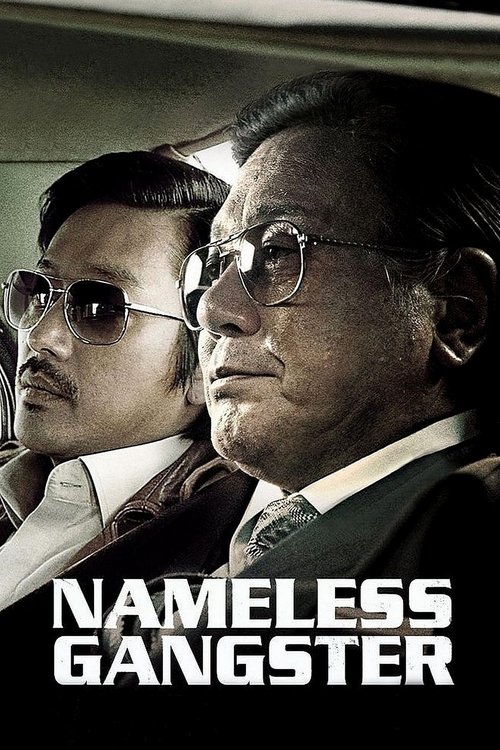
Nameless Gangster
2012 · Yoon Jong-bin
For when you're in the mood for a meaty crime saga — something with scale, scheming, and a great scoundrel at the center. Engrossing rather than punishing, if you don't mind violence and moral rot.
What it's about
Busan, the 1980s: a corrupt, soon-to-be-fired customs official stumbles into a seized drug shipment and parlays it — along with an encyclopedic knack for exploiting family ties, school connections, and hometown loyalties — into a partnership with a genuinely dangerous young gang boss. Together they climb to the top of the city's underworld, until the government declares war on crime and every alliance starts to look negotiable. It's a gangster saga where the sharpest weapon is knowing whom to call uncle.
The experience
Darkly funny, brutal in bursts, and endlessly cynical in a way that's weirdly delicious — you watch a shameless operator talk his way up and around every hierarchy. It plays like a rise-and-fall epic told with a smirk.
Performances
Choi Min-sik is magnificent as the weaselly fixer — pathetic, cunning, and impossible to look away from — while Ha Jung-woo's cold-blooded young boss gives him the perfect dangerous foil.
The craft
Yoon Jong-bin builds a decade-spanning period piece thick with 1980s Busan texture — smoky rooms, bad suits, karaoke bars — and writes corruption as a social system rather than a shootout. The film's power is in the dialogue and maneuvering: deals, toasts, and betrayals staged like battles.
Why it matters
A commercial and critical breakthrough that made Yoon Jong-bin a major Korean director and gave Choi Min-sik one of his signature roles, it's a cornerstone of the modern Korean gangster picture.
Snapshot
Nameless Gangster: Rules of the Time (범죄와의 전쟁: 나쁜놈들 전성시대 — literally "War on Crime: The Heyday of the Bad Guys") is Yoon Jong-bin's third feature and his commercial and critical breakthrough. Set in Busan across the 1980s and into the early 1990s, it follows Choi Ik-hyun (Choi Min-sik), a venal, soon-to-be-redundant customs official who parlays a seized shipment of methamphetamine and an encyclopedic command of clan, school, and hometown connections into a position as fixer and "godfather" to a younger gangster boss, Choi Hyung-bae (Ha Jung-woo). The film is less a gangster shoot-'em-up than a sociological epic of corruption — a study of how Korean networks of obligation (혈연·지연·학연: blood, region, school) metabolize into organized crime and, just as fluidly, into legitimate power. Its Korean title points directly at its historical hinge: the Roh Tae-woo government's October 1990 "Declaration of War on Organized Crime," which serves as the narrative's framing crackdown and ironic punchline. Anchored by Choi Min-sik's career-redefining performance as a man who is all bluster and genuflection rather than muscle, it stands among the most acclaimed Korean crime films of its decade.
Industry & production
The film arrived during a confident phase of the post-millennial Korean industry, when mid-budget genre cinema aimed at domestic audiences could combine star power, period spectacle, and authorial ambition. It was distributed by Showbox, then one of the dominant theatrical players, and its success — it drew several million admissions and ranked among the top Korean releases of 2012 — confirmed the bankability of the serious, adult crime drama as distinct from the broad gangster comedies that had glutted the market in the early 2000s. (I avoid citing a precise admissions figure here, as I cannot verify the exact number from memory.)
Crucial to the production's identity is the continuity of collaborators around Yoon Jong-bin. Ha Jung-woo had appeared in both of Yoon's earlier features — the military-academy drama The Unforgiven (2005) and Beastie Boys (2008) — so casting him as Hyung-bae extended an established working relationship. The coup, however, was Choi Min-sik. Choi had been one of Korea's most revered actors since Oldboy (2003) but had stepped back from the screen in part owing to his prominent activism against the reduction of the screen-quota system in the mid-2000s. Nameless Gangster functioned as a celebrated return to leading work, and the role was tailored to confound expectations of him as a figure of coiled intensity.
Technology
The film was produced and finished on the digital-inflected pipeline standard for a Korean studio release of its moment, and there is nothing about it that foregrounds a technological novelty as its signature — it is not a film "about" a format or a tool in the way a 3-D spectacle or an early-digital experiment might be. Its technical ambition lies instead in period reconstruction: the painstaking analog texture of 1980s Busan, conveyed through production design, costume, hair, vehicles, and signage rather than through any conspicuous capture or effects technology. Where the genuine record of its specific technical workflow is thin, I will not invent details; the film's craft conversation is better located under technique and design than under apparatus.
Technique
Cinematography
The visual scheme is built around a warm, smoke-stained, slightly soured palette — ambers, browns, fluorescent greens — that reads as 1980s interiors remembered through nicotine and bad lighting. The camera favors an observational, often handheld intimacy in the many talk-driven scenes: restaurant back rooms, sauna meetings, office shakedowns, and family dinners where business is transacted under the cover of ritual eating and drinking. Violence, when it comes, is staged with a blunt, ungraceful immediacy rather than choreographed elegance, which keeps the film tonally distinct from the stylized action of contemporaries. I cannot, from memory, reliably attribute the director of photography by name, and I decline to guess; the salient point is the aesthetic strategy, which subordinates beauty to milieu.
Editing
Structurally the film is an elliptical rise-and-fall narrated against a present-tense frame: the 1990 crackdown and Ik-hyun's interrogation anchor a story that loops back through the previous decade. The cutting compresses years of accreting influence into montage-like passages — a deal here, a promotion there, a favor banked — punctuated by extended dialogue scenes allowed to run at length so that the comedy and menace of Ik-hyun's verbal maneuvering can breathe. The rhythm is talk, then sudden rupture; the film's tension lives in the gap between the elaborate social performance and the brutality it occasionally fails to contain.
Mise-en-scène / staging
Design is the film's true special effect. Period Busan is rendered through dense set dressing — wood-paneled offices, hostess bars, family hanok-adjacent interiors, the customs house — and through a costume logic that charts status: Ik-hyun's slightly-too-eager suits, the younger gangsters' sharper tailoring. Staging repeatedly exploits the geometry of Korean hierarchy: who bows to whom, who pours the drink, who sits where at the table. The recurring motif of the ancestral-rite and family-gathering scene literalizes the film's thesis, placing criminal negotiation inside the architecture of Confucian kinship so that the two become indistinguishable.
Sound
The soundtrack leans heavily on the texture of period popular music — Korean and Western pop of the era used as needle-drops to date scenes and to ironize the characters' self-importance — rather than on a wall-to-wall original orchestral score as its identifying feature. Equally central is language: the film is steeped in thick Gyeongsang-do (Busan) dialect, whose blunt cadences and honorific maneuvering are inseparable from the characterization. Much of the picture's pleasure is auditory, residing in the rhythm of insult, flattery, and threat.
Performance
This is, above all, an actors' film, and its central gambit is Choi Min-sik's refusal of gangster cool. His Ik-hyun is a paunchy, middle-aged operator who cannot fight, flinches from real violence, and survives entirely by talking, weeping, bribing, name-dropping, and invoking shared ancestry — yet who insists, with wounded dignity, on his own toughness. The performance mines comedy from cowardice and pathos from self-delusion. Ha Jung-woo supplies the genuine article: a younger boss with real capacity for violence and a colder calculus, whose exasperated, shifting relationship with the older man — part patron, part dupe, part rival — drives the plot. The supporting bench is deep and became, in retrospect, a register of rising Korean talent: Cho Jin-woong, Kim Sung-kyun, and Ma Dong-seok (Don Lee) among the figures circling the two leads.
Narrative & dramatic mode
The dramatic mode is the criminal-historical epic told as social satire. Rather than tracing a tragic individual arc in the classical sense, the film follows the logic of a system: it shows how influence is manufactured out of the raw materials of Korean associational life. Ik-hyun is the engine, and the screenplay's wit lies in making the audience complicit in admiring his ingenuity even as it indicts the rot he exemplifies. The framing device — the retrospective account delivered against the 1990 crackdown — lends the whole the flavor of testimony and confession, and the film withholds the consolation of moral resolution: the "war on crime" is shown to be as much theater as the criminality it targets, with the truly connected sliding free.
Genre & cycle
Nameless Gangster belongs to the Korean crime tradition often glossed as the jopok (gangster) film, but it consciously departs from the genre's earlier dominant mode. The early-2000s domestic market had been saturated with broad gangster comedies (My Wife Is a Gangster and its imitators); Yoon's film instead aligns with the more serious, melancholic, realist strain exemplified by Kwak Kyung-taek's Friend (2001) — also a Busan-set, dialect-heavy chronicle of male loyalty and decay — and Yoo Ha's A Dirty Carnival (2006). Internationally, the obvious lineage is the American rise-and-fall crime epic: the Coppola of The Godfather in its grafting of crime onto family ritual, and especially the Scorsese of GoodFellas and Casino in its retrospective narration, period needle-drops, and ironic, energized portrait of upward mobility through corruption.
Authorship & method
Nameless Gangster is firmly an auteur work: Yoon Jong-bin both wrote and directed, and the film extends preoccupations visible across his career — institutional rot, the performance of masculinity, and the queasy intimacy of male hierarchies (themes already present in The Unforgiven's military setting). His method here is to build outward from milieu and character rather than from plot mechanics, trusting density of social observation to generate drama. The film also confirms the importance of his repertory relationship with Ha Jung-woo, and it gave Yoon the platform for his subsequent larger productions, the period action film Kundo: Age of the Rampant (2014) and the Cold War espionage drama The Spy Gone North (2018). For below-the-line collaborators — cinematographer, editor, composer — the scholarly record as I can reliably recall it does not foreground specific names, and I decline to attribute craft credits I cannot verify; the authorial signature properly belongs to Yoon's writing-directing and to Choi Min-sik's interpretive contribution, which together define the film.
Movement / national cinema
The film is a product of the mature Korean cinema that followed the late-1990s/2000s renaissance — a national cinema by then capable of fusing commercial muscle with social critique and of treating its own recent history as serious material. It participates in a broader post-2000 Korean impulse to re-examine the late-authoritarian and early-democratic decades, using genre as a vehicle for reckoning with the era's compromises. Its dense localism — Busan specificity, regional dialect, the textures of provincial power — is itself characteristic of a confident national cinema unafraid to be untranslatable, exporting its particularity as part of its appeal.
Era / period
Two time horizons matter. The first is the depicted period: roughly the early 1980s through 1990, the years of the Chun Doo-hwan and Roh Tae-woo administrations, when rapid economic growth, entrenched regionalism, and pervasive official corruption created exactly the gray zone the film anatomizes. The 1990 "war on crime" is the historical event the title invokes and the narrative pivots on. The second is the production moment, 2012, when Korean cinema looked back at this period with a mixture of fascination and critique — the film's nostalgia for its pop music and fashions held in tension with its scathing view of the networks of privilege that, it implies, never truly went away.
Themes
The film's governing theme is the continuity between the criminal and the respectable — the argument that gangsterism in this society is not an aberration outside the system but an intensification of its ordinary machinery: kinship obligation, school and hometown ties, gift-giving, deference, and the leverage of shared ancestry. Ik-hyun's signature weapon is genealogy itself; he disarms a prosecutor by establishing common clan descent. Adjacent themes include the performance of masculinity (toughness as a role Ik-hyun cannot actually play), corruption as the true national pastime, and the hollowness of state moralism, since the crackdown punishes the expendable while the well-connected survive. Beneath the comedy runs a sour fatalism about whether anything in this order can be reformed.
Reception, canon & influence
Critically, Nameless Gangster was received as a major work and a high point for both director and star, singled out especially for Choi Min-sik's against-type performance and for the richness of its period and social observation; it features regularly in discussions of the best Korean crime films of the 2010s. Its influences run backward to the Scorsese/Coppola crime epic and to the homegrown Busan-gangster tradition of Friend, as well as to the realist jopok film of the mid-2000s. Looking forward, it helped consolidate a model — the serious, historically grounded, dialect-rich crime drama — that recurs across subsequent Korean cinema and television, and it advanced the careers of an ensemble (Ha Jung-woo's stardom, Ma Dong-seok's later ascent, Cho Jin-woong's and Kim Sung-kyun's ubiquity) that would populate the next decade of the genre. For Yoon Jong-bin it was the decisive step toward larger canvases. Its lasting contribution to "Sightlines" terms is its demonstration that the gangster film could be repurposed as an X-ray of a whole society's connective tissue — that the most dangerous figure in the room is not the man with the knife but the man who knows your grandfather's name.
A Deleuzian reading
A cornered customs official — paunchy, sweating, about to be made redundant — does the only thing he is any good at.
The full Deleuzian reading of Nameless Gangster →
Reception
A domestic smash in Korea in 2012 (nearly 5 million admissions), it barely registered in the West at the time — but as the Korean crime wave got canonized abroad, it's steadily climbed into 'essential deep cut' status, the film people recommend after you've done New World and A Bittersweet Life.
How Nameless Gangster was received, from release to now →
Influences: the films it descends from and the films it influenced
- Goodfellas (1990) — Supplies the template Yoon borrows wholesale: first-person retrospective voiceover narrating a criminal's ascent, compressed elliptical montages of money and ritual, and a wiseguy ensemble whose camaraderie curdles into betrayal.
- The Godfather (1972) — Models the crime film as a study of the family firm — promotions, dinners, and deference staged as corporate hierarchy — which Yoon recasts through the Gyeongsang clan, where bloodline and seniority outrank brute force.
- Once Upon a Time in America (1984) — Pioneers the time-folding gangster epic in which a present-day reckoning frames a decades-spanning rise-and-fall, the same dual-timeline scaffolding Yoon uses with the 1990 crackdown interrogation bracketing the 1980s flashbacks.
- Casino (1995) — Extends Goodfellas into the procedural mechanics of how an operation actually launders, bribes, and distributes — the dense 'how the system works' exposition that Yoon adopts to explain customs-bureau graft and prosecutorial leverage.
- Mean Streets (1973) — Establishes the low-level hustler whose real currency is neighborhood relationships rather than violence, prefiguring Choi Min-sik's Choi Ik-hyun, a man who survives entirely on whom he knows and whose name he can invoke.
- Friend (2001) — The direct homegrown forebear: it fixes the Busan-gangster mode — thick Gyeongsang dialect, period schoolboy-to-mobster nostalgia, and male friendship as fate — that Nameless Gangster inherits and historicizes.
- A Dirty Carnival (2006) — Sets the mid-2000s realist jopok register Yoon builds on — the gangster as exhausted wage-earner servicing bosses and family, observed in handheld, unglamorous proximity rather than stylized action.
- The Unforgiven (2005) — Yoon's own debut where he first anatomizes the queasy intimacy and coercion of male institutional hierarchy (the army), the authorial preoccupation he transplants into the gangster world here.
- New World (2013) — Carries forward the serious, corporate-scaled Korean crime epic with overlapping ensemble loyalties and dialect-coded factions, extending Yoon's notion of the syndicate as a bureaucracy of personal relationships.
- The Spy Gone North (2018) — Yoon's own later film applies the identical method — drama generated from milieu, protocol, and the performance of trust between men — to Cold War espionage, confirming relationships-as-mechanism as his authorial signature.
- Inside Men (2015) — Inherits the X-ray-of-a-society ambition, dramatizing how gangsters, politicians, and media collude through favors and shared dinners, the connective-tissue corruption Nameless Gangster diagnosed.
- The Outlaws (2017) — Built around Ma Dong-seok, whose ascent Nameless Gangster helped launch, and trades in the same dialect-rich, ensemble-thick gangster realism that the 2012 film consolidated as a commercial model.
- Asura: The City of Madness (2016) — Pushes the corrupt-cop-caught-between-powers framework into nihilist excess, descending from Yoon's portrait of a small man surviving by serving every master at once until the favors run out.
- Kundo: Age of the Rampant (2014) — Yoon's immediate follow-up scales his ensemble-and-milieu method onto a period canvas, reusing the rise-of-a-nobody arc and against-type star casting that anchored Nameless Gangster.
- A Bittersweet Life (2005) — A contemporaneous Korean meditation on the organization man undone by a breach of loyalty protocol, sharing the theme of hierarchy-as-trap though pursued through noir lyricism rather than Yoon's social realism.
- The Unjust (2010) — Maps the same collusive triangle of cops, prosecutors, and gangsters as an interlocking favor economy, the corruption-web structure Nameless Gangster renders through Choi's exploitation of school and kinship ties.
Similar films
- New World (2013) — influence & lineage
- Asura: The City of Madness (2016) — influence & lineage
- A Bittersweet Life (2005) — influence & lineage
- The Gangster, the Cop, the Devil (2019) — shared sensibility
- Memories of Murder (2003) — shared sensibility
- Night in Paradise (2020) — shared sensibility
- The Yellow Sea (2010) — shared sensibility
- Beasts Clawing at Straws (2020) — shared sensibility