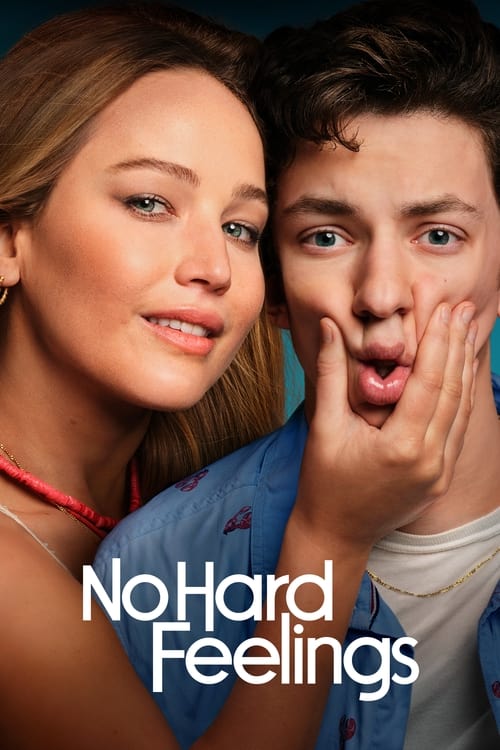
No Hard Feelings
2023 · Gene Stupnitsky
For a low-stakes night when you want to actually laugh out loud — a crowd-pleaser for a date, a group hang, or a beer on the couch. Pure comfort viewing with an R-rated edge.
What it's about
Maddie, a broke Montauk bartender and Uber driver about to lose her childhood home, answers a bizarre Craigslist ad: wealthy helicopter parents will trade a car to anyone who can 'date' their painfully shy 19-year-old son Percy and crack his shell before college. What she assumes will be an easy con turns into something messier, funnier, and more human as Percy proves nothing like a sure thing.
The experience
A raunchy, big-swing studio comedy that keeps veering into genuine sweetness — broad physical gags and squirm-inducing setups sitting next to surprisingly tender scenes about being stuck and being scared. Easy to watch, quicker-witted than its premise suggests.
Performances
Jennifer Lawrence goes all-in on physical comedy with zero vanity — it's a reminder she's as gifted at broad farce as at drama — and Andrew Barth Feldman makes Percy's awkwardness specific and touching rather than a punchline.
The craft
Gene Stupnitsky's script threads a needle: it mines a deliberately queasy premise for laughs while giving both leads real interiority, and it stages a couple of gag setpieces with the confidence of classic hard-R comedies. The Montauk summer setting gives it a sun-bleached, end-of-season melancholy.
Why it matters
A deliberate attempt to revive the star-driven, R-rated studio comedy in the franchise era, with Lawrence spending her A-list capital to prove the genre could still open in theaters.
Snapshot
No Hard Feelings is a hard-R studio comedy built around a deliberately queasy premise: a cash-strapped young woman in Montauk answers a Craigslist ad in which affluent parents offer a used car in exchange for someone to "date" — and, it is implied, sexually initiate — their sheltered, college-bound nineteen-year-old son. Directed by Gene Stupnitsky from a script he co-wrote with John Phillips, the film is best understood as a self-conscious throwback: an attempt to revive the raunchy, star-driven adult comedy that Hollywood had largely abandoned in favor of franchise tentpoles by the early 2020s. Its reason for existing, commercially and artistically, is Jennifer Lawrence, who both headlines and produces, using an Oscar-winner's capital to underwrite a broad physical-comedy vehicle of a kind that studios had grown reluctant to greenlight without one. The result is a genre exercise as much as a story — a wager that a movie star willing to do slapstick, and to appear nude in a fistfight, could still fill a summer theatrical slot. The film is minor in the grand sweep of film history but notable as a case study in the mid-2020s "return of the adult comedy" conversation.
Industry & production
The picture was produced and distributed within the Sony/Columbia orbit, with Lawrence's production company (Excellent Cadaver, which she runs with Justine Polsky) among the producing entities, alongside Stupnitsky's and Naomi Odenkirk's involvement on the producing side. The central industrial fact is that this was conceived as a star-and-concept theatrical comedy at a moment when the theatrical mid-budget comedy had become an endangered form — much of that market having migrated to streaming, where films like it were released without the marketing muscle or box-office stakes of a wide summer opening. Sony positioned it as a counter-programming release in the summer of 2023, and its marketing leaned heavily on Lawrence's willingness to do broad, uninhibited comedy, an image somewhat at odds with the prestige-drama and Hunger Games franchise associations she carried.
The production shot on Long Island, with Montauk and surrounding Suffolk County locations standing in for the story's class-stratified beach town — a setting the film treats as thematically load-bearing rather than incidental (see Themes). I do not have reliable figures for the budget or worldwide gross and will not invent them; contemporaneous coverage framed the film as a modestly budgeted comedy whose commercial performance was watched as a bellwether for whether the theatrical R-rated comedy retained any life. That "test case" framing — rather than any specific grosses I can verify — is the most defensible industrial claim to make about it.
Technology
No Hard Feelings is a conventionally produced digital comedy and does not represent any technological frontier; its interest on this axis is precisely its orthodoxy. It was shot digitally in the standard contemporary studio pipeline, finished for wide theatrical projection, and makes no significant use of visual effects beyond the invisible, corrective kind normal to modern production. The film's most "technological" gesture is anti-technological in spirit: its comedy repeatedly stages the gulf between an analog Gen-X sensibility (Maddie) and a screen-mediated Gen-Z one (Percy and his cohort), mining laughs from dating-app etiquette, smartphone documentation, and online shaming. In other words, technology enters the film as subject matter — the social apparatus of contemporary courtship — rather than as a production innovation. This is standard for the genre and worth stating plainly rather than dressing up.
Technique
Cinematography
The cinematography, by Eigil Bryld — a Danish-born DP known for In Bruges and extensive prestige-television work including House of Cards — is polished and legible in the manner the genre requires: bright, evenly exposed coverage that keeps performers' faces and physical business readable, with the coastal Long Island light lending the summer setting a warm, sun-bleached appeal. Bryld's background in more visually stylized fare is largely held in check here; the camera's job in a broad comedy is to frame gags cleanly and stay out of the performers' way, and the film generally obeys that discipline. The most-discussed visual set piece is the nighttime beach sequence in which Maddie, nude, fights a group of would-be thieves — a scene whose comedy depends on the camera committing to the physical spectacle without either coyly obscuring or leering, a tonal calibration handled largely through framing and blocking rather than showy camerawork.
Editing
The editing serves the standard rhythms of the star-vehicle comedy: scenes built to land performances and reaction beats, with room left for the lead's physical timing. The film is credited to editor Brent White, a longtime cutter in the Judd Apatow comedy tradition (his filmography includes numerous marquee studio comedies of the 2000s and 2010s); if that credit is correct, it situates the film's cutting lineage squarely within the modern American improv-inflected comedy, where the editor's task is as much curatorial — selecting the funniest take and shaping tempo from abundant coverage — as structural. I flag a small uncertainty about the crew attribution and will not overstate it, but the film's cutting sensibility is unmistakably of that school.
Mise-en-scène / staging
Production design draws a sharp visual line between social worlds: Maddie's precarious working-class Montauk — the inherited house she is fighting to keep, the bar and beach-town service economy she scrapes a living from — versus the antiseptic wealth of Percy's helicopter parents. That contrast is doing real dramatic work, encoding the film's class anxieties into decor and space. Staging otherwise favors the two-hander: much of the film is built on the awkward, negotiated proximity between Maddie and Percy, and the blocking repeatedly exploits their mismatch — her aggressive forward momentum against his flinching retreat — for physical comedy.
Sound
The soundtrack leans on recognizable needle drops, most memorably a diegetic piano-and-vocal rendition of Hall & Oates's "Maneater" performed by Percy — a scene that inverts the film's power dynamic, letting the ostensibly seduced boy disarm the seducer through unexpected sincerity. The choice is pointed: "Maneater" is a song about a predatory woman, deployed in a film anxious about exactly that framing of its heroine. Beyond such curated cues, the sound design is functional and unshowy, prioritizing dialogue intelligibility as comedy demands.
Performance
Performance is the film's true medium. Jennifer Lawrence commits to a mode of unguarded physical comedy — pratfalls, rage, the nude brawl, sustained abrasiveness — that trades on the audience's affection for her while pushing against her prestige image. The performance is the film's argument: that a genuine movie star doing broad comedy without vanity is itself an event. Andrew Barth Feldman, a stage actor (a Dear Evan Hansen Broadway alumnus) in a breakout screen role, plays Percy with a delicate, non-caricatured awkwardness that keeps the premise from curdling; the film works only insofar as his vulnerability reads as real, and it largely does. The supporting ensemble, including Matthew Broderick and Laura Benanti as Percy's parents, provides the affluent-adult counterweight.
Narrative & dramatic mode
Structurally the film is a romantic comedy wearing the clothes of a raunchy sex comedy, and much of its interest lies in that bait-and-switch. It opens in the register of transgression — an older woman hired to seduce a teenager — and then systematically defuses that transgression, revealing Percy to be "no sure thing" and redirecting the story toward mutual, mostly non-sexual tenderness and a coming-of-age arc for both leads. The dramatic mode is thus ironic and self-correcting: it invites the audience to expect one (potentially unsavory) film and delivers a gentler one about loneliness, class, and arrested adulthood. This is a familiar comedic maneuver — the outrageous premise redeemed by sentiment — executed with more tonal care than the logline suggests. The engine is character transformation on both sides: Maddie, emotionally guarded and economically desperate, is forced toward connection; Percy, over-protected and inert, is pushed toward independence.
Genre & cycle
The film belongs to the American R-rated comedy, and more specifically to a small, conscious cycle of early-2020s films attempting to resuscitate that form for theaters. Its lineage runs through the raunchy-with-a-heart tradition — the Apatow school and its descendants — and through the older sub-genre of the transactional or "arrangement" romance, where a relationship begins as a paid or contractual scheme and turns real. It also nods to the seduction-comedy and the age-gap comedy, genres it invokes largely in order to subvert their more predatory implications. Within its moment, it functions as a genre-revival gambit: a bet that the star-driven adult comedy, presumed commercially dead, could be reanimated.
Authorship & method
Gene Stupnitsky is the film's authorial center, and his prior career clarifies its sensibility. He came up as a writer-producer on the American The Office, co-wrote the screenplay for Bad Teacher (2011) with his longtime collaborator Lee Eisenberg, and made his feature directing debut with Good Boys (2019). That résumé defines a consistent method: comedy built on placing a caustic or age-inappropriate protagonist into situations engineered for discomfort, then locating unexpected warmth beneath the crudeness — Bad Teacher's abrasive antiheroine and Good Boys' foul-mouthed children are clear kin to Maddie and to the film's teen milieu. He co-wrote No Hard Feelings with John Phillips.
Among key collaborators: cinematographer Eigil Bryld brings prestige-drama polish to broad material; composer Mychael Danna — an Oscar winner for Life of Pi and a composer far better known for lyrical drama scores than for comedy — is a somewhat unexpected choice whose involvement suggests an intent to underpin the raunch with genuine emotional scoring. The editing sits, as noted, in the mainstream improv-comedy tradition. Above all, Jennifer Lawrence's role as producer-star makes this an authored star vehicle: the film exists because she chose to spend her clout on it, and its shape is inseparable from that choice.
Movement / national cinema
This is mainstream American studio cinema with no meaningful affiliation to any art movement or national-cinema tendency beyond Hollywood commercial filmmaking. Its only "movement" is industrial and discursive: the mid-2020s effort — argued in trade press and by filmmakers alike — to reclaim the theatrical adult comedy from streaming. To situate it otherwise would be to overreach.
Era / period
The film is thoroughly of its moment (the early-2020s post-pandemic theatrical landscape) and is legible as a period document in two ways. First, industrially: it arrives amid open anxiety about whether comedies could still draw audiences to theaters, making it a artifact of that debate. Second, thematically: it is preoccupied with a generational rupture, staging a Gen-X/millennial adult against Gen-Z youth and treating that gap — in dating, in risk tolerance, in relation to screens and safety — as its central comic and emotional terrain. Its Montauk setting also registers a specific contemporary anxiety about coastal towns hollowed out by wealth, where lifelong residents are priced out by seasonal affluence.
Themes
Beneath the farce, the film's persistent concerns are class and economic precarity: Maddie's entire predicament stems from the threat of losing her family home and from a service-economy livelihood at the mercy of the rich people she serves. The seduction plot is, at root, an economic transaction, and the film is at its sharpest when acknowledging that its "romance" is downstream of desperation. A second theme is arrested development and its inverse — Maddie's emotional immaturity mirrored against Percy's enforced innocence, each stuck in a different way, each needed to unstick the other. A third is loneliness and the difficulty of genuine connection in a mediated, transactional culture. The film also gingerly interrogates gender and predation, raising the specter of exploitation only to reframe its heroine as damaged rather than dangerous — a maneuver some will read as honest and others as evasive.
Reception, canon & influence
Critical reception was mixed-to-favorable, with a consistent throughline: reviewers credited Jennifer Lawrence's fearless, physically committed performance as the film's chief and often sole justification, while dividing over whether the script's gentler back half earned or squandered its provocative premise. The recurring critical frame was one of relief and modest celebration — that a real movie star had made a real theatrical comedy — often accompanied by the observation that the film was funnier and more good-natured than its logline threatened. I do not have verified aggregate scores or box-office totals to cite and will not fabricate them; the qualitative consensus, however, is well attested.
Influences on the film run backward into the American raunch-comedy tradition — the Apatow lineage, the transactional-romance and seduction-comedy templates, and Stupnitsky's own Bad Teacher and Good Boys, whose abrasive-protagonist-meets-sentiment formula this reprises. The nude fight scene consciously extends a long history of comedic set pieces staked on a star's willingness to abandon dignity.
Its forward influence is necessarily modest and, given how recent it is, still unsettled. The film's most durable role is likely evidentiary: it became a frequently cited data point in the ongoing 2020s argument that the star-driven adult comedy remains commercially viable in theaters, and a demonstration that an A-list dramatic actor could pivot into broad physical comedy with credibility. Whether it seeded a genuine revival or stands as an isolated attempt is a question the historical record cannot yet answer, and it would be premature to claim more. What can be said with confidence is that it functions less as a canonical work than as a marker — of a star's range, and of a genre's contested survival.
A Deleuzian reading
A nineteen-year-old sits down at a piano and sings "Maneater." He is doing it to be charming.
The full Deleuzian reading of No Hard Feelings →
Reception
The trailer set off a firestorm of age-gap discourse before anyone had seen it, but the film itself landed as sweeter and sadder than the premise suggested — and its solid theatrical run got it adopted as Exhibit A in the 'bring back the mid-budget studio comedy' cause.
How No Hard Feelings was received, from release to now →
How to watch No Hard Feelings: what to notice on a first viewing
- Watch who steps forward and who steps back in every scene. Stupnitsky blocks Maddie and Percy as a matched pair of opposite momentum: she moves toward him, he retreats. The same physical shape repeats in scene after scene between them. The comedy is built into the blocking itself, before either character says a word.
- Notice how bright and evenly lit almost every scene stays. Bryld keeps the coastal light warm and sun-bleached and the exposure even, so faces and physical comedy stay fully readable no matter what a scene is doing. The camera stays out of the gag's way instead of styling it.
- Compare the two houses whenever the film cuts between them. Maddie's inherited house is lived-in and precarious; Percy's parents' home is antiseptic and moneyed. The production design keeps the two spaces visually opposed every time you see them. The class gap between them is built into the sets before anyone mentions money.
- Watch Lawrence commit fully to every pratfall and physical bit. Lawrence plays Maddie with unguarded physical comedy, rage, and sustained abrasiveness, trading on her star image rather than protecting it. A recognizable movie star doing broad comedy without vanity is the film's real selling point.
The whole guide to watching No Hard Feelings, with the keys for a rewatch →
Influences: the films it descends from and the films it influenced
- The Graduate (1967) — Establishes the older-woman-initiates-inexperienced-young-man template and the practice of scoring seduction and generational drift with pop needle-drops rather than orchestral cues, both of which No Hard Feelings inverts and reprises.
- Summer of '42 (1971) — Codifies the adolescent-boy's sexual initiation by an older woman as a lyrical coming-of-age structure, the tonal move beneath Maddie-and-Percy's back half where crudeness gives way to tenderness.
- Private Lessons (1981) — The most literal premise ancestor: an older woman is transactionally engaged to deflower a shy teenage boy, the exact commissioned-seduction contrivance Stupnitsky rebuilds.
- Risky Business (1983) — Fuses a transactional-sex plot to class-coded suburban production design and diegetic needle-drops as character punctuation, the same design-and-music grammar mapping Percy's wealthy Montauk household against Maddie's precarity.
- There's Something About Mary (1998) — Perfects the comedic set piece staked entirely on a star's willingness to abandon dignity and physical modesty, the direct forebear of Lawrence's fully-nude beach-fight.
- The 40-Year-Old Virgin (2005) — Sets the Apatow method No Hard Feelings inherits: loose improv-driven coverage cut for the funniest read, built around a sexual-initiation premise that locates genuine sentiment beneath the raunch.
- Knocked Up (2007) — Models the mismatched-pair two-hander shot in naturalistic, over-covered masters that let improvised alt-takes be assembled in the edit, the coverage-and-cutting approach Bryld and the editors reuse.
- Bad Teacher (2011) — Written by Stupnitsky and Eisenberg, it originates their signature abrasive-antiheroine star vehicle whose caustic protagonist is slowly warmed, the exact template Maddie descends from.
- Bridesmaids (2011) — Proves the female-fronted R-rated comedy can hang gross-out physical-humiliation set pieces on a leading actress, the commercial and performative precedent for a woman anchoring this kind of raunch.
- Anyone But You (2023) — A post-pandemic theatrical R-rated star-vehicle rom-com cited alongside it as a data point that big-screen adult comedy remains viable, extending the same movement marker.
- Trainwreck (2015) — A female producer-star raunch vehicle in which the lead shapes a crude comic persona around her own dramatic register, the authored-star-vehicle model Lawrence follows as producer-star.
- The To Do List (2013) — Structures a woman's coming-of-age as an explicit transactional sexual-checklist premise played for R-rated comedy, the gender-flipped kin to Percy's commissioned deflowering.
- Good Boys (2019) — Stupnitsky's directing debut, sharing the same crude-innocent engine — placing age-inappropriate sexual comedy against genuine tenderness — and the teen milieu he restages here.
- Booksmart (2019) — A same-wave coming-of-age R-rated comedy built on naturalistic handheld coverage and character-punctuating needle-drops, the current-era grammar No Hard Feelings shares.
- Long Shot (2019) — Stakes an R-rated romance on a wide status-and-class gap and casts a prestige dramatic actress into broad comedy, the same class-coded transactional dynamic and casting gambit.
- Ticket to Paradise (2022) — A star-driven adult comedy released theatrically as a deliberate test of the genre's commercial survival, the same evidentiary role No Hard Feelings plays in the 2020s adult-comedy-revival argument.
Similar films
- Anyone but You (2023) — influence & lineage
- People We Meet on Vacation (2026) — same viewing thread
- Cha Cha Real Smooth (2022) — shared sensibility
- Frances Ha (2013) — shared sensibility
- Fresh (2022) — shared sensibility
- Jay Kelly (2025) — shared sensibility
- Short Term 12 (2013) — shared sensibility
- Marriage Story (2019) — shared sensibility
All the films related to No Hard Feelings →
Watch it with: curated runs of related films
- The Rom-Com Grows Up — Watch these when you want the modern love story in every register — the giddy fantasy, the one-perfect-day meet-cute, the raunchy hustle, and the version that finally does the math on romance.