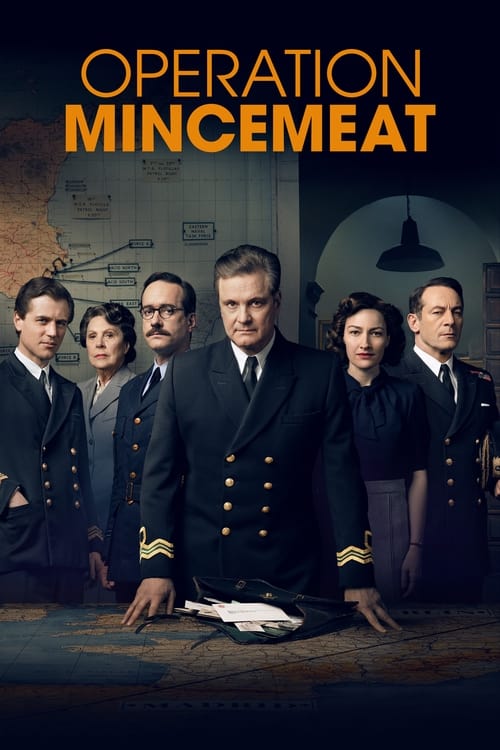
Operation Mincemeat
2022 · John Madden
For a satisfying Sunday-evening kind of film — when you want true-story intrigue, period atmosphere, and clever people doing clever things, without being put through the wringer.
What it's about
In 1943, two British intelligence officers hatch a scheme that sounds like a bad joke: dress a corpse as a Royal Marines officer, plant forged love letters and fake invasion plans on the body, and float it off the coast of Spain so German spies will conclude the Allies are targeting Greece instead of Sicily. The film follows the true story of building that lie in loving detail — inventing a whole life for a dead man — while the planners' own tangled loyalties and private longings complicate the work.
The experience
Handsome, witty, and quietly suspenseful — more chess match than battlefield, with the tension of waiting to see whether an absurd bluff will hold. It's a comfortable watch that still keeps a genuine body count of stakes underneath the tweed.
Performances
Colin Firth and Matthew Macfadyen make a fine double act as the scheme's architects — buttoned-up men whose rivalry and loneliness leak through the professional veneer.
The craft
John Madden directs a fastidious period reconstruction of the war fought in basements, morgues, and memos, and Michelle Ashford's script leans into the operation's strangest truth: its planners were essentially writing fiction, inventing a character whose story had to fool an enemy audience. The result is a spy film that doubles as a sly tribute to storytelling itself.
Why it matters
It brought one of WWII's most famous deception operations — long a favorite of history buffs — to a broad modern audience, extending the long British tradition of the intelligence procedural.
Snapshot
Operation Mincemeat dramatizes one of the Second World War's most audacious deception schemes: the 1943 British plan to float a corpse, dressed as a Royal Marines officer and carrying forged documents, off the coast of Spain so that German intelligence would conclude the Allies intended to invade Greece and Sardinia rather than the obvious target, Sicily. Directed by John Madden from a screenplay by Michelle Ashford, and adapted from Ben Macintyre's 2010 nonfiction bestseller, the film belongs to the durable British tradition of the intelligence procedural — the war fought in committee rooms, morgues, and coded telegrams rather than on the beach. It is at once a fastidious period reconstruction and a meditation on storytelling itself: the operation succeeds precisely because its architects are, in effect, screenwriters, building a fictional dead man convincing enough to deceive an enemy reader. Colin Firth and Matthew Macfadyen anchor the central partnership, with Kelly Macdonald, Penelope Wilton, Jason Isaacs, and Johnny Flynn — the last as a watchful Ian Fleming — filling out an ensemble that treats deception as a literary craft.
Industry & production
The film was produced by See-Saw Films, the company of Iain Canning and Emile Sherman (The King's Speech, Lion), in association with Cohen Media Group, with FilmNation among the financing and sales partners. This pedigree places it squarely within the mid-budget, prestige-literary corner of British filmmaking — the milieu of awards-conscious historical drama produced for an international audience but rooted in domestic talent and subject matter.
Distribution followed the bifurcated pattern that became common in the early 2020s. In the United Kingdom the film received a conventional theatrical release through Warner Bros. in spring 2022, while internationally — including in the United States — it was acquired by Netflix and released on the streaming platform. (The precise rollout dates and any box-office figures are matters I will not assert with false confidence; the theatrical-then-streaming split is the salient industrial fact, and it reflects how a film of this scale and demographic increasingly reached viewers through subscription platforms rather than cinemas.) The project's source — Macintyre's meticulously researched popular history — is itself emblematic of a publishing-to-screen pipeline that has reliably supplied British period drama with vetted, "true story" material carrying built-in credibility and marketing hooks.
Technology
Operation Mincemeat is a conventionally produced digital-era period film, and it makes no ostentatious technological claims; its craft is invested in concealment rather than spectacle. Shot digitally and finished through a standard contemporary post-production pipeline, the film relies on production design, costume, and location work to summon wartime London and the Mediterranean rather than on conspicuous visual-effects set pieces. Where effects appear — the submarine launch of the body, the coastal and naval material, period skies and skylines — they are deployed invisibly, in service of plausibility. This is consonant with the film's theme: like the operation it depicts, the production succeeds by making its constructions undetectable. I have not seen reliable, detailed public documentation of the specific camera systems or VFX vendors used, and I will not invent them.
Technique
Cinematography
The cinematography, credited to Sebastian Blenkov, favors a controlled, classical register: warm interiors lit to evoke the amber of blackout-era offices and clubrooms, set against the colder palette of corridors, morgues, and the open sea. The camera is largely composed and observational, organized around faces in conversation — appropriate to a drama in which the decisive action is intellectual. Period intelligence dramas of this kind live or die on atmosphere, and the film leans on shallow focus, practical-feeling sources, and a muted, desaturated war-time tonality to lend its talk weight. The visual grammar is restrained rather than showy; it serves the actors and the plotting.
Editing
Victoria Boydell's editing manages a structural challenge intrinsic to the material: the operation is a sequence of preparations whose outcome can only be confirmed long after the fact, and much of the third act consists of waiting — for intercepts, for confirmation that the Germans took the bait, for the Sicily landings to validate the deception retroactively. The cutting sustains suspense across this delayed-payoff architecture by intercutting the London planners with the documents' physical journey and the enemy's reception of them, converting administrative patience into tension. The film's rhythm is deliberate, befitting a procedural, but it modulates to register the human stakes braided through the bureaucracy.
Mise-en-scène / staging
The film's mise-en-scène is the connoisseur's pleasure of the British intelligence picture: cluttered basement offices, the green baize of committee tables, filing systems and pneumatic tubes, the props of a war waged on paper. Madden stages the central work — the fabrication of "Major William Martin," the invented officer — as an act of collaborative authorship, the team assembling a love letter, theater stubs, a photograph, and a fictional fiancée into a documentary persona. The staging repeatedly foregrounds objects: the forged letters, the body itself, the canister in which it travels. The morgue and the corpse of Glyndwr Michael, the real pauper whose body was used, are handled with a gravity that the staging insists upon, refusing to let the caper's ingenuity erase its ethical cost.
Sound
Thomas Newman's score supplies much of the film's emotional and tonal signature. Newman, a composer associated both with intimate American drama and, relevantly, with the modern James Bond films (Skyfall, Spectre), brings to the project a sensibility tuned to suspense and melancholy alike — and his presence quietly reinforces the film's flirtation with the Bond lineage through the figure of Fleming. The sound design otherwise observes period-realist conventions: typewriters, telephones, the hush of the deep-archive offices, the mechanical business of submarine and sea. Music is used to bridge the procedural's longueurs and to lend the waiting passages an undertow of dread and hope.
Performance
Performance is the film's principal instrument. Colin Firth plays Ewen Montagu with the banked reserve that has become his register for men of duty under emotional pressure, while Matthew Macfadyen, as Charles Cholmondeley, gives the more socially awkward, inward partner a wounded interiority — the two men's contrasting temperaments, and a hinted rivalry, supply the drama's internal engine. Kelly Macdonald, as the clerk Jean Leslie whose photograph becomes the dead man's "sweetheart," grounds the operation's invented romance in a real one, and Penelope Wilton brings flinty authority to the section's senior woman. Johnny Flynn's Ian Fleming hovers at the edges as observer and chronicler; Jason Isaacs and Mark Gatiss contribute sharply drawn supporting turns within the Admiralty and intelligence apparatus. The ensemble plays in the understated, articulate idiom characteristic of British prestige drama.
Narrative & dramatic mode
The film operates in the mode of the historical procedural crossed with the heist or caper structure: a problem is posed, a team assembled, an elaborate scheme designed and executed, and its reception nervously monitored. Crucially, Ashford's screenplay layers a metafictional self-awareness over the documentary spine. The characters speak, in effect, the language of fiction-makers — debating character, motive, and plausibility as they construct Major Martin — and the presence of Fleming, the future novelist, makes the link explicit: this is a story about people inventing a story so persuasive it alters history. Onto this the film grafts a more conventional emotional register, including a romantic and professional triangle among Montagu, Cholmondeley, and Jean Leslie, and the shadow of Montagu's domestic life. The braiding of caper, romance, and ethical reckoning is the film's chosen dramatic strategy; its narration is largely classical, with the period and the procedure carrying the texture.
Genre & cycle
Operation Mincemeat sits at the intersection of the war film, the espionage drama, and the British "true-story" prestige picture. Within the war genre it belongs emphatically to the home-front, behind-the-lines strain rather than the combat film — the lineage of pictures about codebreakers, planners, and spies (The Imitation Game is a recent commercial cousin) in which the decisive battles are cognitive. As espionage cinema it is a deception-and-counter-deception story, close kin to the literature of the Double-Cross System and the wartime "wilderness of mirrors." It also participates in a long-running British cycle of films that mine the Second World War for narratives of ingenuity, sacrifice, and institutional character — a cycle continuously renewed because the period reliably yields both heroism and moral complication.
Authorship & method
John Madden's direction is the work of a filmmaker long associated with literate, performance-forward period drama. From Mrs Brown and the Academy Award-winning Shakespeare in Love through The Best Exotic Marigold Hotel, Madden has specialized in the well-made ensemble piece built on strong scripts and actorly nuance; he also directed The Debt, an espionage thriller, giving him prior purchase on the genre's mechanics of secrecy and guilt. His method here is essentially that of a careful steward of material — trusting the screenplay, the cast, and the period detail rather than imposing a flamboyant visual signature.
The key collaborators define the film's texture as much as its director. Screenwriter Michelle Ashford, best known for the television series Masters of Sex, brings an interest in the interplay of work, sexuality, and concealment that suits the material. Cinematographer Sebastian Blenkov supplies the controlled period look; editor Victoria Boydell shapes the suspense architecture; and composer Thomas Newman provides the emotional connective tissue, his Bond-adjacent pedigree quietly thematically apt. Above all stands the source author, Ben Macintyre, whose archival reconstruction furnished the film's factual scaffolding — the screenplay's authority derives substantially from his research.
Movement / national cinema
The film is a thoroughgoing product of contemporary British national cinema in its prestige-heritage mode: literary adaptation, period reconstruction, an ensemble of nationally recognizable actors, and a subject drawn from the national mythology of the Second World War. It is not avant-garde and claims no movement affiliation; rather it exemplifies an institutional tradition — the British period film as a stable export commodity, made with public and private financing for a global audience that associates such films with quality and craft. Its international Netflix distribution situates it within the early-2020s reconfiguration of that tradition for the streaming era.
Era / period
Set in 1943, the film reconstructs the texture of mid-war Britain — austerity, blackout, the strained machinery of intelligence — with the heritage genre's customary attention to costume, décor, and manners. Its period of production, the early 2020s, matters too: it arrives within a wave of films and series revisiting the secret war and questioning its received heroics, attentive to the human costs and ethical compromises (here, the use of a dead destitute man's body) that earlier, more triumphalist accounts elided. The film's double consciousness — celebrating ingenuity while acknowledging its grim instruments — reflects a contemporary sensibility brought to bear on a historical subject.
Themes
The film's governing theme is fiction as a weapon: the idea that a sufficiently well-constructed story, anchored in convincing detail and plausible human motive, can move armies and bend history. From this flow its secondary concerns — the ethics of deception, including the appropriation of Glyndwr Michael's anonymous corpse and the lie sustained around it; the porousness of the line between invented and real feeling, as the fabricated romance of Major Martin bleeds into the actual entanglements of its authors; and the costs of secrecy on private life and conscience. The presence of Fleming foregrounds a further theme: the wartime intelligence world as the cradle of postwar popular fiction, the secret services generating both real operations and the myths that would later entertain the public. Loyalty, rivalry, and the moral solitude of those who must keep secrets run throughout.
Reception, canon & influence
Critically, the film was received as a solid, intelligent, if somewhat conventional entry in the British intelligence-drama genre — admired for its cast, its craftsmanship, and the inherent fascination of its true story, while some critics found its romantic and metafictional embellishments a softening of the harder, stranger history. I will not attach invented quotations or aggregate scores to that consensus; the broad shape of the reception — respectful, qualified, actor-centered — is the dependable claim.
The most important line of influence runs backward and is explicit: the same operation was previously dramatized in The Man Who Never Was (1956), directed by Ronald Neame and based on Ewen Montagu's own memoir, making the 2022 film a conscious re-adaptation of material with an established screen and literary lineage. Behind both lies the documentary record of the Double-Cross System and the wartime deception apparatus, and Macintyre's book is the proximate source. The film also draws, in its self-aware way, on the entire tradition of espionage fiction it helped seed — invoking Fleming and, through him, the Bond mythology, with Thomas Newman's Bond-scoring history a quiet reinforcement of that genealogy.
Its forward influence is necessarily modest and recent: as a 2022 release it functions less as a wellspring than as a contemporary node in the ongoing cultural reprocessing of wartime intelligence — a screen companion to the renewed popular and scholarly interest in deception operations, and a reminder of how readily this material crosses between history, film, and the theatrical stage (the same operation having also inspired a celebrated stage musical in the same period, an independent adaptation that testifies to the story's continued generative power). Its lasting place is likely as the definitive modern screen account of Mincemeat, valued for completeness and performance, and as an unusually candid example of a war film thematizing its own status as fiction.
A Deleuzian reading
Start with the corpse.
The full Deleuzian reading of Operation Mincemeat →
Reception
Landed in 2022 as well-reviewed, comfortingly old-fashioned British wartime fare — then got quietly overshadowed when the scrappy SpitLip stage musical of the same story became an Olivier-winning West End phenomenon, so the film now often gets discovered as 'the other Operation Mincemeat'.
How Operation Mincemeat was received, from release to now →
Influences: the films it descends from and the films it influenced
- The Man Who Never Was (1956) — The direct prior screen dramatization of the identical operation from Ewen Montagu's own memoir, supplying the template for staging the corpse-and-documents deception as procedural drama that Madden consciously re-adapts.
- Five Graves to Cairo (1943) — Establishes the WWII impersonation-thriller grammar of feeding the enemy a meticulously fabricated fiction, the deception-procedural mechanics of planting false belief that Mincemeat inherits.
- The Sting (1973) — Models the caper architecture in which an elaborate staged con is the engine, withholding the mechanics of the fabrication to engineer a delayed-payoff reveal.
- Shakespeare in Love (1998) — Madden's own literate, performance-forward ensemble period piece that makes fiction-making its very subject, the play-within structure prefiguring Mincemeat's metafictional self-awareness.
- Mrs Brown (1997) — Madden's restrained British-heritage register — trusting script, cast and period texture over flamboyant visual signature — the directorial method he reapplies wholesale here.
- The Debt (2010) — Madden's prior espionage thriller, giving him purchase on the genre's mechanics of secrecy, guilt and a sustained operational lie that he carries into Mincemeat.
- Darkest Hour (2017) — Extends the same contemporary British-heritage reprocessing of 1940–43 wartime Britain as performance-forward period drama, the movement Mincemeat sits within.
- Tinker Tailor Soldier Spy (2011) — Shares the understated ensemble, banked-reserve performances and shallow-focus period palette wired to a slow, delayed-payoff intelligence procedural rather than action.
- Argo (2012) — An intelligence procedural where a manufactured fiction is itself the operational weapon, assembled as a caper and edited for cross-cut suspense around the deception's plausibility.
- The Imitation Game (2014) — WWII British secret-war procedural built on an ensemble of code and concealment, with the same heritage-cinema texture applied to the bureaucratic machinery of deception.
- Atonement (2007) — Foregrounds fiction-as-weapon metafiction — a fabrication that alters reality — rendered through British-heritage shallow-focus period craft and a writing-as-action conceit.
- Bridge of Spies (2015) — A Cold War intelligence procedural that thematizes the ethics of deception through deliberately understated, banked performance rather than thriller spectacle.
- Their Finest (2016) — WWII fiction-as-weapon told from the writers' room: fabricating a propaganda narrative as a genuine war instrument, with the same metafictional candor about constructed truth.
- Skyfall (2012) — Thomas Newman's Bond scoring pedigree directly links the two — Mincemeat explicitly invokes Fleming and the Bond mythology that wartime deception helped seed.
- Inglourious Basterds (2009) — Pushes fiction-as-weapon to its limit: a staged fabrication deployed to kill the enemy, a metafiction about deception and performance winning the war.
- Munich (2005) — An intelligence-operation drama centered on the moral cost of sanctioned deception, carried by banked, interior performance over plot pyrotechnics.
Similar films
- The Imitation Game (2014) — influence & lineage · same viewing thread
- Darkest Hour (2017) — influence & lineage · same viewing thread
- Tinker Tailor Soldier Spy (2011) — influence & lineage
- Skyfall (2012) — influence & lineage
- Bridge of Spies (2015) — influence & lineage · same viewing thread
- Black Bag (2025) — shared sensibility
- Mayday (2026) — shared sensibility
- The Mastermind (2025) — shared sensibility
All the films related to Operation Mincemeat →
Watch it with: curated runs of related films
- Great Men, Grand Reckonings — A run of prestige true stories about singular, obsessive men chasing an epochal achievement — the bomb, the moon, the checkered flag, a nation — and reckoning with what it cost them and everyone around them.