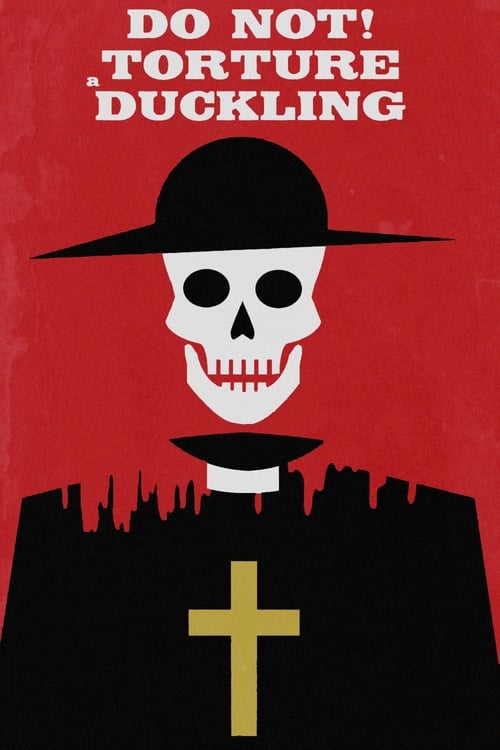
Don't Torture a Duckling
1972 · Lucio Fulci
For when you want a dark, serious thriller with teeth — a whodunit that's also a furious portrait of a closed community. Firmly on the challenge end of the scale; not the pick for a comfort watch.
What it's about
In a remote mountain village in southern Italy, young boys are being murdered, and the community turns on its outsiders — a reputed witch, the village simpleton, a rich young woman exiled from the city — as the police flounder. A Roman reporter arrives to cover the case and starts pulling at threads the town would rather leave alone, in a place where superstition, poverty, and the Church shape every suspicion.
The experience
Grim, angry, and genuinely disturbing — this is a murder mystery that keeps indicting the mob, the media, and the pious along with the killer. It grips like a thriller but leaves a bruise; a few scenes of violence are famously hard to shake.
Performances
Florinda Bolkan is shattering as La Magiara, the outcast the village brands a witch — her big scene is the film's moral center and one of the most harrowing in 1970s Italian cinema. Tomas Milian and Barbara Bouchet anchor the investigation with an unusual, prickly chemistry.
The craft
Lucio Fulci drags the stylish urban murder mystery into dusty rural poverty, shooting the landscape — cliffs, highways, half-modern and half-medieval villages — as a character in itself. The film's violence is staged for moral shock rather than fun, and its willingness to point the finger at sacred institutions gives it a charge most thrillers of its era never risk.
Why it matters
Long suppressed and little seen because of its attack on the Church, it has been rediscovered as one of the boldest Italian thrillers of its decade and the film that proved Fulci was more than a genre craftsman. Its rural, superstition-soaked take on the murder mystery widened what the genre could be about.
Snapshot
Non si sevizia un paperino is a giallo about a series of child murders in Accendura, a fictional mountain village in southern Italy. It moves the urban, fashion-conscious murder mystery of the early 1970s into a world of peasant superstition, Catholic repression, mob violence and economic backwardness. A Roman journalist, Andrea Martelli (Tomas Milian), and Patrizia (Barbara Bouchet), a rich young woman sent to the village after drug trouble in the city, follow the case. The villagers, the police and the press suspect a series of local outsiders in turn: Giuseppe, the "village idiot"; La Magiara (Florinda Bolkan), a woman believed to be a witch; and Patrizia herself. The killer turns out to be the young parish priest, Don Alberto (Marc Porel), who murders pre-adolescent boys to "save" them from the sins of adulthood.
The film is usually counted among Lucio Fulci's best and most personal works. Many critics consider it the most socially pointed giallo of its period. Its most famous sequence, the beating of La Magiara in a cemetery by local men, set to pop songs, is one of the most discussed set-pieces in Italian genre cinema. The film had a limited and contentious release, and its reputation grew mainly through later critical reappraisal and home video.
Industry & production
The film was made at the height of the Italian giallo boom, which followed the commercial success of Dario Argento's The Bird with the Crystal Plumage (1970). In those years Italian producers turned out dozens of thrillers to a recognisable formula, often as international co-productions with mixed European casts. Fulci was a veteran of the industry. He had begun as a screenwriter and assistant, then directed a long run of comedies, including many vehicles for the Sicilian duo Franco Franchi and Ciccio Ingrassia, before turning to thrillers with Una sull'altra (Perversion Story, 1969) and Una lucertola con la pelle di donna (A Lizard in a Woman's Skin, 1971).
The screenplay is credited to Fulci, Roberto Gianviti and Gianfranco Clerici. Clerici later co-wrote Cannibal Holocaust (1980) and Fulci's The New York Ripper (1982). The film was distributed in Italy by Medusa. The cast followed the period's habit of combining international names with Italian character actors: Cuban-born Milian, then becoming a star of Italian popular cinema; Brazilian-born Bolkan, who had starred in Fulci's Lizard; Bouchet, a German-born actress who was a fixture of Italian genre film; and the Greek actress Irene Papas as the priest's mother. French actor Georges Wilson plays Francesco, the hermit who practises folk magic.
Exteriors were shot in the rural south. The production is commonly associated with the Gargano area of Apulia, around Monte Sant'Angelo, and with Basilicata. Detailed accounts of the locations vary, and the precise geography is less well documented than the film's visual use of it. A new motorway viaduct cutting through the old landscape is a recurring image.
The film's release was troubled. Fulci repeatedly said in interviews that it brought him into conflict with Catholic opinion and the censors. The scene in which Bouchet's naked character teases a young boy drew particular criticism. Fulci said it was shot so that the child actor was never present with the nude actress, and that he had to demonstrate this. The details come largely from Fulci's own later recollections, and documentary confirmation is thin. The film did not get a significant contemporary theatrical release in the United States. English-language audiences came to know it mainly through home-video editions from the late 1990s onward.
Technology
The film uses standard Italian commercial technology of its time: 35mm colour stock, widescreen (Techniscope-style 2.35:1) framing, and post-synchronised sound. Most dialogue was dubbed in post-production, which was normal practice in Italy, and English and Italian versions were dubbed separately.
The most notorious technical effect is the death of the killer. Don Alberto falls from a cliff, and his face is shown scraping and smashing against the rocks on the way down. The shot was achieved with a crude dummy and is often cited as an early example of the graphic, anatomical violence Fulci later pushed much further in Zombi 2 (1979) and The Beyond (1981). It is often described as unconvincing as an illusion but very effective as an intention. Otherwise the film relies on location photography, natural light and in-camera staging rather than special effects.
Technique
Cinematography
Sergio D'Offizi's photography sets two worlds against each other. One is the bleached, sunlit, stony landscape of the south: terraced hills, whitewashed walls, dusty tracks and the concrete viaduct. The other is the interiors: dark churches, the shadowy hovel of La Magiara, and the hermit's hut. The widescreen frame often isolates figures against huge, indifferent terrain, and the open, unpicturesque daylight is unusual for a genre so often linked with stylised night-time colour.
Fulci and D'Offizi use the zoom heavily, as was common in Italian popular cinema of the period. They also use dramatic close-ups of eyes and faces, especially the villagers' collective stare at outsiders. The film's look is often contrasted with Argento's baroque colour schemes. Its power comes from a documentary-like starkness interrupted by moments of extreme stylisation.
Editing
Ornella Micheli edited the film. Its rhythm is that of an investigative procedural. The plot moves through a chain of suspects, each brought forward and then discarded, often at the cost of that person's life or safety. The most celebrated editing is in the cemetery beating of La Magiara. Fulci cross-cuts the slow, ritualistic attack with chains with the passing traffic on the motorway beyond the cemetery wall, while pop songs play on the soundtrack, including Ornella Vanoni's "Quei giorni insieme a te." The sequence stretches time and pushes the violence beyond the needs of the plot. The resulting gap between the brutality of the images and the indifference of the modern world is what critics most often single out.
The climax intercuts the struggle on the cliff edge with the priest's fall in a way that dwells on physical destruction. That is a Fulci signature taking shape.
Mise-en-scène / staging
The production design and staging rest on oppositions: old and new, sacred and profane, local and outsider. The motorway viaduct appears repeatedly over the ancient village as a sign of a modernity that passes through the south without changing it. Patrizia's modern villa, her fashion and her open sexuality set her apart from the black-clad village women. La Magiara's world is full of wax effigies, pins and buried bones. These are folk-magic objects that the film treats without irony as real belief practices.
The title comes from a Donald Duck toy (paperino is the Italian name for Donald Duck) belonging to Malvina, the priest's mute sister. The decapitated toy becomes a key clue. The parish church, the confessional, and the football games the priest organises with village boys are staged so that the killer is hidden in plain sight among the institutions of respectability.
Sound
Riz Ortolani's score, from a composer with a large international career, mixes lyrical themes with dissonant suspense cues. The film is most remembered for its ironic use of song. Vanoni's ballad over the cemetery killing is one of the best-known music–image counterpoints in Italian genre cinema: a sentimental pop love song laid over a lynching. The post-synchronised sound gives the dialogue the slightly detached quality common to Italian films of the period, and the English and Italian dubs differ in tone.
Performance
Florinda Bolkan's La Magiara is generally regarded as the emotional centre of the film. She plays a woman shaped by grief and exclusion, who believes in her own magic and dies for the village's need for a culprit. Her bloody crawl to the roadside, ignored by passing cars, is the film's moral low point. Tomas Milian plays against his usual volatile persona with a restrained, ironic reporter. Barbara Bouchet's Patrizia is written as a sexual provocateur and an obvious red herring, and the film gradually reframes her as a sympathetic figure. Marc Porel's priest is gentle and plausible, which makes the reveal work. Irene Papas brings tragic gravity to a small role as his mother. Georges Wilson's Francesco and Vito Passeri's Giuseppe complete the gallery of outcasts.
Narrative & dramatic mode
The film follows the giallo structure of a series of murders, a non-professional investigator, a chain of suspects and a final unmasking. It bends that structure toward social tragedy. The usual pleasure of the whodunit, eliminating suspects one by one, becomes an indictment: each wrong suspect belongs to a marginal group (the mentally disabled, the "witch," the sexually free outsider), and the community turns on each with suspicion, prejudice or violence.
The real killer comes from the centre of the village's moral order. His motive is a perverse theology of innocence: killing boys before puberty to send them to heaven unstained. The narrative therefore moves from superstition to institution. It suggests that the church and the backward village culture are the same system seen from two sides.
The tone combines investigative suspense, grim social realism, black irony and outbursts of grand guignol. The ending gives no catharsis. The killer dies, but the community remains unchanged.
Genre & cycle
Don't Torture a Duckling belongs to the giallo cycle of roughly 1970–1975. It is the leading example of what critics call the giallo rurale or rural giallo, which takes the form out of the bourgeois cities and international jet-set settings typical of Argento and Sergio Martino. It sits beside other gialli of the period built around child murder and Catholic guilt, especially Aldo Lado's Who Saw Her Die? (1972), set in Venice. It anticipates later rural gialli such as Pupi Avati's The House with Laughing Windows (1976).
Recent critics have also placed it within discussions of folk horror. Its isolated community, archaic beliefs, scapegoating ritual and landscape-as-threat connect it to that tradition. The film itself is a murder mystery with no supernatural element, though it treats belief in the supernatural as a social fact.
Authorship & method
The film is often seen as the bridge between Fulci the versatile commercial craftsman and Fulci the auteur of extremity. His earlier gialli were urbane and psychological thrillers. Here, for the first time, he combines his hostility toward institutions, especially the church and the family, with the graphic violence that later defined his horror films. Fulci was an outspoken figure, by many accounts a Catholic who was fiercely anticlerical. He described the film in later interviews as one of the works he was proudest of. Critics, most extensively Stephen Thrower in Beyond Terror: The Films of Lucio Fulci (1999), have treated it as central to his work.
Key collaborators:
- Writers: Fulci, Roberto Gianviti (a frequent Fulci co-writer through the 1970s, including The Psychic) and Gianfranco Clerici.
- Cinematographer: Sergio D'Offizi.
- Composer: Riz Ortolani, with the Ornella Vanoni song as a key element.
- Editor: Ornella Micheli.
Fulci's method here is to place a familiar genre machine in a socially specific setting and then sharpen its violence beyond the needs of the plot, so that the audience must face what the genre usually treats as entertainment.
Movement / national cinema
The film belongs to Italian filone cinema: the industrial system of cycles (westerns, gialli, poliziotteschi, horror) that dominated Italian popular production in the 1960s and 70s. It also engages with a long tradition in Italian culture and cinema concerned with the Mezzogiorno, the "southern question" of underdevelopment, emigration and the gap between the industrial north and the agrarian south. Critics have linked its picture of southern magic and religious practice to the anthropological work of Ernesto de Martino (Sud e magia, 1959), which studied the survival of magical belief in the Italian south. The film does not cite de Martino directly. The link is an interpretive frame that commentators apply.
The film's critique of the clergy and of provincial hypocrisy also echoes themes found in Italian art cinema and commedia all'italiana of the 1960s, especially Pietro Germi's satires of southern manners, though Fulci's register is much darker.
Era / period
The film came out in 1972, in the middle of Italy's "years of lead." These were years of political violence, social conflict and rapid secularisation, as divorce became legal in 1970 and the 1974 referendum loomed. Economic modernisation was spreading unevenly, with motorways and consumer goods reaching regions still marked by poverty and traditional religion. The film's central image, a motorway passing over an archaic village, captures this uneven development.
The period was also a time of loosened censorship and of growing explicitness about sex and violence in popular cinema. The scandal over the Bouchet scene and the anticlerical plot shows where the limits still lay.
Themes
- Scapegoating and collective violence. The community needs a culprit and finds one among the powerless. La Magiara's lynching is the film's thematic core.
- The church and repression. The killer embodies a Catholic fixation on sexual purity, taken to murderous extremes. The film implicates religious institutions in the sexual repression that runs through the village.
- Innocence and sexuality. The boys' curiosity (spying on prostitutes, being teased by Patrizia) is treated as natural. The adult world is the one that pathologises it.
- North and south, modern and archaic. Outsiders from the city (the journalist, Patrizia) are both more enlightened and more cut off. Modernity passes through without transforming the place.
- Superstition and belief. Folk magic is presented as a sincere worldview, not a joke, and as something the official church both opposes and resembles.
- Indifference. The passing cars that ignore the dying La Magiara stand for a society that looks away.
Reception, canon & influence
Critical reception. On release the film was treated mainly as a genre product. Its anticlerical content and the scene involving a child drew controversy in Italy. It had little international profile in the 1970s. Its rise in reputation came later, through the reassessment of Italian horror and giallo by fan and specialist critics from the 1980s and 1990s. Thrower's Beyond Terror and writing in genre journals presented it as Fulci's most mature film. Its release on home video, notably later restored Blu-ray editions, brought it to a wider audience. It is now regularly listed among the best gialli and often cited as evidence that Fulci was more than a gore specialist. Reliable data on its original box office are not readily available.
Influences on the film (backward). The immediate genre template is the Argento-led giallo boom and, behind it, Mario Bava's founding gialli (The Girl Who Knew Too Much, 1963; Blood and Black Lace, 1964). The southern setting and anticlerical satire draw on Italian traditions of social cinema about the Mezzogiorno. The treatment of folk magic matches the anthropological discourse associated with de Martino. Critics have also noted parallels with Fritz Lang's M (1931), the model child-murder film in which a community hunts a killer. Fulci's version reverses Lang's mob justice: the mob kills the wrong person.
Legacy (forward). Within Fulci's own career, the film's graphic climax and pessimistic view of institutions point toward his horror films of 1979–1982, including Zombi 2, City of the Living Dead (1980) with its suicidal priest, The Beyond and The House by the Cemetery (1981). Within the giallo, it set the model for the rural variant pursued by Avati's The House with Laughing Windows and later regional thrillers. Its pairing of pop songs with extreme violence anticipates a technique that became widespread in later international cinema, though tracing direct lines of influence is speculative. In recent criticism the film is frequently brought into folk-horror canons and into discussions of how European genre cinema dealt with Catholicism, class and regional inequality. It remains a key reference for viewers who see the giallo as a form able to make serious social criticism.
Influences: the films it descends from and the films it influenced
- M (1931) — Lang's procedural structure, in which the hunt for a child-murderer spreads through a whole community until the townspeople act as their own court, is the model Fulci reverses: his mob convicts and kills the wrong suspect.
- The Girl Who Knew Too Much (1963) — Bava's founding giallo gave the form its amateur-investigator outsider, here Thomas Milian's Milanese reporter, who walks into a closed community and works through a misleading chain of suspects.
- Blood and Black Lace (1964) — Bava's set-piece logic, where each murder is staged as a separate, drawn-out spectacle, is the model for Fulci's prolonged cemetery lynching and the dummy-body cliff fall.
- The Bird with the Crystal Plumage (1970) — Argento's commercial giallo template supplied the plot machinery Fulci deliberately moves into a sunlit southern village: the killer's identity withheld until a final reveal, extreme close-ups of eyes, and a pop-inflected score.
- La Taranta (1962) — This short documentary, made with Ernesto de Martino's ethnographic input, set the plain observational way of filming southern Italian magic rites that Fulci borrows for La Magiara's wax-doll pin rituals.
- Il demonio (1963) — Rondi's de Martino-influenced Lucanian drama of a woman branded a witch, persecuted by villagers and handled by the clergy is the direct prototype for Bolkan's Magiara as the village's scapegoat.
- Salvatore Giuliano (1962) — Rosi's harsh, flat sunlight on bare southern landscapes and his use of village faces as a chorus set the 'Southern Question' look that D'Offizi's photography carries into genre film.
- The House with Laughing Windows (1976) — Avati takes Fulci's rural giallo model to the Po delta: an outsider in a closed village, a decaying church, local superstition, and a final reveal that implicates the clergy.
- Solamente nero (1978) — Bido rebuilds Duckling's whodunit, in which a priest is the killer and is ultimately exposed and destroyed, on an isolated lagoon island whose small community suspects one villager after another.
- City of the Living Dead (1980) — Fulci revisits the corrupted village priest (Father Thomas, whose suicide opens the film) and pushes Duckling's practical dummy-and-prosthetic gore toward the drawn-out set pieces of his Gates of Hell cycle.
- Zombi 2 (1979) — The fixation on zooms into eyes and slow, unflinching gore effects, which first come together in Duckling's climax, becomes the splinter-through-the-eye set piece that defined Fulci's later horror.
- The Beyond (1981) — Fulci builds the violence around attacks on the eyes and lingers on slow physical destruction, the same unbearable extended staging seen in Duckling's chain-beating in the cemetery.
- Zeder (1983) — Avati continues the regional line of gialli about Catholic institutions in the countryside, joining clerical secrets and folk belief about the dead to an outsider's investigation in a sunlit provincial setting.
- Il signor diavolo (2019) — Avati's late return to the rural gothic is set in the 1950s Veneto and turns on a child's killing, peasant superstition and the Church's cover-up, extending Duckling's model of the scapegoat chain in a backwater community.
- A Lizard in a Woman's Skin (1971) — Fulci's previous giallo, also co-written with Roberto Gianviti and also starring Florinda Bolkan, tried out the zoom-heavy subjective style and the willingness to linger on graphic violence that Duckling then roots in a real place.
- Who Saw Her Die? (1972) — Released the same year, Lado's film pairs a child-murder plot with a clergy-shadowed setting (Venice) and uses Morricone's children's-choir theme as eerie counterpoint, just as Fulci sets the Vanoni pop song against killing.
- What Have You Done to Solange? (1972) — Dallamano also turns the giallo against Catholic institutions, making sexual repression in a religious school the motive for murder, the same clerical-repression mechanism as Fulci's priest-killer reveal.
- My Dear Killer (1972) — Valerii's giallo builds its investigation around a buried child's death and a respectable adult's guilt, sharing Duckling's structure in which crimes against children are hidden behind a community's figures of authority.
Similar films
- The Bird with the Crystal Plumage (1970) — influence & lineage
- Salvatore Giuliano (1962) — influence & lineage
- Blood and Black Lace (1964) — influence & lineage
- Suspiria (1977) — shared sensibility
- Witchhammer (1970) — shared sensibility
- Deep Red (1975) — shared sensibility
- Canoa: A Shameful Memory (1976) — shared sensibility
- Rocco and His Brothers (1960) — shared sensibility