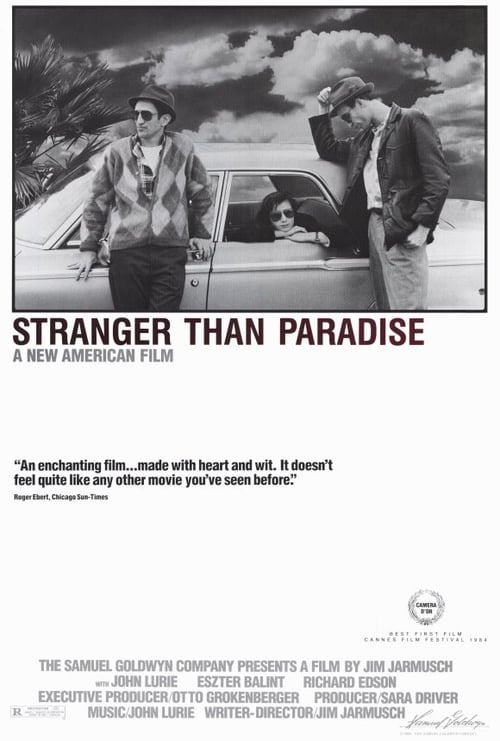
Stranger Than Paradise
1983 · Jim Jarmusch
For when you want cool over comfort — a late-night watch for a certain wavelength, when plot sounds exhausting and you'd rather hang out inside a mood. Absolutely not for a night when you need things to happen.
What it's about
A Hungarian transplant playing at being a hardboiled New York hustler gets saddled with his teenage cousin, newly arrived from Budapest, in his bare Lower East Side apartment. She's cooler than he expects; he's less American than he pretends. Along with his equally aimless buddy Eddie, they drift — through cramped rooms, frozen off-season Cleveland, and points south — discovering that everywhere looks pretty much like everywhere else.
The experience
Deadpan to the bone: long, static black-and-white scenes separated by cuts to black, where the comedy lives in dead air, bad TV dinners, and things pointedly not happening. It's hypnotic if you settle into its rhythm — boredom turned into a running joke you're in on.
Performances
John Lurie's studied slouch and Eszter Balint's unimpressed teenage cool play off each other beautifully — the acting is all attitude and timing, and it works.
The craft
Shot for next to nothing in stark black and white, built entirely from single-take tableaux — no coverage, no cutting within scenes — with stretches of black leader between them. The austerity is the style: every frame looks like a photograph of nowhere in particular, and the minimalism makes the smallest gesture land like a punchline.
Why it matters
More than any single film, this one defined what 'American independent cinema' would mean in the 1980s — proof that attitude, formal rigor, and no money could beat a studio budget. It made Jim Jarmusch a movement unto himself.
Snapshot
Stranger Than Paradise is the film that, more than any single other, crystallized what "American independent cinema" would come to mean in the 1980s: shot in stark black-and-white for next to nothing, built from rigid single-take tableaux separated by stretches of black leader, and animated by a deadpan affect that turned boredom, displacement, and hanging around into a deliberate aesthetic. Jim Jarmusch's second feature follows Willie (John Lurie), a transplanted Hungarian who has remade himself as a hardboiled New York hustler; his teenage cousin Eva (Eszter Balint), newly arrived from Budapest; and Willie's friend Eddie (Richard Edson). The three drift from the Lower East Side to a frozen, off-season Cleveland and finally to a flat, anticlimactic Florida, discovering — in the film's signature joke — that everywhere in America looks and feels the same. Its genesis is unusual and bears directly on its dating: the work began life as a roughly half-hour short, made with leftover film stock and shown at the 1983 International Film Festival Rotterdam, before Jarmusch expanded it into a three-act feature (premiered at Cannes in 1984, where it won the Caméra d'Or). The original short became the feature's first act, "The New World." The "1983" attribution reflects that initial standalone short and the film's completion timeline; many catalogs list the feature as 1984.
Industry & production
The production history is inseparable from the film's mythology of resourcefulness. The opening segment was shot on a short reel of 35mm... no — on 16mm black-and-white stock left over from another production and given to Jarmusch by the German director Wim Wenders, with whom Jarmusch had a mentor-adjacent relationship. (Jarmusch had worked as an assistant on Wenders's Lightning Over Water / The State of Things milieu; the leftover-stock provenance is one of the best-documented origin stories in American independent film.) That economy of means dictated the method: with limited stock, Jarmusch shot scenes as complete single takes, a constraint that hardened into the film's defining formal signature.
Encouraged by the reception of the short, Jarmusch raised modest financing to expand it. The feature was produced by Sara Driver — Jarmusch's longtime partner and a downtown filmmaker in her own right — and completed with German backing, part of the transatlantic support network (including West German television and Wenders's circle) that sustained several New York independents of the period. The budget is consistently described as tiny, in the low six figures; precise figures vary across sources, so the exact sum is best treated as approximate rather than cited as fact. The Samuel Goldwyn Company handled the U.S. theatrical release in 1984, and the film became a genuine art-house success relative to its cost, helping prove that a rigorously personal, uncommercial-looking picture could find a paying audience — a demonstration effect that mattered as much to the nascent indie sector as any single box-office figure.
Technology
The film was shot on 16mm black-and-white reversal/negative stock (the leftover Wenders material for the first act), a format chosen as much by circumstance and budget as by taste, though its grainy, high-contrast monochrome became central to the film's look. The technological story here is essentially one of scarcity productively embraced: a small camera package, available or minimal lighting, location sound, and direct cutting on film. There is nothing showy in the apparatus; the innovation is conceptual rather than mechanical — the decision to let the limitations of the equipment and stock determine form. In that sense Stranger Than Paradise belongs to a lineage of films whose "technology" is really a philosophy of constraint.
Technique
Cinematography
The cinematography is by Tom DiCillo, who would later become a director himself (his 1995 Living in Oblivion affectionately satirizes exactly this world of scrappy independent shooting). Every scene is rendered as a single, predominantly static shot — a fixed frame the actors enter, occupy, and leave. There is no shot/reverse-shot, almost no camera movement, and no conventional coverage; when the camera does move, it is a rare, motivated pan or a slow tracking gesture that registers all the more because stillness is the norm. The black-and-white photography flattens New York, Cleveland, and Florida into a continuous gray expanse, visually enacting the film's thesis that America's variety is illusory. Frames are often composed frontally, with characters arranged across a shallow, theatrical playing space; the look is austere, grainy, and deliberately unglamorous, closer to documentary or snapshot photography than to studio gloss.
Editing
Editing — credited to Melody London with Jarmusch — is the film's most radical formal stroke. Each scene is a self-contained take that opens out of and dissolves back into black leader, so the film advances as a series of discrete "blackout" vignettes, like punctuation marks or the panels of a comic strip. These interstitial blacks do the structural work that cutting-within-scenes usually does: they mark ellipses, withhold transitions, and impose rhythm by what they omit. Because there is no cutting inside scenes, the editing happens between units rather than within them, which gives the film its peculiar tempo — patient, becalmed, then abruptly elliptical. The three-act architecture ("The New World," "One Year Later," "Paradise") is itself a kind of macro-edit, joining three temporally and geographically separated movements into a single deadpan arc.
Mise-en-scène / staging
Staging is theatrical and frontal, owing something to the downtown performance scene from which the cast emerged. Within each fixed frame, blocking is precise but unforced; actors slouch, wait, smoke, watch television, and circle one another in cramped apartments, motel rooms, and cars. The barrenness of the settings — Willie's shabby flat, the snowbound nothing of Lake Erie, the generic Florida motel — is the mise-en-scène's chief expressive content. Props and gestures carry disproportionate weight: a TV dinner, a cigarette, a cassette player. The environments are not dressed to charm; their drabness is the point, and the long-take staging forces the viewer to dwell in spaces designed to feel like dead ends.
Sound
Sound is spare and largely diegetic, with the texture of real rooms and streets. The most celebrated sonic element is Screamin' Jay Hawkins's "I Put a Spell on You," which Eva plays repeatedly on her portable cassette recorder — her talismanic anthem and one of the film's few sources of vitality, a wild American voice that the characters' own affectlessness cannot match. The recurring song functions almost structurally, a motif that travels with Eva across the three acts and ties the film's geography together.
Performance
The performances are studiedly deadpan, anti-naturalistic in their refusal of conventional emotional display yet utterly specific. John Lurie — leader of the downtown jazz group the Lounge Lizards — plays Willie with a put-on cool that keeps slipping; Richard Edson gives Eddie an amiable, slightly bewildered passivity; and Eszter Balint, drawn from the émigré Hungarian theater family associated with New York's Squat Theatre, grounds the film with a watchful, unimpressed presence that makes Eva its true center of gravity. None of the three "act" in the demonstrative sense; the comedy and pathos emerge from underplaying, timing, and the long takes that leave performers nowhere to hide.
Narrative & dramatic mode
The dramatic mode is anti-narrative, or perhaps post-narrative: a comedy of inertia in which the ordinary engines of plot — goals, obstacles, transformation — are deliberately stalled. Things happen (a visit, a road trip, a windfall at a dog track, a near-miss at an airport), but they are flattened to the level of incident, refusing to cohere into momentum or moral. The film is structured around waiting, drifting, and the small frictions of people stuck together. Its humor is dry and situational, derived from repetition and anticlimax; its melancholy comes from the sense that the characters are going through motions that lead nowhere. This "nothing happens" dramaturgy — closer to Beckett or to certain strains of European modernism than to Hollywood storytelling — was precisely what felt new about it.
Genre & cycle
The film inhabits and subverts several genres at once. It is a road movie whose road leads only to more sameness; a deadpan comedy stripped of punchlines; an immigrant story that denies the immigrant the promised "new world." It sits within the late-1970s/early-1980s No Wave Cinema cycle of downtown New York — low-budget, anti-commercial, post-punk filmmaking tied to the Lower East Side music and art scenes — while pointing beyond it toward the broader American independent movement it would help inaugurate. As a road film it explicitly answers the European art-cinema road movie (especially Wenders's) by transplanting that contemplative drift onto an unromantic American map.
Authorship & method
Stranger Than Paradise is a foundational auteur statement. Jarmusch wrote, directed, and co-edited it, and the film established the signature he would carry through Down by Law (1986), Mystery Train (1989), and beyond: the static long take, the blackout structure, the deadpan tone, the affection for marginal characters and dead time, and a sensibility steeped equally in American vernacular culture (music, B-movies, Beat literature) and European art cinema. His key collaborators were essential to the result: cinematographer Tom DiCillo, whose austere monochrome framing realized the one-shot-per-scene concept; editor Melody London, who shaped the blackout rhythm; composer and lead actor John Lurie, whose spare, plaintive string score supplies much of the film's emotional undertow; and producer Sara Driver, whose work made the expansion from short to feature possible. The casting of nonprofessional or non-traditional performers from the downtown music and theater worlds was itself a method — authorship distributed across a scene as much as concentrated in a single director.
Movement / national cinema
The film is a product of the New York downtown underground — the No Wave moment where punk, free jazz, performance art, and Super-8/16mm filmmaking overlapped on the Lower East Side. Yet it is also, pointedly, a transatlantic object: financed in part with German money, indebted to the Wenders road movie and to a European tradition of slow, contemplative cinema, and built around Hungarian émigré experience. It thus straddles American independent cinema and European art cinema, and is frequently read as the hinge between the two. Within American national cinema it is conventionally cited as the inaugural work of the modern indie movement that would crest at Sundance over the following decade.
Era / period
Made at the start of the Reagan 1980s, the film offers an oblique, unsentimental portrait of America in that moment — not through topical reference but through landscape and affect: frozen industrial Cleveland, off-season Florida, cramped New York apartments, a country of motels, TV dinners, and racetracks. Its emotional register — drift, stasis, the sense that the American promise has gone slack — reads as a quiet counter-image to the period's official optimism. Technologically and industrially it belongs to the pre-video-boom, pre-Sundance art-house ecosystem, just before the independent sector it helped create became an industry of its own.
Themes
Its central theme is the irony of "paradise": the immigrant's New World turns out to be interchangeable with everywhere else, and the title's promise curdles into a joke about sameness and disappointment. Related currents run throughout: displacement and outsiderhood (Eva as the perpetual newcomer, Willie as the assimilated cousin who has buried his own foreignness); boredom and dead time as conditions of modern life; the failure of communication and connection among people who are nonetheless bound together; and the gap between American mythology and American banality. Eva, the actual stranger, sees most clearly; the men, who imagine themselves at home, are the more deeply lost.
Reception, canon & influence
Critically, the film was received as a revelation and quickly became a landmark. It won the Caméra d'Or at Cannes in 1984 (the festival's prize for best first feature) and the Golden Leopard at the Locarno Festival the same year, and it found unusual commercial traction for so austere a work, helping legitimize the idea of a viable American art cinema independent of Hollywood. In 2002 the Library of Congress selected it for the National Film Registry as a work of cultural and historical significance.
Its influences backward are eclectic and well attested in Jarmusch's own sensibility: the static, contemplative framing recalls Yasujirō Ozu; the alienated drift and flattened landscapes evoke Antonioni and the European modernists; the road-movie structure and transatlantic gaze descend directly from Wim Wenders; the snapshot Americana and Beat-inflected cool connect to Robert Frank (whose Pull My Daisy and photography hover behind the film's monochrome vision of America); and the comedy of waiting and inconsequence has a clear affinity with Samuel Beckett. The downtown No Wave milieu supplied its cast, music, and anti-commercial nerve.
Its influence forward is enormous and is the principal reason the film is canonical. It served as a template and permission for the American independent surge of the late 1980s and 1990s — the milieu that produced Hal Hartley's deadpan tableaux, Richard Linklater's Slacker-style hang-out structure, Kevin Smith's talk-driven minimalism, and the whole Sundance generation's belief that distinctive vision could substitute for budget. Its sensibility resonates internationally with the deadpan minimalism of Finland's Aki Kaurismäki, with whom Jarmusch shares a mutual affinity. The black-and-white austerity, the single-take blackout structure, the embrace of "nothing happening," and the dignified attention to marginal lives became a recognizable grammar of art-house and independent filmmaking. Within Jarmusch's own career it set the terms for everything that followed. Few low-budget American films of its era have proven so generative; Stranger Than Paradise is studied less as a single masterwork than as the opening of a door.
A Deleuzian reading
They drive out to see Lake Erie.
The full Deleuzian reading of Stranger Than Paradise →
Reception
It arrived in 1984 as a shock — the Caméra d'Or at Cannes and the National Society of Film Critics' Best Film prize for a $100k black-and-white deadpan comedy — and it's since been enshrined as the big bang of modern American independent cinema.
How Stranger Than Paradise was received, from release to now →
Influences: the films it descends from and the films it influenced
- Tokyo Story (1953) — The one-shot-per-scene aesthetic of a locked-off, frontally composed camera that holds the tableau through 'dead time' after the dramatic beat has passed descends from Ozu's static, low-height framing.
- L'Avventura (1960) — Antonioni's dedramatized 'dead time' — characters adrift in flattened, depopulated landscapes with no narrative payoff — is the modernist model for STP's anti-narrative of waiting and inconsequence.
- Alice in the Cities (1974) — The black-and-white transatlantic road movie with a European gaze on American emptiness is Wenders' template; he literally supplied Jarmusch the leftover film stock that seeded the project.
- Kings of the Road (1976) — Episodic male-drift road structure built from long, unhurried takes in monochrome, prioritizing the texture of travel over plot.
- Pull My Daisy (1959) — Beat-improvised monochrome snapshot Americana — Frank's photographic eye for vernacular American desolation hovers behind DiCillo's austere black-and-white vision.
- Shadows (1959) — The founding model of American independent production outside Hollywood, with non-traditional casting drawn from a downtown arts milieu as a method rather than a constraint.
- Band of Outsiders (1964) — Deadpan cool and flat affect — characters performing genre poses (the gangster, the road trip) with ironic, distanced detachment rather than emotional investment.
- Permanent Vacation (1980) — Jarmusch's own debut establishing the drifting downtown protagonist, static framing, and No Wave sensibility that STP refined into the blackout one-shot grammar.
- Slacker (1991) — Converts STP's 'nothing happening' into a structuring principle — a plotless hang-out architecture of drift and overheard talk where narrative momentum is deliberately withheld.
- The Unbelievable Truth (1989) — Flattened, frontally-staged deadpan tableaux with affectless, stylized line delivery — Hartley systematizes STP's theatrical staging and performance register.
- Clerks (1994) — Talk-driven black-and-white minimalism proving that a distinctive voice and fixed-camera economy can substitute for budget — the Sundance-generation lesson STP licensed.
- Living in Oblivion (1995) — STP's cinematographer turns director, carrying the black-and-white indie idiom and one-shot economy he forged on STP into his own filmmaking.
- Frances Ha (2012) — Black-and-white New York deadpan indie organized into titled episodic chapters — a later inheritance of STP's monochrome austerity and blackout-segment structure.
- Gummo (1997) — Blackout-vignette anti-narrative of marginal Americana, abandoning continuity coverage for discrete tableaux of dead-end lives.
- Down by Law (1986) — Reunites DiCillo's monochrome, one-shot-per-scene static tableaux and the deadpan trio dynamic, extending STP's exact formal vocabulary.
- Leningrad Cowboys Go America (1989) — Deadpan minimalist road movie of marginal characters held in static frontal compositions, sharing STP's tone via Jarmusch and Kaurismäki's mutual affinity.
- The Match Factory Girl (1990) — Rigorously static frontal framing and minimal coverage granting dignified attention to a marginal life, with emotion carried by withholding rather than performance.
Similar films
- Down by Law (1986) — influence & lineage
- Gummo (1997) — influence & lineage
- Stranger Than Paradise (1984) — shared sensibility
- Mystery Train (1989) — shared sensibility
- Only Lovers Left Alive (2013) — shared sensibility
- Easy Rider (1969) — shared sensibility
- Microhabitat (2018) — shared sensibility
- Shadows in Paradise (1986) — shared sensibility