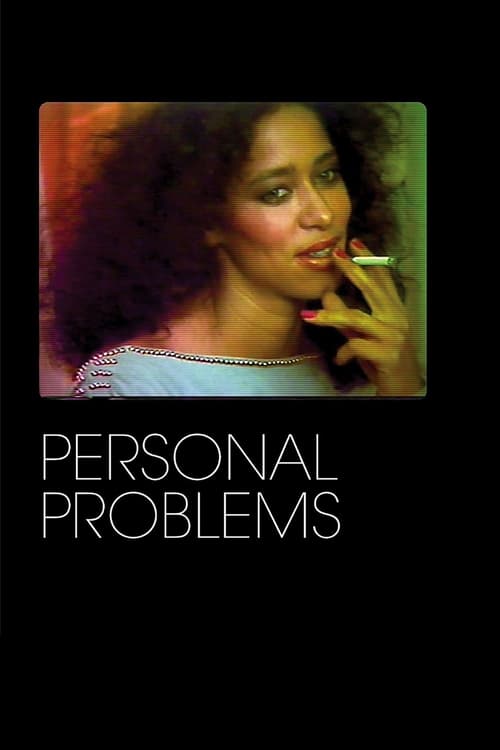
Personal Problems
1980 · Bill Gunn
For when you're tired of plot and want presence — a slow, humane hang of a film that rewards patience and leaves a lasting ache. Challenging in form, tender in spirit.
What it's about
Johnnie Mae is a Harlem nurse holding several lives at once: a strained marriage, an ailing father-in-law at home, and a musician lover across town. Billed as an 'experimental soap opera,' it simply follows her days — hospital shifts, kitchen arguments, gatherings that swell into song and grief — and lets ordinary Black life in New York fill the frame at full length.
The experience
Scenes run long past the point a normal drama would cut, and that's where the film lives — you stop watching a story and start eavesdropping on real people. Loose, intimate, sometimes funny, and then suddenly, deeply piercing.
Performances
Vertamae Smart-Grosvenor is extraordinary as Johnnie Mae — a lived-in, unperformed performance that feels less acted than witnessed.
The craft
Bill Gunn, working with novelist Ishmael Reed, shot it on smeary early video for public television — and the poverty of the format turned into its poetry: light blooming off dark skin, conversations caught rather than staged. It's filmmaking that trusts duration and faces over plot mechanics.
Why it matters
Essentially unseen for decades and made by a director whose earlier work had been taken from him, its restoration revealed a missing landmark of American independent film and of Black filmmaking outside the studio system.
Bill Gunn, whose Ganja & Hess had been taken from him and recut by its distributors, found freedom at the margins of the industry: an 'experimental soap opera,' written with the novelist Ishmael Reed, shot on smeary early video for a public-television project that television never aired. Vertamae Smart-Grosvenor plays Johnnie Mae, a Harlem nurse suspended among a husband, an ailing father-in-law, and a musician lover, and Gunn simply lets her live — scenes run long past their dramatic point into the truer territory beyond it, kitchen arguments and hospital shifts and a wake that becomes one of the most piercing passages in American independent film. The video texture, once a mark of poverty, now feels like intimacy itself: light blooming off dark skin, conversations caught rather than staged. Essentially unseen for decades, it was restored in 2018 and recognized at once as a missing landmark of Black American filmmaking — proof of the cinema Gunn might have built had anyone let him. Reed called it counter-programming to every image television offered of Black life.
Reception
Conceived by Ishmael Reed as a Black 'meta-soap opera' for public television, it was barely seen after 1980 and effectively vanished for decades — then the 2018 restoration (released by Kino Lorber) turned it into one of the most celebrated rediscoveries in American independent film.
How Personal Problems was received, from release to now →
Influences: the films it descends from and the films it influenced
- Ganja & Hess (1973) — Gunn's own prior feature set the template of an elliptical, ritual-driven Black art film organized around mourning and a climactic wake rather than plot, which Personal Problems transposes into video.
- Faces (1968) — Its handheld, improvisation-generated long takes of domestic emotional attrition model the performance-first, anti-dramatic duration Gunn lets play out uncut.
- Shadows (1959) — Jazz-scored, actor-improvised observation of Black urban intimacy pioneered building scenes from behavior and cadence instead of scripted incident.
- Portrait of Jason (1967) — Near-real-time low-fi recording of a marginal Black subject simply talking, with the recording apparatus and its duration foregrounded, prefigures Gunn's confessional video intimacy.
- Nothing But a Man (1964) — Its restrained, unsensational realism of a Black marriage supplied a precedent for privileging domestic interiority over melodramatic event.
- Eight Hours Don't Make a Day (1972) — A public-television serial that repurposed the soap/melodrama form for social realism, a direct precedent for Gunn hijacking the soap opera as a public-TV art project.
- Chelsea Girls (1966) — Warhol's durational, real-time capture of people merely existing legitimized non-event and 'boredom' as legitimate cinematic content.
- Daughters of the Dust (1991) — Extends the Gullah/African-American vernacular world of Vertamae Smart-Grosvenor into lyrical tableau, carrying forward the Black-independent voice Personal Problems foregrounds.
- To Sleep with Anger (1990) — Carries forward the gathering-of-kin domestic drama and folk-inflected observational staging into a more composed register.
- An Oversimplification of Her Beauty (2012) — Continues Gunn's essayistic, formally unstable Black authorship that mixes media and narrative registers around romantic and domestic feeling.
- Hale County This Morning, This Evening (2018) — Applies anti-narrative duration and textured, intimate image-making to Black Southern everyday life, released the same year Personal Problems was restored.
- Black Mother (2018) — Grainy, first-person video-texture intimacy layered with the recorded subjects' own voices descends directly from Gunn's use of video as communion rather than illustration.
- The Inheritance (2020) — Braids Black communal and political life with self-aware, theatrical-domestic staging and literary intertext, echoing the Gunn–Ishmael Reed authorial collaboration.
- Jeanne Dielman, 23 quai du Commerce, 1080 Bruxelles (1975) — Shares the commitment to real-time domestic duration and fixed observational framing that deliberately withholds dramatic climax.
- Killer of Sheep (1978) — Contemporaneous L.A.-school Black independent work assembled from observational vignettes of everyday domestic and neighborhood life rather than a plotted arc.
- Losing Ground (1982) — A near-simultaneous Black independent feature centering Black intellectual and domestic interior life, similarly marginalized in its moment and rediscovered through later restoration.
Similar films
- Losing Ground (1982) — influence & lineage
- Killer of Sheep (1978) — influence & lineage
- The Forty-Year-Old Version (2020) — shared sensibility
- Jeanne Dielman, 23, quai du Commerce, 1080 Bruxelles (1976) — shared sensibility
- Sankofa (1993) — shared sensibility
- White Mangrove (2020) — shared sensibility
- She's Gotta Have It (1986) — shared sensibility
- Caged (1950) — shared sensibility