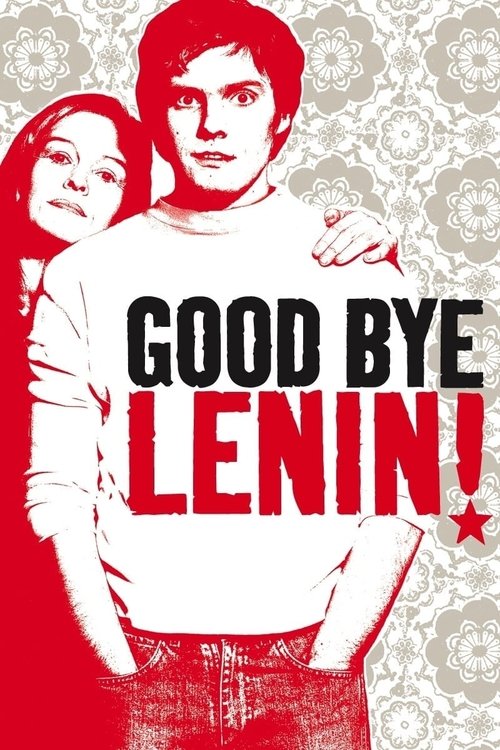
Good Bye, Lenin!
2003 · Wolfgang Becker
When you want to laugh and cry in the same sitting, or when you're drawn to stories about a world ending and people improvising through it. Warm enough for a cozy night, substantial enough to talk about after.
What it's about
East Berlin, 1989. Alex's mother — a true-believing socialist — collapses into a coma just before the Wall falls, and sleeps through the end of her country. When she wakes, doctors warn that any shock could kill her, so Alex rebuilds the vanished East Germany inside her small apartment: hunting down discontinued groceries, staging fake newscasts, drafting neighbors into an ever-more-elaborate fiction that the republic still stands.
The experience
A comedy that keeps sneaking up on you with grief — the schemes are genuinely funny, and the film keeps deepening them into something tender about love, loss, and the stories families tell to protect each other. It moves briskly but leaves a lump in your throat.
The craft
The film's great pleasure is the craft of the deception itself — the fake news broadcasts Alex produces are little films-within-the-film, and the production design lovingly resurrects East German brands, apartments, and television down to the last pickle jar. The visual gags about capitalism flooding in (a soda banner unfurling, statues in transit) are staged with real wit.
Why it matters
A massive hit in Germany and one of the country's biggest international successes, it became the defining film about reunification and put a word — nostalgia for the old East — into the global conversation.
Snapshot
Good Bye, Lenin! is a tragicomedy about the German Democratic Republic's final months, told as a domestic deception. In East Berlin, the committed socialist Christiane Kerner collapses into a coma in October 1989 after seeing her son Alex arrested at a pro-democracy demonstration; she sleeps through the fall of the Wall, the collapse of the state, and the rush toward reunification. When she wakes some eight months later, her doctors warn that any shock could kill her. Alex resolves to reconstruct the vanished GDR inside her 79-square-metre apartment — restocking it with discontinued East German groceries, staging fake news broadcasts, and recruiting friends and neighbors into an elaborate fiction that the socialist republic still stands. What begins as filial protection becomes, over the course of the film, an act of mourning and invention: a private utopia of the country Alex wishes the GDR had been. Released in February 2003, the film became one of the most commercially and critically successful German films of its era and the defining cinematic expression of Ostalgie — the bittersweet nostalgia for East German everyday life — even as it interrogates that very sentiment.
Industry & production
The film was produced by X Filme Creative Pool, the Berlin company founded in 1994 by Becker, Tom Tykwer, Dani Levy and producer Stefan Arndt, a collective explicitly modeled on auteur-driven, commercially viable filmmaking that had already broken out internationally with Tykwer's Run Lola Run (1998). Good Bye, Lenin! was a co-production involving X Filme, the public broadcaster WDR and the Franco-German cultural channel Arte, with backing from German film-subsidy bodies — a financing structure typical of the publicly supported German feature sector. The production was developed over a long gestation; Becker and co-writer Bernd Lichtenberg worked the screenplay through many drafts, and Becker has spoken in interviews about the unusually protracted writing and shooting process. The film was a substantial domestic hit on release and traveled widely on the international festival and arthouse circuit, becoming one of the highest-profile German exports of the early 2000s. Precise budget and grosses I will not assert here, as I cannot verify exact figures, but its commercial success was conspicuous enough to make it a reference point for the renewed international visibility of German cinema in the decade that produced The Lives of Others and Downfall.
Technology
Good Bye, Lenin! is a film shot on 35mm photochemical film in the conventional manner of its moment, but its formal signature lies in its integration of archival material and fabricated "archival" material. The deception plot requires Alex and his film-obsessed co-worker Denis to manufacture counterfeit Aktuelle Kamera news bulletins — the actual name of the GDR state news program — splicing genuine East German broadcast footage with newly staged segments to explain away the increasingly visible signs of Western capitalism. The film thus stages, within its diegesis, an act of analog video forgery, and the production reproduced the look and texture of late-1980s East German television to make those fakes legible as fakes-passing-as-real. The film also makes extensive use of documentary archive footage from 1989–90 — the demonstrations, the opening of the Wall, the reunification celebrations — woven into the fiction. The most discussed image, the helicopter transporting a dismantled statue of Lenin through the Berlin sky past Christiane, is a composited visual effect; the film's effects work is generally restrained and in service of the conceit rather than spectacle.
Technique
Cinematography
The cinematography is by Martin Kukula, who shoots the Kerner apartment and its surrounding Plattenbau world in a warm, slightly burnished palette that lends the reconstructed GDR an affectionate glow without tipping into outright kitsch. The camera is mobile and observational, favouring handheld and Steadicam movement that tracks Alex's increasingly frantic logistics, and it is attentive to the textures of socialist domesticity — wallpaper, pickle jars, furniture, the cramped geometry of the flat. The film contrasts the enclosed, time-capsule interior with the rapidly Westernizing exterior city, where Coca-Cola banners unfurl and IKEA-bright consumer surfaces invade the frame. A recurring formal motif is the screen-within-the-screen: the framing of television images, both real and faked, which the film treats as the principal interface through which history is mediated and falsified.
Editing
The editing, by Peter R. Adam, is central to the film's meaning rather than merely its rhythm, because the plot is itself about cutting and recombination. The fake newscasts are constructed before us as editing problems — how to make a Western advertisement read as a wave of Westerners fleeing to the East, how to stitch stock anchor footage to new voiceover. The film's montage sequences, often propelled by voiceover narration, compress the breathless tempo of historical change, and the editing repeatedly juxtaposes private domestic time (the slow, sealed bubble of the apartment) against the accelerating public timeline outside. The cross-cutting between Christiane's controlled fiction and the unmanageable real keeps the comic machinery turning while accumulating emotional weight.
Mise-en-scène / staging
Production design is the film's most celebrated craft achievement, and it is fundamentally a film about set dressing as historical argument. The labor of the plot is the labor of art direction: Alex scours the city for discontinued Spreewald gherkins, Mocca Fix coffee and Trabant-era consumer goods, and the apartment becomes a stage that must be continuously re-dressed to maintain the illusion for an audience of one. The film makes the spectator complicit in this staging, so that we watch props being sourced, arranged and explained. The material culture of the GDR — its packaging, brands, furniture and clothing — is cataloged with an ethnographic precision that is simultaneously the engine of the comedy and the substance of its Ostalgie. The mise-en-scène also stages the irony of authenticity: the "real" GDR Alex reconstructs is partly his own invention, a better country than the one that existed.
Sound
The score is by the French composer Yann Tiersen, whose piano-and-strings idiom — familiar from Amélie (2001) — gives the film much of its wistful, music-box melancholy. Tiersen's themes lend the domestic deception a fairy-tale tenderness that complicates the comedy, pulling it toward elegy. The sound design carefully exploits the GDR's broadcast soundscape: the jingles, anchor cadences and sonic texture of Aktuelle Kamera are part of the period reconstruction, and the contrast between East German media sound and the incoming noise of Western advertising registers the larger collision of systems. Voiceover narration, delivered by Alex, frames the film as retrospective testimony and binds its montage together.
Performance
Daniel Brühl's performance as Alex was the film's breakout, establishing him as a leading figure of his generation of German actors and launching an international career; he plays Alex with an earnest, harried sweetness that keeps the deception sympathetic rather than monstrous. Katrin Saß, herself a star of DEFA-era East German cinema, brings biographical authority and considerable gravity to Christiane, the true believer whose faith the film both honors and gently dismantles. The ensemble — Chulpan Khamatova as Alex's Soviet girlfriend Lara, Maria Simon as his sister Ariane, and Florian Lukas as the cinephile collaborator Denis — sustains a tonal register that holds farce and grief in suspension. The casting of Saß in particular knits the film into the lineage of the East German film industry it elegises.
Narrative & dramatic mode
The film's dramatic engine is the classic comic structure of the maintained lie — the protagonist who must tell ever larger falsehoods to protect a single original deception — but Becker and Lichtenberg bend that structure toward pathos. The mechanism produces escalating farce (each new intrusion of Western reality demands a more baroque cover story) while steadily revealing that the fiction serves Alex as much as his mother: it is his way of authoring an alternative GDR and of postponing the loss embedded in her recovery. The retrospective voiceover establishes the film as memory and confession. A secondary plot strand — a family secret concerning Christiane's husband, who defected to the West years earlier — turns the political deception into a mirror of an older private one, so that the film's structure rhymes personal and national concealment. The ending withholds full disclosure, leaving deliberately ambiguous how much Christiane finally understands, an ambiguity that converts the comedy into a meditation on loving deception.
Genre & cycle
Good Bye, Lenin! sits at the center of a post-reunification cycle of German films reckoning with the GDR and the Wende (the turning-point of 1989–90). It is the film most often credited with crystallizing the Ostalgie phenomenon in cinema, arriving amid a wider early-2000s wave of East German nostalgia in television and consumer culture. As a tragicomedy it belongs to a tradition of using domestic farce to process historical rupture, and it is frequently paired in criticism with later, tonally opposite reckonings — most pointedly Florian Henckel von Donnersmarck's The Lives of Others (2006), which treats Stasi surveillance with sober drama where Becker treats GDR everyday life with affectionate comedy. The pairing has structured much academic debate about how the unified Germany should remember the East.
Authorship & method
Wolfgang Becker, a co-founder of X Filme, is a relatively sparing director whose reputation rests heavily on this film; he is associated with patient, script-driven, character-centred filmmaking rather than stylistic flamboyance, and Good Bye, Lenin! is generally regarded as his signal achievement. The screenplay, co-written by Becker with Bernd Lichtenberg, is the film's foundational accomplishment, and its long development is part of the film's lore. Key collaborators define its texture: cinematographer Martin Kukula, editor Peter R. Adam, and composer Yann Tiersen, whose contribution is unusually determinative of the film's emotional key. The X Filme context matters to the authorship question: the film is a product of a collective committed to reconciling auteurist ambition with popular appeal, and its blend of formal cleverness, emotional accessibility and political seriousness reflects that program. The presence of Katrin Saß connects the production to the DEFA heritage it memorialises.
Movement / national cinema
The film is a landmark of the German cinema revival of the late 1990s and 2000s, a period in which German features regained substantial domestic market share and international visibility after the relative doldrums of the 1980s and early 1990s. X Filme was a central institution of that revival. More specifically, Good Bye, Lenin! belongs to the post-unification German cinema's project of working through the GDR past — a body of work that constitutes, in effect, a national-cinematic memory practice. The film's engagement with DEFA history (through Saß and through its loving reconstruction of East German visual culture) ties it to the absorbed inheritance of the dissolved East German film industry, while its financing and aesthetic ambitions place it squarely within the publicly supported, festival-oriented Western German production system.
Era / period
The film is doubly periodised. Diegetically it is anchored with documentary precision to the months between October 1989 and the official reunification of October 1990 — the most compressed and consequential window in recent German history. As a production it belongs to the early 2000s, and it is best understood as a film looking back across roughly a decade and a half, at the moment when the Wende generation had matured enough to convert lived rupture into popular art. That dual temporality is the film's subject: it is about how a society narrates its own immediate past, and it arrived precisely when unified Germany was actively negotiating what the GDR had meant. The early-2000s Ostalgie wave it both expressed and scrutinized is integral to reading it.
Themes
The film's governing theme is the construction of historical truth — the idea that history is mediated, edited and staged, and that a sufficiently loving lie can become a more bearable reality than fact. Closely bound to this is the theme of Ostalgie itself, which the film treats with deliberate ambivalence: it is genuinely tender toward the textures of East German life while making explicit that the GDR Alex preserves never existed, that it is a curated, improved fiction. Memory, mourning and the impossibility of return run throughout, with Christiane's coma functioning as a figure for a society that wakes to find its world erased. The family-secret subplot extends the theme of concealment from the political to the intimate, suggesting that nations and families alike are held together by selective forgetting. Consumer culture is a persistent motif — the film reads the transition from socialism to capitalism through the iconography of products and packaging. Finally, the film meditates on filial love and the gap between generations divided by belief.
Reception, canon & influence
Good Bye, Lenin! was received as both a popular phenomenon and a critically serious work. It won major recognition at the German film awards and at the European Film Awards, and it traveled internationally as one of the most successful German films of its time; Daniel Brühl's performance was widely singled out and effectively launched his career. Critical writing praised the film's tonal balance and its production design while also debating the politics of its nostalgia — whether its affection for GDR everyday life softened or obscured the realities of an authoritarian state, a debate that became a staple of scholarship on German memory cinema.
Looking backward, the film's lines of influence run through the tradition of the comic-deception narrative and through the broader European art-cinema vein of whimsical, music-driven storytelling — its kinship with Amélie is most directly carried by Yann Tiersen's score, and its X Filme parentage links it to the kinetic, popular auteurism of Run Lola Run. Its reconstruction of media artifacts owes a clear debt to the documentary record of 1989–90 and to the DEFA visual culture embodied by its cast. Looking forward, Good Bye, Lenin! became the touchstone against which subsequent GDR films were measured. It is most consequentially read in dialogue with The Lives of Others (2006), which offered the sober, surveillance-focused counter-narrative to Becker's affectionate comedy; together the two films frame the central debate about how reunified Germany remembers the East. The film cemented Ostalgie as a cinematic and cultural category, established Daniel Brühl as an international actor, and remains the canonical screen account of the GDR's disappearance — a film whose lasting achievement is to have turned the loss of a country into an intimate domestic fable.
A Deleuzian reading
A statue of Lenin hangs from a helicopter, sliding sideways across the Berlin sky, one bronze arm stretched out as if pointing — or pleading.
The full Deleuzian reading of Good Bye, Lenin! →
Reception
A phenomenon on release — over six million tickets in Germany, the European Film Award for Best Film, and a Golden Globe nomination — it's since settled in as *the* reunification movie, the film a generation of German-language students watched in class.
How Good Bye, Lenin! was received, from release to now →
Influences: the films it descends from and the films it influenced
- The Legend of Paul and Paula (1973) — The DEFA touchstone of GDR domestic and consumer textures that Becker's production design lovingly reconstructs as set-dressing-as-history, and to whose performance tradition Katrin Saß belongs.
- Solo Sunny (1980) — A DEFA realist portrait of GDR private everyday life whose material-culture detail is exactly the vanished world Becker's mise-en-scène labors to rebuild inside the mother's apartment.
- Run Lola Run (1998) — X Filme stablemate whose kinetic cross-cutting and splicing of mock-media (photo flurries, fabricated footage) into the narrative models the popular-auteurist montage Becker deploys for his fake newscasts.
- Amélie (2001) — Yann Tiersen's solo-piano cycles literally carry over as the film's emotional key, paired with the same omniscient, whimsical retrospective voiceover narrating an interior world.
- Forrest Gump (1994) — The technique of compositing the protagonist's reality into doctored broadcast archive — Gump's fake newsreels prefigure the faked Aktuelle Kamera bulletins Alex fabricates for his mother.
- Zelig (1983) — Pioneers mock-archival fabrication as a formal device, manufacturing a counterfeit documentary record indistinguishable from the real one — the exact illusion Becker's fake-archival footage sustains.
- Life Is Beautiful (1997) — The tragicomic maintained-lie engine: a family member sustains an elaborate, loving fiction to shield a vulnerable relative from a brutal political reality.
- The Truman Show (1998) — The engineered reality-bubble whose upkeep becomes the plot mechanism — a single person kept inside a fabricated world that must be continuously stage-managed.
- Toto the Hero (1991) — Builds memory from a retrospective voiceover braided with a recurring musical leitmotif, the music-driven, time-folding storytelling structure Becker inherits.
- The Lives of Others (2006) — The sober surveillance counter-narrative that adopts the same GDR set-dressing-as-history method but redirects it from affectionate comedy toward Stasi dread, framing the memory debate Lenin opened.
- The Edukators (2004) — Extends the earnest-young-idealist Daniel Brühl persona launched by this breakout, within the same vein of accessible German political tragicomedy.
- Barbara (2012) — GDR memory cinema in austere mode, deploying meticulous period reconstruction not as Ostalgie warmth but as critical scrutiny — the deliberate antithesis of Becker's nostalgic set-dressing.
- NVA (2005) — A post-Lenin Ostalgie comedy mining GDR institutional material culture (army life) for the same bittersweet satirical nostalgia Becker's success made bankable.
- Sonnenallee (1999) — An Ostalgie comedy mining GDR youth material culture and pop ephemera, working the same affectionate-nostalgia register the dossier credits Lenin with cementing as a category.
- Jojo Rabbit (2019) — Tragicomedy that filters an authoritarian regime through a protective childlike fantasy, balancing whimsy against political horror in the same tonal tightrope as Becker's domestic fable.
- The Death of Stalin (2017) — Tragicomic treatment of a collapsing communist apparatus keyed to bureaucratic and material detail, extending the use of comedy to anatomize the dissolution of a state.
Similar films
- The Lives of Others (2006) — influence & lineage
- Run Lola Run (1998) — influence & lineage · often watched together
- Kolya (1996) — often watched together
- So Long, My Son (2019) — shared sensibility
- Downfall (2004) — shared sensibility
- The Marriage of Maria Braun (1979) — shared sensibility
- A Moment to Remember (2004) — shared sensibility
- Even If This Love Disappears Tonight (2025) — shared sensibility