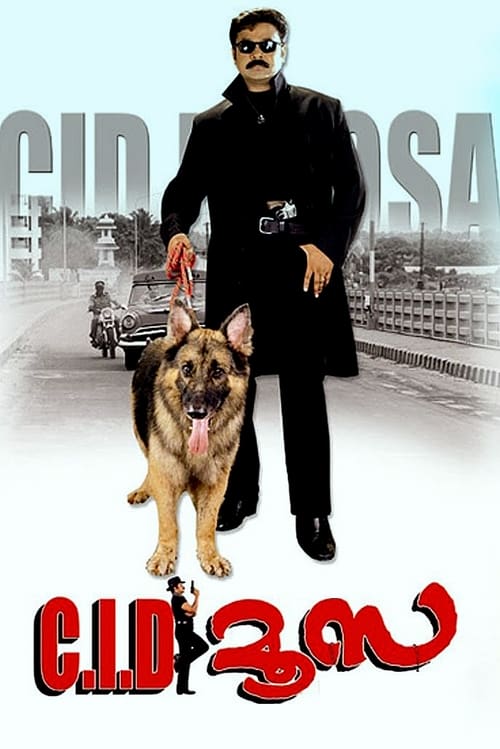
C.I.D. Moosa
2003 · Johny Antony
For when you want to switch your brain off and laugh — a crowd-pleaser to put on with friends or family, no homework required. Pure comfort, zero challenge.
What it's about
Sethuraman, a small-time chancer, reinvents himself as the private detective 'C.I.D. Moosa' — trench coat, swagger, and confidence far exceeding his competence — and stumbles into cases involving everything from petty theft to a genuine bomb plot. His fiercest ongoing battle, though, is domestic: his brother-in-law is a real police officer who'd love nothing more than to see the fake detective humiliated.
The experience
Broad, fast, gag-a-minute mass entertainment — a comedy that spoofs cop-movie posturing while still delivering chases and action beats of its own. It's cheerfully silly and knows it, which is exactly the charm.
Performances
Dileep, then at his peak as Malayalam cinema's leading comedy star, carries the whole film on timing and bluster — the joke is the gap between the hero's self-image and his actual abilities, and he plays both sides of it.
The craft
Johny Antony's debut, written by veteran comedy writer Benny P. Nayarambalam, runs on the machinery of the star-comedy vehicle: set-piece gags, a rivalry engine, and a knowing wink at detective-movie iconography. The fun is in how self-aware the borrowing is — it plays the investigator's clichés for laughs while using them to structure a real caper.
Why it matters
One of the defining Malayalam comedy blockbusters of the early 2000s, it cemented Dileep's reign as the industry's comedy hero and remains an endlessly rewatched TV staple in Kerala.
Snapshot
C.I.D. Moosa is a Malayalam-language comedy-action film released in 2003, the directorial debut of Johny Antony working from a screenplay by the veteran comedy writer Benny P. Nayarambalam. It centers on Sethuraman, a small-time operator who reinvents himself as the private detective "C.I.D. Moosa," and the running domestic-professional feud with his brother-in-law Peethambaran, a serving police officer. The film belongs squarely to the tradition of the Malayalam mass-comedy vehicle built around a single charismatic star — here Dileep, then consolidating his position as the industry's leading comedy hero. What distinguishes the picture is its self-aware relationship to the detective and cop genres it borrows from: it plays the iconography of the investigator (the trench-coat swagger, the confident deduction, the action-hero finish) as both aspiration and joke. The film became one of the more durable comedy successes of its moment and, over subsequent years of television rotation, a recurring reference point in Kerala popular culture, remembered chiefly through its dialogue rather than through any single set piece. Precise production figures and a complete technical-credit record are not something this account can verify with confidence, and where that is the case it is flagged below rather than filled in.
Industry & production
The film emerged from the commercial Malayalam industry (frequently called Mollywood) at a moment when the mid-budget star comedy was the dependable engine of Kerala's box office. By 2003 the two-decade dominance of the "superstar" duopoly of Mohanlal and Mammootty was being supplemented by a younger generation of leads whose appeal was specifically comic; Dileep was the most successful of these, having built a persona around the everyman-underdog who triumphs through cunning and charm rather than physical dominance. C.I.D. Moosa was tailored to that persona.
For Johny Antony the film was a debut, and it is significant that a first-time director was entrusted with a star vehicle of this profile — a reflection of how much the project's identity rested on its writing and its lead rather than on directorial authorship. Benny P. Nayarambalam, by contrast, arrived as an established name: a screenwriter associated with dialogue-driven Malayalam comedy whose scripts were valued for their verbal invention and situational farce. In practice the creative center of gravity of a film like this sits with the writer-star pairing, and the production can be understood as an industry apparatus assembled to deliver Nayarambalam's comic architecture through Dileep's timing.
Beyond these structural facts, the granular production history — shooting schedule, locations, budget, and the commercial return in verifiable figures — is not something I can state reliably, and I will not invent numbers. What can be said with confidence is that the film performed well enough to enter the rotation of perennially re-broadcast Malayalam comedies, which is itself a meaningful marker of commercial and cultural success in that market.
Technology
C.I.D. Moosa was produced on 35mm photochemical film, consistent with standard Malayalam commercial practice in 2003, several years before digital acquisition became normal in the industry. It would have been finished and distributed as film prints for theatrical exhibition. Nothing about the picture suggests technological ambition or novelty; it uses the conventional toolkit of the early-2000s Indian commercial feature — location and set-based shooting, playback song recording, post-synchronized dialogue in the usual dubbing workflow of South Indian production. Its "technology," in the sense that matters to the film, is generic and industrial rather than expressive: the point was reliable, legible delivery of comedy and action, not formal experiment. Any claim to specific equipment, film stock, or lab process would be speculation, and I decline to manufacture it.
Technique
Cinematography
The visual scheme is functional in the manner typical of the star comedy: bright, evenly lit, and organized to keep the performer's face and gesture unambiguous. Comedy of this kind depends on clarity — the audience must read a reaction the instant it lands — and the camerawork accordingly favors clean framing over atmosphere. The parodic dimension does invite occasional inflation of "detective-movie" visual grammar (the low angle on the hero, the sting of a dramatic push-in) precisely so that it can be deflated. I am not able to confirm the director of photography by name from reliable memory, so I will not attribute the work; the description here is of the film's evident visual approach rather than of a credited artist.
Editing
Cutting in C.I.D. Moosa serves comic timing above all. In the Nayarambalam mode, the joke frequently lives in the beat — the pause before a retort, the held reaction, the abrupt cut that punctuates an absurdity — and the edit is the instrument that meters those beats. The film alternates dialogue-driven comic sequences, which are cut to breathe and let performances play, with action passages that adopt the faster, more percussive rhythm expected of the genre being spoofed. The join between these registers is part of the film's texture. I cannot reliably name the editor and will not guess.
Mise-en-scène / staging
Staging is built around the ensemble comic scene: characters arranged so that reactions ripple across a group, with the frame accommodating the by-play of supporting comedians around the star. The film's world is the recognizable middle-class Kerala milieu of the period — households, offices, the ordinary interiors that ground the farce — against which Moosa's self-styled detective flamboyance reads as comic incongruity. The costume and prop language of the "detective" (the deliberately overdone accessories of investigation) is a staging device: the mise-en-scène dresses an ordinary man in the signifiers of a genre he has no real claim to, and the gap is the comedy.
Sound
As with all commercial Malayalam cinema of the era, dialogue is paramount, delivered through the standard post-synchronized workflow. The film's reputation rests heavily on its spoken lines, which means the sound design's primary job is intelligibility and comic emphasis. Songs function in the usual Indian-cinema way, as set-piece interludes; the score punctuates gags and inflates action beats. I believe the music was composed by Alex Paul, but I hold that with moderate rather than full confidence and flag it as such rather than presenting it as settled fact.
Performance
Performance is the film's true medium. Dileep's Moosa is the engine: a portrait of bravado exceeding competence, the small man performing largeness, which the actor modulates so that the character remains sympathetic even at his most ridiculous. The role sits perfectly within Dileep's established range — the underdog whose weapon is wit — and the film is calibrated to give him the space to build and land extended comic runs. Around him, the picture depends on the Malayalam comedy ensemble tradition, in which veteran supporting comedians (the industry's deep bench of character actors, with Jagathy Sreekumar the archetype of the form) generate much of the laughter through reaction and verbal sparring. The brother-in-law antagonism with Peethambaran gives the comedy a stable relational spine — two men locked in a domestic rivalry that keeps escalating into professional competition. I am cautious about assigning specific supporting roles to specific actors from memory and have kept those attributions general.
Narrative & dramatic mode
The dramatic mode is farce organized as a mock-investigation. The narrative uses the detective plot as a scaffold — a case to solve, obstacles to overcome, a resolution to reach — but treats that scaffold primarily as an armature for comic set pieces. The engine of the story is not suspense but incongruity: the distance between Moosa's self-image as a master investigator and his actual, improvised competence. The brother-in-law rivalry supplies a parallel comic-dramatic track, converting the genre plot into a domestic contest of egos. This is a common and effective structure in Malayalam comedy — braid a "serious" genre spine (crime, action) with an interpersonal feud so that the plot supplies momentum while the relationships supply the jokes. The tone stays light throughout; even the action climax, where the film pays off its genre debts, is inflected with comedy rather than played straight. The result is a picture that promises the shape of a thriller and delivers the pleasures of a farce.
Genre & cycle
C.I.D. Moosa sits at the intersection of comedy and action, but its more precise genre identity is the affectionate spoof — a comedy that runs on the audience's familiarity with the detective/spy/cop film and its clichés. It belongs to the broad early-2000s cycle of Malayalam star comedies, and within that cycle to the sub-current of genre-parody vehicles in which a comic hero plays at being an action or investigative protagonist. This lineage runs deep in Indian popular cinema, where the "hero as detective" and the comic deflation of the tough-guy investigator are long-standing forms. The film's specific contribution to its cycle is the durability of its comic writing: it is remembered less as a plot than as a set of situations and lines, which is exactly how the most successful entries in this genre survive.
Authorship & method
If C.I.D. Moosa has an author, it is the writer-star partnership rather than the debuting director. Benny P. Nayarambalam's screenplay supplies the film's structure, its comic logic, and above all its dialogue — the element for which the film is chiefly remembered. His method, as visible in the work, is verbal and situational: constructing scenes as escalating comic negotiations and arming characters with quotable lines that travel beyond the film. Johny Antony, directing his first feature, functions as the enabler of that material — a director whose task is to stage the writing cleanly and give the star room, and whose later career would continue in commercial Malayalam comedy. Dileep completes the authorship as the interpretive instrument, shaping the written Moosa into a specific comic persona. The key technical collaborators — cinematographer, editor, and composer (possibly Alex Paul, as noted) — I am unable to name with full confidence, and rather than risk misattribution I describe their functions above and leave the credits to a more authoritative source.
Movement / national cinema
The film is a product of Malayalam cinema, one of the major South Indian regional industries and a national cinema with a distinctive double identity: internationally esteemed for its parallel/art tradition (Adoor Gopalakrishnan, Aravindan, and their heirs) and, domestically, sustained by a robust commercial mainstream of star-driven comedy and drama. C.I.D. Moosa belongs entirely to the second stream. It is worth situating it against the industry's self-image, because Malayalam cinema is often discussed abroad only through its auteur cinema, whereas films like this one — verbally sophisticated, locally rooted, commercially central — are what the broad Kerala audience actually watched and quoted. The film's humor is culturally specific in a way that resists translation: its comedy is embedded in Malayalam idiom, social types, and the shared reference frame of Kerala domestic life, which is part of why its legacy is regional and linguistic rather than international.
Era / period
The picture is a document of early-2000s Malayalam popular cinema, the last stretch before digital production and, later, the "New Generation" wave of the 2010s reshaped the industry's aesthetics and subject matter. It reflects the period's reigning commercial formula: the mid-budget comedy built around a bankable comic lead, dialogue-forward, family-audience-friendly, and structured around songs and set pieces. This was the era in which Dileep's brand of everyman comedy was near its commercial peak. Viewed from later vantage, C.I.D. Moosa reads as a well-made specimen of a formula that the industry would subsequently move away from stylistically even as it kept the film alive through television.
Themes
Beneath the farce, the film plays with a recurring theme of Malayalam popular comedy: the aspirational ordinary man who performs a status he does not possess and, through nerve and improvisation, partly earns it. Moosa's masquerade as a detective is a comedy of self-invention — the fantasy of becoming the confident, capable figure the genre promises. The brother-in-law rivalry adds a theme of masculine ego and domestic competition, the friction of two men measuring themselves against each other within a family. And running throughout is the genre's own subject: the film is, at some level, about our appetite for cop-and-detective heroics, which it indulges and mocks simultaneously. These themes are handled lightly — the film is not a satire with a thesis but a comedy that finds its humor in the gap between self-image and reality.
Reception, canon & influence
In terms of reception, C.I.D. Moosa was a commercial success and, more tellingly, achieved the kind of afterlife that eludes most films of its type: it became a fixture of Malayalam television rotation and a lasting source of quotable comedy in Kerala, with lines and situations circulating in everyday reference. I cannot cite specific box-office figures or contemporary critical verdicts with confidence and will not fabricate them; the surest evidence of its standing is this persistent popular memory.
The influences on the film run backward into two traditions: the long lineage of Indian genre-parody comedy that spoofs the detective and action hero, and the specific Malayalam dialogue-comedy craft that Benny P. Nayarambalam represents, itself descended from the industry's rich mid-budget comedy of the 1990s. Moosa is a comic detective in a line of comic detectives, filtered through Kerala's particular verbal sensibility.
Looking forward, the film's legacy is chiefly as a touchstone within Dileep's filmography and within the canon of beloved Malayalam comedies of its decade — the sort of film later comedies are measured against and that audiences invoke as a benchmark of the form. Its influence is more cultural than industrial: it did not launch a formal movement, but it entrenched a persona and a comic register. Whether it directly shaped later filmmakers is not something I can assert on the record, so I frame its forward influence in the terms I can defend — as an enduringly quoted, frequently re-watched entry that helped define what a Malayalam star comedy of the early 2000s could be.
Reception
A blockbuster on release in 2003 and one of the defining hits of Dileep's early-2000s comedy run, it has since graduated from box-office success to permanent TV-rerun fixture — the kind of film Malayalis have half-memorised through sheer repeat exposure.
How C.I.D. Moosa was received, from release to now →
Influences: the films it descends from and the films it influenced
- The Pink Panther (1963) — Establishes the incompetent-detective engine C.I.D. Moosa runs on — comedy generated by a sleuth whose costume, gravity and self-image are wildly incongruous with his bungling method, the same costume-incongruity gag Moosa builds his persona from.
- The Naked Gun: From the Files of Police Squad! (1988) — Parent of the spoof method Moosa deploys: literalizing and deadpanning the clichés of detective/police grammar (the stakeout, the interrogation, the reveal) so that genre conventions themselves become the joke rather than the plot.
- Ramji Rao Speaking (1989) — The Malayalam template of ordinary strivers stumbling into a crime/ransom plot, structured as escalating comic negotiations with quotable dialogue — the exact verbal-situational architecture Benny Nayarambalam inherits and rebuilds around a fake detective.
- In Harihar Nagar (1990) — Model for Moosa's comic-ensemble amateur-investigation braid: a cluster of bumbling non-professionals conducting a mock-sleuthing into a mystery, with each man a distinct comic register feeding a shared braided plot.
- Godfather (1991) — Source of the masculine-domestic-rivalry comedy engine — feuding households and wounded male pride played as escalating slapstick — which supplies Moosa's home-front conflict scaffolding.
- Kilukkam (1991) — Ancestor of Moosa's detection-as-farce structure: a paid pursuit of a mysterious person that keeps collapsing into comic misadventure, mixing investigation beats with romance and chase for tonal cover.
- C.I.D. Unnikrishnan B.A., B.Ed. (1994) — The direct Malayalam precursor of the comic detective as star persona — a common man adopting the trappings and title of an investigator — the specific Mollywood 'joke-sleuth' lineage Moosa quotes and updates.
- Punjabi House (1998) — Cements the Dileep star-vehicle persona Moosa exploits: the sympathetic trickster-underdog whose aspirational self-reinvention and rapid comic patter carry the film, an interpretive instrument the writing is tailored to.
- Meesa Madhavan (2002) — Immediate persona ancestor — Dileep as the mustachioed underdog outwitting authority through cunning and disguise — the self-invention-through-role-play register Moosa recasts as fake-detective masquerade.
- Kakkakuyil (2001) — Sibling in the con-comedy craft of the period: ordinary men running an elaborate impersonation/scheme whose comedy comes from sustaining a fraudulent professional identity under pressure.
- Kunjikoonan (2002) — Contemporaneous Dileep star vehicle running the same early-2000s Mollywood engine — bright functional lighting, dialogue-driven set pieces and a persona of comic overreach built to a star's timing.
- Pandippada (2005) — Sibling spoof-vehicle for Dileep that parodies the action-hero posture through a common man play-acting toughness, extending Moosa's staging of costume/role incongruity for laughs.
Similar films
- Drishyam (2013) — shared sensibility
- Nadodikkattu (1987) — shared sensibility
- Michael Madana Kama Rajan (1990) — shared sensibility
- Manjummel Boys (2024) — shared sensibility
- Soodhu Kavvum (2013) — shared sensibility
- Drishyam (2015) — shared sensibility
- Aavesham (2024) — shared sensibility
- Kireedam (1989) — shared sensibility