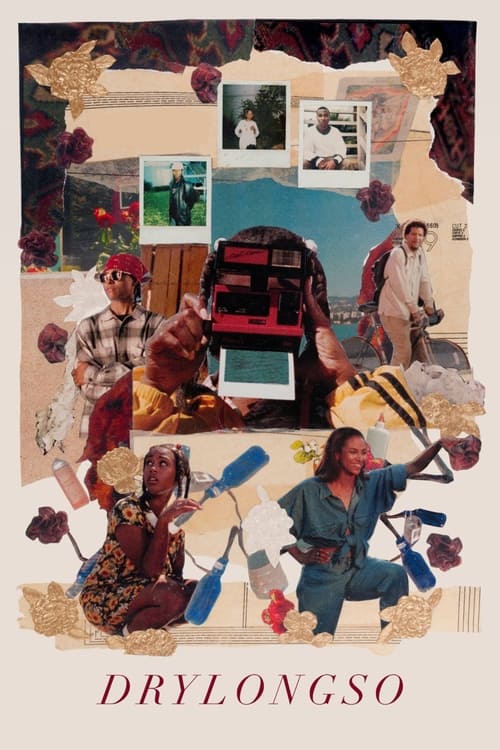
Drylongso
1999 · Cauleen Smith
For when you want something rough-edged and real — a film that treats everyday life as precious without preaching. Comfort and ache in equal measure; great for a thoughtful solo watch.
What it's about
Pica, a young photography student at an Oakland community college, becomes convinced that young Black men are becoming an endangered species — so she starts taking Polaroids of every one she meets, building an archive against disappearance. Around that project the film gathers her friendships, her family, and a neighborhood shadowed by violence but full of ordinary life.
The experience
Sun-washed, casual, and warmer than its premise suggests — it moves with the loose humor of hanging out, while the grief underneath it stays quietly present. It feels handmade in the best sense.
The craft
Cauleen Smith shot it on 16mm as her UCLA thesis film, with community actors and visible seams — and the seams are the point, carrying the handmade, neighborhood-rooted ethos of Black independent filmmaking into the late-1990s Bay Area. The sun-washed color and Polaroid textures give it a look nothing studio-made has.
Why it matters
Long hard to see and now rediscovered as a touchstone of 1990s Black independent cinema, it's the rare feature by Cauleen Smith, who went on to become one of America's most celebrated moving-image artists working in galleries.
Convinced that young Black men are becoming an endangered species, Pica — an Oakland community-college photography student — starts shooting Polaroids of every one she meets, an archive against disappearance, while navigating friendship, family and a neighborhood shadowed by violence. Cauleen Smith made Drylongso as her UCLA thesis film, on 16mm, with community actors and visible seams, and the seams are the point: it carries the handmade, neighborhood-rooted ethos of the L.A. Rebellion filmmakers north into the late-1990s Bay Area. The title is Gullah for 'ordinary,' and the film's radicalism lives exactly there — in its insistence that ordinary Black life, rendered in sun-washed color and casual humor, is subject enough for cinema. Smith went on to become one of America's most celebrated moving-image artists, working mostly in galleries, which leaves Drylongso her sole narrative feature — long nearly impossible to see until a 4K restoration returned it to circulation in 2023. The Polaroid, instant and unrepeatable, remains its perfect emblem: proof that someone was here.
Reception
It charmed Sundance, SXSW and Urbanworld in 1999 and earned Cauleen Smith an Independent Spirit 'Someone to Watch' nod — then got no real distribution and effectively vanished for two decades, until a 2022 4K restoration (Criterion, Janus and the Academy) and a 2023 theatrical re-release turned it into one of the great rediscoveries of '90s Black independent cinema.
How Drylongso was received, from release to now →
Influences: the films it descends from and the films it influenced
- Killer of Sheep (1978) — The founding L.A. Rebellion template Smith inherits at UCLA: nonprofessional neighborhood cast and unforced, plotless vignettes of ordinary Black life shot on grainy 16mm as ethnographic tenderness rather than melodrama.
- Daughters of the Dust (1991) — A Black-woman-authored L.A. Rebellion feature built on painterly, sun-saturated color and the image-as-heirloom — a griot/photographer preserving a people on the verge of vanishing, which Drylongso literalizes in Pica's Polaroids.
- Bless Their Little Hearts (1984) — Observational long-take realism about endangered Black manhood and joblessness, with Burnett's script and nonprofessional performances — the direct forebear of Drylongso's worry over disappearing Black men.
- Bush Mama (1979) — Guerrilla on-location shooting in the Black neighborhood that leaves its seams visible — production texture as politics — the L.A. Rebellion habit Smith adopts in her staging/visible-seams approach.
- La Jetée (1962) — A narrative built almost entirely from arrested still photographs, positing the frozen image as a hedge against death and disappearance — the exact conceptual charge Drylongso gives the Polaroid.
- Blow-Up (1966) — The photographer-protagonist whose prints are scrutinized as evidence of a reality the naked eye missed — photography-as-investigation, which Drylongso recasts as a photography student cataloging men she fears will be erased.
- Bicycle Thieves (1948) — The neorealist method the L.A. Rebellion explicitly built on: nonprofessional actors, real streets, and the dignity of everyday poverty rendered without genre machinery.
- Losing Ground (1982) — An early independent feature authored from a Black woman intellectual-artist's point of view, modeling the interior, image-making female protagonist Smith centers in Pica.
- Medicine for Melancholy (2008) — A desaturated, sun-washed Bay Area two-hander of Black interiority inside a gentrifying city — inheriting Drylongso's regional specificity and intimate, indie-scale neighborhood realism.
- Fruitvale Station (2013) — An Oakland-specific docu-realist portrait that turns the film itself into an archive mourning an endangered Black man's last day — Drylongso's archive-against-disappearance made literal and biographical.
- Moonlight (2016) — Color-forward, tender portraiture that treats Black manhood as fragile and worth preserving, with naturalistic near-nonprofessional performance — the emotional and cinematographic extension of Smith's endangered-manhood theme.
- Pariah (2011) — Bradford Young's expressive, warm-hued color cinematography wrapped around an intimate first-person Black coming-of-age — the same authored gaze and painterly-realist palette Smith pioneered on 16mm.
- An Oversimplification of Her Beauty (2012) — A moving-image artist collapsing photography, personal archive, and essay into a hybrid feature — extending Smith's dual identity as gallery artist and narrative filmmaker.
- She's Gotta Have It (1986) — The low-budget 16mm Black-indie feature blueprint — a self-financed debut whose scrappy monochrome/color economy proved this scale of authorship was viable outside the studio system.
- Just Another Girl on the I.R.T. (1992) — A Black woman director's shoestring realist portrait of a young protagonist speaking in her own vernacular and framing — the same first-person neighborhood authorship, contemporaneous with Drylongso's making.
- Smoke (1995) — Auggie's daily photographs of one street corner as an obsessive archive of ordinary life against loss — the same emblem of photography-as-preservation that drives Pica's project.
Similar films
- Moonlight (2016) — influence & lineage
- Dry Leaf (2026) — shared sensibility
- Sankofa (1993) — shared sensibility
- Rotting in the Sun (2023) — shared sensibility
- Compensation (1999) — shared sensibility
- Hundreds of Beavers (2024) — shared sensibility
- The Watermelon Woman (1997) — shared sensibility
- Blue (1993) — shared sensibility