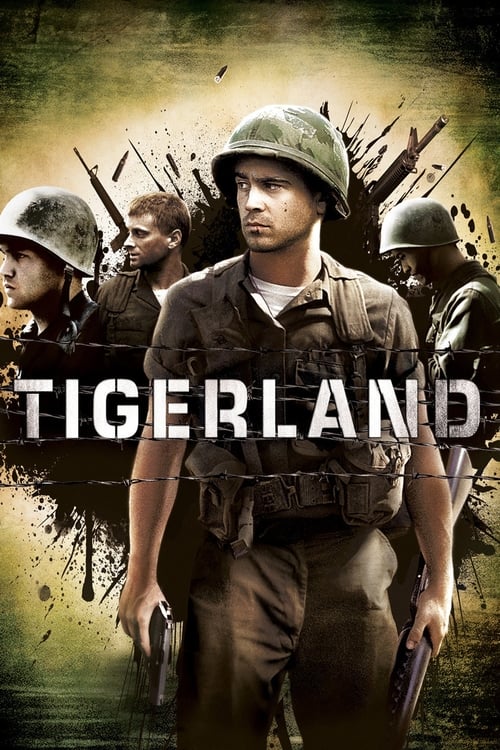
Tigerland
2000 · Joel Schumacher
For when you want a war movie about character rather than combat — something raw and stripped-down that earns its feeling. Grounded and intense, but more moving than punishing.
What it's about
Fort Polk, Louisiana, autumn 1971: a company of draftees grinds through Advanced Infantry Training at the swampy mock-combat village nicknamed Tigerland — the last stop before Vietnam. At its center is Bozz, a charming, insubordinate Texan who hates the Army and has a lawyer's gift for finding the regulation loopholes that get other men sent home, even as his own deployment date closes in.
The experience
Gritty, sweaty, and immediate — handheld cameras put you shoulder to shoulder with the recruits, and the film runs on the tension between barracks cruelty and unexpected acts of decency. It's tough but human, with a slow-building emotional charge under the mud and shouting.
Performances
This is Colin Farrell's breakout, and you can see why: he plays Bozz with a loose, dangerous charisma that makes rebellion look like a moral position, holding the screen effortlessly in his first major role.
The craft
Joel Schumacher, deliberately shedding his glossy blockbuster style, shot the film fast and rough on grainy handheld 16mm — no polish, natural light, documentary nerve. The rawness isn't a budget compromise; it's the aesthetic, and it makes the training ground feel oppressive and real.
Why it matters
It launched Colin Farrell internationally and stands as Schumacher's most respected late-career work — the film that proved the director of megabudget spectacle could reinvent himself with a small, stripped-down drama.
Snapshot
Tigerland is a 2000 American war drama set in the autumn of 1971 at the U.S. Army's Advanced Infantry Training ground at Fort Polk, Louisiana — the simulated combat village nicknamed "Tigerland," the last waystation before deployment to Vietnam. The film follows Roland Bozz (Colin Farrell), a charismatic, insubordinate Texan with a gift for finding the loopholes in Army regulations that let fellow recruits out of the war, and his more conventional, literary-minded friend Jim Paxton (Matthew Davis), who narrates and is implicitly writing the story we watch. The picture is most significant on three counts: it served as Colin Farrell's international breakout; it marked a deliberate aesthetic self-reinvention by Joel Schumacher, who turned from the high-gloss, high-budget studio spectacle of the late 1990s to a stripped-down, handheld, 16mm vérité register; and it stands as a late entry in the post-Vietnam war-film cycle that confines its entire drama to the training camp, refusing ever to reach combat. Critically well received but commercially marginal, it has aged into a respected, somewhat under-seen marker of both an actor's arrival and a director's range.
Industry & production
Tigerland was produced under the New Regency banner with distribution through Twentieth Century Fox, and made on a notably modest budget for a studio-affiliated picture — figures commonly cited place it around the low eight figures, a fraction of Schumacher's contemporaneous studio work. The decision to make a small film was itself the project's defining industrial fact. Coming off Batman & Robin (1997), a critical drubbing, and the larger productions 8mm (1999) and Flawless (1999), Schumacher used Tigerland as a conscious palate-cleanser: a low-cost, fast, lightly supervised shoot that let him work outside the apparatus of tentpole filmmaking.
The screenplay was written by Ross Klavan and Michael McGruther, drawing on the historical reality of Fort Polk's infantry training pipeline. Schumacher's most consequential industrial choice was casting. Rather than anchor the film with an established star, he cast the then-largely-unknown Irish actor Colin Farrell in the lead — a gamble of the kind Schumacher had made before in his career as a director associated with launching young performers. Production took place not in Louisiana but in Florida, in and around the Jacksonville area and Camp Blanding, standing in for the Fort Polk environs; this is consistent with the film's economical, location-driven approach, though readers should treat precise location details as secondary to the well-documented core facts.
The film opened in limited release in the autumn of 2000 and did not perform commercially — it never achieved wide distribution and its theatrical gross was slight. Its industrial value proved to be reputational rather than financial: it repositioned Schumacher with critics and, far more durably, established Farrell as a leading man. Schumacher cast Farrell again almost immediately, in Phone Booth (shot 2000, released 2002), cementing a director-actor relationship that the smaller film had seeded.
Technology
Tigerland is, technologically, a film defined by its format choice. It was shot on 16mm (Super 16), a gauge associated with documentary, news, and low-budget production rather than studio features, and the grainy, desaturated, high-contrast image that results is foundational to the film's meaning, not incidental to its economy. The smaller-gauge negative was finished for 35mm theatrical projection, and the visible grain and instability of the blow-up were embraced rather than suppressed. Lightweight 16mm camera bodies enabled the pervasive handheld shooting and the ability to move quickly through cramped barracks, latrines, and field-training spaces with minimal crew. Lighting leaned heavily on available and naturalistic sources. (Specific camera and stock model designations are not something I can confirm with certainty here, and I won't assert them; the salient, well-established point is the deliberate use of the small gauge and its grain.) The technological posture is the inverse of Schumacher's Batman films: where those foregrounded production design, optical polish, and controlled studio light, Tigerland foregrounds the texture of the recording medium itself as a guarantor of immediacy.
Technique
Cinematography
The cinematography is by Matthew Libatique, in the same period that he shot Darren Aronofsky's Requiem for a Dream (also 2000) — and the contrast between the two films is a useful measure of his range. Here Libatique works almost entirely handheld, with a roving, reactive camera that behaves like an embedded observer rather than an omniscient narrator. Framing is loose and frequently imperfect: figures drift to the edges, focus is hunted for rather than pre-set, and the operator's presence is palpable. The palette is muted and earthen — fatigue green, mud, overcast Southern light — and the 16mm grain coarsens skin and landscape alike. The effect is reportorial, recalling combat journalism and observational documentary, and it deliberately denies the war film its usual visual grandeur. Even the training-village climax is shot for confusion and proximity rather than spectacle.
Editing
The cutting (the film's editor of record is Mark Stevens) reinforces the vérité conceit. Scenes are assembled to feel caught rather than staged, with a tolerance for rough joins, overlapping speech, and a rhythm closer to observation than to classical action coverage. The film is structured episodically around the daily attrition of training — drills, infractions, punishments, small acts of resistance — rather than around a tightly engineered plot, and the editing honors that loose, accumulative shape. Crucially, the picture is built to stop short of Vietnam: its dramatic architecture withholds the combat payoff a more conventional cut would build toward, ending instead at the threshold of deployment.
Mise-en-scène / staging
The staging is anti-decorative. The world is barracks, bunks, latrines, mess, mud, and the mock-village of Tigerland itself, dressed for plausibility rather than effect. Bodies are arranged in the regimented geometries of military life — rows of bunks, formations, the institutional architecture of basic training — and the drama emerges from how Bozz disrupts those geometries. The mock Vietnamese village is the film's one piece of overt theatrical artifice, and the script is self-aware about that artifice: Tigerland is a stage set for a war, and the recruits are rehearsing roles they may not survive. Schumacher stages the interpersonal scenes with an ensemble looseness that lets supporting players register as individuals within the mass.
Sound
The soundscape is naturalistic and dense with the ambient noise of the camp — shouted commands, small-arms fire on the range, weather, the constant low churn of men in close quarters. The original score is by Nathan Larson, and it is used with restraint, eschewing the swelling orchestral cues of the prestige war picture in favor of a sparer, more atmospheric presence that keeps the film tethered to its observational register. Paxton's voice-over narration frames the events as recollected and authored, a literary overlay that sits in productive tension with the immediacy of the image and ambient track.
Performance
Performance is where the film's reputation chiefly rests. Colin Farrell's Bozz is a star-making turn: insolent, magnetic, and morally legible beneath the rule-breaking, a soldier who games the system not from cowardice but from a refusal of the war's logic. Farrell's American accent and easy charisma carry the picture. Around him, Schumacher assembles a strong young ensemble — Matthew Davis as the watchful, writerly Paxton; Clifton Collins Jr. as the volatile Miter; Thomas Guiry, Shea Whigham, and Russell Richardson among the recruits; and Cole Hauser as a hard-edged drill cadre figure. The acting style is keyed to the documentary aesthetic: overlapping, unpolished, physically committed, with the camera often catching reactions at the margins of the frame.
Narrative & dramatic mode
The film's dramatic mode is observational and character-driven rather than plot-driven, organized as a retrospective first-person account. Paxton's narration positions the story as memoir and, implicitly, as the war novel he aspires to write — a framing that makes authorship and witness part of the subject. The central relationship is the dialectic between Bozz, the instinctive resister, and Paxton, the idealist who romanticizes experience and wants to see the war in order to write it. The institution of training is the antagonist: an impersonal machine for converting young men into infantry, against which Bozz's small subversions register as moral acts. By ending at the point of deployment, the narrative converts the conventional war-film structure into a study of dread and anticipation — the entire film is the held breath before combat that never comes on screen.
Genre & cycle
Tigerland belongs to the American Vietnam war-film cycle, but to a specific and unusual sub-region of it: the boot-camp/training film that locates its drama in the making of soldiers rather than in battle. The obvious lineage point is the first half of Stanley Kubrick's Full Metal Jacket (1987), the canonical depiction of basic training as dehumanizing ritual. Where Kubrick proceeds from Parris Island to Hue, Tigerland makes the radical move of staying in the camp for its entire length — the war remains permanently off-screen, an approaching catastrophe rather than a depicted one. It thus reads simultaneously as a war film and as an anti-war film that withholds war, closer in spirit to a process-drama about institutions than to a combat picture.
Authorship & method
As an authorial statement, Tigerland is Schumacher in a deliberately self-effacing key. A director long associated with sleek studio craft — The Lost Boys, Flatliners, the Grisham adaptations, the Batman films — here suppresses his signature gloss almost entirely, adopting the Dogme-adjacent toolkit of handheld 16mm, natural light, location shooting, and minimal crew. The method was the message: Schumacher publicly framed the film as a return to first principles after a difficult studio period, and the reduced budget was a feature, freeing him from the oversight that scaled productions invite.
The key collaborators each contribute to that program. Cinematographer Matthew Libatique supplies the grainy, reactive image. Composer Nathan Larson provides a restrained, atmospheric score that refuses war-film bombast. Editor Mark Stevens assembles the episodic, observational structure. Writers Ross Klavan and Michael McGruther supply the camp's institutional texture and the Bozz/Paxton dialectic, including the self-conscious framing of Paxton as the story's author. The most consequential authorial decision, though, was casting Farrell — a director's bet on an unknown that the film's afterlife vindicated.
Movement / national cinema
The film is American — a studio-distributed, U.S.-set production about a defining national trauma — but its formal allegiance is partly European. Its handheld immediacy, natural light, location realism, and refusal of polish align it with the influence of Dogme 95 and the broader turn-of-the-millennium vogue for vérité and "raw" digital-and-16mm aesthetics in art cinema. Tigerland sits at the intersection of American independent realism and a studio's prestige ambitions: it has the budget and distribution of a Hollywood film but the methodology of something far smaller and more European in sensibility.
Era / period
The film operates on two timelines. Its diegetic period is 1971 — late in American involvement in Vietnam, when the draft pipeline was still feeding Fort Polk's training ground even as domestic disillusionment with the war had deepened; Bozz's resistance is legible against that historical moment of waning belief. As a production, it belongs to the year 2000, a high point of American independent and indie-prestige filmmaking and of vérité-inflected style, and to a turn-of-the-millennium return to Vietnam as subject at a generation's remove. The two eras comment on each other: a 2000 film, made in a documentary idiom, looking back at the moment when the war's moral case had already collapsed for many of the men being trained to fight it.
Themes
The governing theme is institutional dehumanization and the individual's resistance to it — the Army as a machine for unmaking and remaking men, and Bozz as the friction that exposes its workings. Around this cluster several others: the morality of refusal (Bozz helps others escape not out of cowardice but conviction); witness and authorship (Paxton's drive to experience war in order to write it, and the film's awareness of itself as recollected narrative); masculinity under institutional pressure; and the dread of an off-screen future, the way training is haunted by the combat it rehearses. Tigerland-the-village crystallizes the film's deepest idea — that war here is first a performance, a set on which young men rehearse roles that reality will make lethal.
Reception, canon & influence
Critical reception was substantially favorable, particularly toward Farrell, whose performance drew the lion's share of attention and was widely identified as a breakthrough; the film earned Schumacher some of his strongest reviews in years for its discipline and sincerity. (The film attracted breakthrough-performance recognition for Farrell from critics' bodies; I won't enumerate specific award citations I can't verify precisely.) Commercially it was a non-event, limited in release and slight in gross — a film whose influence ran entirely through reputation rather than receipts.
Its influences run backward to the Vietnam and training-film tradition — most directly the basic-training half of Kubrick's Full Metal Jacket, with the broader Vietnam canon (Stone's Platoon, the war's depiction of institutional grind) and earlier service dramas in the background — and, formally, to the Dogme 95 movement and the vérité documentary tradition that shaped its handheld, natural-light method. Its forward legacy is twofold. First and most decisively, it launched Colin Farrell, opening directly onto Phone Booth, Minority Report (2002), and a major international career; Tigerland is the film that "found" him. Second, it stands as the pivot in Joel Schumacher's filmography toward smaller, rougher, more personal work, demonstrating that a director typecast as a purveyor of gloss could operate convincingly in a stripped-down register. In the longer view, Tigerland has settled into the status of a respected, somewhat under-seen film — valued less as a popular landmark than as a case study in actorly arrival, directorial reinvention, and the war film that earns its power by never showing the war.
A Deleuzian reading
A war film that never reaches the war.
The full Deleuzian reading of Tigerland →
Reception
Fox barely released it in 2000 — it grossed almost nothing — but critics were startled that the Batman & Robin guy had made a raw, handheld 16mm Vietnam picture; it's since become the standard Exhibit A in every 'Joel Schumacher was better than you think' reappraisal, especially after his death in 2020.
How Tigerland was received, from release to now →
Influences: the films it descends from and the films it influenced
- Full Metal Jacket (1987) — Supplies the core architecture Tigerland inherits wholesale: a war film built entirely from the boot-camp crucible, where a sadistic drill instructor systematically breaks recruits and the dramatic engine is institutional dehumanization rather than combat.
- Platoon (1986) — Models the grunt-level ensemble naturalism — interchangeable enlisted men in shared misery, a moral dialectic between two leader figures — that Tigerland transplants into the Bozz/Paxton axis and its barracks collective.
- The Boys in Company C (1978) — Establishes the earliest template Tigerland follows of training-camp-as-the-whole-movie, using basic training itself, not the front, as the indictment of the war machine.
- The Celebration (Festen) (1998) — Codifies the Dogme 95 toolkit Tigerland adopts directly — handheld reactive camera, available light, location shooting, stripped crew — as a deliberate discipline rather than a budget accident.
- Breaking the Waves (1996) — Pioneers the grainy, loose-framed, constantly-correcting handheld image that lets the camera chase performance, the exact vérité grammar Libatique reproduces on 16mm here.
- The Battle of Algiers (1966) — Founds the newsreel-vérité war aesthetic — documentary-grain, anti-decorative staging that disguises fiction as found footage — which Tigerland's restrained, you-are-there method descends from.
- An Officer and a Gentleman (1982) — Provides the training-drama spine of the recruit broken down and remade under a relentless instructor, the genre frame Tigerland strips of sentiment and uplift.
- Pi (1998) — Launches Matthew Libatique's signature high-contrast, grainy, reactive handheld 16mm style — the same DP method, two years before he brings it to Tigerland.
- Phone Booth (2002) — The immediate payoff of Tigerland's two bets — Farrell as lead and Schumacher in a lean, contained, low-budget register — extending the director's pivot toward stripped-down, performance-anchored filmmaking.
- Jarhead (2005) — Extends the central Tigerland gambit of a war film that earns its power by never showing the war, sustaining tension through training, waiting, and the psychic grind that combat never relieves.
- The Hurt Locker (2008) — Carries the handheld, multi-camera, grainy 16mm vérité immediacy forward, using reactive camerawork and naturalistic ambient sound to put the viewer inside the soldier's nervous system.
- Stop-Loss (2008) — Inherits the ensemble-naturalism and character-driven, anti-decorative approach to the enlisted soldier, prioritizing the institutional and psychological cost over battlefield set-pieces.
- Generation Kill (2008) — Pushes Tigerland's observational, episodic vérité further into procedural realism — handheld, ambient, performance-led, refusing score-driven heroics in favor of the texture of military routine.
- The Thin Red Line (1998) — Shares the anti-war voiceover-frame device, narrating combat through a soldier's interior reflection and withholding spectacle, the same refusal of war-film bombast Tigerland's Paxton narration enacts.
- Requiem for a Dream (2000) — Same-year companion in Libatique's filmography, demonstrating the identical grainy, intimate, performance-driven handheld image deployed for raw emotional immediacy over polish.
Similar films
- Platoon (1986) — influence & lineage
- Jarhead (2005) — influence & lineage
- The Thin Red Line (1998) — influence & lineage
- Full Metal Jacket (1987) — influence & lineage
- The Hurt Locker (2008) — influence & lineage
- All Quiet on the Western Front (2022) — often watched together
- True Grit (2010) — often watched together
- Warrior (2011) — shared sensibility