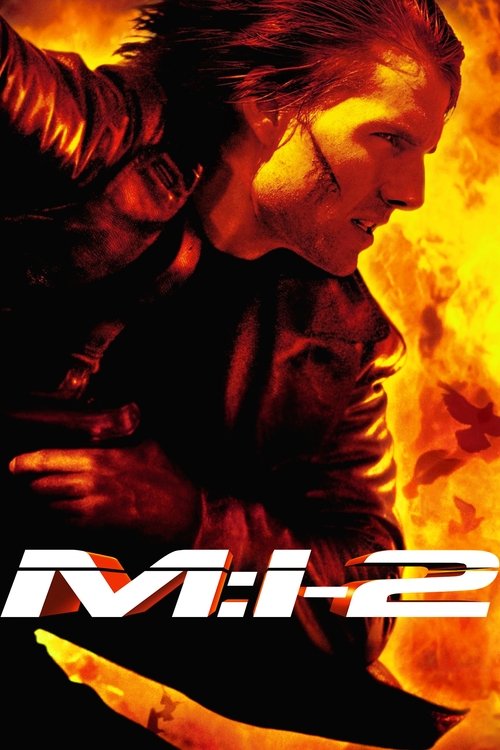
Mission: Impossible II
2000 · John Woo
For a turn-your-brain-off night when you want action at its most flamboyant — a so-extra-it's-glorious watch, great with friends and commentary. Comfort food, heavily seasoned.
What it's about
Ethan Hunt races across Australia and Spain to stop a rogue agent from unleashing a genetically engineered virus called Chimera — with a computer genius at his side and a beautiful thief he's fallen for caught in the middle. The mission is really a love triangle with a bioweapon in the center of it.
The experience
Deliriously stylized — slow-motion gun duels, fluttering doves, motorcycles jousting like knights — action as opera rather than realism. It's ridiculous and knows it; you either surrender to the excess or laugh at it, and either way it's never boring.
The craft
John Woo imported his Hong Kong action grammar wholesale into a Hollywood tentpole — mirrored standoffs, balletic slow motion, faces peeling into other faces — making this less an espionage film than a pure style delivery system. The set-pieces are choreographed like dance, and the sunbaked Spanish and Australian locations give it a heat most spy films lack.
Why it matters
A massive worldwide hit that kept the franchise alive, it stands as the boldest moment of Hong Kong action style crossing into the American blockbuster — divisive then, increasingly appreciated now as a full-tilt director's statement inside a studio machine.
Snapshot
John Woo's Mission: Impossible II is the most audacious experiment the Hollywood blockbuster conducted with Hong Kong action grammar in the late-studio era — a film that subordinates narrative almost entirely to the kinetics of the body in motion. Tom Cruise returns as IMF agent Ethan Hunt in a plot that cannibalizes Hitchcock's Vertigo (1958) while detonating itself across the sunbaked landscapes of Utah, Sydney, and Seville. The result is a work of extreme stylization — slow-motion doves, mirrored gun duels, faces dissolving into faces — that divided critics upon release but has gained retrospective appreciation as a maximalist auteur statement delivered inside a franchise machine. Its commercial triumph, grossing approximately $545 million worldwide, ensured the survival of the Mission: Impossible series even as it rerouted the franchise's DNA away from the cerebral paranoia of Brian De Palma's 1996 original toward pure kinetic spectacle.
Industry & production
The film emerged from the productive but creatively tense partnership of Tom Cruise and his producing partner Paula Wagner through their Cruise/Wagner Productions banner, with Paramount distributing. After De Palma's original had been a critical and commercial success built on Cold War spy-thriller conventions, Cruise and the producers sought a bolder stylistic departure for the sequel. The decision to hire John Woo — whose Hollywood trajectory had moved from the cult genre exercise of Hard Target (1993) through the mid-budget Broken Arrow (1996) to the baroque mainstream thriller Face/Off (1997) — was a deliberate escalation toward spectacle.
Reports from production suggest that Woo and Cruise operated under a complex collaborative arrangement in which Cruise retained significant creative authority, a dynamic that became a recurring subject in trade commentary about the film. Woo has spoken carefully about the collaboration, acknowledging shared creative ownership without detailing specific friction. What is documented is that production ran substantially over schedule and over its reported budget (estimated in the range of $125 million, though the final figure has been variably reported), partly due to Cruise's extensive stunt preparation and choreography-intensive action sequences. A notable downstream consequence: Dougray Scott, cast as the principal villain Sean Ambrose, was delayed by the overrun, causing him to forfeit the role of Wolverine in Bryan Singer's X-Men (2000) — a casting accident that gave Hugh Jackman the part that defined his career.
The screenplay credit went to Robert Towne — one of Hollywood's most prestigious script doctors, the author of Chinatown (1974) — working from a story attributed to Ronald D. Moore and Brannon Braga, writers who had built their careers in television. Towne's engagement carried prestige but the final film's narrative architecture, lean to the point of sparseness, bears the marks of a production process in which action set pieces preceded and motivated story rather than the reverse.
Technology
Woo and cinematographer Jeffrey L. Kimball — their second collaboration after Face/Off — employed a combination of high-speed photography, wirework, and practical stunt work that pushed against the emerging reliance on CGI that characterized Hollywood's turn into the new century. The opening sequence, in which Cruise free-solos a sheer cliff face at Dead Horse Point in Utah with no safety net visible onscreen (accomplished with a harness rig later digitally removed), announced the franchise's commitment to physical stunt performance as a brand value.
Action choreography drew heavily from Woo's Hong Kong practice: the collaboration included advisors and stunt coordinators experienced in the wire-assisted "gun-fu" that had characterized The Killer (1989) and Hard Boiled (1992). The climactic motorcycle sequence and hand-to-hand fight combined wirework with high-speed cinematography, requiring extensive pre-visualization and weeks of rehearsal. The film's optical effects — particularly the Chimera/Bellerophon biological weapon visualization — represent a relatively restrained use of digital compositing by the standards of the period.
The production's use of locations was technological as well as aesthetic. The Centennial Park and wilderness areas outside Sydney, and the Osborne circuit and Sevilla landscapes in Spain, were chosen partly for their photogenic extremity — wide skies and empty terrain that could isolate and magnify the human figure in motion, a consistent visual priority for Woo.
Technique
Cinematography
Jeffrey L. Kimball's work here extends and amplifies the approach he developed with Woo on Face/Off: a grammar of slow-motion inserts, rack-focus intimacy in close-up, and wide anamorphic frames that flatten foreground and background into graphic abstraction. The film operates in two distinct visual registers — the golden-lit warmth of Spain and Australia functioning as a kind of lyrical pastoral, interrupted by the steely blues and hard shadows of action sequences. Kimball makes frequent use of the extreme telephoto to compress spatial planes during the motorcycle duel, turning riders into silhouettes converging against blurred earth, an image that becomes almost heraldic.
The doves — Woo's signature — appear most prominently in the film's final fight, released into slow-motion flight as bodies collide, an ornamental flourish that operates as pure authorial signature and which critics, both admiringly and mockingly, cited as the film's most naked declaration of Woo's sensibility.
Editing
Editing was handled by Steven Kemper and Christian Wagner. The cut is rapid and rhythmically governed by the musical score, with action sequences broken into micro-units and reconstituted through graphic matches — a cutting strategy more aligned with the MTV-influenced action editing style of the period than with the spatial continuity Woo had practiced in Hong Kong. The tension between Woo's tendency toward prolonged, savored action beats and the Hollywood-blockbuster pressure toward velocity is legible in the film's rhythm: certain moments stretch into nearly operatic duration, while others compress. The result is an editing register that can feel internally inconsistent, though defenders argue this unevenness is itself expressive.
Mise-en-scène / staging
Woo's staging is architecturally symmetrical and frontally oriented in a way that derives from his Hong Kong work and ultimately from the kinetic staging of the Shaw Brothers martial arts tradition. Adversaries face each other across balanced space; the duel encodes a kind of tragic intimacy between hero and villain that verges on the homoerotic — Hunt and Ambrose are positioned throughout as doubles, a motif reinforced by the narrative's identity-swap mechanics. The face-mask technology, which had been a puzzle-thriller device in De Palma's film, becomes in Woo's hands a metaphysical conceit: the self is a surface, and beneath every surface is another face.
The set pieces are elaborately pre-designed as discrete units: the cliff-face prologue, the nightclub seduction sequence, the horse-riding meet-cute, the racetrack chase, the laboratory infiltration, the motorcycle duel, the beach fight. Each functions nearly as a self-contained performance in a different genre — heist, Western, road movie, martial arts film — assembled into a loosely sequenced anthology.
Sound
Hans Zimmer composed the score, building on Lalo Schifrin's iconic theme while pushing it toward rock-inflected symphonic bombast consistent with Zimmer's output in this period. The integration of guitar sonorities into the orchestral bed reflects both the franchise's desire for a contemporary sound and Woo's own affinities — the rock aesthetic had been a component of his Hong Kong films' soundtracks. Metallica's "I Disappear," written for the film's soundtrack, became a significant cultural moment independent of the film itself: the track was leaked via Napster prior to its official release, accelerating the band's high-profile legal action against the file-sharing service and making the song a flashpoint in the early music-industry wars over digital distribution.
Sound design during action sequences employs heightened foley and the characteristic slowing of diegetic sound during slow-motion — a technique Woo had established in Hong Kong as a way of aestheticizing violence, drawing attention to the sensory texture of impact, wind, and material deformation.
Performance
Tom Cruise operates here primarily as a physical instrument — the narrative's emotional demands are minimal, and Cruise channels his charisma into the controlled athleticism of stunt performance and the photogenic intensity of extreme close-up. His persona is less the cerebral tactician of De Palma's film than a neo-classical action hero in the tradition of the lone gunfighter, which suits Woo's thematic framework.
Thandie Newton as Nyah Hall brings considerably more complexity than the film's narrative asks of her, playing a character explicitly modeled (by Towne's own account) on Kim Novak's Madeleine/Judy in Vertigo — a woman manipulated by a male agent into an undercover role that endangers her, whose agency is finally constrained by the needs of the plot. Newton's performance works against the narrative's instrumentalization of Nyah, lending her scenes an emotional sharpness that the action-thriller frame cannot fully accommodate.
Dougray Scott's Ambrose is a functional heavy — charming, sadistic, and structurally a dark mirror of Hunt — but the role offers limited range. Anthony Hopkins appears in the briefing prologue as IMF director Swanbeck, lending establishment authority to the franchise handshake.
Narrative & dramatic mode
The film operates in a mode of pure action-melodrama: the biological threat (Chimera, a modified influenza with an engineered antidote, Bellerophon, held by the same criminal enterprise that produced the virus) functions as a MacGuffin of mass-casualty scale, but the real narrative engine is the love triangle between Hunt, Nyah, and Ambrose. The Vertigo borrowing is systematic: Nyah is inserted into a dangerous relationship by an authority figure who withholds his true motives, used as an instrument, and finally endangered by the logic of surveillance and control. The film's climax turns on her having infected herself with Chimera, which transforms the action conclusion into a medical countdown — a device that creates urgency without significantly complicating the action-film resolution.
The narrative's relationship to its Hitchcock source is both admitted and superficial: the architecture is borrowed, the metaphysical dread is absent. What Woo substitutes is a different kind of intensity — kinetic rather than psychological, visual rather than subjective.
Genre & cycle
MI:2 occupies a specific moment in the evolution of the Hollywood action blockbuster: post-The Matrix (1999), which had absorbed and domesticated Hong Kong action grammar through a science-fiction frame, the film represents a more direct, less mediated deployment of that grammar within a mainstream thriller. The late 1990s had seen a cluster of Hong Kong-influenced Hollywood productions — Woo's own Face/Off, the Wachowskis' The Matrix, McTiernan's Die Hard films in their earlier iterations — that collectively constituted a cycle of action cinema newly interested in the choreographic, the balletic, and the operatic.
The film also participates in the late-90s cycle of spy-franchise revivals: the James Bond series had been relaunched with GoldenEye (1995) and was producing increasingly spectacle-driven entries; the MI franchise represented a competing model rooted in television nostalgia but capable of absorbing auteur sensibilities. The bioterrorism plot — a pathogen engineered for profit — anticipates the post-9/11 thriller preoccupations that would dominate the genre in the following decade, though in 2000 it read primarily as a generic mechanism rather than a topical statement.
Authorship & method
John Woo brought to Hollywood a practice developed across two decades of Hong Kong genre filmmaking — from the heroic bloodshed films of the mid-1980s (A Better Tomorrow, 1986) through the operatic action of The Killer (1989) and Hard Boiled (1992). His Hong Kong work established a set of visual and thematic signatures — the balletic slow-motion gunfight, the double-fisted pistol, the dove as symbol of grace amid violence, the male bond-unto-death between adversaries — that collectively constituted one of the most recognizable directorial styles in world cinema.
His Hollywood transition produced films of varying integration: Face/Off (1997) is generally considered his most successful American work, a film in which the studio genre and Woo's sensibility found genuine synthesis. MI:2 represents a more unstable compound, in which Woo's stylistic maximalism is deployed within a franchise architecture that constrains his ability to develop the themes — loyalty, sacrifice, the doubling of identity — that his best work explores with tragic depth.
Jeffrey L. Kimball (cinematographer) collaborated with Woo closely enough to be considered a creative partner in establishing the film's visual grammar.
Hans Zimmer (composer) was in his peak commercial period, his rock-orchestral hybrid sound functioning as a period marker of 2000s blockbuster aesthetics.
Robert Towne (screenplay) brought literary prestige to the project; the extent of his creative control over the final shooting script, given the production's action-first development process, is difficult to assess from the available record.
Movement / national cinema
MI:2 stands as the most commercially successful expression of Hong Kong action cinema's Hollywood absorption — a process that had been underway since the early 1990s through the emigration of directors (Woo, Tsui Hark, Ringo Lam), choreographers (Yuen Wo-ping's work on The Matrix), and aesthetic conventions. The film is simultaneously a Hong Kong film by a Hong Kong director and a Hollywood blockbuster with no organic connection to Hong Kong — an index of how thoroughly the genre's forms had been denationalized by the time of its production.
The Australian locations connect the film to a specific period of American-Australian co-production in which Sydney's infrastructure and the Australian dollar's exchange rate made the country attractive for large American productions, though the landscape functions primarily as a visual vocabulary — heat, space, isolation — rather than as a culturally specific setting.
Era / period
The film is a precise artifact of the millennial blockbuster moment — post-Titanic (1997), post-Matrix (1999), in the final months before the September 2001 attacks would alter Hollywood's relationship to mass-casualty scenarios. Its bioterrorism plot, its extreme physical spectacle, its deployment of a prestigious-auteur director within a franchise, and its soundtrack's entanglement with the Napster crisis all locate it with unusual precision at the cultural hinge between the late 1990s and the early 2000s.
The film's extraordinary commercial performance — it ranked among the top-grossing releases of 2000 — makes it a data point in the consolidation of the summer blockbuster as the organizing event of Hollywood's commercial calendar, a consolidation that had been building since Jaws (1975) and Star Wars (1977) but reached a kind of systemic completion in the 1990s.
Themes
The film's central thematic preoccupation, carried over from Woo's Hong Kong work and inflected by the Vertigo borrowing, is the relationship between identity and surface. The face-mask device literalizes a philosophical concern: if the self can be worn and removed, what constitutes authentic selfhood? Woo's action heroes in Hong Kong consistently faced this question through the doubling of hero and villain — men who mirror each other in capability and are divided only by the moral choices encoded in their violence. Hunt and Ambrose are doubles of this kind: the film's staging and dialogue repeatedly insist on their structural equivalence.
The manipulation of Nyah — used as an intelligence asset by Hunt, exploited emotionally by Ambrose, finally endangered by both — raises questions about female agency and the ethics of instrumentalization that the film registers but does not resolve. The romantic narrative is ultimately absorbed by the action resolution: Nyah is saved, the mission is completed, and the moral complexity of Hunt's having endangered her is foreclosed by the genre's demand for a clean conclusion.
Redemption through sacrifice is a Woo constant; here it is displaced onto the villain's death and the heroine's near-martyrdom, which the hero's physical mastery prevents. The thematic architecture is present but compressed by the film's commitment to spectacle over interiority.
Reception, canon & influence
Critical reception at release was divided, roughly along lines of whether reviewers valued the film as spectacular entertainment or measured it against the narrative and psychological ambitions of De Palma's original. The film's ratio of action to character was widely noted; opinions differed as to whether that ratio was a failure or a feature. Roger Ebert's review was broadly appreciative of the film as a display of kinetic technique, while a number of critics found its deployment of Hitchcock's Vertigo structure reductive. The film's Rotten Tomatoes score, which settled at a majority-negative critical consensus over time, has become a routine citation in discussions of franchise quality inconsistency, though such aggregate metrics imperfectly capture the film's significant positive reception among viewers who engaged it on its own terms.
Influences on the film: The primary upstream influence is Hitchcock's Vertigo (1958) — the manipulation plot, the blonde-brunette doubling, the male authority figure's engineering of a woman's undercover role. Woo's own Hong Kong films, particularly The Killer and Hard Boiled, supply the action grammar. The spaghetti Western duel tradition, particularly Leone's operatic face-offs, informs the motorcycle confrontation. The Matrix's (1999) incorporation and normalization of wirework and bullet-time created both a competitive context and an audience prepared for stylized balletics.
Legacy and forward influence: The film's most significant legacy is within the Mission: Impossible franchise itself: by establishing the series as a directorial showcase — a vehicle in which a prominent auteur is given latitude to impose a distinctive sensibility — it created the template for subsequent installments. J.J. Abrams's Mission: Impossible III (2006) and Brad Bird's Ghost Protocol (2011) returned to the series with different auteur sensibilities, but both operated within the franchise's established willingness to subordinate house style to directorial personality. Christopher McQuarrie's subsequent entries (Rogue Nation, 2015; Fallout, 2018) consolidated and refined the stunt-driven action aesthetic that MI:2 had intensified.
More broadly, the film's saturated color palette, its stylized use of slow motion, and its gun-fu choreography participated in the wider diffusion of Hong Kong action aesthetics into mainstream Hollywood that produced, within the decade, a variety of hybrid action films. The Woo-style moment of doves-in-slow-motion became culturally shorthand — affectionate parody in Shoot 'Em Up (2007), earnest homage in various action films of the early 2000s — signaling the degree to which Woo's visual language had entered the common grammar of commercial cinema.
The Metallica-Napster episode, while incidental to the film's artistic identity, made MI:2 a node in the cultural history of digital distribution and intellectual property — a notoriety that outlasts most discussions of the film's action sequences in certain technological and legal histories.
Scholarship on Woo tends to position MI:2 as the limit case of what happens when his stylistic method is deployed without the emotional stakes and moral seriousness of his best Hong Kong work: a film that demonstrates both the portability of his grammar and the conditions of depth that grammar requires to mean something beyond its own beauty.
A Deleuzian reading
Two men hit the sand and a dove goes up.
The full Deleuzian reading of Mission: Impossible II →
Reception
The biggest box-office hit of 2000 worldwide, it drew shrugs from critics even then — and as the franchise reinvented itself as a precision stunt machine, M:I-2 settled in as the entry everyone ranks last. Lately it's picked up a vocal defense squad who treat Woo's slow-mo excess as the feature, not the bug.
How Mission: Impossible II was received, from release to now →
Influences: the films it descends from and the films it influenced
- Vertigo (1958) — Robert Towne's screenplay directly replicates Hitchcock's structural premise — a man coercing a woman to impersonate a dead rival so that his romantic obsession can be resolved — transposing the Novak/Carlotta doubling into Nyah's impersonation of Ambrose's ex-lover as the spy plot's engine.
- The Wild Bunch (1969) — Woo's use of high-speed photography to transform the moment of violence into lyrical slow-motion spectacle — the aesthetic and philosophical basis of his entire filmography — is Peckinpah's invention, explicitly cited by Woo as the technical source he imported wholesale into Hong Kong cinema and then into MI:II.
- A Better Tomorrow (1986) — Originated the heroic bloodshed visual grammar MI:II directly inherits: dual-pistol symmetrical gunplay staged as ballet, white doves released as spiritual counterpoint to killing, and the action-melodrama fusion where romantic sacrifice and gun violence carry equal emotional freight.
- The Killer (1989) — Established the mirrored protagonist-antagonist face-off as the climactic convention, the heightened Foley design that makes slow-motion gunfire tactile and musical simultaneously, and the gun-fu choreography of bodies as weaponized instruments — all directly extended in MI:II's beach finale.
- Hard Boiled (1992) — Introduced wire-assisted mobility that transforms gunfighters into aerial dancers and the philosophy of the sustained action sequence as kinetic aria — both migrate directly into MI:II's motorcycle duel and climactic hand-to-hand choreography.
- Hard Target (1993) — Woo's first Hollywood production established the template for translating Hong Kong gun-fu grammar into American studio filmmaking under MPAA constraints, using wirework and slow-motion inserts in a genre context — MI:II is the full commercial and aesthetic maturation of that Hollywood-adaptation experiment.
- Mission: Impossible (1996) — Established the franchise's impossible-disguise mechanics and Hitchcockian identity-paranoia architecture that MI:II inherits as narrative scaffolding, while deliberately dismantling De Palma's cerebral suspense register and replacing it with Woo's melodrama-action mode.
- Face/Off (1997) — Immediate technical precursor in every dimension: Jeffrey L. Kimball's anamorphic slow-motion cinematography, the identity-swap narrative engine, dove staging as authorial signature, and the physical-melodrama emotional register are all rehearsed here and carried forward unchanged into MI:II.
- The Matrix (1999) — Legitimized wire-assisted choreography and slow-motion ballistic action at Hollywood blockbuster scale immediately before MI:II's production, creating the audience expectation and studio tolerance for wirework gun-fu that made Woo's approach commercially viable rather than marginal.
- Equilibrium (2002) — The diegetic gun-kata fighting system is a direct formal codification of MI:II's gun-fu premise: the idea that firearms choreography could be a kinetic martial art with geometrically precise body positions, elevated from action-film grammar into a narratively grounded discipline.
- Crank (2006) — Extends MI:II's implicit argument that kinetic spectacle can substitute for narrative architecture into pure formal experiment, inheriting the commitment to the body-as-instrument as the film's primary aesthetic object while stripping away any remaining melodrama scaffolding.
- Shoot 'Em Up (2007) — A sustained formal homage and deconstruction of Woo's gun-fu grammar: dove iconography, dual-pistol choreography, and slow-motion inserts are all present but rendered deliberately absurdist, confirming that MI:II's visual language had become canonical enough to serve as the object of parody.
- Wanted (2008) — Extends MI:II's graphic-match cutting and slow-motion ballistic choreography into animation-adjacent abstraction — curved bullet trajectories and impossible kinetic geometry push the gun-fu grammar beyond physical plausibility into the pure action-fantasy register that MI:II's wirework had already been nudging toward.
- The Replacement Killers (1998) — A parallel Hong Kong-to-Hollywood gun-fu translation starring Chow Yun-fat that deploys the same slow-motion inserts, dual-pistol symmetrical staging, and action-melodrama emotional register — a direct competitor to MI:II in establishing heroic bloodshed as a viable American action grammar.
- Windtalkers (2002) — Woo applies the identical Hollywood cinematographic grammar — slow-motion, Kimball-register anamorphic frames, melodramatic action staging — to a WWII combat context, demonstrating that MI:II's visual language was Woo's stable American mode rather than a franchise-specific adaptation.
Similar films
- Mission: Impossible (1996) — influence & lineage · often watched together
- Hard Boiled (1992) — influence & lineage · often watched together
- Face/Off (1997) — influence & lineage
- The Killer (1989) — influence & lineage
- A Better Tomorrow (1986) — influence & lineage
- The Matrix (1999) — influence & lineage
- Vertigo (1958) — influence & lineage · often watched together
- Mission: Impossible - The Final Reckoning (2025) — often watched together