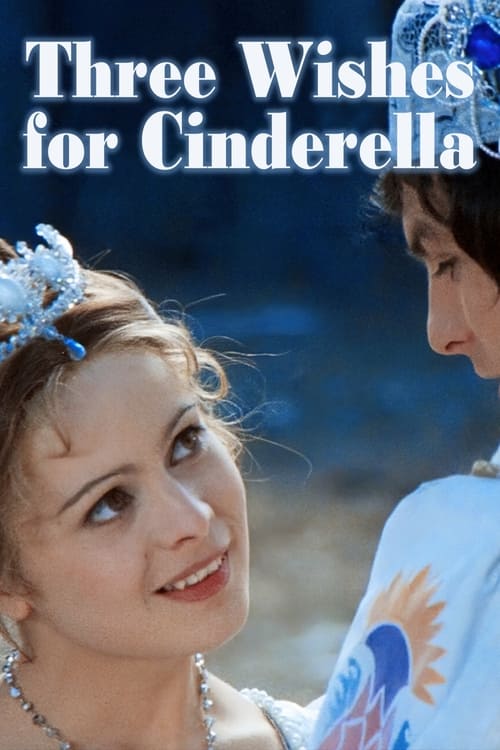
Three Wishes for Cinderella
1973 · Václav Vorlíček
For a cozy snowy-evening watch with the whole family, or when you want a fairy tale that makes you grin instead of roll your eyes. Pure comfort, best with something warm in hand.
What it's about
Popelka is the orphaned servant of a scheming stepmother in a snowbound Bohemian manor, but she's nobody's victim — she rides better, shoots a crossbow straighter, and thinks faster than the prince who keeps crossing her path. When three magic hazelnuts come into her hands, each grants a wish, and she uses them on her own terms: to test, tease, and outwit her way toward a love she chooses rather than waits for.
The experience
Playful, brisk, and glowing with real winter — snow-covered forests, firelit halls, a heroine with a permanent glint of mischief. It's warm without being syrupy, and its romance works because the two leads genuinely spar.
Performances
Libuše Šafránková's Popelka is the whole show — quick, self-possessed, and radiantly funny, she made the character a beloved icon across half of Europe.
The craft
The masterstroke is setting Cinderella in deep winter instead of storybook spring: shot around real castles in genuine snow, it looks like no other version of the tale. The production design and lilting, instantly hummable score give it a handmade sparkle that modern effects-driven fairy tales can't fake.
Why it matters
It became an annual Christmas-television ritual in the Czech Republic, Germany, Norway, and beyond — for generations of Europeans, it simply is Christmas — and its self-rescuing heroine quietly predated decades of 'active princess' revisions.
Snapshot
Three Wishes for Cinderella — Czech Tři oříšky pro Popelku, German Drei Haselnüsse für Aschenbrödel, and literally "Three Nuts (Hazelnuts) for Cinderella" — is a Czechoslovak–East German fairy-tale film directed by Václav Vorlíček and released in 1973. It reworks the Cinderella story through the Bohemian literary tradition of Božena Němcová, grafting onto it the magical hazelnuts that descend, ultimately, from the Brothers Grimm's Aschenputtel. Its defining gesture is twofold: it sets the tale in deep winter snow rather than in the conventional storybook spring, and it recasts its heroine, Popelka, as an active, resourceful, horse-riding, crossbow-wielding young woman who tests and teases the prince rather than waiting passively to be rescued. Shot largely at Moritzburg Castle in Saxony and Švihov Castle in Bohemia, and built on the pairing of Libuše Šafránková and Pavel Trávníček, the film became one of the most durable pieces of Central and Northern European popular culture — an unbroken Christmas television fixture in Germany, Norway, the Czech Republic, Slovakia and beyond for half a century.
Industry & production
The film is a co-production between the Czechoslovak state studio Barrandov (Prague) and DEFA, the state film enterprise of the German Democratic Republic, whose fairy-tale unit operated out of Babelsberg. Such bilateral arrangements were standard within the Eastern Bloc: they pooled scarce hard resources, spread costs, gave each partner a finished film for its domestic distribution, and let a production draw on locations and talent across two countries. Here the arrangement is legible in the cast, which mixes Czech and East German performers, and in the fact that two distinct language versions were prepared for the two home markets, with somewhat different edits (see Editing).
Production sits squarely inside the Czechoslovak "normalization" era — the period of political retrenchment that followed the crushing of the Prague Spring by the 1968 Warsaw Pact invasion. In that climate, the pohádka (fairy tale) was a comparatively safe genre: distant from contemporary politics, aimed at family audiences, and welcomed by the authorities. This partly explains the concentration of directorial energy on such projects in the 1970s. Vorlíček, already an experienced genre craftsman, was well suited to the assignment. The screenplay is credited to František Pavlíček, working from Němcová; Pavlíček was a writer whose standing under normalization was precarious and who would become associated with the dissident milieu around Charter 77 later in the decade. The precise contractual details of his credit are a point where the popular record should be treated with care rather than embellished.
Financial specifics — budget and box-office returns — are not the kind of figures that were reported in the Western sense for state-socialist productions, and I will not invent numbers; the film's "success" is better measured in its extraordinary broadcast longevity than in any release-year gross.
Technology
Technologically the film is conventional for a well-resourced Eastern Bloc production of its moment: 35mm color, location and studio shooting, orchestral score recorded to picture. DEFA and Barrandov both worked in color by this date, and the film's look is consistent with the ORWO color stock used in the GDR — a palette that reads slightly cooler and less saturated than Western Eastmancolor, which suits the snowbound setting. There is no optical or special-effects showmanship of the kind associated with, say, Karel Zeman; the "magic" of the acorns is achieved through simple, unobtrusive means — costume changes, staging, and cutting — rather than trick photography. The salient production-technology story is environmental rather than mechanical: a winter shoot dependent on real snow, with the attendant continuity and scheduling difficulties that such conditions impose. That the film had to reconcile snowy and less-snowy footage is part of its well-known production lore, though specific day-to-day accounts should be reported cautiously.
Technique
Cinematography
The photography is by Josef Illík, a seasoned Czech cinematographer. His work here is central to the film's identity. The decision to shoot in winter gives the images a distinctive graphic clarity: dark figures, horses and bare trees set against white ground, with the castle architecture reading as silhouette and mass. Illík favours clean, legible compositions and a naturalistic use of the low winter light, which lends the hunting and riding sequences a crisp, outdoor energy rare in fairy-tale cinema, where soundstage artifice is the norm. The interiors, by contrast, are warmer and more enclosed, so that the film alternates between the cold freedom of the forest — Popelka's element — and the domestic confinement of the stepmother's household.
Editing
The most concrete editing fact about the film is that it exists in more than one cut: the Czechoslovak and East German versions differ in length and detail, a natural consequence of the co-production preparing separate releases for separate audiences. Within scenes, the cutting is classical and economical, prioritizing narrative clarity and the comic or romantic beat over stylistic display; the film moves briskly for a family picture. The identity of the editor is a detail on which I would rather flag the record as thin than assert a name I cannot confirm.
Mise-en-scène / staging
The staging repeatedly organizes itself around Popelka's mobility. She is framed on horseback, in trees, in disguise, in motion — against a stepmother and stepsister who are framed within rooms, mirrors and social ritual. The three transformations granted by the hazelnuts (a huntsman's outfit, a ball gown, a bridal dress) are staged as reveals that shift her legibility to the other characters, and the film's most famous set piece — the ball, and the riddle Popelka poses to the prince — turns on costume and recognition rather than spectacle. Locations do heavy dramaturgical work: Švihov stands in for the household world, while Moritzburg's silhouette supplies the royal, aspirational world across the snow.
Sound
The score by Karel Svoboda is inseparable from the film's memory; its main theme is among the most recognizable pieces of Czech film music, and the film's enduring seasonal broadcast has fixed it in the ears of several national audiences. Svoboda, a prolific composer of popular and screen music, gives the film a lyrical, hummable romanticism that carries the emotion the restrained cutting deliberately underplays. A song associated with the film's musical world, "Kdepak, ty ptáčku, hnízdo máš," circulates in Czech popular culture in connection with it, though the exact relationship between song and film soundtrack is a detail worth stating carefully rather than overclaiming. Dialogue and voice are themselves a production fact of note: because of the bilingual co-production and the practice of post-synchronisation, the two national versions carry different voice performances, and in the Czech version the prince was dubbed by another actor rather than voiced by Trávníček himself.
Performance
Libuše Šafránková's Popelka is the film's engine and the reason for its afterlife. She plays the heroine not as a martyr of patience but as quick, wry, physically capable and self-possessed — sorrowful in servitude but never servile in spirit. The performance made her a lasting star of Czech cinema. Pavel Trávníček's prince is boyish and headstrong, a foil whose growth is to earn Popelka's regard rather than simply bestow his own. The supporting playing is broad in the manner the genre invites: the stepmother and stepsister as comic-grotesque obstacles, and the East German actor Rolf Hoppe lending genial weight as the King. The ensemble's tonal balance — sincerity in the leads, comedy at the margins — is a large part of why the film reads as warm rather than saccharine.
Narrative & dramatic mode
Structurally the film is a wish-fulfilment fairy tale, but its dramatic mode is closer to romantic comedy than to solemn wonder-tale. The three hazelnuts function as a fairy-tale triad of gifts, each unlocking a disguise that lets Popelka cross a social threshold otherwise closed to a servant. Crucially, agency is relocated to the heroine: she chooses when to reveal and conceal herself, she bests the prince at hunting and archery before she charms him, and the climactic recognition is gated by a riddle she sets him, inverting the usual dynamic in which the prince conducts the search. The mode is thus playful and slightly ironic, courting the audience's pleasure in a heroine who is smarter and more skilled than her would-be rescuer, while retaining the reassuring shape of the classic tale.
Genre & cycle
The film belongs to two overlapping national fairy-tale cinemas. On the Czechoslovak side it stands in the tradition of the live-action filmová pohádka, whose earlier landmarks include Bořivoj Zeman's The Proud Princess (1952); on the German side it joins DEFA's substantial Märchenfilm output, a post-war program of fairy-tale features aimed at children and families. Vorlíček's own filmography places it within a personal cycle of fantasy and genre work — he is also known for the comic science-fiction of Who Wants to Kill Jessie? (1966), the witch comedy The Girl on the Broomstick, and, later, the enormously popular fantasy television serial Arabela. Three Wishes for Cinderella is the crowning, most exportable instance of that cycle, and arguably the single most internationally beloved product of either studio's fairy-tale line.
Authorship & method
The film is best understood as the meeting of several strong collaborators around Vorlíček's assured genre direction. Vorlíček's method throughout his career was to take fantastical or fairy-tale premises and play them with a light, humane, faintly ironic touch, trusting narrative momentum and performance over heavy stylization — an approach perfectly matched to this material. Josef Illík's winter cinematography supplies the visual signature; Karel Svoboda's score supplies the emotional and mnemonic one; František Pavlíček's screenplay supplies the decisive interpretive choice — the active Popelka drawn from Němcová's literary sensibility — that distinguishes the film from every softer Cinderella. Above all, Libuše Šafránková's casting is itself an authorial act: her particular blend of melancholy, wit and competence is what the film's conception of the heroine requires, and no small part of the film's meaning is carried in her performance rather than in the script alone.
Movement / national cinema
The film is not a work of a self-conscious art movement but of two state cinemas at a specific historical juncture. On the Czech side, it comes after the internationally celebrated Czechoslovak New Wave of the 1960s had been shut down by normalization; many of that movement's directors were silenced or exiled, and genre and children's cinema became a refuge for craft. Vorlíček, never a New Wave figure in the strict sense, exemplifies the skilled genre professionalism that continued to thrive when more overtly critical filmmaking could not. On the German side, the film belongs to DEFA's institutional culture of family and fairy-tale production. Its cross-border character — Czech and German cast, dual versions, shared locations — makes it a representative artifact of Eastern Bloc co-production practice as much as of any single national cinema.
Era / period
1973 places the film in the earlier, hardening years of Husák-era normalization in Czechoslovakia and in the mature GDR of the Honecker period. In both states, culture aimed at children and families operated under lighter ideological scrutiny than adult drama, and the fairy tale offered a domain of relative creative safety. It is one of the quiet ironies of the period that a film so bound up with the constraints of its moment — a politically "safe" genre, a co-production of censorship-era state studios, a screenwriter whose freedom was shrinking — should have produced so free-spirited a heroine and so lasting a public affection, one that would ultimately outlive the political order that made the film.
Themes
The governing theme is agency won from constraint: a servant who refuses the passivity her position and her genre assign her. Around it cluster several others. Disguise and true identity — the film repeatedly asks who Popelka "really" is beneath her ash-stained servitude and her borrowed finery, and answers that her worth is intrinsic, revealed rather than conferred by the gowns. Merit versus rank — she earns the prince by out-riding and out-shooting him, so that love follows respect. Nature versus household — the snowy forest is the space of her freedom and skill, the stepmother's house the space of her oppression. And a gentle proto-feminist reversal of the courtship plot, in which the woman sets the terms of recognition. These readings are grounded in the film's own action; its lasting appeal owes much to the fact that its "message" is carried by plot and character rather than delivered as moral.
Reception, canon & influence
Backward (influences on the film): The film descends from a documented literary and cinematic lineage — Božena Němcová's nineteenth-century retelling of the Cinderella tale, the Grimm motif of the wishing hazel/hazelnuts, and the established Czech and DEFA fairy-tale film traditions that gave Vorlíček his idiom and his production apparatus.
Contemporary and critical reception: Contemporary domestic reception was warm, and the film quickly entered the seasonal viewing repertoire of its home countries; I would rather characterize this in terms of its evident popular embrace than cite specific reviews or figures I cannot verify.
Forward (legacy): The legacy is exceptional. The film became a fixed Christmas television ritual across Germany, the Czech Republic, Slovakia, Norway, and other European countries, broadcast annually for decades and beloved across generations — a rare instance of a socialist-era production achieving unbroken pan-European affection after the fall of the Bloc. Moritzburg Castle, its principal royal location, became a site of Cinderella-themed tourism and seasonal exhibition. In Norway, where the film enjoys near-national-treasure status, its popularity was distinctive enough to prompt a full Norwegian remake, Three Wishes for Cinderella (Norwegian Tre nøtter til Askepott, 2021). Libuše Šafránková remained identified with the role for the rest of her life and is mourned as one of Czech cinema's most cherished figures. Half a century on, the film is canonical less through critical enshrinement than through the more durable route of collective memory — the standard by which the Cinderella story is imagined for millions of viewers in Central and Northern Europe.
Reception
A modest Czechoslovak–East German fairy-tale co-production that quietly became one of Europe's biggest Christmas TV rituals — broadcast every December in the Czech Republic, Germany, and famously on Norwegian TV on Christmas Eve morning, where whole generations grew up with it.
How Three Wishes for Cinderella was received, from release to now →
How to watch Three Wishes for Cinderella: what to notice on a first viewing
- Notice the dark figures and horses against white snow. Illík shoots almost entirely in winter, so riders and bare trees read as silhouette and mass against a bright snowfield, unusual for a fairy tale. The winter setting gives the images a graphic clarity most storybook films never bother with.
- Watch Popelka on horseback versus the stepmother indoors. The staging keeps Popelka in motion, riding, climbing, in disguise, while the stepmother and stepsister stay framed within rooms, mirrors, and social ritual. Mobility itself is the film's argument for who actually has the freedom here.
- Watch Šafránková play sorrow without ever playing servility. She plays Popelka as quick, wry, and physically capable, sorrowful in her circumstances but never bowed by them, even in the household scenes. You can see her self-possession in her posture before the story gives her a single line to prove it.
- Listen for Karel Svoboda's main theme returning throughout. The lyrical, hummable score carries the emotion the restrained cutting deliberately underplays, becoming one of the most recognizable pieces of Czech film music. The music is doing the emotional work the images and editing are keeping deliberately plain.
The whole guide to watching Three Wishes for Cinderella, with the keys for a rewatch →
Influences: the films it descends from and the films it influenced
- Pyšná princezna (1952) — Founded the Barrandov live-action pohádka idiom this film inherits — location-shot painterly landscapes, sung lyrical interludes, and the assertive-princess template that Pavlíček's active Popelka directly extends.
- Byl jednou jeden král... (1955) — Canonized the Czechoslovak studio method of playing the fairy-tale straight with a humane, faintly ironic comic register — the exact tonal control Vorlíček adopts, trusting performance and narrative momentum over stylization.
- Das kalte Herz (1950) — DEFA's first color Märchenfilm (Agfacolor), it established the East-German fairy-tale production apparatus and the saturated color-fairy-tale look the ORWO-stock, DEFA-co-produced German side of this film descends from.
- Morozko (1964) — Codified the Slavic winter-location fairy tale shot in real snow and low seasonal light with folkloric naturalism — the snowbound-forest cinematography Josef Illík carries directly into this film.
- La Belle et la Bête (1946) — Made costume-and-transformation the load-bearing narrative device of fairy-tale cinema — the disguise/true-identity dramaturgy on which this film's ball-gown and huntsman-costume reveals depend.
- Cinderella (1950) — The formal template — ball, midnight deadline, slipper-test — that Vorlíček retains structurally as a romantic-comedy scaffold while pointedly inverting its passive heroine into an agential one (the defining foil).
- Malá mořská víla (1976) — Re-casts Libuše Šafránková as the melancholic fairy-tale heroine, extending the specific 'Šafránková-as-authorial-presence' casting logic — her blend of wit, competence and sadness carrying meaning the script alone does not.
- Princ a Večernice (1978) — Later Vorlíček winter-set pohádka reassembling the same collaborators' idiom — snow-location photography, folk-comic staging and a resourceful protagonist — as a direct continuation of this film's method.
- Sůl nad zlato (1983) — Slovak live-action pohádka extending the agency-won-from-constraint heroine and the studio tradition's mix of location shooting and moral-folk comedy into the following generation.
- S čerty nejsou žerty (1985) — Carries forward the quick-witted, self-rescuing folk heroine and the ironic-humane comic register of the normalisation-era pohádka that this film had crystallized.
- Cinderella (2015) — Returns Cinderella to location-shot live action built around the costume/ball-gown reveal as a set-piece — the transformation-as-staging device that this film, not the Disney cartoon, had grounded in real spaces.
- Tre nøtter til Askepott (2021) — Direct Norwegian remake that reproduces the exact craft signature — winter-location shooting in low seasonal light, the three-costume/huntsman disguise reveals, and the active, hunting Popelka conception.
- Kdo chce zabít Jessii? (1966) — Established Vorlíček's authorial method of staging the fantastical with deadpan straight-faced comic timing and brisk classical cutting — the same economical, momentum-first construction reused here.
- Dívka na koštěti (1972) — Immediately prior Vorlíček fantasy comedy built on a witty, self-directing young heroine and a light ironic touch — the register and heroine-conception carried straight into Popelka.
- Šíleně smutná princezna (1968) — Contemporaneous Czech musical pohádka whose song-driven, melodically-signposted structure is the sung-fairy-tale idiom Karel Svoboda's mnemonic score answers within the same tradition.
- Ever After (1998) — Independently strips the magic from Cinderella and rebuilds her as an agential heroine who effects her own rescue — the same heroine-agency inversion, executed with location realism rather than animated fantasy.
Similar films
- Cinderella (2015) — influence & lineage
- Wonka (2023) — shared sensibility
- The Snow Queen (1957) — shared sensibility
- The Peasants (2023) — shared sensibility
- Klaus (2019) — shared sensibility
- Valerie and Her Week of Wonders (1970) — shared sensibility
- The Ugly Stepsister (2025) — shared sensibility
- Howl's Moving Castle (2004) — shared sensibility