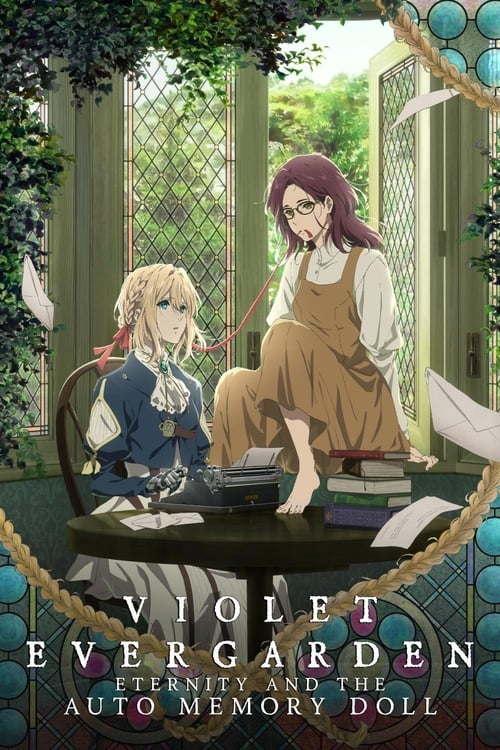
Violet Evergarden: Eternity and the Auto Memory Doll
2019 · Haruka Fujita
For a soft, rainy-evening watch when you want something beautiful that makes you feel — and maybe cry — without ever getting dark or cynical. Pure comfort with an ache in it.
What it's about
Violet, a former child soldier who now works as a professional ghostwriter of letters, is hired as a private tutor for Isabella, a lonely heiress sequestered at a strict girls' boarding academy. Isabella wants nothing to do with her polished new companion, but Violet's patience and her strange, hard-won gentleness slowly open a door. Behind Isabella's coldness is a person she loved and lost track of — and a letter she has never been able to send.
The experience
Quiet, tender, and unhurried — a chamber piece that builds its emotion in small gestures, dance lessons, and hesitations, then lands it with real force. It's gorgeous to look at and openly sentimental in the best way; keep tissues within reach.
The craft
Kyoto Animation's craft is the star: painterly light through academy windows, lace and hair animated with absurd care, and character acting told through posture and hands rather than dialogue. The pastel period-fantasy world — part steampunk, part postwar Europe — rewards a big, bright screen. Its ninety minutes are shaped like two linked short stories, each built around a letter.
Why it matters
Released between the acclaimed 2018 series and the 2020 finale film, it proved the franchise could carry a theatrical feature — and stands as a testament to Kyoto Animation's studio craft at a poignant moment in its history.
Snapshot
Violet Evergarden: Eternity and the Auto Memory Doll (ヴァイオレット・エヴァーガーデン外伝 —永遠と自動手記人形—) is a feature-length side story ("gaiden") in Kyoto Animation's Violet Evergarden franchise, released in Japanese cinemas on 6 September 2019 and directed by Haruka Fujita. It stands between the 2018 television series and the 2020 capstone Violet Evergarden: The Movie, adapting an episode of Kana Akatsuki's light novels in which Violet — the traumatized former child soldier turned "Auto Memory Doll," a professional ghostwriter of letters — is engaged as a tutor and companion for a lonely heiress at a girls' academy. Roughly ninety minutes long, the film narrows the series' epistolary premise to a chamber drama about class, coerced femininity, and the letters people cannot bring themselves to send. It is also, unavoidably, a film marked by tragedy: it reached theaters less than two months after the arson attack on Kyoto Animation's Studio 1 on 18 July 2019, one of the deadliest such crimes in modern Japanese history, which killed thirty-six people and devastated the studio that made it.
Industry & production
The film was produced by Kyoto Animation ("KyoAni"), a studio distinguished within the Japanese anime industry by an unusual business model: it employs its animators as salaried staff rather than freelance piece-workers, runs its own in-house training and light-novel imprint (KA Esuma Bunko), and tends to originate projects from properties it owns or cultivates. Violet Evergarden began life as a submission to the Kyoto Animation Award — Kana Akatsuki's novel took a grand prize — and was developed internally, giving the studio rights and creative control rare among adaptation-driven anime.
Eternity and the Auto Memory Doll was conceived as a theatrical side story bridging the TV series and the forthcoming feature, a common release strategy in which a franchise sustains audience attention (and box-office relationships with exhibitors) between major installments. Its production overlapped with one of the most catastrophic events in the medium's history. The 18 July 2019 arson struck the studio during the broader Violet Evergarden production period; precisely how the attack affected this specific film's post-production is not something I can document with confidence, and I will not speculate on internal detail. What is certain is that the film opened as scheduled in early September 2019, and that the franchise's continuation — including the 2020 movie's delayed release — unfolded in the shadow of that loss. Box-office figures for a limited-run side story of this kind are not something I can cite reliably, and I will not invent them.
Technology
The film was produced with Kyoto Animation's characteristic digital pipeline: hand-drawn 2D character animation composited digitally over painted and digitally-assembled backgrounds, with extensive use of digital compositing ("satsuei," photography) for lighting, atmosphere, depth-of-field effects, lens flares, and the soft bloom that defines the studio's late-2010s look. The Violet Evergarden franchise as a whole is notable for the density of its digital finishing — layered light, particulate air, reflective surfaces — deployed to lend a hand-drawn image the tactile richness of live-action photography. This film continues that approach at feature scale. Sparing, restrained use of 3DCG appears in service of complex mechanical or architectural elements typical of the series' quasi-Edwardian setting, integrated to sit beneath the 2D linework rather than call attention to itself. Beyond these general observations, granular technical specifications (frame counts, specific software) are not reliably part of the public record.
Technique
Cinematography
As with all animation, "cinematography" here denotes composed staging, virtual camera, and the photographic finishing that simulates a lens. The film favors the franchise's signature grammar: patient wide and medium shots that place figures within grand interiors — dormitories, corridors, the halls of the academy — using window light and lamplight as expressive instruments. Shallow simulated depth-of-field isolates faces and hands; racking focus and rim-lighting carry emotional beats without dialogue. The identity of the film's director of photography (satsuei kantoku) is a specific credit I cannot attribute with certainty, so I will not name one. What can be said is that the imagery extends KyoAni's house style of luminous naturalism, where the drama of a scene is often located in the play of light across a face turned toward or away from a window.
Editing
The cutting is deliberate and unhurried, built around held reactions and the rhythm of gesture rather than incident — a pace suited to a story about waiting, watching, and the slow closing of emotional distance. Scenes are allowed to breathe, with cuts motivated by shifts in attention (a glance, a hand reaching) more than by action. I cannot confidently attribute the editor of record for this particular film and will not guess at the name; the observable style is consistent with the measured, character-first editing of the parent series.
Mise-en-scène / staging
Production and staging are among the film's strongest assets. The setting — a European-inflected girls' academy in the series' post-war, roughly early-twentieth-century-analogue world — is realized with the studio's obsessive material detail: tea services, uniforms, ironwork, the choreography of etiquette lessons. Blocking is organized around hierarchy and constraint: the heiress is repeatedly framed as enclosed by architecture and by the expectations of her class, while Violet's upright, formal bearing (a residue of her military past) is staged against the softer bodies of the schoolgirls. Costume functions dramatically, marking rank, discipline, and performance of femininity. The recurring motif of the letter — paper, ink, the physical act of writing — is given tactile weight in close staging of hands.
Sound
Composer Evan Call, who scored the Violet Evergarden series, provides the film's music, continuing the franchise's lush orchestral idiom of strings and piano that underscores its epistolary sentimentality. The sound design leans on quiet: rustling fabric, footsteps in stone corridors, the scratch of a pen, ambient room tone that makes silence expressive. Music is generally reserved for emotional crescendos, particularly around the disclosure and delivery of letters. Specific insert or theme-song credits for this side story are not something I can confirm precisely, so I refrain from asserting them.
Performance
Voice performance carries the intimate register the story demands. Yui Ishikawa reprises Violet, sustaining the character's flat, formal diction — the vocal signature of someone taught emotion secondhand — so that small inflections register as major events. The film's dramatic weight rests heavily on the young heiress's arc, and the interplay between Violet's guarded delivery and the girl's more volatile, wounded voicing generates its central tension. Performance in this register is a matter of restraint: the actors underplay, letting the animation of eyes and hands complete the emotion.
Narrative & dramatic mode
The film is an intimate, melodramatic chamber piece organized around the franchise's core conceit: Violet is an "Auto Memory Doll," hired to write letters that give voice to feelings her clients cannot express. Here the assignment is unusual — she is placed at a women's academy as a tutor and social companion to a solitary young heiress being groomed for an advantageous marriage and a public debut. The dramatic mode is one of gradual emotional thaw between two constrained figures, culminating in the writing and sending of a letter that reconciles severed family ties. It is a two-hander built on suppressed feeling, secrets withheld and finally spoken, and the belated arrival of words that heal. The structure is quietly bifurcated, characteristic of the source material's short-story form: an initial movement at the academy gives way to a coda that widens the emotional aperture toward family and continuity — the "eternity" of the title, love and words that outlast the moment. Sentiment is the explicit aim; the film does not disguise its intent to move.
Genre & cycle
Formally it sits at the intersection of drama, fantasy, and animation. Its "fantasy" is soft and atmospheric — a secondary world with the texture of a post-Great-War Europe, technologically anachronistic (typewriters and telephones alongside the fictional Doll profession) rather than magical. Within anime taxonomy it belongs to the character-driven, emotionally earnest drama that Kyoto Animation made a house specialty in the 2010s, adjacent to the studio's iyashikei ("healing") sensibility and to the broader cycle of prestige anime melodrama aimed at adult and crossover audiences. It is also part of a specific commercial cycle: the franchise-bridging theatrical side story, a form that treats a beloved TV property as a continuing world worth revisiting on the big screen between seasons and features.
Authorship & method
Direction is credited to Haruka Fujita, a Kyoto Animation staff director who worked within the studio's system and on the Violet Evergarden series before helming this side story; the film is very much an expression of the studio's collective house style rather than a radical auteur statement, though Fujita's handling favors intimacy and stillness. The overarching creative identity of the franchise was set by series director Taichi Ishidate, who would go on to direct Violet Evergarden: The Movie (2020), and this film operates in continuity with that established design language. The source is Kana Akatsuki's light novels, with the franchise's distinctive character designs derived from Akiko Takase's work adapting the original illustrations into animation. Music is by Evan Call. Yui Ishikawa anchors the voice cast as Violet. For several below-the-line feature credits specific to this side story — screenwriter of record, director of photography, editor — I cannot supply confidently attributed names, and rather than risk error I note the gap; the reliable through-line is that the film was made by KyoAni's in-house teams working in the established franchise idiom.
Movement / national cinema
The film belongs to Japanese commercial animation and, more specifically, to the Kyoto Animation "school" — a studio whose salaried, craft-intensive model and pursuit of photographic delicacy set it apart within the industry and made "KyoAni quality" a recognized shorthand for high-fidelity character animation and lighting. It sits within the tradition of anime as a mainstream theatrical and televisual art form in Japan, and within the 2010s wave of prestige, emotionally driven anime that circulated internationally through streaming and simulcast. Its European-flavored setting participates in a long anime lineage of romanticized Western pastiche, filtered here through the studio's meticulous realism.
Era / period
Produced and released in 2019, the film is a document of KyoAni at the technical peak of its late-2010s style — and, tragically, of the studio at the moment of its greatest crisis. The July 2019 arson reshaped the context around everything the studio released that year and after. Culturally, it arrived during the maturation of global anime streaming, when a Japanese side-story film could find an international audience quickly. Its fictional "period" — an imagined early-twentieth-century post-war society — is a deliberate anachronistic composite rather than a historical setting, used to naturalize the letter-writing premise at the heart of the series.
Themes
The film's governing theme is communication across emotional distance — the letter as a bridge between people who cannot speak directly, and Violet, herself learning to feel, as the medium through which suppressed love is finally articulated. Around this cluster related concerns: the constraints of class and gendered expectation, embodied in a young woman groomed for marriage and public performance; loneliness and the hunger for genuine connection within institutions designed to shape rather than nurture; and the reconciliation of fractured family bonds. The title's "eternity" points to the film's belief that words and love endure beyond their moment — that a letter can outlast circumstance, distance, even a person. Running beneath is the franchise's abiding question of what it means to learn emotion, dramatized through Violet's own halting growth as she teaches, and is taught by, those she serves.
Reception, canon & influence
Violet Evergarden as a franchise was widely praised for the sheer craft of its animation and for its earnest emotional ambition, while some critics found its sentimentality overt — a divide the side story inherits. Detailed, sourced critical reception specific to Eternity and the Auto Memory Doll is thinner than for the flagship series and the 2020 feature, and I will not manufacture quotations or aggregate scores to fill that gap; the honest summary is that it was received as a well-regarded, if minor, companion piece to a major property.
Its influences run backward to Kana Akatsuki's award-winning light novels; to the epistolary and coming-of-age traditions those novels draw on; to the "girls' academy" setting familiar in Japanese fiction; and to Kyoto Animation's own accumulated house style, forged across works like Clannad, K-On!, and A Silent Voice, which prized character interiority and photographic finish. Its European romanticism echoes the long anime habit of stylized Western settings.
Forward, the film's chief significance is as a bridge within its own franchise, sustaining the Violet Evergarden world between the 2018 series and Violet Evergarden: The Movie (2020) and reinforcing the studio's model of treating a property as a continuing emotional universe. Its most consequential legacy, however, is contextual rather than aesthetic: released in the immediate aftermath of the arson, it became one of the works through which audiences and the industry reckoned with the loss of Kyoto Animation's artists, and part of the body of work by which the studio's craft is now remembered and mourned. That circumstance has shaped the film's meaning far beyond anything internal to its modest, tender story.
Reception
Released in Japan in September 2019, it carried enormous emotional weight as Kyoto Animation's first theatrical release after the arson attack that summer — and its 2020 Netflix drop later turned a quiet side story into a widely shared 'this destroyed me' discovery.
How Violet Evergarden: Eternity and the Auto Memory Doll was received, from release to now →
How to watch Violet Evergarden: Eternity and the Auto Memory Doll: what to notice on a first viewing
- Notice how often a face turns toward or away from a window. The film uses window light and lamplight as its main emotional instrument, with racking focus and rim light carrying feeling in place of dialogue. You learn to read what a character feels from the light on her face before she speaks.
- Watch how often the camera isolates a hand holding a pen. Shallow focus repeatedly picks out hands and faces from the rest of the frame, giving the physical act of writing letters as much weight as anyone's expression. The film asks you to watch hands as closely as faces, since Violet learns feeling through her work.
- Notice how architecture keeps boxing in the young heiress. Doorways, halls, and formal rooms repeatedly frame the heiress as enclosed, while Violet's stiff, upright bearing is staged against the softer bodies of the other schoolgirls. The building itself tells you how much freedom this girl actually has before anyone says a word.
- Listen for the quiet: fabric, footsteps, the scratch of a pen. The sound design leans on near silence, rustling cloth, stone corridors, a pen on paper, saving music for a handful of emotional high points. Silence becomes the film's normal register, so you feel it exactly when the music finally arrives.
Influences: the films it descends from and the films it influenced
- Violet Evergarden (2018) — The direct parent series: it fixed Akiko Takase's illustration-to-animation character designs, the amanuensis-letter-writing premise, and the emotive-detail 'acting' (fingers, prosthetic hands, eyes) that the side story reuses wholesale.
- Clannad ~After Story~ (2009) — KyoAni's melodrama-of-loss-and-time forged here — the studio's grammar of slow-paced everyday scenes detonating into earnest grief — is the emotional engineering the film inherits.
- A Silent Voice (2016) — Yamada's KyoAni toolkit of extreme shallow depth-of-field, rack focus, and off-center foot/hand framing to externalize interiority, plus a drama built around the failure to communicate, is the direct cinematographic precedent.
- K-On! the Movie (2011) — Consolidated KyoAni's dense, photo-referenced background art and quotidian-interiority pacing — lingering on ordinary rooms and light — the 'photographic finish' house style the film applies to a European register.
- Whisper of the Heart (1995) — Ghibli's template for earnest coming-of-age interiority rendered through quiet domestic realism and a girl's emotional/creative awakening, without irony — the sincerity the iyashikei mode descends from.
- Only Yesterday (1991) — Takahata's memory-driven, muted naturalistic performance style — restrained faces, understated acting beats over melodrama — is the ancestor of the film's vocal-restraint approach to feeling.
- Kiki's Delivery Service (1989) — The anime lineage of a warmly hand-crafted, stylized-European town rendered as a lived-in space is the visual-romanticism tradition the film's Western setting draws on.
- The Remains of the Day (1993) — Merchant-Ivory's costume-as-rank period design, architectural-enclosure staging, and drama of servitude and unspoken feeling conveyed through vocal restraint is the live-action model for the doll's servant-class dignity and repression.
- Barry Lyndon (1975) — Kubrick's naturalistic window-light cinematography and painterly costume-as-social-rank framing in a period-European world is the source aesthetic for the film's window-light and rank-signaling costume design.
- Violet Evergarden: The Movie (2020) — Ishidate carries this side story's chamber-drama intimacy and epistolary structure forward into the flagship feature, extending the same photographic finish and orchestral-restraint grammar to close the letter-writing arc.
- Liz and the Blue Bird (2018) — A near-contemporaneous KyoAni chamber two-hander staged inside girls'-school architecture, driven by expressive silence and micro-gesture acting rather than dialogue — the same enclosure-and-restraint staging.
- Sound! Euphonium (2015) — KyoAni's photographic school-life realism wedded to a full orchestral score, establishing the studio idiom of window-lit ensemble interiors that the academy setting here reproduces.
- Hyouka (2012) — KyoAni's refinement of window-light and shallow-focus compositing on low-stakes everyday drama, treating mundane rooms with cinematographic gloss, is a direct studio-craft cousin.
- The Garden of Words (2013) — Shinkai's hyperreal digital compositing of light, rain, and layered depth in an intimate two-hander about connection parallels the film's 2D-cel-with-photographic-compositing pursuit of emotional atmosphere.
- 5 Centimeters per Second (2007) — An epistolary structure built on letters and longing across physical distance, told through lush layered background compositing — the same 'communication across distance' device made formal.
Similar films
- Violet Evergarden: The Movie (2020) — influence & lineage
- Liz and the Blue Bird (2018) — influence & lineage
- Kiki's Delivery Service (1989) — influence & lineage
- Only Yesterday (1991) — influence & lineage
- K-ON! The Movie (2011) — influence & lineage
- A Silent Voice: The Movie (2016) — shared sensibility
- Look Back (2024) — shared sensibility
- Kaguya-sama: Love Is War -The First Kiss That Never Ends- (2022) — shared sensibility
All the films related to Violet Evergarden: Eternity and the Auto Memory Doll →