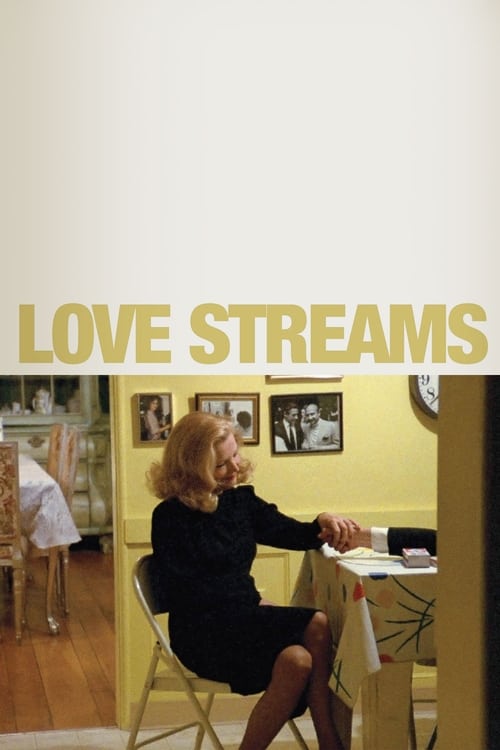
Love Streams
1984 · John Cassavetes
For when you want to feel something real and can handle it hitting close to the bone — this is challenge viewing, best met when you're ready to sit with two broken people who refuse to stop loving.
What it's about
A hard-drinking writer who fills his Los Angeles house with paid company and a woman unraveling in the wreckage of a divorce and custody fight turn out to be brother and sister, reunited after years apart. Over a few chaotic days under one roof they try, clumsily and desperately, to hold each other together — she believing love is a stream that never stops, he no longer sure he can feel it at all.
The experience
Raw, messy, and startlingly intimate, with sudden swerves into dream logic and absurd comedy — a house filling with animals, a fantasy that becomes an operetta. It's emotionally bruising but never cold; you come out shaken and strangely consoled.
Performances
Gena Rowlands is volcanic as Sarah — fragile, funny, and frightening within a single scene — and Cassavetes himself, playing opposite her, gives the character's exhaustion a lived-in weight. Together they make sibling love feel as consuming as any romance.
The craft
Shot largely inside Cassavetes' own home, it has his signature style at full maturity: scenes that run long past comfort, a camera that hunts faces, and a script that slides from naturalism into open dream without warning. The homemade texture is the point — it feels less directed than confided.
Why it matters
The last film Cassavetes made with full control, it won the Golden Bear at Berlin and stands as the summing-up of American independent cinema's founding voice — a farewell testament that later indie filmmakers keep returning to.
Snapshot
Love Streams is the last film John Cassavetes directed with full authorial control, and it plays like a summation of everything his independent cinema had pursued since Shadows. Adapted from a play by Ted Allan, it follows two middle-aged siblings — Robert Harmon (Cassavetes), a dissolute writer who surrounds himself with women and drink, and Sarah Lawson (Gena Rowlands), a woman coming apart in the wreckage of a divorce and custody battle — who reunite after a long estrangement and spend a few days trying to hold each other up. The film is at once raw and strange, moving between naturalistic emotional siege and frank dream logic (Sarah's operetta fantasy, the notorious sequence in which she fills the house with animals). Made under the unlikely patronage of Cannon Films and shot largely inside Cassavetes' own home, it is a domestic epic about the persistence of love as a force that, in the film's governing metaphor, never stops flowing. Cassavetes was already gravely ill during production, and the film carries an unmistakable valedictory charge.
Industry & production
Love Streams occupies a genuinely odd niche in 1980s production history: a fiercely personal Cassavetes picture financed by Cannon Films, the company run by Menahem Golan and Yoram Globus and best known for low-budget action and exploitation fare. Cannon's willingness to bankroll prestige auteurs alongside its genre output — it also produced work by figures such as Godard and Zeffirelli in this period — gave Cassavetes the money to mount a film on his own terms, and the arrangement is widely understood to have been part of a multi-picture relationship with the studio.
The material originated on stage. Ted Allan's play Love Streams was staged in Los Angeles in the early 1980s in association with Cassavetes' own theater work, and Cassavetes reworked it into a screenplay with Allan. The film reflects Cassavetes' lifelong preference for self-contained, artisanal production: much of it was shot at his and Rowlands' home in the Hollywood Hills, which doubles as Robert Harmon's house, blurring the line between the actors' lives and their roles in a way typical of his method.
The most consequential production fact is biographical. Cassavetes was suffering from cirrhosis of the liver and was seriously ill during the making of the film; he would die in 1989, and Love Streams stands as the final feature he authored in full. (His subsequent credit, the 1986 comedy Big Trouble, was a work-for-hire he took over from another director and is generally set apart from his body of work.) The awareness — shared by cast and crew — that this might be his last film informs both the film's emotional weather and the retrospective readings it has attracted. The picture premiered at the Berlin International Film Festival in 1984, where it won the Golden Bear.
Technology
Technologically, Love Streams is unremarkable by design, and that plainness is itself a Cassavetes signature. It was shot on 35mm color film using conventional equipment of the era, without recourse to the gloss, gliding camera movement, or synthesizer-driven scoring that marked much studio product of 1984. Cassavetes' aesthetic had always been oriented against technological polish: he prized the responsiveness of a camera that could follow a performance wherever it went over the stability of a locked, pre-blocked setup. Nothing in the film's toolkit calls attention to itself; the "technology," such as it is, is subordinated entirely to the capture of behavior. Where the film feels formally adventurous, that adventurousness comes from staging, editing, and performance rather than from any apparatus.
Technique
Cinematography
The cinematography, by longtime Cassavetes collaborator Al Ruban, embodies the director's anti-classical approach. The camera favors human presence over compositional elegance: it crowds actors, holds on faces past the point of comfort, and reframes to chase gesture and speech rather than dictating them. Interiors — above all the Harmon house — are shot to feel lived-in and cluttered rather than curated, with available-seeming light and a palette that runs to warm domestic tones. The image frequently privileges the messy middle distance of a room full of people over clean singles. This is a cinematography of attention rather than of beauty, though the film achieves a battered lyricism, particularly in its nocturnal and dream passages, where the naturalist grammar loosens.
Editing
Editing (credited to George Villaseñor) sustains Cassavetes' characteristic rhythm, in which scenes are allowed to run long and to sit inside discomfort. Cuts tend to follow emotional logic rather than continuity convention; the film will hold an exchange until it curdles or exhausts itself, then move abruptly. The looser structure also accommodates the film's tonal shifts — the pivot from grinding domestic realism into Sarah's fantasy sequences — without smoothing them over. The result is a running time (roughly two hours and twenty minutes) that feels expansive and unhurried, giving the performances room while resisting the compression of conventional dramaturgy.
Mise-en-scène / staging
Staging is where the film is most radical. Cassavetes composes in depth and in duration, letting several performers occupy a frame and letting their interactions overlap, collide, and trail off. The domestic space is treated almost as a theater: bodies move through rooms, doorways, and staircases in long articulated actions, and the house itself becomes a character — a container for Robert's crowd of women and, later, for Sarah's improbable menagerie. That animal sequence, in which Sarah arrives home in a taxi laden with livestock, is the film's most famous coup of mise-en-scène, a literalization of overflowing, uncontainable love that erupts out of the otherwise grounded register. The staging consistently favors the awkward truth of how people actually inhabit space over the legibility of dramatic blocking.
Sound
Sound in a Cassavetes film is deliberately unglamorous: dialogue is close and sometimes overlapping, ambient life is present, and the overall texture resists the sweetening of studio mixing. The score and songs are the work of Bo Harwood, another core member of Cassavetes' repertory of collaborators, whose contributions lean toward intimate, sometimes rough-hewn musical textures rather than orchestral underscoring. Music surfaces most prominently in the film's stylized sequences, where song is allowed to carry emotional weight that the naturalistic scenes withhold.
Performance
Performance is the film's true medium. Rowlands' Sarah is one of the great achievements of her career — a woman whose love is so total that it reads as illness, veering between radiant warmth, comic excess, and genuine breakdown, and Rowlands plays every register without protective irony. Cassavetes, directing himself as Robert, gives a performance of shambling charm and evasion, a man who has organized his whole life to avoid the demands love makes. The sibling relationship gains additional charge from the audience's knowledge that these are the film's married co-creators playing brother and sister, and from Cassavetes' visible physical frailty. Seymour Cassel, another member of the Cassavetes stock company, appears as Sarah's ex-husband, contributing to the ensemble's worn, familial texture.
Narrative & dramatic mode
The dramatic mode is Cassavetes' signature blend of behavioral realism and heightened emotional theater. The narrative is loosely plotted by conventional standards: it is organized less around events than around states of feeling and the slow revelation of two damaged interior lives. The film withholds a clean expository account of the siblings' shared history and, for much of its length, even of their relationship, trusting the audience to assemble understanding from behavior. Into this naturalist frame Cassavetes inserts frankly non-realist passages — dream, fantasy, musical interlude — that externalize the characters' inner lives. The effect is a drama that operates simultaneously on two planes: the grinding, real-time observation of people failing to connect, and a more symbolic register in which love is rendered as flood, performance, and dream. Resolution, when it comes, is emotional and provisional rather than plot-driven.
Genre & cycle
Nominally a drama, Love Streams resists genre placement, which is characteristic of Cassavetes' independent project. It belongs to no commercial cycle of its moment; in 1984 American cinema was dominated by high-concept studio entertainment, and this film sits entirely outside that. Its truer lineage is Cassavetes' own cycle of intimate relationship dramas — the loose sequence running from Faces and A Woman Under the Influence to Opening Night — films concerned with marriage, family, women's interior lives, and the performance of self under emotional pressure. To the extent it participates in a genre, it might be called a domestic melodrama radically stripped of melodrama's machinery, or an anti-genre chamber piece about family. Its incorporation of musical fantasy also gestures, obliquely and without pastiche, toward the possibility of a self-conscious hybrid form.
Authorship & method
Love Streams is a near-pure expression of Cassavetes as author, and it is inseparable from his working method. He wrote (with Ted Allan), directed, and starred; he shot in his own home; and he surrounded himself with the repertory company of collaborators and family members he had used for two decades. The presence of Rowlands as co-lead is central to his authorship: their partnership was the creative engine of his cinema, and here it is both the film's subject and its instrument. Cinematographer Al Ruban, a producer-collaborator across many Cassavetes films, translates the director's demand for a camera that serves performance. Bo Harwood's music and George Villaseñor's editing similarly reflect an in-house, artisanal sensibility rather than industry convention. Ted Allan, as the source playwright and co-screenwriter, supplies the underlying architecture — the sibling reunion, the governing metaphor of love as a stream — which Cassavetes then dissolves into his behavioral idiom. The method is one of trust, duration, and repetition-in-life: casting intimates, shooting in real domestic space, and letting scenes run until something true emerges. The film's power derives directly from the collapse of distance between the makers' lives and the fiction.
Movement / national cinema
The film is a landmark of American independent cinema, the tradition Cassavetes is credited with founding and sustaining almost single-handedly from Shadows (1959) onward. He built a mode of filmmaking outside the studio system — self-financed or independently financed, actor-centered, formally unruly — that stood as the principal American alternative to Hollywood realism for a generation. Love Streams is a late, mature statement of that movement: it demonstrates how far a personal cinema could be pushed even while nominally inside the industry (here, through Cannon's financing). It has no meaningful relationship to any national film movement abroad, though its European art-cinema kinship — its comfort with duration, ambiguity, and interior drama — helps explain its warm reception at Berlin.
Era / period
Released in 1984, Love Streams is defiantly out of step with its era. The mid-1980s American mainstream was defined by blockbuster spectacle, high-concept comedy, and glossy production values; the decade's independent scene that would later coalesce around Sundance and figures like Jim Jarmusch was only beginning to form. Cassavetes' film belongs, in spirit, to the 1970s cinema of psychological realism and to his own earlier work more than to 1984. This temporal dislocation is part of its meaning: it is the closing statement of a filmmaker whose sensibility was forged in an earlier moment, made just as the culture that might have supported it was disappearing. Read against Cassavetes' terminal illness, the film's untimeliness reinforces its quality of last testament.
Themes
The film's central theme is announced in its title: love as a continuous stream, a current that (in Robert's formulation) never stops. Around this it gathers Cassavetes' lifelong preoccupations. There is the burden and excess of love — Sarah's incapacity to love in moderation, which destroys her marriage and endangers her sanity, set against Robert's flight from love's demands into drink, women, and work. There is loneliness and the terror of being unloved; family as both wound and refuge; and the persistence of sibling bonds where romantic and parental ones have failed. The film examines gender and the performance of self — Robert as a professional connoisseur of women who cannot actually be with one, Sarah as a woman whose whole identity is bound up in loving. Alcohol, illness, and physical decline shadow the whole. And running through it is the tension between the real and the dreamed, between the grinding reality of human failure and the redemptive, overflowing fantasy of love that the film's stylized passages make visible.
Reception, canon & influence
On release, Love Streams was recognized at the highest festival level — it won the Golden Bear at the 1984 Berlin International Film Festival — but its wider commercial profile was modest, consistent with Cassavetes' career-long marginality to the mainstream. Detailed contemporary box-office figures are not something the public record makes readily available, and its reputation, like much of Cassavetes' work, was consolidated over subsequent decades rather than at the moment of release.
Looking backward, the film's influences are essentially internal: it draws on Cassavetes' own accumulated method and thematics, on the theatrical source by Ted Allan, and on the ensemble tradition he had built. Its lineage is his own filmography more than any outside school.
Looking forward, Love Streams has grown in stature as both the capstone of Cassavetes' career and one of his most formally daring films, prized for the way it fuses his behavioral realism with unabashed dream and fantasy. Its critical standing has been reinforced by its availability through the Criterion Collection and by the broad canonization of Cassavetes as the foundational figure of American independent cinema. His influence — visible in the work of later American independents and in any filmmaking that privileges the truth of performance over narrative machinery — is diffuse but real, and Love Streams, as his final authored film, occupies a special place within it: the last word from the director who taught American cinema how to sit inside a room and watch people love each other badly. The record is admirably documented on the broad outlines of its making and reception; where it thins — on precise financial terms of the Cannon deal, or granular production anecdote — this account declines to fill the gaps.
A Deleuzian reading
A taxi pulls up outside the house and out of it climbs a small menagerie — a goat, a duck, chickens, a miniature horse.
The full Deleuzian reading of Love Streams →
Reception
It won the Golden Bear at Berlin in 1984 but barely registered in the US, then spent decades nearly impossible to see on home video — until Criterion's 2014 release turned it into the consensus 'secret masterpiece' of the Cassavetes canon.
How Love Streams was received, from release to now →
How to watch Love Streams: what to notice on a first viewing
- Watch the camera hold on faces past the point of comfort. Al Ruban's camera crowds the actors and stays on a face well after a normal scene would cut away, chasing gesture and speech instead of composing pretty shots. You end up watching people exist in a room rather than watching a story get told at you.
- Notice how much the story happens while people move through rooms. Cassavetes stages long, articulated movement through doorways and staircases in the Harmon house, treating the home almost like a theater the characters keep drifting across. The house itself starts to feel like a character holding these two siblings together.
- Watch a scene run long past where you expect it to end. Villaseñor's cutting follows emotional logic rather than plot convention, holding an exchange until it exhausts itself and then leaving abruptly, with no smoothing transition. The film's rhythm is the rhythm of actually being stuck in a room with someone, not the rhythm of a story being managed for you.
- Listen for dialogue that overlaps or talks over itself. Conversations in the Harmon house are close, sometimes overlapping, and left unsweetened by studio mixing, so people often talk past each other rather than in clean exchanges. The sound design refuses to clean up how people actually interrupt and miss each other.
- Watch Sarah swing from warmth into comic excess without warning. Rowlands plays Sarah's love as something close to illness, moving between radiant tenderness, comedy, and breakdown without ever softening it with irony to protect herself or the audience. You are watching a performance with no safety net, which is exactly what makes it exhausting to watch and hard to look away from.
The whole guide to watching Love Streams, with the keys for a rewatch →
Influences: the films it descends from and the films it influenced
- Shadows (1959) — Cassavetes' first film established the workshop-improvisation method — scenes built from actors' behavioral discoveries rather than plot points — that Love Streams brings to full maturity.
- Faces (1968) — Its grainy 16mm handheld camera pressed into faces during marital cruelty, holding shots until performers break, is the raw prototype for Ruban's performance-serving camera in Love Streams.
- Husbands (1970) — Pioneers the plotless ensemble of grown people avoiding grief, letting scenes run far past narrative usefulness — the 'states of feeling' structure Love Streams inherits.
- A Woman Under the Influence (1974) — Rowlands and the family home as pressure cooker; the domestic interior staged as a theatrical arena where love expresses itself as breakdown, directly echoed in Love Streams' house.
- Opening Night (1977) — Introduces frank dream/ghost interludes rupturing behavioral realism, giving Rowlands' interior life a hallucinatory register — the exact fusion Love Streams extends with Sarah's fantasy sequences.
- The Killing of a Chinese Bookie (1976) — Its drifting, elliptical editing that follows a man's mood rather than his objectives models the 'emotional-logic long takes' governing Love Streams' cutting.
- A Streetcar Named Desire (1951) — Kazan's screen translation of Method acting — behavioral truth over declamation, adapted from a stage play — is the acting tradition Cassavetes dissolves into Ted Allan's theatrical source material.
- Husbands and Wives (1992) — Allen's jagged handheld camera and overlapping, unpolished marital arguments — talking-head confessionals staged in cramped apartments — openly adopt Cassavetes' verité treatment of couples coming apart.
- Buffalo '66 (1998) — Gallo casts intimates and himself, shoots a wounded family reunion in charged domestic interiors, and lets discomfort run untrimmed — a direct heir to Cassavetes' collapse of distance between maker and role.
- Funny Ha Ha (2002) — The founding mumblecore film rebuilds Cassavetes' plotless behavioral realism — nonactors, overlapping halting dialogue, scenes that are states of feeling rather than events — on a micro-budget.
- Blue Valentine (2010) — Cianfrance had his actors live in a house in character and shot long improvised takes of love decaying — a literal application of Cassavetes' duration-and-immersion method to a two-hander.
- Margaret (2011) — Lonergan's overlapping, spilling, unglamorous dialogue and editing that follows a young woman's runaway emotional logic rather than plot beats extend Cassavetes' 'emotional-logic long takes.'
- Marriage Story (2019) — Baumbach cites Cassavetes directly, staging the film's climactic fight as an unbroken theatrical eruption inside a bare apartment, trusting performance over cutting exactly as Love Streams does.
- Good Time (2017) — The Safdies' camera glues itself to a single performer in continuous handheld pursuit, privileging the moment-to-moment truth of the actor's body over narrative clarity — Cassavetes' 'handheld-performance-following' intensified.
- Mikey and Nicky (1976) — May built a whole film around Cassavetes-as-performer, shooting endless improvised duration to catch behavioral truth — the same in-the-room, let-it-run method practiced from the other side of the camera.
- Wanda (1970) — A contemporaneous American-independent chamber piece of a drifting woman, shot in real locations with unglamorous handheld observation and no narrative machinery — a parallel to Cassavetes' anti-melodrama.
Similar films
- A Woman Under the Influence (1974) — influence & lineage
- Faces (1968) — influence & lineage
- Husbands (1970) — influence & lineage
- Opening Night (1977) — influence & lineage
- My Own Private Idaho (1991) — same viewing thread
- Shadows (1960) — shared sensibility
- sex, lies, and videotape (1989) — shared sensibility
- Mirror (1975) — shared sensibility
All the films related to Love Streams →
Watch it with: curated runs of related films
- Adrift and Coming Apart — A run of solitary souls drifting through motels, deserts, and empty apartments and quietly dissolving — they rhyme on stillness, loneliness, and dread.