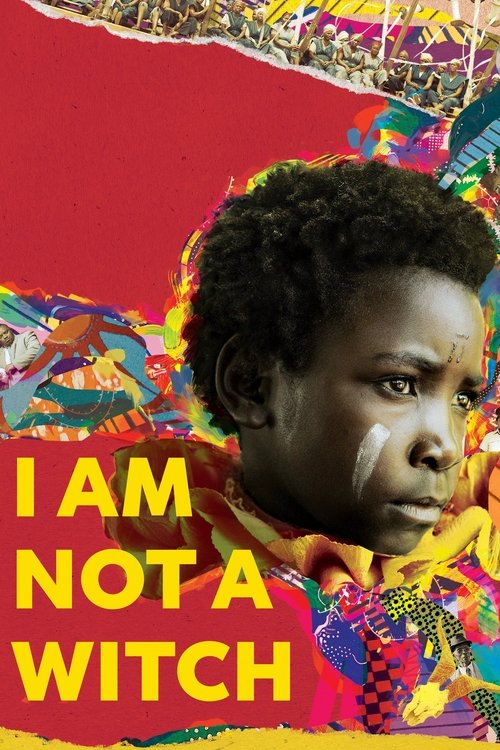
I Am Not a Witch
2017 · Rungano Nyoni
For when you want something strange and striking rather than comforting — a film that's funny in a way that stings and stays with you. More challenge than comfort, but a short, hypnotic one.
What it's about
An eight-year-old girl in rural Zambia is accused of witchcraft by her village and shipped to a state-run witch camp, where women are tethered to giant spools of white ribbon and told they'll turn into goats if they cut loose. Silent, watchful Shula becomes a minor celebrity: a government official parades her on television, tourists take photos, and the adults around her turn her supposed powers into a business.
The experience
Deadpan and furious at the same time — you laugh at the absurdity of the bureaucracy and then feel guilty for laughing, because a real child is at the center of it. It moves at a stately, picture-book pace, and the anger sneaks up on you.
Performances
Maggie Mulubwa, a first-time child actor discovered in a village during location scouting, carries the film almost wordlessly — her still, unblinking face does the work whole monologues couldn't.
The craft
The central image — women bound to towering wooden reels of white ribbon unspooling across ochre landscapes — is one of the decade's most indelible, and David Gallego's widescreen compositions give it the scale of a fable. Rungano Nyoni researched real witch camps before writing, and grounds the satire in that reality. It rewards a big screen: the film thinks in wide, painterly frames.
Why it matters
One of the most acclaimed feature debuts of the 2010s, it won Nyoni the BAFTA for Outstanding Debut and announced a major new voice working between African realities and European art cinema.
An eight-year-old girl, silent and unblinking, is accused of witchcraft by her Zambian village and sent to a state-run witch camp, where the women are tethered to giant spools of white ribbon — cut the ribbon, they're told, and you'll turn into a goat. Rungano Nyoni, born in Lusaka and raised in Wales, spent time researching real witch camps in Ghana before making her debut, and the film's fury is real even as its method is deadpan absurdism: government officials tout their captive witch on television, tourists snap photos, a jury of chickens is consulted. The ribbons — spooled on towering wooden reels, unfurling across ochre landscapes in David Gallego's widescreen compositions — are among the decade's indelible images, bureaucratic cruelty made visible as thread. Young Maggie Mulubwa, discovered in a village during scouting, carries the film with a gaze that gives nothing away. It premiered in Cannes' Directors' Fortnight and won Nyoni the BAFTA for outstanding British debut; she waited seven years to follow it, with On Becoming a Guinea Fowl.
Reception
It arrived at Cannes' Directors' Fortnight in 2017 as a buzzy debut and won the BAFTA for Outstanding British Debut, then became the UK's surprise Oscar entry. Its stock has only risen since — once Nyoni's On Becoming a Guinea Fowl hit in 2024, cinephiles streamed back to this one and re-crowned it a landmark first feature.
How I Am Not a Witch was received, from release to now →
Influences: the films it descends from and the films it influenced
- Embrace of the Serpent (2015) — Cinematographer David Gallego, whom Nyoni carried over, developed here the same austere anamorphic-widescreen compositions and precise horizon-line framing of figures dwarfed by landscape that structure the witch-camp vistas.
- Songs from the Second Floor (2000) — Locks the camera into static, symmetrical deadpan tableaux where absurd institutional cruelty plays out in pale, drained color — the staging grammar Nyoni uses for the tribunal and tourist-photo scenes.
- Dogtooth (2009) — Establishes the flat, affectless absurdist register in which an arbitrary system of control over female bodies is filmed as banal routine rather than horror, letting the allegory sting through understatement.
- Moolaadé (2004) — Sembène's model of African social satire — indicting a communal tradition's cruelty to women from inside the village rather than from a colonial outside — is the polemical spine Nyoni inherits.
- Touki Bouki (1973) — Pioneered the elliptical, surrealist-collage editing and ironic distance in Senegalese cinema that license Nyoni's non-realist gestures like the tethering ribbons.
- Hyènes (1992) — A caustic parable of a community that collectively scapegoats and exploits one person for gain — the same satirical mechanism of communal complicity Nyoni dramatizes around Shula.
- The Exterminating Angel (1962) — Buñuel's device of an invisible, unspoken rule that physically binds people in place is literalized by Nyoni into the white ribbons that tether the accused witches.
- The Spirit of the Beehive (1973) — Supplies the watchful, near-silent child protagonist whose steady gaze frames an incomprehensible and menacing adult order — the point-of-view architecture built around Maggie Mulubwa's Shula.
- Timbuktu (2014) — Marries widescreen Sahel lyricism to a deadpan, almost absurdist anatomy of petty bureaucratic tyranny — the exact tonal fusion of beauty and administrative cruelty Nyoni pursues.
- Xala (1975) — Uses ridicule and comic humiliation as political weapons against post-colonial authority and superstition, modeling satire-as-critique rather than melodrama.
- On Becoming a Guinea Fowl (2024) — Nyoni's own follow-up carries forward the exact toolkit — deadpan absurdist framing, symbolic staging, and a young female protagonist exposing a family/community's ritualized cruelty toward women.
- Zama (2017) — Shares the off-center, oblique framing and the treatment of colonial/state bureaucracy as an absurd machine of waiting and dehumanization, shot with the same estranging sound and composition.
- The Lobster (2015) — Extends the same deadpan-absurdist strategy of literalizing a social coercion (conform-or-be-punished) into a concrete rule, played completely straight for satirical effect.
- Atlantics (2019) — Part of the same contemporary current of African women-directed arthouse that fuses social realism about female disposability with poetic, quasi-supernatural imagery.
- Rafiki (2018) — A parallel contemporary East/Southern African feature deploying saturated color design and pop-inflected visual stylization to frame women constrained by communal moral policing.
- Félicité (2017) — A same-year African festival feature centering a woman ground down by unfeeling institutions, blending documentary texture with lyrical, near-mystical interludes as Nyoni does.
Similar films
- On Becoming a Guinea Fowl (2024) — influence & lineage
- Beasts of No Nation (2015) — shared sensibility
- Yeelen (1987) — shared sensibility
- The Mysterious Gaze of the Flamingo (2025) — shared sensibility
- The Breadwinner (2017) — shared sensibility
- The Craft (1996) — shared sensibility
- Beasts of the Southern Wild (2012) — shared sensibility
- The Ugly Stepsister (2025) — shared sensibility