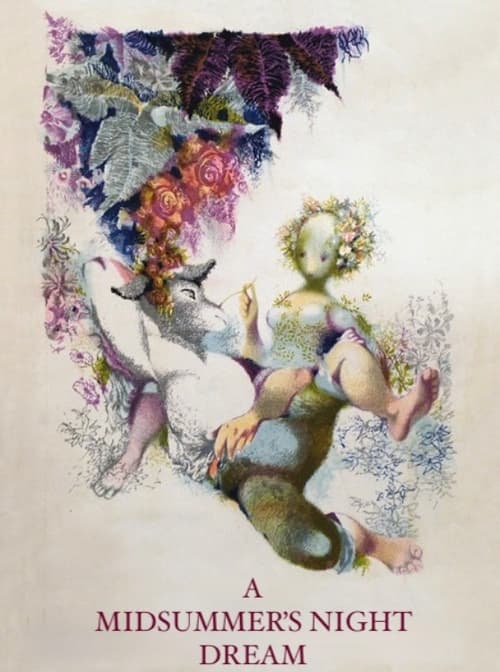
A Midsummer's Night Dream
1959 · Jiří Trnka
For a night when you want pure enchantment — something beautiful to sink into rather than follow closely. A calm, wondering watch, good for winding down or sharing with someone who loves craft.
What it's about
Shakespeare's comedy of crossed lovers, meddling fairies, and amateur actors — staged entirely with puppets. Three worlds tangle in an enchanted wood: noble Athenian couples fleeing and chasing each other, a troupe of tradesmen rehearsing a hopeless play, and the quarreling king and queen of the fairies whose magic scrambles everyone's hearts for a night.
The experience
Dreamy and playful rather than talky — the wit comes through gesture, music, and light instead of dialogue, so it washes over you like a ballet. Gentle, funny, and quietly virtuosic; the pleasure is in watching impossible delicacy of movement.
The craft
Jiří Trnka spent the accumulated skill of the world's finest puppet-film studio on this one object: the first puppet feature shot in CinemaScope, translating Shakespeare's verbal fireworks into continuous flows of motion, orchestral score, and painterly light. The widescreen frame gives the puppets a stage-like grandeur, and the color and lighting are ravishing — this one genuinely wants the biggest screen you can give it.
Why it matters
Widely considered the summit of Trnka's career and a milestone of Czech animation, it showed that puppet film could carry a full-length classic on movement and music alone.
Snapshot
Sen noci svatojánské is the summit and the terminus of Jiří Trnka's feature career in puppet animation — a Czechoslovak adaptation of Shakespeare's comedy staged entirely with articulated puppets, and the first puppet feature shot in CinemaScope. Trnka had spent the postwar decade building the Prague puppet-film studio into the most technically accomplished stop-motion operation in the world; here he spent its accumulated capital on a single, enormously ambitious object. The film runs roughly seventy-five minutes, dispenses almost entirely with dialogue in its original conception, and translates Shakespeare's verse into a continuous flow of movement, orchestral score, and light.
The strategic gamble is legible in the material: a play whose pleasures are overwhelmingly verbal — puns, rhetorical inversions, the mechanicals' malapropisms — rendered in a medium that cannot speak. Trnka's puppets famously have fixed faces; they do not lip-sync and their expressions do not change. What the film substitutes is choreography, gesture, camera movement, and Václav Trojan's score, which carries much of the dramatic argument. The result divided its audiences on first release and has divided them since: for some viewers the most beautiful animated film ever made, for others a magnificent object slightly airless at the center, its wordless lyricism unable to supply the comic friction that Shakespeare's language generates.
Its historical position is unambiguous even where its evaluation is not. The film marks the point at which Czech puppet animation asserted itself as a medium for canonical literature rather than for children's fable, and it stands as the most sustained argument ever made that stop-motion could sustain feature-length adult art cinema. Trnka made no further puppet feature; he returned to shorts, most consequentially Ruka (The Hand, 1965), and the trajectory from the lyrical pastoral of the Dream to the political parable of The Hand is one of the more striking late turns in animation history.
Industry & production
The film was produced within the Czechoslovak state film system, at the puppet-film studio in Prague that Trnka had co-founded in 1946 and that later carried his name. This institutional fact governs nearly everything about the production. Czechoslovak animation after 1945 was nationalized, centrally funded, and organized around permanent studio units rather than project-by-project financing. Trnka's unit operated with continuity of personnel across more than a decade — sculptors, puppet-makers, animators, set builders, and cameramen who had worked together since the late 1940s on Špalíček (The Czech Year, 1947), Císařův slavík (The Emperor's Nightingale, 1949), Bajaja (Prince Bayaya, 1950), Staré pověsti české (Old Czech Legends, 1953), and Dobrý voják Švejk (The Good Soldier Švejk, 1954–55).
That continuity is the precondition for a film of this complexity. Stop-motion at feature length is a labor problem before it is an aesthetic one: every second requires two dozen or more individually posed and photographed frames, across dozens of characters and sets. A production of this scale is measured in years, not months, and is only feasible where a standing crew can be maintained on state salary without the pressure of commercial recoupment schedules. Western stop-motion of the same era — George Pal's American work, or the effects animation of Ray Harryhausen — operated at short or insert length precisely because no commercial structure would fund the alternative.
The state system's protection came with the era's constraints. The film was made in the years following the Czechoslovak cultural thaw that began after 1956, when the strictest Socialist Realist prescriptions of the early 1950s had loosened without disappearing. Adapting Shakespeare was, among other things, a shrewd choice within that environment: a canonical classic of world literature carried unimpeachable cultural prestige and offered a subject on which no ideological line needed to be taken. Trnka had already navigated similar terrain with Old Czech Legends (national mythology) and Švejk (Hašek's satire, safely anti-Austrian). The literary-adaptation strategy let his studio work at the height of its craft on material that was formally demanding and politically inert.
Specific production figures — budget, shooting schedule length, frame counts, the exact size of the crew — are not reliably documented in accessible English-language sources, and this dossier will not invent them. What the record does establish is that this was the largest undertaking of Trnka's career and that it exhausted a particular ambition: he never attempted another puppet feature.
Technology
The CinemaScope claim is the film's most cited technical fact and deserves precision. CinemaScope's anamorphic system, introduced by Twentieth Century-Fox in 1953, squeezed a wide field horizontally onto standard 35mm negative via an anamorphic lens, to be unsqueezed in projection at roughly 2.35:1. Applying this to puppet animation was not a matter of swapping a lens. It reorganized the entire physical apparatus of the shoot.
Three consequences follow. First, sets had to be built dramatically wider — the frame's horizontal appetite meant that every constructed forest, palace interior, and clearing had to extend far beyond what a 1.37:1 Academy set required, multiplying carpentry, painting, and dressing labor across the whole production. Second, anamorphic lenses of the period were slow, requiring substantially more light than spherical optics at equivalent stops. Stop-motion sets are miniature enclosures; pouring the necessary light into them produced heat, and heat is the enemy of puppets built with wax, glue, painted surfaces, and fabric that must hold position identically across hundreds of exposures. Third, early anamorphic optics had a shallow and quirky close-focus performance and characteristic distortion toward frame edges, which on miniature sets shot at short distances becomes conspicuous rather than negligible.
The film was made in color, and the color engineering is as consequential as the aspect ratio. Trnka's design depends on the modulation of light through a narrow tonal band — the forest sequences work in blues, greens, and silvers with warm interruptions — and holding that palette stable across a multi-year shoot, over thousands of separate setups, is a chemical and procedural achievement as much as an artistic one. Eastern Bloc productions of the period generally worked with Agfa-derived color stocks (the ORWO family and its predecessors) rather than Eastmancolor, and these had their own tonal characteristics; the film's cool, jewel-like register is partly a property of the emulsion available.
The animation itself is straight stop-motion: puppets with internal armatures, posed and photographed frame by frame. Trnka's puppets are conventionally described as having carved, immobile faces, a deliberate refusal of the replacement-head and mechanical-expression systems that other traditions used to give puppets mobile features. This is a design philosophy as much as a technical limit, and its consequences run through every other section below.
Technique
Cinematography
The camera in Trnka's earlier films is relatively reserved; here, the widescreen frame forces a rethink. The dominant strategy is lateral — the CinemaScope frame invites the eye to travel horizontally, and the film organizes its forest as a receding series of planes through which the camera tracks and pans, discovering figures rather than presenting them. The characteristic image is not a centered portrait but a wide field with activity distributed across it, the composition asking the viewer to scan.
Lighting is the film's most distinctive photographic quality. Where much stop-motion of the period is flatly and evenly lit — the practical solution, since even lighting is easier to maintain across long shooting periods — this film builds strongly directional, atmospheric schemes: shafts through foliage, pools of illumination surrounded by deep blue-black shadow, backlit haze that gives the miniature forest an impression of genuine depth and air. This is where the medium's usual tell — that we are watching small objects on a table — is most effectively suppressed. Depth cues that stop-motion normally lacks are supplied optically.
Scale is handled through a full grammar of shot sizes, which for puppet work of the era was itself unusual. The film moves from wide establishing views of the Athenian court and the forest down to close framings of individual puppets, trusting that the sculptural quality of the faces will hold a close-up. Whether it does is one of the film's genuine points of contention: a carved face at close range can read as monumental and still, or as inert, depending on the viewer.
Editing
The editing follows musical rather than dramatic logic for long stretches. Because the film carries no continuous dialogue track to cut against, sequences are shaped to Trojan's score, with cutting rhythms keyed to musical phrase rather than to line delivery or reaction. This produces a distinctive texture — passages that are effectively danced, where the montage functions as choreography — and a distinctive risk, which is that scenes tend toward the length their music wants rather than the length their narrative needs.
Transitions favor dissolves, fades, and optical layering over hard cuts, reinforcing the dream frame. The lovers' confusions in the wood, which in performance depend on rapid entrances and exits and on the audience tracking who has seen whom, are here handled through spatial and optical means: the camera reveals and conceals, characters materialize out of foliage, the frame's width lets two mutually oblivious figures occupy the same shot. The comedy of the play's mistaken pairings survives this treatment only partially — it becomes a comedy of geometry rather than of language.
Mise-en-scène / staging
This is the film's greatest strength and the reason for its reputation. Trnka was a trained illustrator and painter before he was a filmmaker, and the design draws on Central European book illustration, folk art, and the Baroque and Rococo visual vocabulary of Bohemian art. The Athenian court is rendered with a courtly formality — architectural symmetry, ordered processions, costume that reads as period-composite rather than historically specific. The forest is its inverse: irregular, organic, layered, built to be moved through rather than looked at.
The three worlds named in the film's own framing — court, mechanicals, fairies — are given distinct plastic identities. Costume, scale, movement quality, and palette separate them, so that the play's structural architecture is communicated visually to a viewer who cannot hear the verse. Puck is the film's most inventive design, a figure of continuous transformation and motion whose energy contrasts against the stillness elsewhere.
The forest sets deserve particular attention as constructions. Building a convincing miniature wood that can be shot from multiple angles at CinemaScope width, lit atmospherically, and animated within, means solving problems of sightline, foliage density, and modular reconfiguration across an enormous number of setups. The persuasiveness of these sets — their impression of extending beyond the frame — is a craft achievement that survives every critical objection to the film.
Sound
Václav Trojan's score is not accompaniment; it is the film's primary expressive channel. Trojan had scored Trnka's films since The Czech Year, and the collaboration is among the most sustained composer-director partnerships in animation. His idiom draws on Czech symphonic tradition and on folk material, and in this film he is asked to do the work that dialogue does in a live-action Shakespeare: carry character, mark tonal shifts between the three worlds, generate comedy, and sustain lyric mood over long wordless passages.
The film's speech situation is where the historical record requires care. The original Czechoslovak version was conceived to be carried by music and movement rather than by continuous spoken text; the film circulated internationally in versions with added narration or spoken passages, and the English-language releases of the period introduced narration by figures unconnected to the original production. The specifics of these various international cuts are inconsistently documented, and viewers encountering the film through different versions have genuinely encountered different films. Critical judgments of the film's "wordlessness" therefore need to specify which version is under discussion — a caveat that applies to a good deal of the older English-language commentary.
Performance
Performance in this film is a compound of three things: the sculptor's work in the puppet's fixed face, the animator's work in body movement, and the camera's work in choosing angle and light. Trnka's refusal of facial articulation is doctrinal. His argument, consistent across his career, is that a fixed expression is not an absence but a reserve — a face that does not change lets the viewer project shifting emotion onto it, whereas a mechanically emoting puppet asserts a specific feeling and forecloses the rest. It is a theory of animated performance closer to the mask traditions of theater than to the Disney principle of expressive elasticity.
The practical burden falls on the animators, who must carry emotion through posture, hand gesture, the tilt of a head, the timing of a turn. The film's best sequences — the fairy passages, Puck's mischief, the lovers' entanglements at their most balletic — demonstrate how much can be done this way. The mechanicals' scenes, which in Shakespeare are pure verbal comedy, are the hardest case, and the film converts them into physical clowning of a broader register.
Narrative & dramatic mode
The film's dramatic mode is closer to ballet or tone poem than to filmed drama. Shakespeare's plot is retained in outline — the Athenian marriage frame, the lovers' flight, Oberon and Titania's quarrel, the love-juice, the mechanicals' rehearsal and performance, the resolution — but the play's dramatic engine, which is language producing misunderstanding, is replaced by a visual engine of transformation and displacement.
This produces a characteristic compression and expansion. Passages that are verbally dense compress, since they cannot be spoken; passages that are visually generative expand, since movement and music can elaborate them indefinitely. The forest occupies the film's center of gravity in a way it does not quite in the play, where the court frame carries more weight. The dream logic implicit in Shakespeare's title becomes the film's organizing principle rather than its conceit: the film is dreamlike in structure, not merely about a dream.
The mode's limitation is candidly acknowledged even by admirers. Comedy that depends on the gap between what a character says and what they mean has no purchase without speech. The film substitutes a comedy of physical incongruity — Bottom's transformation, the mechanicals' earnestness — which is real but narrower. Viewers who come to the film for Shakespeare frequently report a beautiful object that has mislaid the play's wit; viewers who come to it as animation frequently report the opposite, a medium finally given material worthy of it.
Genre & cycle
The film sits at an intersection of three cycles. First, the Czechoslovak puppet-feature cycle that Trnka himself created — a sequence of features from 1947 to 1959 that has no real parallel anywhere else, and that established puppet animation as a feature medium. Second, the international cycle of postwar Shakespeare adaptation, which in these years included Olivier's and Welles's films and, in Eastern Europe, adaptations that used Shakespeare's canonical standing as cultural cover and formal opportunity. Third, the widescreen cycle: 1953–1960 saw virtually every national industry test the new formats, and Trnka's application of CinemaScope to animation belongs to that wave of technical experimentation.
Within animation specifically, the film represents the fullest development of an alternative to the American model. Where Disney's features had established feature animation as drawn, dialogue-driven, song-carrying, and aimed at a family audience, Trnka's line proposed dimensional puppets, music-carried, adult in address, and rooted in a national illustrative tradition. That opposition was recognized at the time and has structured discussion of the film ever since.
Authorship & method
Trnka (1912–1969) came to film from illustration and puppet theater. He had trained under Josef Skupa, the puppeteer who created Spejbl and Hurvínek, and worked extensively as a book illustrator — a background that explains the flatness-into-depth quality of his design and his instinct for the single arresting image. He was a designer and director rather than a hands-on animator across every shot; his method was to conceive and design the film comprehensively and to direct a studio of specialists in its execution.
The key collaborators are a stable group. Václav Trojan (1907–1983) composed the scores for essentially all of Trnka's major films, and his contribution here is structurally decisive rather than decorative — in a film without continuous dialogue, the composer is effectively co-dramatist. Břetislav Pojar (1923–2012), who animated on Trnka's features before becoming a major director in his own right, represents the studio's animation lineage; Trnka's unit functioned as a school, and several of the most important Czech animators of the following generation passed through it. Trnka also worked repeatedly with the writer Jiří Brdečka, himself a significant animation director, on script adaptation across his career.
Attributing specific shots or sequences to individual hands is not possible from the available record, and the studio's collective mode of production makes such attribution partly meaningless. What can be said is that Trnka's authorship is design authorship: the puppets, the palette, the architecture of the sets, and the conception of movement are his, and the film looks like his drawings in a way that few animated features look like any single person's hand.
Movement / national cinema
The film belongs to the Czech animation school, one of the most distinctive national traditions in the medium. Its foundations are prewar and pre-cinematic: a deep Bohemian puppet-theater tradition dating to the eighteenth and nineteenth centuries, in which traveling puppeteers performed for adult audiences and puppet theater carried Czech-language culture through periods of German-language dominance. This history matters. In the Czech lands, puppets are not inherently a children's form; they are a national medium with adult political and cultural associations.
Postwar nationalization institutionalized this. Alongside Trnka's puppet studio, Prague housed Karel Zeman's unit (working in a different register — the mixed-media fantasias of Vynález zkázy, 1958, and the Baron Munchausen film of 1961) and, later, the surrealist practice of Jan Švankmajer. Czechoslovakia thereby produced, within one small industry, three distinct and internationally significant animation authorships. The Dream is the high-water mark of the first of these.
The film's relation to the Czech literary-national tradition is oblique but real: adapting Shakespeare in Czech, with Czech visual vocabulary and Czech music, participates in a long practice of national self-assertion through the appropriation of world classics — a practice with particular resonance in a culture that spent centuries asserting linguistic and artistic autonomy against imperial neighbors.
Era / period
1959 sits at a specific conjuncture. In Czechoslovakia, the post-1956 loosening had begun to open space that would widen into the Czechoslovak New Wave of the 1960s — Forman, Chytilová, Menzel, Němec — and this film belongs to the period of gathering rather than to the wave itself. Its politics are those of retreat into aesthetic autonomy: a lyrical, apolitical beauty that constituted its own quiet position.
Internationally, 1959 is the year of Les Quatre Cents Coups and Hiroshima mon amour, of a European art cinema turning toward modernist self-consciousness and contemporary subject matter. Trnka's film runs against that current — it is anti-modernist in address, lyrical rather than analytical, oriented toward beauty rather than toward interrogation. This is part of why its reception in the West was warm but slightly sidelong: it arrived as a marvel of craft into a critical moment preoccupied with something else entirely.
In animation, the same year saw the American industry contracting into television production and stylized limited animation. Trnka's maximalism — full dimensional animation, feature length, widescreen, symphonic score — represents the opposite response to the same historical moment, and its non-repeatability is part of its meaning.
Reception, canon & influence
Critical reception. The film was widely admired on release for its craft and widely questioned on its central premise. The admiration was for the design, the lighting, the sets, and the score; the questions concerned whether Shakespeare's comedy could survive the loss of his language, and whether the film's beauty came at the cost of dramatic energy. This split has proved stable — it is essentially the same conversation the film generates today. It circulated internationally and was presented at festivals, and Trnka's international standing was already established by 1959 through the prior features; the Dream consolidated rather than created his reputation abroad. Specific prizes and their citations are inconsistently recorded in accessible English-language sources, and this dossier declines to specify them.
The confusion introduced by international versions has shaped reception in ways that are still being untangled. English-language viewers who encountered a narrated cut formed judgments about a film Trnka did not entirely make, and some of the older Anglophone criticism should be read with that in mind.
Influences on the film (backward). Four streams converge. From Bohemian puppet theater comes the fundamental assumption that puppets are an adult expressive medium. From Central European book illustration and folk art comes the design vocabulary — Trnka's own illustration practice is the most direct source. From the Baroque and Rococo art of Bohemia comes the courtly register of the Athenian scenes. And from Shakespeare, mediated through the Czech translation tradition, comes the structure — the three-world architecture the film's own synopsis foregrounds is a reading of the play, and a good one.
Musically, Trojan's idiom descends from the Czech national school — Smetana, Dvořák, Janáček — adapted to dramatic function.
Legacy (forward). The film's influence operates on several levels. Most concretely, it stands as the proof-of-concept for stop-motion as a medium for serious literary adaptation at feature length, and the reference point invoked whenever that ambition recurs. Trnka's studio and its personnel seeded the subsequent Czech tradition directly: Pojar's own directorial career, and the broader continuity of Prague puppet animation, run through this unit.
Trnka's reputation abroad — he was called, in a formulation that circulated widely, the Walt Disney of Eastern Europe, a comparison he is reported to have disliked — made him the standard counter-model to American animation for anyone arguing that the form could be something other than what Hollywood had made it. That argument was taken up by later generations of stop-motion filmmakers in Britain, the United States, and Japan, for whom the existence of Trnka's features established the ceiling of what the medium could attempt.
The specific technique of the expressionless face has proved the most durable and most debated bequest. It is a genuine alternative theory of animated performance, and it recurs wherever animators reject the elastic emotive face in favor of stillness and projection.
Finally, the film's status as terminus matters as much as its status as summit. Trnka made no further feature. Six years later he made Ruka (The Hand), a short in which an artist is coerced by a giant hand into making only what it demands — the most direct political statement of his career, and a film that acquired grim resonance after the 1968 invasion. Read against The Hand, the Dream's retreat into pure lyricism reads less as escapism than as a position held under pressure, and the pairing of the two films has become one of the standard ways of narrating what happened to Czechoslovak art in the decade between them.
A Deleuzian reading
A pool of light on the forest floor, blue-black shadow on every side of it, and inside the pool a small carved face that will never change.
The full Deleuzian reading of A Midsummer's Night Dream →
Reception
Trnka's most ambitious puppet feature met a cool, divided reception at Cannes in 1959 — critics balked at Shakespeare without Shakespeare's words — and the disappointment stung him; today it's widely regarded as the summit of his art and one of the most beautiful puppet films ever made.
How A Midsummer's Night Dream was received, from release to now →
How to watch A Midsummer's Night Dream: what to notice on a first viewing
- Watch the puppets' faces: they never change expression. Trnka's puppets are carved with one fixed look and never move a feature, from the first scene to the last, no matter what happens to them. A face that can't change lets you project the feeling onto it yourself instead of being told what to feel.
- Watch for shafts of light through the forest foliage. Instead of the flat, even lighting most stop-motion of the period used, Trnka builds pools of illumination ringed by deep blue-black shadow and backlit haze. That directional light gives a miniature set on a table a real sense of depth and air.
- Notice how the widescreen camera scans sideways through the trees. The CinemaScope frame invites your eye to travel horizontally, tracking and panning across receding planes so figures are discovered rather than presented centered. The wide frame asks you to scan the image for activity instead of just reading it.
- Listen for how the score carries scenes with no dialogue. Václav Trojan's music does the work speech normally does: marking character, shifting tone between the three worlds, and carrying comedy across long wordless passages. The score isn't accompaniment here. It's effectively telling half the story on its own.
The whole guide to watching A Midsummer's Night Dream, with the keys for a rewatch →
Influences: the films it descends from and the films it influenced
- The Tale of the Fox (1937) — Establishes the feature-length armature puppet film as a vehicle for canonical literature — ball-and-socket armatures under sculpted fur and fabric, acted through body and costume in shallow miniature stages, is the working method Trnka's unit inherits and scales.
- The Adventures of Prince Achmed (1926) — The first animated feature conceived without dialogue, its narrative load carried by a commissioned symphonic score cued to the cut — the structural precedent for Trojan's score-as-primary-channel and for reading flat, backlit figures against layered atmospheric depth.
- The New Gulliver (1935) — The state-studio puppet feature at industrial scale, built on thousands of interchangeable replacement heads for lip-sync and expression — precisely the technique Trnka's unit refuses, so the immobile carved face is a polemical answer to Ptushko's mechanized emoting.
- A Midsummer Night's Dream (1935) — Treats the play as a lighting and design problem rather than a verbal one — Mendelssohn cued to the cut, spun-glass forest, backlit fairy processions through smoke and gauze — the plastic, music-led Dream Trnka rebuilds at miniature scale.
- The Emperor's Nightingale (1949) — Trnka's own template: Trojan's score carrying narrative continuity, faces held expressionless while meaning is projected by staging and light, and the international-narration problem (Karloff's English commentary over a wordless conception) that recurs on the Dream.
- Prince Bayaya (1950) — Works out the lateral tracking shot across shallow, friezelike sets and the Bohemian book-illustration palette at feature length — the camera grammar later stretched into CinemaScope for the Dream.
- Old Czech Legends (1953) — Rehearses the stratified world-design and the directional, low-key modeling of carved wood — separate registers of set scale, palette and light for mythic versus earthly action, which becomes the Dream's three-world plastic architecture.
- Fantasia (1940) — The film Trnka is arguing with: image edited to a pre-recorded score with no dialogue. He takes the structural premise wholesale and rejects what came bundled with it — the elastic, squash-and-stretch emotive face.
- Dojoji Temple (1976) — Kawamoto apprenticed in Trnka's Prague studio; his bunraku-derived fixed face, with all performance displaced into neck angle, hand position and the fall of costume, is Trnka's theory of expression-free acting carried into Japanese puppet film.
- Tale of Tales (1979) — Multiplane cutout figures modeled by directional side-light and haze, joined by optical dissolves and layered exposures, with a composed score rather than dialogue driving the cut — the same conviction that animated performance lives in light and staging, not facial mobility.
- Street of Crocodiles (1986) — Central European puppet grammar pushed to extremis: miniature close-up staging with rack focus and long-lens shallow depth, dissolve-based optical layering, and Jankowski's score as the sole narrative channel over a wordless track.
- The Pied Piper (1986) — The most literal continuation — carved wooden puppets whose faces never move, Gothic-woodcut set design derived from the director's own graphic practice, and an invented non-language soundtrack, produced within the same Prague studio lineage Trnka seeded.
- Next (1989) — Stop-motion Shakespeare staged as a single proscenium performance with no spoken text, meaning carried by gesture, prop and musical cue — a direct rejoinder to Trnka's wager that the plays survive the loss of the language.
- Alice (1988) — Inherits Trnka's proof-of-concept — stop-motion as an adult feature-length literary adaptation — while inverting its surface, replacing carved lyricism with tactile found objects, taxidermy and abrasive contact sound.
- Isle of Dogs (2018) — Anamorphic widescreen puppet animation staged in planimetric lateral tracks along shallow friezelike miniature sets, faces held close to neutral and the percussion score cueing the cut — Trnka's CinemaScope puppet grammar rebuilt at contemporary scale.
- The Lion and the Song (1959) — Made the same year by Trnka's lead animator, using the same studio armatures and directional lighting: a wordless puppet drama whose beats are set entirely by the score, proving the unit's method transferable to another authorship.
- Invention for Destruction (1958) — The parallel Czech route from graphic illustration into plastic space — Zeman literalizes Riou's hatched engravings as physical sets, costumes and painted-line backdrops, exactly as Trnka literalizes his own book illustration as carved puppets and Rococo interiors.
- The Hand (1965) — Same unit, same immobile-face grammar and Trojan score, inverted: the puppet's incapacity to register expression now reads as coercion rather than lyric reverie, which is why the two films are conventionally read as a pair.
Similar films
- The Pied Piper (1986) — influence & lineage
- Fantasia (1940) — influence & lineage
- Alice (1988) — influence & lineage
- The Tale of the Fox (1941) — shared sensibility
- The Snow Queen (1957) — shared sensibility
- Guillermo del Toro's Pinocchio (2022) — shared sensibility
- The King and the Mockingbird (1980) — shared sensibility
- Romeo and Juliet (1968) — shared sensibility