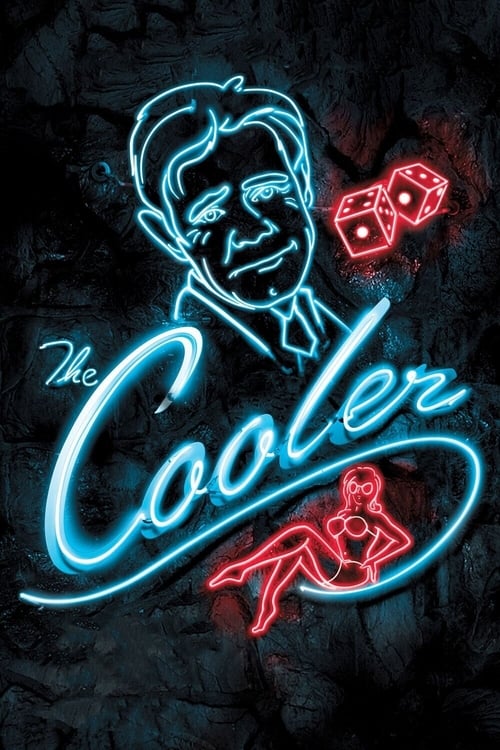
The Cooler
2003 · Wayne Kramer
For a late night when you want a grown-up love story with an edge — something hopeful about second chances that still keeps your stomach a little tight. Comfort and unease in the same glass.
What it's about
Bernie Lootz is the unluckiest man in Las Vegas, and a fading old-school casino pays him for it: his job is to stand next to winning gamblers so his bad luck rubs off and their hot streaks die. His boss Shelly, a bruiser who runs the joint the old way, likes the arrangement exactly as it is. Then Bernie starts seeing Natalie, a cocktail waitress, and falling in love does something to his luck that makes him suddenly very inconvenient to a dangerous man.
The experience
A slow-burn mix of tenderness and menace — genuinely romantic one scene, quietly threatening the next, all soaked in cigarette-smoke melancholy. It's intimate and adult, with a streak of real sweetness that keeps getting shadowed by the sense that Shelly could turn violent at any moment.
Performances
William H. Macy makes a sad-sack loser genuinely moving rather than pathetic, Maria Bello matches him with warmth that never feels sentimental, and Alec Baldwin earned an Oscar nomination as Shelly — a charmer whose affection and brutality live in the same breath.
The craft
Wayne Kramer's debut leans into the unglamorous side of Vegas — worn carpets, dim lounges, a casino that time forgot — so the romance glows against the seediness. The frank, tender love scenes and the lounge-music atmosphere give it a texture most casino movies skip; it plays best late, with the lights low.
Why it matters
A Sundance breakout that announced Kramer as a filmmaker and gave Macy and Baldwin two of their most celebrated roles, with Baldwin's Oscar-nominated turn reviving his reputation as a heavyweight character actor.
Snapshot
The Cooler is a neo-noir romance set in a fading Las Vegas casino, built around a deceptively simple supernatural conceit: Bernie Lootz (William H. Macy) is a "cooler," a man whose luck is so catastrophically bad that proximity to him drains the fortune from any winning gambler. The casino's old-school boss, Shelly Kaplow (Alec Baldwin), deploys Bernie as a living instrument against hot streaks. The film's engine is what happens when Bernie falls for cocktail waitress Natalie Belisario (Maria Bello) and his luck inverts — love makes him lucky, which makes him useless, which makes him dangerous to a man who has spent years controlling him. Wayne Kramer's feature directorial debut, the film premiered at the 2003 Sundance Film Festival and earned Baldwin an Academy Award nomination for Best Supporting Actor. It is at once a melancholy chamber romance, a gangster-inflected character study, and an elegy for a vanishing version of Las Vegas. Working from a modest budget, Kramer and co-writer Frank Hannah fused gritty backroom realism with a fairy-tale logic of luck, producing one of the more distinctive American genre hybrids of its year.
Industry & production
The Cooler belongs to the early-2000s American independent ecosystem in which Sundance functioned as both proving ground and marketplace. It was an independently financed production released by Lions Gate Films, a distributor that had built its identity on character-driven, often abrasive material that the major studios avoided. The project was developed by Kramer and Hannah, with Kramer — a South African–born filmmaker who had worked his way toward directing — making his feature debut behind the camera. The precise budget is not authoritatively fixed in widely circulated records, but by every account it was a low-budget shoot, which shaped its compressed locations, small principal cast, and reliance on performance over spectacle.
The most consequential industry episode attached to the film was its collision with the Motion Picture Association ratings board. The MPAA initially assigned an NC-17, reportedly over a post-coital scene involving Maria Bello's character, and the filmmakers fought the rating to secure an R. The dispute became one of the recurring case studies cited in discussions of the ratings system's inconsistency around sexuality versus violence, and it was featured in Kirby Dick's documentary This Film Is Not Yet Rated (2006). That context matters: it positioned The Cooler not merely as a romance but as a flashpoint in the perennial argument about how the American ratings apparatus polices adult intimacy in independent film.
Casting was central to the film's commercial and critical viability. William H. Macy, by 2003 an established character lead following Fargo and a long association with David Mamet's milieu, anchored the production with the kind of hangdog credibility the part required. Alec Baldwin's casting proved pivotal both onscreen and off — the role arrived during a period when Baldwin was transitioning toward the character work that would define his later career, and the resulting Oscar nomination became part of the film's legacy.
Technology
The Cooler was a photochemical, 35mm production of its era, made before digital acquisition had displaced film for low-budget dramas. Its technological profile is unglamorous by design: this is a movie of interiors, of casino floors, lounges, motel rooms, and back offices, and its craft investment went into lighting and lensing rather than effects. The "cooling" conceit — Bernie's contagious bad luck — is realized almost entirely through staging, performance, editing, and sound rather than through visual-effects technology; dice that go cold and cards that turn are filmed as ordinary events whose meaning is supplied by context. This restraint is itself a technological-aesthetic choice, keeping the supernatural premise grounded in tactile, analog reality. Specific data on the camera packages, lenses, and aspect ratio are not reliably documented in the public record, and I will not invent them; what is clear from the finished film is a commitment to naturalistic, available-feeling casino light rather than any technological showmanship.
Technique
Cinematography
The film's visual scheme, photographed by James Whitaker, leans into the seductive-but-seedy palette of casino interiors: pooled warm light, deep shadow at the edges of frames, the artificial glow of slot machines and neon. The cinematography distinguishes between two emotional registers — the cold, watchful surveillance of the gambling floor and the tender, softer light of Bernie and Natalie's growing intimacy. Las Vegas exteriors are used sparingly and pointedly, often to underline the contrast between the corporatized Strip and the older, dingier world Shelly presides over. The camera tends to stay close to faces, privileging reaction and the small humiliations of Bernie's existence over wide spectacle, which keeps the budget-appropriate intimacy from ever reading as a limitation.
Editing
Cut by Arndt-Wulf Peemöller, the film modulates between the loose, observational rhythm of the romance and the tightening, suspense-driven pacing of the gangster plot as Shelly's grip on Bernie becomes more violent. The editing has to sell the central gag repeatedly — the moment a table "cools" when Bernie arrives — and it does so through timing and juxtaposition: the build of a winning streak, the insertion of Bernie, the deflation. The film's structure tracks Bernie's arc from passive instrument to a man with something to lose, and the cutting accelerates accordingly as the third act converges on debt, betrayal, and reprisal.
Mise-en-scène / staging
Production design is one of the film's quiet strengths. The fictional Shangri-La casino is rendered as a relic — carpets, lounge, and signage evoking a Rat Pack–era Vegas that corporate modernization is actively erasing. This décor is dramaturgically loaded: it externalizes Shelly's nostalgia and his refusal to surrender to the sleek, focus-grouped future embodied by the young Harvard-trained executive Larry Sokolov (Ron Livingston). Bernie's drab apartment and the motel-grade spaces of his life are staged to emphasize loneliness and arrested existence, against which Natalie's presence registers as warmth breaking into a closed system.
Sound
Mark Isham's score and the film's use of source music are essential to its tonal balance, threading lounge-era romanticism through the noir. The aging crooner Buddy Stafford (Paul Sorvino), a washed-up lounge singer Shelly keeps on out of loyalty, makes music literal to the plot — a figure of faded showmanship who embodies the same obsolescence as the casino itself. Sound design also serves the luck premise, the ambient clatter and chime of the floor functioning as the texture of fortune itself.
Performance
Performance is where The Cooler most fully earns its reputation. Macy plays Bernie as a study in defeated posture and apologetic decency, a man so accustomed to bad luck that hope frightens him; his physical limp (the legacy of an old debt to Shelly) is woven into the character's entire bearing. Bello brings unguarded sensuality and emotional risk to Natalie, refusing to let the character collapse into either a noir femme fatale or a redemptive angel — the screenplay complicates her motives, and Bello plays the ambiguity. Baldwin's Shelly is the film's volcanic center: charming, sentimental about old Vegas, and capable of sudden, frightening brutality. The role's blend of menace, wounded loyalty, and rage is what carried him to the Oscar nomination, and it reads as a deliberate dismantling of his leading-man image.
Narrative & dramatic mode
The film operates in a hybrid mode that is its signature: hard-edged character realism shot through with a single, unexplained element of magic. Bernie's curse is treated as literally real within the story's world — luck is a contagious physical property — yet the film never explains or mythologizes it, which keeps the conceit closer to fable than to fantasy. The dramatic structure is a romance braided with a crime narrative. The romance supplies the inversion (love turns Bernie lucky); the crime plot supplies the threat (Shelly cannot afford a lucky cooler, and Natalie's involvement turns out to be entangled with Shelly's manipulations). The screenplay's key complication — that Natalie may have been steered toward Bernie by Shelly to keep him in place — injects noir suspicion into the love story without finally canceling its sincerity. The result is a narrative that asks whether a man defined entirely by misfortune is permitted to change his luck, and at what cost.
Genre & cycle
The Cooler sits at the intersection of several cycles: the Las Vegas film, the gambling movie, the neo-noir, and the indie romance. Its closest kin is the gambling-world chamber drama exemplified by Paul Thomas Anderson's Hard Eight (1996), with which it shares an older-mentor/younger-protégé dynamic, a casino setting, and a fascination with the rituals and superstitions of play. It also converses with the broader Vegas canon — the operatic gangster sweep of Casino (1995) and the doomed romanticism of Leaving Las Vegas (1995) — though The Cooler is smaller and more intimate than either. Its magical-luck premise sets it apart from the realist mainstream of the gambling film, aligning it with a thin tradition of American genre pictures that smuggle a fairy-tale mechanism into otherwise grounded settings.
Authorship & method
The film is most legible as Wayne Kramer's authorial debut, co-written with Frank Hannah. Kramer's interests — fate, luck, masculine self-destruction, and the underclass of American cities — recur in his subsequent work, including the kinetic Running Scared (2006) and the immigration mosaic Crossing Over (2009). The Cooler establishes his fondness for protagonists trapped by circumstance and for stylized premises grounded in unglamorous milieus. The key collaborators shape the film decisively: cinematographer James Whitaker supplies the warm-cold casino palette; composer Mark Isham, a prolific film scorer with a jazz-inflected sensibility, provides the romantic-melancholic musical voice; and editor Arndt-Wulf Peemöller balances the romance and the thriller. But the film's authorship is also, unmistakably, a matter of performance — it is co-authored by Macy, Bello, and especially Baldwin, whose work expanded the material beyond its modest scale.
Movement / national cinema
This is an American independent film of the post-Sundance, Lions Gate era, a moment when mid-budget adult dramas could still find theatrical distribution through specialty distributors rather than studios. It carries no formal movement affiliation, but it is representative of an indie sensibility that prized morally ambiguous characters, frank sexuality, and genre revisionism. Its place in that landscape is partly defined by its ratings battle, which made it a minor cause célèbre in the American conversation about artistic freedom and the MPAA.
Era / period
Released in 2003 and set contemporaneously, The Cooler is acutely conscious of its own historical moment: the corporatization of Las Vegas, the replacement of the old mob-adjacent, personality-driven casino culture with sanitized, shareholder-friendly entertainment complexes. The conflict between Shelly and the young executive Sokolov dramatizes this generational and economic shift directly. The film thus functions as a period piece about the present — an elegy for an era already disappearing as it was being filmed, capturing the twilight of "old Vegas" at the precise moment of its commercial extinction.
Themes
The governing theme is luck as both metaphysics and metaphor — the question of whether a person's fortune is fixed or can be changed, and whether love constitutes a kind of grace that rewrites fate. Around this orbit several others: loneliness and the fear of happiness (Bernie is so habituated to loss that good fortune destabilizes him); debt and ownership (Shelly's hold over Bernie is financial, physical, and psychological, raising the question of who owns a man's life); loyalty and obsolescence (Shelly, Buddy the crooner, and the casino itself are all relics resisting replacement); and the commodification of human warmth (the suspicion that even Natalie's affection is a transaction Shelly arranged). The film's romanticism is genuine but never naïve — it insists that tenderness is real while acknowledging the mercenary structures that surround it.
Reception, canon & influence
Critically, The Cooler was well received on its release, with particular praise for its three central performances and for the freshness of its central conceit. The consensus singled out Baldwin's supporting turn, and his Academy Award nomination for Best Supporting Actor became the film's most durable accolade and a marker of his career reinvention as a character actor. Macy and Bello were likewise praised for the rawness and credibility of the romance. The film did not become a major box-office property — its scale and subject matter kept it in the specialty-release lane — and the comprehensive financial record is not something I will fabricate here.
Looking backward, the film draws on the gambling-world chamber drama (notably Hard Eight), the elegiac Vegas film (Casino, Bugsy, Leaving Las Vegas), and the long noir tradition of fatalistic men undone by women and luck. Its magical-realist premise echoes a fable logic older than cinema — the idea of the unlucky man as a folk figure. Looking forward, its most concrete cultural afterlife lies in two places: the ongoing critical reputation of Baldwin's performance as a pivot point in his career, and the film's recurring citation in debates over the MPAA, cemented by its appearance in This Film Is Not Yet Rated. Beyond that, its direct influence on subsequent filmmaking is modest and diffuse; it endures less as a model widely imitated than as a well-regarded, distinctive entry in the early-2000s American indie canon — a film remembered for the strange beauty of its premise and the conviction of its acting.
A Deleuzian reading
Watch Bernie Lootz cross a casino floor and you learn the film's whole grammar in ten seconds.
The full Deleuzian reading of The Cooler →
Reception
A Sundance 2003 hit that rode Alec Baldwin's awards run through the season, it has since slipped into the ranks of half-forgotten early-2000s indies — the kind cinephiles periodically rediscover and insist was better than anyone remembers.
How The Cooler was received, from release to now →
Influences: the films it descends from and the films it influenced
- Hard Eight (1996) — The explicit kinship the dossier names: a casino-floor chamber drama built on a paternal old-pro and a marked, luckless younger man, played in long quiet takes on weathered faces rather than gambling spectacle.
- Casino (1995) — Supplies the elegy of old mob-run Vegas dissolving into corporate management, and the procedural eye for casino-floor mechanics and surveillance light that frames Bernie as a relic of a dying staffing model.
- Leaving Las Vegas (1995) — Models the doomed Vegas romance scored to jazz-lounge melancholy — the same Isham-adjacent sensibility of saxophone-soaked fatalism wrapping two damaged people in a neon city.
- Bugsy (1991) — Founds the nostalgic mythology of hand-built old Vegas that The Cooler's Shangri-La invokes as a doomed relic — the glamour of the original casino dream against the coming corporate sterility.
- Atlantic City (1980) — The direct template for obsolescence-as-fate: an aging small-time gambling-world man, written off as a loser, is briefly revived by luck and a woman while his town is literally being demolished around him.
- The Hustler (1961) — Establishes the gambling chamber tragedy where the protagonist's fate turns on a woman's love against the house's cruelty, shot in close, smoky interiors that read defeat on the face.
- Out of the Past (1947) — The noir DNA of the resigned man undone by his past and a woman — the fatalistic male whose luck is sealed before the film begins, which The Cooler literalizes into a curse.
- California Split (1974) — Naturalistic immersion in the compulsive-gambler ecosystem — overlapping low-life texture and the casino as lived workplace rather than glamorous set, grounding the milieu in the unglamorous.
- Running Scared (2006) — Kramer's own follow-through on the authorial obsession seeded here — protagonists trapped by circumstance and masculine self-destruction in a stylized underclass milieu, escalated into kinetic pulp.
- Crossing Over (2009) — Extends Kramer's method of grounding stylized fate in unglamorous American underclass life, carrying forward the director's signature interest in people boxed in by their circumstances.
- Mississippi Grind (2015) — Revives the luck-as-fate gambling indie around a talismanic 'lucky' companion, trading jackpot spectacle for melancholic Americana and two-hander intimacy in the same lineage.
- This Film Is Not Yet Rated (2006) — The documentary that cemented The Cooler's afterlife as an MPAA case study, citing its Macy–Bello sex scene as evidence of the ratings board's double standard on explicitness.
- Croupier (1998) — The casino-insider noir told from the staff side of the table, treating the dealer/employee as an instrument of other people's fate — the same inside-the-house vantage The Cooler adopts.
- Magnolia (1999) — Shares the structured magical-realist fable logic where chance and coincidence are dramatized as cosmic forces — the conceit that luck obeys a narrative law, made literal as Bernie's contagious bad fortune.
- Owning Mahowny (2003) — The same-year gambling chamber piece built on a deliberately unglamorous, interior performance of compulsion, prioritizing the credibility of an ordinary face over casino spectacle.
Similar films
- Leaving Las Vegas (1995) — influence & lineage
- Casino (1995) — influence & lineage
- The Hustler (1961) — influence & lineage
- Hard Eight (1997) — shared sensibility
- Good Night, and Good Luck. (2005) — shared sensibility
- The Killing of a Chinese Bookie (1976) — shared sensibility
- Anora (2024) — shared sensibility
- Some Like It Hot (1959) — shared sensibility