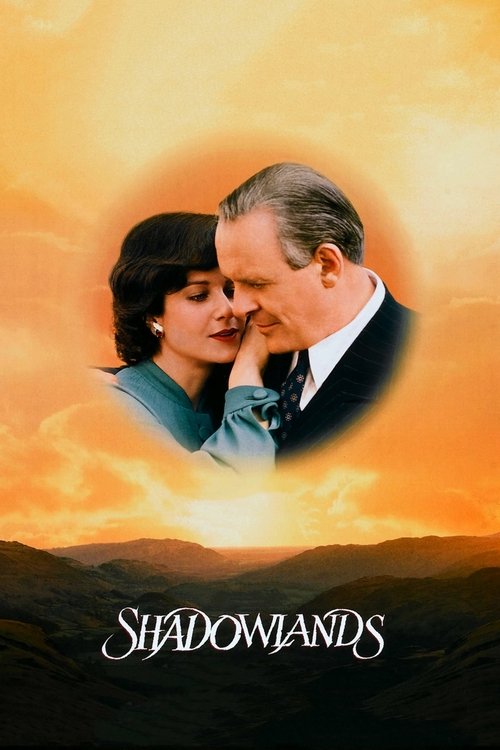
Shadowlands
1993 · Richard Attenborough
When you need a good cry with your dignity intact — a grown-up love story for a quiet evening, comforting in its warmth even as it goes somewhere hard.
What it's about
C. S. Lewis — Oxford don, Christian thinker, author of the Narnia books — has built a comfortable bachelor life of lectures, debates, and safely theoretical ideas about suffering. Then Joy Gresham, a blunt, brilliant American poet, walks into it and refuses to play by donnish rules. What begins as a wary literary friendship slowly becomes the love of his life — and puts everything he's ever argued about pain and faith to the test.
The experience
Restrained, literate, and then quietly devastating — it earns its tears the slow way, through conversation and small thawings rather than melodrama. You leave it tender and wrung out, in a good way.
Performances
Anthony Hopkins gives one of his most delicate performances, a man visibly unpracticed at feeling anything; Debra Winger's forthright, unsentimental Joy earned an Oscar nomination and keeps the film honest whenever it threatens to go soft.
The craft
Attenborough, famous for epics, works here at deliberately intimate scale: burnished Oxford quads, book-lined rooms, and a screenplay by William Nicholson (from his own play) that lets ideas about love and suffering breathe as actual conversation. Handsome, unhurried filmmaking where the close-up is the special effect.
Why it matters
A high-water mark of 1990s British heritage cinema and one of the defining screen portraits of C. S. Lewis, it showed Attenborough could move audiences as deeply in one room as on a battlefield.
Snapshot
Shadowlands dramatizes the late-life romance between C. S. Lewis — the Oxford don, Christian apologist, and author of the Narnia books — and the American poet Joy Davidman Gresham, whose marriage to Lewis was cut short by her death from cancer. Adapted by William Nicholson from his own work, the film is a chamber drama of restraint and devastation: a study of an intellectual who has theorized about suffering at a safe distance and is then made to live it. Directed by Richard Attenborough at a deliberately intimate scale — a marked contrast to the epic canvases (Gandhi, Cry Freedom, Chaplin) for which he was best known — it pairs Anthony Hopkins's contained, donnish Lewis with Debra Winger's forthright, unsentimental Joy. The result is a high-water mark of early-1990s British heritage cinema: handsomely mounted, theatrically rooted, and built almost entirely on the textures of speech, weather, and reticence rather than incident. Its enduring reputation rests on its emotional honesty about grief and on a screenplay that treats theology not as decoration but as the very ground the drama stands on.
Industry & production
The film is the third incarnation of a single piece of writing. Nicholson first told the Lewis–Davidman story as a BBC television play, Shadowlands (1985), directed by Norman Stone with Joss Ackland and Claire Bloom; it was well received and won recognition in British television. Nicholson then reworked the material for the stage, where it ran in the West End and on Broadway around 1989–1990, with Nigel Hawthorne as Lewis. The 1993 feature is thus a third pass over thoroughly tested dramatic material — a lineage that explains both the screenplay's polish and its essentially theatrical architecture of scenes built around extended two-person exchanges.
Attenborough produced as well as directed, working within the mid-budget prestige economy of the period; the film was financed and distributed through arrangements involving Savoy Pictures in the United States, with Spelling-affiliated and British production partners. It belongs to a recognizable commercial category of the moment: the literate, adult, awards-oriented British drama, modestly budgeted by Hollywood standards but assembled with first-rank craft talent. The production drew on real and evocative English locations — Oxford's colleges and the surrounding countryside stand in for Lewis's world at Magdalen and the Kilns — which gave the film its grounded sense of place without recourse to spectacle. Beyond these broad contours, detailed production-budget and grosses figures are not something I can state with confidence, and I will not invent them.
Technology
Shadowlands is, by design, technologically conventional, and that conventionality is part of its aesthetic argument. It was photographed on 35mm film using the standard photochemical processes of early-1990s studio production, with no notable reliance on optical novelty, early digital tools, or visual effects. There is nothing here that advanced the technical state of the art, and it would be false to claim otherwise. The film's "technology," properly understood, is the inherited apparatus of classical narrative cinema — film stock, lenses, practical and naturalistic lighting, location sound supplemented by post-production scoring — deployed in service of legibility and warmth rather than display. The deliberate absence of any technological signature is consistent with a project whose entire method is to make the machinery disappear so that performance and text carry the experience.
Technique
Cinematography
Roger Pratt's photography is the film's quiet engine. Pratt — whose range ran from the baroque fantasy of Brazil and The Fisher King to mainstream studio work — here adopts a muted, autumnal palette keyed to Oxford stone, wood-panelled interiors, and English overcast light. The camera is largely composed and unhurried, favoring stable framings that let actors hold the frame through long beats. Interiors are lit with a low-key naturalism — fires, lamps, and gray window light — that lends the college rooms a hushed, enclosed quality, while the exteriors of the countryside excursion open the palette toward warmth at the film's emotional peak. The visual scheme tracks the drama's movement: from cloistered, shadowed bachelor spaces toward light, and then back toward shadow as illness encroaches.
Editing
Lesley Walker, a frequent Attenborough collaborator, cuts for emotional patience rather than pace. The film's rhythm is conversational; scenes are allowed to breathe, with cutting that respects the actors' timing and the weight of pauses. Walker's restraint is most conspicuous in the film's hardest passages — the diagnosis, the hospital scenes, the aftermath of Joy's death — where the editing declines the easy intensifications of montage and instead lets duration do the work, trusting silence and stillness to register loss.
Mise-en-scène / staging
The film's staging bears the unmistakable imprint of its theatrical origins, and Stuart Craig's production design gives that staging its substance. Craig — among the most decorated designers of his generation — renders the closed masculine world of an Oxford common room with documentary conviction: the leather, the books, the ritual of port and conversation. Into this airless, male, donnish enclosure Joy's arrival is staged as an intrusion of vitality and plain American directness. Attenborough blocks much of the drama around thresholds, doorways, and tables — the geometry of a world organized to keep feeling at bay — and the gradual softening of that geometry, as Lewis's house admits a wife and a child, is itself a form of meaning.
Sound
George Fenton's score, discussed below as authorship, governs the film's aural temperature, used sparingly to underline rather than to manufacture emotion. Beyond the music, the soundscape is one of muted naturalism — rain, fire, the acoustics of stone halls and lecture rooms — and of voices: the film is unusually attentive to the cadence of cultivated English speech and to the way Joy's flatter, franker American register cuts across it.
Performance
Performance is where the film lives. Hopkins plays Lewis as a man fluent in ideas and fluent in nothing else — courteous, witty in the safe currency of debate, and almost physically braced against intimacy. It is a performance of withholding, which makes the late collapse of his composure all the more wrenching. Winger's Joy is its necessary counterweight: sharp, unawed by Oxford's self-regard, and possessed of an emotional plainness that exposes Lewis's evasions. The two performances are calibrated as a duel that becomes a love story. Strong supporting work — including Edward Hardwicke and John Wood among Lewis's Oxford circle, and the young Joseph Mazzello (the same year as Jurassic Park) as Joy's son Douglas — surrounds the central pairing without crowding it.
Narrative & dramatic mode
The film operates in the mode of restrained realist tragedy. Its structure is essentially a movement from stasis to feeling to loss: Lewis's settled, bachelor existence; the disruption and deepening of his bond with Joy; the cancer that turns an intellectual abstraction — the problem of human suffering — into lived agony. Nicholson frames Lewis through his own public discourse: a man who has lectured serenely that pain is "God's megaphone to rouse a deaf world," and who must then discover whether that consolation survives contact with the death of someone he loves. The dramatic engine is therefore the collision between doctrine and experience. The mode is talk-driven and interior; what would be off-screen in life — argument, hesitation, the slow admission of love — is the on-screen action. This is unapologetically a writer's film, and its tragedy is structured as an argument the protagonist cannot win with words.
Genre & cycle
Shadowlands sits squarely within the British "heritage film" cycle that flourished from the mid-1980s into the 1990s — the tradition of literate, period-set, immaculately appointed dramas associated above all with Merchant Ivory (A Room with a View, Howards End, and, the very same year, The Remains of the Day, also starring Hopkins). It shares that cycle's hallmarks: a recent-historical English setting, a preoccupation with repression and propriety, prestige craft, and an address to an adult, educated audience. It also belongs to the durable sub-genre of the literary biopic and to the narrower category of the terminal-illness romance. What distinguishes it within these cycles is its theological seriousness: where many heritage films treat emotional repression as a social or psychological condition, Shadowlands roots it in a specific intellectual and religious worldview, making the genre's characteristic reticence a matter of belief as much as of class.
Authorship & method
The film is best read as the meeting of two authorships: Attenborough's and Nicholson's. Richard Attenborough, working against type, subordinates the epic instinct of Gandhi and Cry Freedom to an intimate, actor-centered method; his direction here is self-effacing, organized around giving performers space and trusting the text. William Nicholson, as both originating dramatist and screenwriter, is arguably the film's primary author — the material's three-stage evolution from teleplay to stage play to screenplay reflects a sustained personal authorship of the Lewis story, and the screenplay's structure, its theological through-line, and its most quoted lines are his.
The key collaborators reinforce a house style of dignified craft. Roger Pratt (cinematography) supplies the muted, weather-bound English light. George Fenton (composer), a long-standing Attenborough partner whose work for the director reaches back to Gandhi and Cry Freedom, provides a restrained orchestral score that supports the drama without overwhelming it. Lesley Walker (editor), another recurring Attenborough collaborator, shapes the film's patient rhythm. Stuart Craig (production design), one of the era's premier designers, builds the persuasive Oxford world the drama inhabits. The method across all departments is the same: conceal the craft, foreground the human encounter.
Movement / national cinema
This is emphatically a work of British national cinema in a particular register — the prestige, internationally financed, export-oriented British film of the late twentieth century, made for the world market but steeped in distinctly English institutions, landscapes, and manners. It draws on the long tradition of British literary adaptation and on the country's deep theatrical culture, evident in its dialogue-forward construction and its reliance on stage-trained actors. It is not a film of any avant-garde or oppositional movement; rather, it represents the establishment center of British cinema at the moment when heritage drama was the nation's most successful cultural export alongside the costume romance.
Era / period
Shadowlands arrives at a high point of the early-1990s heritage boom and invites direct comparison with its 1993 sibling The Remains of the Day — both English, both about emotional repression, both featuring an internalized Hopkins performance. The era's prestige economy — mid-budget, awards-driven, adult dramas funded through transatlantic arrangements — is precisely the niche the film occupies. Its period setting (England in the 1950s) is rendered with the cycle's characteristic care, but the film's sensibility belongs as much to its moment of production: a 1990s confidence that serious, literate, unspectacular drama could find a substantial theatrical audience, a confidence that the subsequent decades would gradually erode.
Themes
The governing theme is theodicy — the reconciliation of love and suffering, and the cost of belief tested by loss. Lewis the apologist had written about the meaning of pain from a position of relative safety; the drama strips that safety away and asks whether faith consoles when it is most needed. Around this sit the film's other concerns: the thawing of an over-intellectualized life by love; the tension between the life of the mind and the life of the body and heart; grief as the price of attachment, distilled in the screenplay's most enduring formulation that the pain of loss is bound up with, and inseparable from, the earlier happiness — that this is, in effect, the bargain of loving at all. The title itself carries the thematic weight: the "shadowlands" evoke a Platonic and Christian sense, drawn from Lewis's own thought, of earthly life as the shadow of a fuller reality — a consoling idea the film both honors and pressures, refusing to let it tidily resolve the rawness of bereavement. Childhood, fatherhood, and the inheritance of grief enter through Joy's son. Throughout, the film resists piety: its sympathy lies with the honesty of feeling over the sufficiency of any doctrine.
Reception, canon & influence
Shadowlands was warmly received as a model of intelligent, restrained adult drama, with particular praise for its two central performances; Hopkins and Winger were widely singled out, and the film was recognized in the major awards season. It earned Academy Award nominations for Debra Winger (Best Actress) and for William Nicholson's adapted screenplay; it featured prominently in British awards as well, though I will refrain from asserting specific wins I cannot verify precisely. Where the film drew reservation, it was on the familiar charge leveled at heritage cinema — that its very tastefulness and stateliness risked muffling the emotional violence at its core, a middlebrow restraint that some critics found admirable and others found becalmed.
The influences on the film are clear and layered: C. S. Lewis's own writings, most pointedly the contrast between The Problem of Pain (his early, confident theology of suffering) and A Grief Observed (the harrowed journal of his bereavement); Nicholson's own prior teleplay and stage versions; and the broader heritage and literary-adaptation traditions of British cinema and theater. Its influence forward is more diffuse and should not be overstated. The film did not found a school or alter cinematic technique; its legacy is one of exemplary craft within an established mode. It stands as a touchstone for the literary biopic of late love and grief and as a benchmark for restrained, performance-led treatments of illness and mourning — a film other prestige dramas of intimate loss are measured against more than one they imitate. Its most concrete cultural afterlife may be its part in cementing a popular, humane image of C. S. Lewis the man, and in demonstrating that a drama built almost entirely from conversation, faith, and bereavement could command a wide and serious audience. On the question of any direct, traceable influence on specific later filmmakers, the record is genuinely thin, and the honest assessment is that the film endures as an accomplished culmination of its tradition rather than as the origin point of a new one.
A Deleuzian reading
A man stands at a lectern and tells a room full of strangers that pain is God's megaphone to rouse a deaf world.
The full Deleuzian reading of Shadowlands →
Reception
A respectable prestige hit in 1993 — Oscar nominations for Debra Winger and William Nicholson's screenplay, and the BAFTA for Best British Film — it was filed under 'handsome middlebrow weepie' and gradually slipped from view. It's since been quietly reappraised as one of Attenborough's warmest films and a devastating two-hander rather than stuffy heritage cinema.
How Shadowlands was received, from release to now →
Influences: the films it descends from and the films it influenced
- Brief Encounter (1945) — Codifies the British register of emotional withholding — clipped RP dialogue, stolen glances, and feeling routed through suppression rather than display — the repression-as-form grammar Shadowlands inherits wholesale.
- The Heiress (1949) — Model for the theatrical chamber adaptation: static drawing-room blocking and held compositions in which a withholding performance, not camera movement, carries the suppressed feeling.
- Dark Victory (1939) — Establishes the terminal-illness romance's structural spine — diagnosis, denial, remission, dignified death — that the Joy Gresham plot tracks beat for beat.
- Love Story (1970) — Brings the dying-beloved template into prestige mainstream cinema, proving a romance organized entirely around impending bereavement could command a wide serious audience.
- Terms of Endearment (1983) — Debra Winger's own prior cancer-deathbed performance; the withholding, unsentimental grief she plays there is the direct performance lineage to her Joy Gresham.
- Gandhi (1982) — Same authorship and the George Fenton scoring partnership reaching back here; Shadowlands deliberately subordinates this film's epic instinct to a self-effacing, actor-centered method.
- A Room with a View (1985) — Establishes the Merchant-Ivory heritage house style — literary source, painterly English light, tasteful period restraint, concealed craft — the mode Shadowlands operates squarely within.
- Howards End (1992) — The heritage boom's immediate peak: theatrical ensemble blocking in period interiors and a muted, weather-bound palette that is Shadowlands' direct genre context.
- The End of the Affair (1999) — Shares Roger Pratt's muted, rain-darkened English photography and the same theodicy through-line — love, grief, and a quarrel with God staged as the drama's engine.
- Iris (2001) — Extends the literary-biopic of late Oxford love undone by illness — a restrained, performance-led portrait of a writer's intellect, the mode Shadowlands set as benchmark.
- Wit (2001) — Chamber treatment of terminal cancer built on theatrical monologue and withholding performance, the academic-confronting-mortality structure rendered as dignified restraint.
- Amour (2012) — Pushes the restrained terminal-illness drama toward long-take patience and a near-total refusal of score, foregrounding the unadorned human encounter of bereavement.
- The Theory of Everything (2014) — British heritage illness-biopic of an intellectual couple, using an autumnal palette and performance-led physical decline within the same tasteful-restraint tradition.
- The Father (2020) — Theatrical adaptation by its own originating dramatist — Nicholson's three-stage path replayed — with Hopkins anchoring a chamber drama of cognitive loss through pure withholding.
- The Remains of the Day (1993) — Same-year Hopkins masterclass in withholding-restraint, where the entire drama is built from emotion conveyed through repression and the unspoken — the twin of his C. S. Lewis.
- 84 Charing Cross Road (1987) — Dialogue-driven transatlantic literary romance carried by epistolary restraint, with Hopkins again as the bookish, emotionally guarded Englishman warmed by an American woman.
Similar films
- The Remains of the Day (1993) — influence & lineage
- The Father (2020) — influence & lineage
- Brief Encounter (1945) — influence & lineage
- Gandhi (1982) — influence & lineage · often watched together
- All of Us Strangers (2023) — shared sensibility
- The English Patient (1996) — shared sensibility
- The Hours (2002) — shared sensibility
- Philomena (2013) — shared sensibility