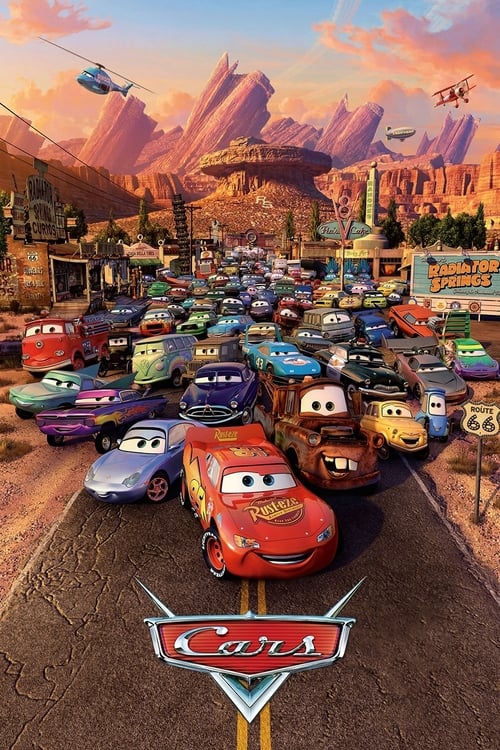
Cars
2006 · John Lasseter
For a cozy family night in when you want zero stress and a warm landing — comfort viewing about friendship and taking the scenic route.
What it's about
Lightning McQueen is a hotshot rookie race car with one thing on his mind — winning the Piston Cup — until a cross-country detour strands him in Radiator Springs, a faded little town on old Route 66. Sentenced to repave the road he wrecked, he gets tangled up with the locals: a lovesick tow truck, a sharp small-town lawyer, and a gruff old doctor with secrets of his own. It's a world of nothing but cars, and a story about slowing down.
The experience
Easygoing, sunny, and sweeter than its racing premise suggests — the pace deliberately downshifts once it hits the small town, trading spectacle for hangout charm. It's gentle enough for little kids and quietly nostalgic for the adults driving them.
Performances
Owen Wilson's laid-back drawl is a perfect fit for a cocky racer learning humility, and Paul Newman — a real-life racing man in one of his final roles — gives the old Hudson genuine gravel and grace.
The craft
Pixar's desert Southwest is gorgeous — neon at dusk, canyon light, chrome that actually reflects the world around it — and the racing sequences have real roar on a good sound system. The whole film is a love letter to Route 66 Americana, right down to its twangy, radio-friendly soundtrack.
Why it matters
It launched one of animation's biggest franchises and a merchandising empire that changed how animated films are valued, while preserving a nostalgic snapshot of America's bypassed roadside towns.
Snapshot
Cars is the seventh feature from Pixar Animation Studios and the last produced before — though released just after — the studio's acquisition by The Walt Disney Company in early 2006. It is also the most personal of the early Pixar films: a passion project for John Lasseter, co-founder and creative chief of the studio, rooted in his love of automobiles, Route 66, and the vanishing roadside America that the Interstate Highway System bypassed. The film imagines a world populated entirely by anthropomorphized vehicles, with no humans at all, and uses that conceit to tell a redemption story about a brash rookie race car, Lightning McQueen, who is stranded in the forgotten desert town of Radiator Springs and learns to value community, mentorship, and the journey over the trophy. Where Pixar's preceding films had been built on high-concept "what if" premises (toys, bugs, monsters, fish, superheroes), Cars is notably gentler and more elegiac in its ambitions — a nostalgia piece as much as an adventure. It became a merchandising juggernaut and the seed of Pixar's most commercially lucrative, and most critically contested, franchise.
Industry & production
Cars arrived at a hinge moment for Pixar and Disney. The two companies' distribution and co-production partnership, dating to Toy Story (1995), had grown acrimonious under Disney CEO Michael Eisner, and Cars was understood at the time as potentially the final film of that original deal. The picture went into production amid that uncertainty and emerged into a transformed landscape: in January 2006 Disney, now led by Robert Iger, announced the acquisition of Pixar, making Lasseter chief creative officer of both Pixar and Walt Disney Animation Studios. Cars, released that June, thus straddles the line between the independent-minded Pixar and the Disney-owned studio.
The production was unusually long and troubled by the standards of the studio's hot streak. The film is dedicated to Joe Ranft, the veteran story artist and co-director who died in a car accident in 2005 during production — a loss that resonates painfully given the subject matter. The release date was pushed from late 2005 to mid-2006. Lasseter has described undertaking research road trips along Route 66 to ground the film, consulting people who lived along the old highway about how the Interstate had hollowed out their towns. That fieldwork is the documented backbone of the film's setting and its central theme of bypassed America.
Commercially, Cars performed strongly at the box office, though it is widely noted that the franchise's extraordinary value lay less in ticket sales than in consumer products: Cars-branded toys, particularly die-cast vehicles, generated merchandising revenue on a scale that reshaped how Disney valued the property and helped justify two sequels and the Planes spin-offs produced by DisneyToon Studios.
Technology
Cars posed a specific and well-documented rendering problem: reflective, curved automotive surfaces. Real cars are defined visually by what their paint and chrome reflect, and earlier rendering techniques could not affordably simulate accurate reflections of a full environment off a moving, curved body. For this film Pixar adopted ray tracing at production scale for the first time — a computationally expensive technique that traces the path of light rays to produce true reflections, refractions, and more physically accurate shadows and ambient occlusion. This was integrated into the studio's RenderMan pipeline and is generally cited as a milestone in Pixar's technical history, since ray tracing's cost had previously kept it out of feature animation. The payoff is visible in the way the cars' bodies pick up the desert, the racetrack, and one another.
The film also pushed the studio's work on large environments and surfacing — sun-baked desert rock, neon, asphalt, and the layered atmospheric haze of the American Southwest. As with all Pixar films of the period, the production ran on the studio's proprietary tools layered over RenderMan; specific internal toolchain details beyond the ray-tracing advance are not something I can attribute precisely without risking invention.
Technique
Cinematography
Cars is "shot" by a virtual camera, but the film is deliberate about emulating live-action lensing conventions, and the racing sequences in particular borrow the grammar of televised motorsport and racing cinema: low track-level angles, sweeping aerial passes over the speedway, whip pans, and long telephoto-style compressions that flatten the field of cars into a churning pack. By contrast, the Radiator Springs material slows down markedly — wide vistas of mesa and desert, golden-hour lighting, and a more contemplative, painterly framing that consciously evokes the Western landscape tradition and, in its romanticization of Route 66, the iconography of mid-century American road photography. The contrast between the kinetic race footage and the becalmed desert is the film's primary visual argument.
Editing
The editing mirrors that structural split. The Piston Cup racing sequences are cut fast and percussively to convey speed and competition, while the central Radiator Springs section is paced slowly and patiently, letting scenes breathe to dramatize McQueen's enforced deceleration — the narrative literally and formally slows him down. The signature emotional set piece, McQueen and Sally's drive through the surrounding country (scored to a James Taylor song), is built on longer held shots and lyrical cutting rather than action rhythm. Pixar's films of this era were edited with reel-by-reel story-reel iteration; the late schedule slip on Cars suggests substantial reworking, though I won't attribute specific cuts without documentation.
Mise-en-scène / staging
The film's most distinctive design decision is anatomical: Pixar placed the cars' eyes in the windshield rather than in the headlights. Lasseter has explained this as a way to make the eyes read as a true window to a soul and to keep the face higher and more expressive — a choice that governs all the character staging, since the cars "look" and emote through the glass. Radiator Springs itself is a carefully art-directed period artifact: a strip of streamline-moderne and mid-century roadside architecture, neon signage, and a dusty palette, staged to feel like a preserved relic. The world-building extends the conceit thoroughly — buildings, geology (mountains shaped like tail fins and hood ornaments), and insects all conform to automotive forms — which is both a source of visual wit and, for some critics, a logical strain the film never fully resolves.
Sound
Sound is central to Cars because the characters are engines. The film leans heavily on the texture of motors — the throaty roar of the racing pack, the wheeze of older vehicles, the distinct "voices" of engines as character signifiers. Randy Newman's score blends his familiar Americana idiom with motorsport energy, and the soundtrack is anchored by source songs that carry the nostalgia theme, including Sheryl Crow and a James Taylor recording of "Our Town," plus a Randy Newman end-credits song. Rust-eaze, tire squeal, and the ambient quiet of the desert are used to mark the tonal shift between the racing world and Radiator Springs.
Performance
The voice cast pairs a Hollywood lead with motorsport and comedy figures. Owen Wilson voices Lightning McQueen, bringing his characteristic laid-back drawl and self-amused cockiness; Paul Newman — in one of his final major performances — voices Doc Hudson, the town's reclusive doctor and former racing champion, lending real gravitas and weathered authority that anchors the film's themes of lost glory and passed-down wisdom. Larry the Cable Guy voices the tow truck Mater as broad comic relief, Bonnie Hunt voices Sally, and the cast is salted with real racing personalities (Richard Petty, for instance) and broadcasters playing versions of themselves, which grounds the motorsport material in a recognizable culture.
Narrative & dramatic mode
Structurally, Cars is a classic redemption arc grafted onto a fish-out-of-water comedy. Its dramatic engine is the moral reformation of an arrogant protagonist who must be removed from the arena of his ambition (the championship) and placed in a community that values different things. The model is overtly that of the small-town reawakening film — the brash outsider stranded among eccentrics who teach him to slow down — a lineage critics quickly traced to Doc Hollywood (1991) and to a broader American tradition of pastoral retreat narratives. The film is sentimental and unironic in its mode, embracing nostalgia and earnestness where earlier Pixar films had hedged with wit; the climax pointedly rejects the conventional sports-movie payoff, having McQueen sacrifice the win to help an injured rival, which reframes victory as character rather than result.
Genre & cycle
Cars sits at the intersection of the family/animation feature, the sports (racing) film, and the road movie / small-town pastoral. Within Pixar's output it belongs to the studio's mature commercial peak, but it also inaugurated a distinct cycle: the Cars franchise (Cars 2, 2011; Cars 3, 2017) and the DisneyToon Planes films, plus an enormous body of shorts and direct-to-video content. As a racing film it draws on the genre's conventions — the rookie, the veteran, the comeback — while as a road movie it participates in the long American fascination with the highway as a space of self-discovery. Its NASCAR-inflected world also locates it specifically within American motorsport culture rather than the European racing tradition that Cars 2 would later visit.
Authorship & method
Cars is the most directly authored of Pixar's films by John Lasseter, who returned to solo directing (with Joe Ranft as co-director) after handing A Bug's Life-era and Toy Story 2 duties around the studio. Lasseter's authorship here is biographical: his automotive enthusiasm and his interest in industrial design and Americana suffuse the project, and he has framed it as a story about American values being lost to speed and convenience. His method — extensive research trips, story-reel iteration, and a collaborative "brain trust" review process — is the documented Pixar working model of the era.
Key collaborators: Joe Ranft, co-director and story leader, whose death the film memorializes. Randy Newman, the composer, continued his long Pixar association (Toy Story, A Bug's Life, Monsters, Inc.) with a score blending Americana and motorsport. The screenplay is credited to multiple writers, with story credit shared among Lasseter, Ranft, and others — a typical Pixar collective-authorship situation; I would avoid asserting a precise division of credit without the documents in front of me. The production design realized the Route 66 nostalgia and the automotive world-building that define the film's look.
Movement / national cinema
The film belongs to the American computer-animated feature movement that Pixar itself founded with Toy Story and that, by 2006, dominated mainstream family filmmaking and had drawn competitors (DreamWorks Animation, Blue Sky). More than any other Pixar film, Cars is also a self-conscious work of American national myth-making — its subject is a particular vision of the United States: the open road, small-town community, the romance of the automobile, and the cultural cost of mid-century modernization. It is, in effect, a Pixar Western, trading the frontier for the highway.
Era / period
Released in 2006, Cars is a product of the high-water mark of pre-recession Hollywood animation and of the precise moment of Disney's absorption of Pixar. Technologically it marks the arrival of feature-scale ray tracing. Culturally it looks backward rather than forward: its emotional center is the 1950s–60s heyday of Route 66 and the trauma of the Interstate era (the highway system whose mid-1950s federal authorization reshaped American travel), making the film a meditation on a vanished period as much as a 2006 artifact. That doubled temporality — a 2006 film mourning a 1950s America — is essential to reading it.
Themes
The governing theme is the opposition between speed and presence: McQueen's worship of winning and velocity must yield to the slower values of place, friendship, mentorship, and care. Closely bound to this is nostalgia and obsolescence — Radiator Springs as an emblem of communities "bypassed" by progress, and Doc Hudson as a champion discarded once he could no longer perform. The film advances a critique, however gentle, of American acceleration and disposability, arguing for the dignity of the overlooked. Mentorship and legacy run through the Doc–McQueen relationship (given extra poignancy by Paul Newman's late-career presence), and humility is the moral McQueen earns by surrendering the championship. The all-automotive world also quietly thematizes American identity itself as something built around the car.
Reception, canon & influence
Critically, Cars was received as a comparative step down within Pixar's then-spotless run — admired for its technical beauty, its heartfelt Americana, and Newman's contributions, but faulted by a number of reviewers for a slack midsection, a familiar plot, and the Mater comedy. It is frequently ranked toward the lower end of the studio's filmography by critics even as it remains beloved by a large audience, especially children. It competed in the awards season of its year but did not reach the top tier of Pixar's Oscar honors; I'd avoid stating specific wins or losses without checking the record.
Influences on the film run backward to Doc Hollywood and small-town-reawakening comedies, to the American road movie and the Western landscape tradition, to NASCAR and motorsport broadcast culture, and to mid-century roadside Americana and Route 66 lore. Its legacy forward is twofold and somewhat paradoxical. Artistically, Cars is minor within Pixar's canon and is often the film cited when critics date the studio's drift toward sequels and franchise logic. Commercially, it is among the most consequential animated films of its era: its merchandising revenue — driven by the die-cast toy line — was so vast that it underwrote two theatrical sequels, the Planes spin-off line, theme-park expansion (the Cars Land area at Disney California Adventure), and a durable evergreen brand. In that sense Cars shaped not the aesthetics of animation but the economics and franchise strategy of Disney-Pixar, demonstrating that a film's cultural footprint can be measured as much in shelf space as in screen time.
A Deleuzian reading
Picture the headlights finding nothing.
The full Deleuzian reading of Cars →
Reception
In 2006 it landed as Pixar's first critical shrug — solid grosses but the studio's lowest Rotten Tomatoes score to that point, and it lost the animation Oscar to Happy Feet. Twenty years on it's split into two reputations: cinephiles still rank it near the bottom of Pixar, while the kids who grew up on it defend it as sincere Americana about slowing down.
How Cars was received, from release to now →
Influences: the films it descends from and the films it influenced
- Susie the Little Blue Coupe (1952) — Disney's anthropomorphic car short established the windshield-as-eyes design grammar (rather than headlight-eyes) that Cars adopts to keep expression and sightline at the driver's-window position.
- Luxo Jr. (1986) — Lasseter's foundational Pixar technique of investing a wholly inanimate object with personality through weight, timing, and motion alone is the direct method by which Cars animates vehicles without faces beyond the glass.
- Toy Story (1995) — Same author's arrogant-hero-humbled redemption arc and buddy dynamic, plus the Pixar pipeline of giving soul to manufactured objects, is recycled almost beat-for-beat in McQueen's chastening.
- Doc Hollywood (1991) — Supplies the literal plot scaffold — a fast-track careerist stranded in a bypassed small town who is reformed by its slower values — that Cars transposes onto Route 66.
- Grand Prix (1966) — Pioneered the in-cockpit mounted-camera POV and rhythmic cross-cut race montage that Cars restages as its motorsport-broadcast editing grammar.
- Days of Thunder (1990) — Models the NASCAR television aesthetic — sponsor-plastered bodywork, pit-lane drama, telephoto pack-racing — that Cars parodies and reproduces in its Piston Cup sequences.
- Le Mans (1971) — Its near-documentary fetishizing of engine noise and mechanical detail informs Cars' use of engines-as-voice and the sound design that lets motors carry emotion.
- The Searchers (1956) — The Western tradition of framing figures against golden-hour monument-valley buttes is borrowed wholesale for Cars' Ornament Valley vistas and its landscape-as-character cinematography.
- Tucker: The Man and His Dream (1988) — Romantic, lovingly lit fetishization of mid-century American automotive industrial design supplies the nostalgic chrome-and-curves visual reverence that defines Cars' production design.
- Two-Lane Blacktop (1971) — Its existential American road movie, where the car is a near-mute protagonist and the highway a moral landscape, underwrites Cars' road-movie-pastoral structure and speed-versus-presence theme.
- Easy Rider (1969) — Codified the open-road travelogue montage scored to American roots music — a template Cars echoes in its Route 66 driving sequences set to Randy Newman Americana.
- Cars 2 (2011) — Direct sequel by the same author that inherits the windshield-eye character system and motorsport grammar while pivoting the world-building from Route 66 pastoral to international racing.
- Cars 3 (2017) — Extends the franchise's racing-film craft with simulation-rig and dirt-track cinematography while explicitly returning to the speed-versus-obsolescence theme of the original.
- Planes (2013) — Disneytoon spin-off that ports Cars' anthropomorphic-vehicle design language and underdog sports-racing structure from asphalt to the air.
- WALL-E (2008) — Adjacent Pixar experiment in making a near-faceless machine emotionally legible through movement and Ben Burtt's mechanical-sound vocabulary, extending the engines-as-voice idea Cars opened.
- Turbo (2013) — DreamWorks' racing underdog applies the same motorsport-broadcast editing and aerodynamic hero-streak grammar Cars established, swapping the stock car for a speed-obsessed snail.
Similar films
- Toy Story (1995) — influence & lineage · same viewing thread
- Two-Lane Blacktop (1971) — influence & lineage
- WALL·E (2008) — influence & lineage
- Days of Thunder (1990) — influence & lineage
- Toy Story 5 (2026) — same viewing thread
- Toy Story 3 (2010) — same viewing thread
- Inside Out 2 (2024) — same viewing thread
- Little Miss Sunshine (2006) — shared sensibility
All the films related to Cars →
Watch it with: curated runs of related films
- Pixar and the Fear of Being Replaced — Watch these together for Pixar's quiet obsession with obsolescence — the toy outgrown, the newer model, the town the highway forgot.