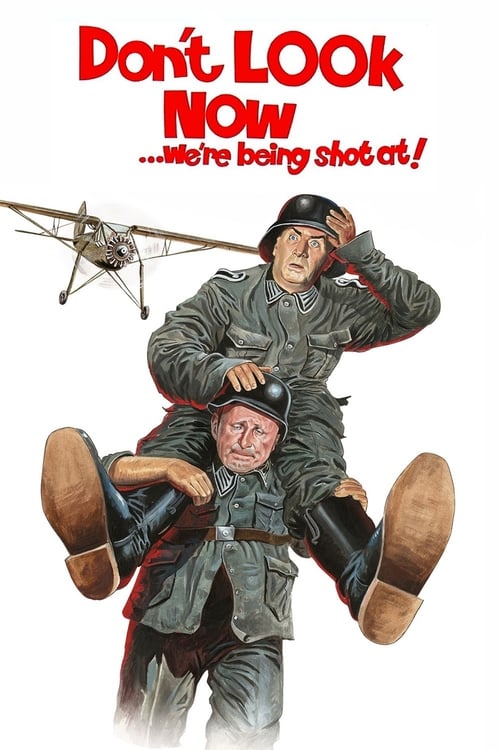
Don't Look Now... We're Being Shot At!
1966 · Gérard Oury
For when you want a proper crowd-pleaser — the whole-family, laugh-out-loud kind — and proof that a war movie can be pure fun. Comfort viewing of the highest order.
What it's about
In Nazi-occupied Paris, three downed British airmen parachute into the laps of two Frenchmen who want nothing to do with heroism: a grumbling house painter and a pompous opera conductor. The mismatched pair get dragooned into smuggling the Britons south across the demarcation line to freedom, dodging German patrols — and, just as often, the fallout of their own blunders.
The experience
A big, generous chase comedy that barrels from set-piece to set-piece — disguises, near-misses, pratfalls — with real momentum. The friction between its two leads keeps the laughs coming even when you can see the gag arriving.
Performances
Bourvil and Louis de Funès, arguably the two most beloved French comic actors of their era, are a perfect double act — Bourvil's put-upon everyman against de Funès's imperious, sputtering conductor. Their chemistry is the engine of the whole film.
The craft
Gérard Oury builds the film as a chase engine dressed in war-movie clothes, staging elaborate physical comedy across occupied Paris and the French countryside on a genuinely handsome scale. The set-pieces are choreographed with a precision that still plays.
Why it matters
For over three decades the most-attended film in French history, and still near the top of the all-time French box office — a national institution the way few comedies anywhere are. It fixed the Bourvil–de Funès pairing in the culture permanently.
Snapshot
Known in France as La Grande Vadrouille ("The Great Stroll"), Gérard Oury's WWII farce is one of the central artifacts of French popular cinema — for more than three decades the most-attended film in the country's history, and still, after being overtaken only by Titanic (1998) and Bienvenue chez les Ch'tis (2008), among the very highest on the all-time French admissions table. Its premise is a chase engine dressed as a war film: in Occupied Paris, three downed RAF airmen parachute onto a house painter, an opera conductor, and the city zoo, and the two mismatched Frenchmen are dragooned into shepherding the Britons south across the demarcation line to the Free Zone. The film's lasting fame rests less on plot than on the pairing of Bourvil and Louis de Funès — arguably the two most beloved French comic actors of the century — set against Terry-Thomas's clipped English bewilderment. It is comfort cinema of a very deliberate kind, engineered for maximum breadth of appeal, and it succeeded at that on a scale few films anywhere have matched.
Industry & production
The film was a Franco-British co-production, produced by Robert Dorfmann (Films Corona) with partners across the Channel, and it arrived as the confirmation of a formula rather than a gamble. Oury had scored an enormous hit the previous year with Le Corniaud (1965), which first teamed Bourvil and de Funès; La Grande Vadrouille was conceived to reunite them at greater scale and cost. Budgets and shooting logistics were substantial by the standards of French comedy: large-scale location work in Paris (including the Opéra and other landmarks) and extensive filming in Burgundy — the Beaune region, Meursault, and surrounding countryside stood in for the demarcation-line borderlands — plus set-piece sequences requiring crowds, aircraft, and stunt coordination.
The production sat squarely in the commercial mainstream of mid-1960s French cinema, the popular tradition against which the Nouvelle Vague had defined itself and which, in raw attendance, dwarfed it. Its release performance was historic: roughly 17.3 million admissions in France, a record that stood until Titanic and remained the benchmark for a homegrown French film until Les Ch'tis. That figure is not a marketing gloss but a documented fact of French exhibition history, and it reframes the film as a genuine national event — the sort of picture that a large share of the French population saw, and many saw repeatedly, over subsequent decades of television broadcast.
Technology
La Grande Vadrouille was shot in color and anamorphic widescreen, the standard "prestige comedy" presentation of the period, with color rendered on the Eastmancolor-type stock then near-universal in French production. The palette is bright and legible — deliberately unshadowed, in keeping with a farce that wants clarity of gag over atmosphere. The technological ambition of the film is concentrated in its scale of location capture rather than in any single novel process: sustained daylight exteriors across Paris and Burgundy, large ensemble staging, and, for the climactic escape, aerial and aircraft photography (the finale turns on gliders lifting the fugitives toward freedom). These aerial and stunt elements represented the genuine production-value showcase, the money on the screen. Sound was post-synchronized in the standard French manner of the era, which mattered less for a broad comedy than for a naturalistic drama and gave the filmmakers latitude to shape performance and music in the mix.
Technique
Cinematography
Photography is credited to Claude Renoir — grandson of the painter Pierre-Auguste Renoir and a distinguished cinematographer in his own right — working with André Domage. The visual approach is functional in the best sense: wide, well-lit compositions that keep both comic bodies and their environments fully readable, so that a gag depending on a character not seeing what the audience sees can land cleanly. Renoir's lighting is even and high-key; the widescreen frame is used to hold two contrasting performers in the same shot and to stage the geography of pursuit — the open road, the vineyard, the airfield — as a comic playing field. There is little of the expressive shadow one associates with Renoir's darker assignments; the camera here is a servant of legibility and momentum.
Editing
Albert Jurgenson cut the film, and the editing is the hidden craft of its success. Farce of this kind lives or dies on the timing of reveal, reaction, and collision, and the picture sustains a chase rhythm across a long running time without slackening. Jurgenson's cutting privileges the reaction beat — especially de Funès's, whose comedy is built from lightning shifts of facial register — and choreographs the set pieces (the recognition scene, the demarcation-line crossing, the aerial finale) so that spatial cause and effect stay clear even at high speed. The film's reputation for never dragging, despite an episodic structure, is substantially an editorial achievement.
Mise-en-scène / staging
Oury stages the film as a series of escalating comic situations linked by movement south. The controlling device is the odd couple placed inside hostile territory: nearly every scene juxtaposes the two Frenchmen's incompatible temperaments against a shared threat, and the Germans are staged as an obstacle course — pompous, literal-minded, and repeatedly outmaneuvered by accident. Landmark set pieces are built around a single legible mechanism: the Turkish-bath sequence in which strangers must identify one another by whistling "Tea for Two"; the crossing of the demarcation line; the disguises and mistaken identities. Locations are chosen for both spectacle and plausibility, and the staging consistently converts real geography — a Paris rooftop, a Burgundian estate, an airfield — into a stage for physical comedy.
Sound
The soundtrack's decisive gesture is musical: the use of the popular standard "Tea for Two" (Vincent Youmans) as a recognition signal, a diegetic tune that becomes a running structural motif and one of the film's most-remembered elements. Around it, Georges Auric's original score supplies the propulsive, tongue-in-cheek underscoring that keeps the chase buoyant and cues the audience toward comedy rather than danger. Dialogue, post-synchronized, is written and delivered for maximum verbal contrast between Bourvil's soft, hesitant diction and de Funès's staccato eruptions, with Terry-Thomas's English adding a third linguistic register and a recurring source of cross-Channel misunderstanding.
Performance
Performance is the film's true medium. Bourvil, as the house painter Augustin Bouvet, plays gentleness, decency, and slow-witted good sense — the everyman who blunders into heroism. Louis de Funès, as the opera conductor Stanislas Lefort, plays the opposite pole: vain, imperious, explosively irritable, a petit-bourgeois tyrant reduced to panic by circumstance. The comedy is generated by the friction between these two fully opposed styles — one recessive and warm, the other manic and centrifugal — forced into partnership. Terry-Thomas, as the RAF officer, contributes a very English deadpan of gap-toothed exasperation. The film is, in effect, a showcase built to let two national comic institutions do what each did best, simultaneously, in the same frame.
Narrative & dramatic mode
The dramatic mode is picaresque farce with a war-movie chassis. The narrative is a journey structured as a chain of episodes — capture narrowly avoided, disguise adopted, cover blown, escape improvised — each escalating the stakes while resetting the comic situation. Tension is real enough to matter (these are enemy soldiers with guns) but always defused toward laughter; the Germans' menace is systematically undercut by their buffoonery. The through-line is the odd-couple relationship, which follows the familiar arc from mutual antagonism to grudging solidarity as shared danger welds the pair together. The film never seriously courts tragedy; its contract with the audience is that decent, ordinary people will muddle through, and it honors that contract completely.
Genre & cycle
The film belongs to the durable French tradition of the comédie populaire and specifically to the WWII comedy — the treatment of the Occupation as a stage for farce rather than a subject of moral reckoning. Within Oury's own work it forms the heart of the Bourvil/de Funès cycle bracketed by Le Corniaud, and it stands as the definitive example of the star-driven, set-piece-heavy comic spectacle that dominated French box office in the 1960s. Internationally it sits alongside the era's broad war-adjacent capers, but its sensibility is distinctly French: rooted in character comedy, regional texture, and the specific cultural memory of Occupation and demarcation line. It is a genre film that became a genre landmark largely by executing a familiar formula at an unrepeatable level of popular resonance.
Authorship & method
The film is a director's project in the sense that Oury conceived, co-wrote, and orchestrated it as a vehicle for a particular comic chemistry. A former actor turned filmmaker, Oury specialized in exactly this large-canvas star comedy and was, in commercial terms, one of the most successful French directors of his generation. The screenplay was written by Oury with Danièle Thompson — his daughter, for whom this collaboration marked the beginning of a major screenwriting career — and Marcel Jullian, the trio shaping the episodic structure and the running gags around the two leads' opposed personalities.
Among key collaborators, cinematographer Claude Renoir brought the pedigree and the technical assurance to render the film's bright, legible look and its aerial spectacle; editor Albert Jurgenson supplied the timing on which the comedy depends; and composer Georges Auric — a member of Les Six and one of the most distinguished film composers France produced, with credits from Cocteau to Hollywood — provided the score and helped make "Tea for Two" an enduring signature. Producer Robert Dorfmann assembled the resources for a production of unusual ambition for a comedy. The method, in short, was to surround an irreplaceable star pairing with top-rank craft and a structure engineered entirely around their contrast.
Movement / national cinema
The film is a monument of cinéma populaire français — the commercially dominant mainstream that the critics of Cahiers du cinéma and the Nouvelle Vague had positioned themselves against, and which, measured in tickets sold, overwhelmed the art cinema of the same years. It has no avant-garde pretensions; its allegiances are to the tradition of star comedy, verbal wit, and regional and national self-recognition. In that sense it is a document of what the mass French audience of the mid-1960s actually chose, and it is often cited as such in discussions of the gap between critical canon and popular taste in French film history.
Era / period
Released in 1966, the film belongs to the Gaullist high-consensus period, when the dominant national narrative of the Occupation emphasized a France of ordinary decent people and resisters outwitting the occupier. Its comic treatment of that era — Germans as bumbling obstacles, Frenchmen as improvising underdogs — reflects and reinforces that consensus, and it arrived before the more critical reckonings that would follow. The mode rétro and the harsher reexamination of collaboration and complicity (Ophüls's The Sorrow and the Pity, 1969; Malle's Lacombe Lucien, 1974) came only afterward; La Grande Vadrouille stands on the earlier side of that shift, and part of its later cultural interest lies precisely in what its cheerful farce chooses not to see about the years it depicts.
Themes
The film's recurring theme is class and temperament forced into solidarity: the aristocratic-minded conductor and the humble painter, initially incompatible, discover a shared humanity under pressure. Beneath the farce runs a gentle populism — competence and decency belong to ordinary people, while both the occupiers and the self-important are objects of ridicule. There is a strand of national self-flattery (the French muddle through, outwit authority, and help their allies) and of cross-Channel comedy (Franco-British mutual incomprehension played for warmth). Occupation itself is rendered as inconvenience and adventure rather than trauma — a thematic choice that is inseparable from the film's era and its purpose as consolation and entertainment.
Reception, canon & influence
Popular reception was, by any measure, extraordinary: the film became the most-seen movie in French history and held that position for a generation, with roughly 17.3 million admissions, and it entered the permanent repertoire of French television, where repeated broadcasts made it a shared cultural memory across age groups. Critically, its standing is more complicated — it is rarely treated as an auteurist landmark in the Cahiers tradition, and serious scholarly writing on it is comparatively thin relative to its fame, which is itself a telling fact about the divide between critical and popular canons in France. Where it is discussed critically, it is often as an emblem of that divide, or as a case study in how the Occupation was domesticated into comedy.
Looking backward, the film draws on the established French tradition of star comedy and boulevard farce, on the odd-couple structure of its own immediate predecessor Le Corniaud, and on the wider vein of war-caper entertainment; "Tea for Two" imports a Tin Pan Alley standard into a French comic context. Looking forward, its influence is measured less in stylistic imitation than in cultural permanence: it consolidated the Bourvil/de Funès pairing as a touchstone, confirmed Oury's formula for the blockbuster French comedy, and set an attendance benchmark that later French popular filmmakers were explicitly measured against for decades. Its status as national comfort cinema — endlessly rewatched, quoted, and affectionately parodied — is arguably its most durable legacy, the rare case of a film whose importance rests less on what it changed in cinema than on how completely it lodged in a country's collective memory.
Reception
Critics sniffed at Gérard Oury's crowd-pleasing farce in 1966 while audiences made it the biggest hit in French box-office history — a record it held for over four decades. Today even the critical establishment treats it as national heritage, a rite-of-passage comedy every French household knows by heart.
How Don't Look Now... We're Being Shot At! was received, from release to now →
Influences: the films it descends from and the films it influenced
- La Traversée de Paris (1956) — Established the Occupation-as-picaresque-trek structure with Bourvil as the fumbling everyman crossing a Nazi-controlled Paris on foot — the wartime-journey armature Oury lifts and turns comic.
- Le Corniaud (1965) — The immediate predecessor that engineered the de Funès/Bourvil odd-couple road structure and the running-gag rhythm built entirely on their opposed temperaments, which Oury reran here.
- La Vache et le prisonnier (1959) — Codified the POW cross-country escape as populist star-comedy vehicle — a single beloved comic (Fernandel) shepherded through enemy territory in episodic set pieces.
- Babette s'en va-t-en guerre (1959) — Proved WWII/Resistance farce could be mounted as big-budget Eastmancolor widescreen spectacle, the production-scale-for-comedy precedent Oury and producer Dorfmann expanded.
- La Grande Illusion (1937) — Source of the cross-border prisoner-evasion template and, directly, of the Renoir compositional pedigree that DP Claude Renoir (Jean's nephew) carried into the film's legible widescreen staging.
- To Be or Not to Be (1942) — Model for the disguise-and-impersonation farce in which the comic protagonists survive by masquerading past occupying Germans — the German-officer-fooled-by-costume gag Oury builds set pieces around.
- La Belle et la Bête (1946) — Showcase of Georges Auric's leitmotif scoring method — the single recurring musical signature — which Auric reprises here by making 'Tea for Two' the film's identifying motif.
- Jour de fête (1949) — Precedent for choreographed physical set-pieces staged across provincial French landscapes, where the geography of a village or field becomes the mechanism of the sight gag.
- La Folie des grandeurs (1971) — Oury reapplies the identical formula — a mismatched star duo (de Funès/Montand) framed by top-rank craft and lavish set pieces — confirming the blockbuster-comedy engine perfected here.
- Les Aventures de Rabbi Jacob (1973) — Culmination of Oury's method: de Funès as the rigid bourgeois foil driven through escalating disguise-and-chase set pieces engineered entirely around his character's contrast with a companion.
- Mais où est donc passée la 7e compagnie? (1973) — Extends the domesticated-Occupation comedy directly — ordinary bumbling Frenchmen stumbling through the 1940 debacle, the same class-leveling populist gag structure applied to soldiers.
- Papy fait de la résistance (1983) — Parodic heir to the Occupation-as-farce mode, weaponizing the very conventions (comic Germans, Resistance disguises, family under Occupation) that this film made national comfort iconography.
- La Chèvre (1981) — Rebuilds the contrast-duo comedy engine — pairing rigidly opposed temperaments (Richard/Depardieu) whose friction generates every gag — inheriting the Bourvil/de Funès mismatched-pair architecture.
- Bon Voyage (2003) — Revives the large-canvas Occupation ensemble as a chase-and-mistaken-identity farce staged with prestige production values, descending from Oury's big-budget-comedy-of-the-war formula.
- Bienvenue chez les Ch'tis (2008) — The explicit attendance-benchmark heir — the populist comedy of regional/class contrast that finally challenged this film's admissions record, built on the same warm class-solidarity engine.
- The Great Escape (1963) — Parallel development of the war-caper as an ensemble of comic-contrasting escape specialists, each chase and evasion built as a self-contained bravura set piece.
Similar films
- To Be or Not to Be (1942) — influence & lineage · same viewing thread
- Grand Illusion (1937) — influence & lineage
- The Great Escape (1963) — influence & lineage
- De Gaulle: Liberté (2026) — shared sensibility
- Charade (1963) — shared sensibility
- Day for Night (1973) — shared sensibility
- The Battle of Algiers (1966) — shared sensibility
- The Rules of the Game (1939) — shared sensibility
All the films related to Don't Look Now... We're Being Shot At! →
Watch it with: curated runs of related films
- Comedy Declares War on Fascism — A run of satires and cabaret turns that meet tyranny with ridicule — watch these together to see performers puncture dictators and expose the void behind the uniform.