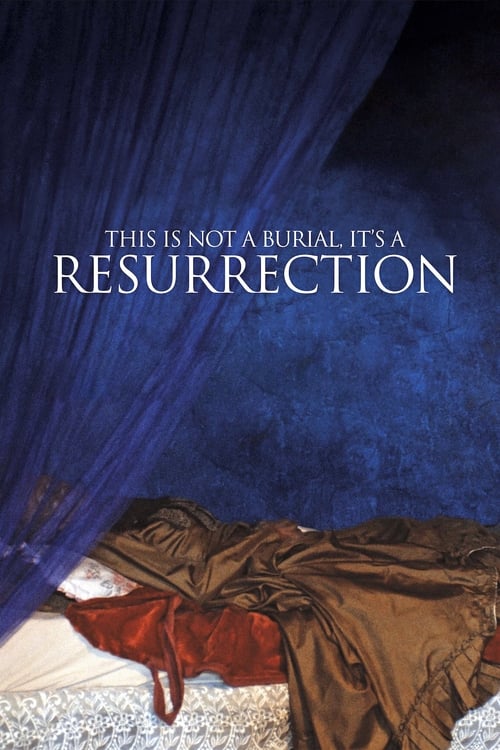
This Is Not a Burial, It's a Resurrection
2020 · Lemohang Jeremiah Mosese
For when you want to be transported somewhere cinema almost never goes and feel something profound about land, memory, and the dead. A contemplative, challenging watch — save it for a night you can give it your full attention.
What it's about
In the mountains of Lesotho, an eighty-year-old widow who has buried everyone she loves calmly settles her affairs and plans her own funeral. Then word arrives that her village — and the graves of its ancestors — will be drowned beneath a new dam reservoir. Facing the erasure of everything her dead are rooted in, she finds an unexpected reason to live, and her defiance starts to spread through the community.
The experience
Slow, hypnotic, and ravishing — it unfolds like a sung legend, grief and defiance braided together in images that feel carved rather than shot. It asks patience and repays it with real awe.
Performances
Mary Twala Mhlongo, the veteran South African actress in her final leading role, carries the film with a face like a landscape — fury, grief, and stubborn life with barely a raised voice.
The craft
Self-taught director Lemohang Jeremiah Mosese frames the highlands in a boxy, painterly ratio with colors saturated like stained glass, and hands the narration to a griot playing the lesiba, a traditional mouth-bowed string instrument, so the whole story arrives as oral legend. Every frame could hang on a wall; the sound design deserves good speakers.
Why it matters
The first film Lesotho ever submitted to the Oscars, and an announcement that one of world cinema's most distinctive new voices had arrived fully formed.
The first film ever submitted to the Oscars by Lesotho, and a debut of staggering visual confidence from Lemohang Jeremiah Mosese, a self-taught Mosotho filmmaker working from Berlin. An eighty-year-old widow, having buried everyone she loves, prepares calmly for her own death — until word comes that her village, with its ancestral graves, is to be drowned beneath a dam reservoir. What follows is less social-realist protest drama than visionary elegy: Mosese frames the highlands in a boxy, painterly ratio, saturates his palette like stained glass, and hands the narration to a griot playing the lesiba, a traditional mouth-bowed string instrument, so the whole film unfolds as sung legend. At its center is Mary Twala Mhlongo, the veteran South African actress in her final leading role, her face a landscape as eroded and enduring as the mountains. The film took a Special Jury Prize at Sundance in 2020 and announced a new voice in African cinema — one drawing on Sembène and Mambéty's defiance but arriving at something closer to liturgy, a requiem for every community asked to trade its dead for progress.
Reception
It slipped out in the worst possible moment — a Sundance 2020 prize-winner (Special Jury Award for Visionary Filmmaking) whose theatrical life was swallowed by the pandemic — then quietly climbed, via word of mouth and a Criterion Collection release, into 'modern classic of African cinema' status.
How This Is Not a Burial, It's a Resurrection was received, from release to now →
Influences: the films it descends from and the films it influenced
- Touki Bouki (1973) — The seed inherits Mambéty's collision of griot oral-tale rhythm with saturated, near-surreal African color, staging myth and departure as image rather than plot.
- Hyènes (1992) — A returning avenging figure and a whole village's moral displacement told as parable across sun-scorched landscapes — the same allegorical-elegy register applied to communal uprooting.
- Ceddo (1977) — Sembène's use of oral-tradition narration and sung legend as the film's structuring spine, treating cinema as a griot's mode of address, is the direct precedent for the sung-legend framing.
- The Color of Pomegranates (1969) — Frontal, tableau-flat compositions and densely saturated liturgical iconography that render a life as a sequence of sung stanzas rather than dramatized scenes.
- Nostalghia (1983) — Elegiac long-take landscapes charged with faith and requiem, where a solitary figure carries a ritual burden through mist and ruin — the transcendental-elegy grammar Mosese adopts.
- The Turin Horse (2011) — Mosese trained at Tarr's film.factory; the debt is direct — durational tableaux, ostinato repetition, and the apocalyptic stubbornness of rural people refusing to leave dying ground.
- Horse Money (2014) — Chiaroscuro static portraiture that monumentalizes the marginalized and displaced, holding faces like painted icons until they become landscape — the landscape-face compositional logic.
- Silent Light (2007) — Transcendental widescreen landscape building to a literal resurrection climax, treating a rural faith-community's grief with sacramental patience — the resurrection-as-formal-event kinship.
- Tabu (2012) — Boxy near-academy framing and desaturated-then-saturated register deployed as elegy for a vanishing colonial Africa, narration sung over image like a lament.
- Days of Heaven (1978) — Whispered off-screen narration laid over golden-hour landscape, letting a folk-toned voice mythologize labor and land instead of dialogue driving the scene.
- Uncle Boonmee Who Can Recall His Past Lives (2010) — Ancestral spirits and animist folk-legend woven into an unhurried rural elegy, where the dead and the land co-inhabit the frame — sibling in the ancestral-graves cosmology.
- Atlantics (2019) — Contemporary West African elegy of displacement in which the uprooted return as spectral ancestors, scored to griot-like incantation over coastal light — the closest sibling in craft.
Similar films
- Uncle Boonmee Who Can Recall His Past Lives (2010) — influence & lineage
- Emitaï (1973) — shared sensibility
- Our Land (2026) — shared sensibility
- I'm Still Here (2024) — shared sensibility
- Leila and the Wolves (1986) — shared sensibility
- No Other Land (2024) — shared sensibility
- The Metamorphosis of Birds (2021) — shared sensibility
- Minari (2021) — shared sensibility
All the films related to This Is Not a Burial, It's a Resurrection →