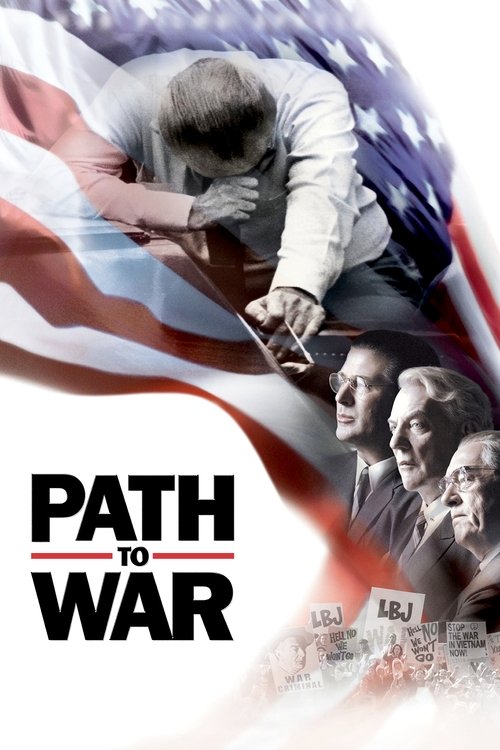
Path to War
2003 · John Frankenheimer
For when you're in the mood for serious, substantive political drama — the kind you watch leaning in, ideally when current events have you thinking about how decisions actually get made. More absorbing than fun; history-buff comfort food with a bitter finish.
What it's about
Inside Lyndon B. Johnson's White House, from the mid-1960s to his stunning 1968 decision not to seek re-election, a president who dreamed of remaking America watches his Great Society get swallowed by Vietnam. The film tracks the escalation not on battlefields but in cabinet rooms — advisors like Robert McNamara and Clark Clifford arguing over troop numbers while the war devours a presidency. It's a portrait of a powerful man walking, meeting by meeting, into a trap he can see.
The experience
Talky, absorbing, and quietly tragic — a slow-burn chamber drama where the tension comes from watching intelligent people rationalize disaster one memo at a time. It builds a real sense of doom without a single combat scene.
Performances
Michael Gambon is towering as LBJ — coarse, wounded, tender, and volcanic by turns, capturing a man of enormous gifts being ground down. Alec Baldwin and Donald Sutherland give the advisors real weight as true believers and doubters.
The craft
This was John Frankenheimer's final film, and the director behind some of cinema's great political thrillers brings a lifetime of craft to its corridors and cabinet rooms — long dialogue scenes staged with a veteran's confidence in faces and silence. The writing trusts the audience with policy detail while never losing the human tragedy underneath.
Why it matters
A late-career capstone for Frankenheimer and one of the projects that proved HBO could make films with the ambition and gravity of prestige cinema — it remains a reference point for dramatizations of how America goes to war.
Snapshot
Path to War is a two-and-a-half-hour HBO political drama tracing the escalation of American military involvement in Vietnam through the private corridors of Lyndon Baines Johnson's White House, roughly from the Gulf of Tonkin Resolution in 1964 through Johnson's announcement in March 1968 that he would not seek re-election. Its driving question is not strategic or military but psychological and moral: how does a man of genuine domestic ambition — a president who had passed the Civil Rights Act and launched the Great Society — allow himself to be consumed by a war he neither wanted nor understood how to end? Michael Gambon plays LBJ as a figure of Shakespearean entrapment, brilliant and coarsened, capable of bottomless tenderness and volcanic cruelty. The film is less interested in the war itself than in the architecture of groupthink and the slow erosion of dissent inside closed rooms. It stands as one of the most sober and formally controlled political films made for American television.
Industry & production
Path to War was produced by HBO Films and Mace Neufeld Productions, part of the cable network's sustained investment in prestige long-form drama that had begun in earnest with And the Band Played On (1993) and continued through Barbarians at the Gate (1993), Truman (1995), Recount (2008), and Game Change (2012). By the early 2000s HBO had positioned itself as the primary institutional sponsor of serious American political cinema — a role the major studios had largely abandoned. The film was shot primarily in the United Kingdom, with British locations and sets standing in for Washington interiors, a production decision that reflects the economics of HBO prestige television at the time rather than any artistic choice. The screenplay was written by Daniel Giat, whose research drew heavily on the historical record available through the LBJ Presidential Library, David Halberstam's foundational 1972 account The Best and the Brightest, and the published memoirs of Robert McNamara, Clark Clifford, and George Ball. Giat's script is notable for its fidelity to the documented deliberative process — the Tuesday Lunch Group meetings, the escalation cables, the dissenting memos from Undersecretary of State George Ball — without pretending to verbatim reconstruction. The film premiered on HBO in the United States in 2002 and received its wider international release the following year.
The production arrived at a historically charged moment. American forces entered Afghanistan in October 2001; by the time Path to War aired, the debate over invading Iraq was gathering force in Washington. Reviewers and audiences immediately registered the parallels, and the film's portrait of a president receiving filtered intelligence, suppressing internal dissent, and escalating a conflict whose costs he had privately acknowledged as prohibitive acquired an urgency that was not wholly retrospective.
John Frankenheimer, who died in July 2002 at age seventy-two, completed the film shortly before his death. Path to War is widely regarded as his final major work.
Technology
The film was shot on 35mm in the widescreen format standard for prestige HBO productions of the period, and its visual grammar owes less to the increasingly prevalent digital video aesthetic — used to different effect in contemporaneous HBO drama — than to the classical American political filmmaking Frankenheimer had himself helped define four decades earlier. The production design leans toward deliberate understatement: rooms look institutional rather than glamorous, the Oval Office and Cabinet Room sets communicating the functional severity of the executive apparatus. Archival footage of Vietnam combat, anti-war demonstrations, and news broadcasts is integrated sparingly, functioning as punctuation rather than wallpaper, and the transitions between recreation and archive are handled with enough tact that the seams are rarely distracting.
Technique
Cinematography
The cinematography rewards attention. Frankenheimer had always been a director of strong spatial intelligence — his use of wide-angle lenses and deep-focus compositions in The Manchurian Candidate (1962) and Seven Days in May (1964) gave those films an institutional claustrophobia that matched their paranoid content. In Path to War the visual approach is somewhat more restrained, befitting the documentary gravity the subject demands, but the spatial preoccupations remain. Conference rooms are frequently shot so that multiple figures occupy distinctly stratified planes: Johnson at the far end of a table, his advisers arrayed in middle distance, a dissenter or supplicant positioned near the frame's edge. This compositional habit externalizes power — who is centered, who is peripheral — without becoming schematic. The color palette tends toward institutional greens, ochres, and the flat fluorescent white of government interiors. Exterior scenes, notably the few moments Johnson is shown at his Texas ranch, introduce warmer, more naturalistic light, marking those sequences as momentary respites from the pressure chamber of Washington. Detailed production records regarding the specific camera systems and lenses employed are not widely documented in the public record.
Editing
The editing is patient by the standards of prestige television drama, willing to sustain long scenes of political argument without resort to cutaway relief. The film understands that its dramatic engine is verbal — the speeches, the threats, the silences between advisers who know more than they say — and it does not rush that engine. Intercutting between Washington deliberation and combat footage or protest imagery is used economically, appearing at moments of maximum ironic pressure: a scene of optimistic escalation rationale cut against the television images of body counts. The rhythm overall is deliberate, even austere, which distinguishes the film from the more kinetically edited political dramas that would follow in the streaming era.
Mise-en-scène / staging
Frankenheimer's staging consistently emphasizes the physical and social dynamics of rooms under pressure. Johnson is rarely allowed to occupy comfortable space — he looms over advisers, plants himself in doorways, circles the perimeter of conversations he is supposed to be leading. The blocking communicates a man whose physical dominance is a compensatory performance for his deepening uncertainty. The contrast between Johnson's bear-like physical presence and the suit-and-tie containment of the policy process becomes one of the film's quiet visual themes. Key scenes — McNamara's first private doubts, the arrival of Clark Clifford, Ball's persistent dissenting memos — are staged with enough open floor that actors can use physical withdrawal and approach as part of the dramatic argument.
Sound
The sound design and score support the film's restraint. A limited musical vocabulary avoids the triumphalist tones that might sentimentalize or operaticize a story the film is determined to present in moral gray. The score functions largely as atmospheric underscore, entering and withdrawing with discretion. Archival audio — Johnson's taped phone calls to McNamara, his recorded conversations with advisers — is apparently not directly incorporated; the film reconstructs dialogue from the historical record rather than replaying recordings. The sound of the war itself, when heard, is deliberately not aestheticized.
Performance
The performances are the film's most discussed and most durable achievement. Michael Gambon's LBJ is a remarkable construction: physically credible despite Gambon's very different body type, vocally calibrated to suggest the Hill Country accent without caricature, and emotionally complex in ways that resist the temptation to portray Johnson as either a tragic hero or a straightforward villain. Gambon plays the self-deception as active rather than passive — Johnson is shown choosing, repeatedly, not to know what he half-knows, and Gambon makes those moments of willed ignorance as legible as the moments of genuine anguish. Alec Baldwin's Robert McNamara traces an arc from technocratic confidence to quiet horror with considerable discipline; the scenes in which McNamara begins to understand that the body of analysis he has generated does not correspond to reality are among the film's most uncomfortable. Donald Sutherland's Clark Clifford — the Washington wise man brought in as Secretary of Defense in 1968, who helps engineer Johnson's reversal — is played with patrician authority and a useful ambiguity about whose interests the wise men ultimately serve. John Amos, Frederic Forrest, and Tom Skerritt round out an ensemble that collectively conveys the intellectual and moral texture of the foreign policy establishment.
Narrative & dramatic mode
The film adopts a chronicle structure, moving through a compressed sequence of discrete decision points rather than building toward a single climactic confrontation. This episodic architecture mirrors the historical reality it depicts: the Vietnam escalation was not a single decision but a series of incremental commitments, each of which made the next more difficult to avoid. The narrative tension is generated not by uncertainty about outcome — the audience knows how Vietnam ends — but by the question of when and whether any of these men will acknowledge what they have done. The film's most powerful formal choice is its refusal of catharsis: Johnson's decision not to run in 1968 is presented not as redemption but as exhaustion, a man who has used up his credibility along with his options. The dramatic mode is closer to classical tragedy than to political thriller, and closer to the HBO tradition of Truman than to the conspiratorial energy of The Manchurian Candidate.
Genre & cycle
Path to War belongs to the American tradition of the political biopic and the institutional drama, genres that share roots in the biographical stage plays of the mid-twentieth century and the prestige historical films of the studio era. Its more immediate generic predecessors include All the President's Men (1976), which established the template of the closed-room political procedural as serious adult cinema, and the cycle of HBO political films that includes Truman (1995) and RFK (2002). It anticipates the wave of cable and streaming political dramas that would follow — Game Change, Recount, The Crown, Lyndon — in its willingness to treat executive decision-making as inherently dramatic material without requiring conventional thriller mechanics. The Vietnam War film cycle, which spans from The Green Berets (1968) through Apocalypse Now (1979), Platoon (1986), Full Metal Jacket (1987), and Born on the Fourth of July (1989), is the film's generic relative, but Path to War occupies a distinctive position within that cycle: it is almost entirely set in Washington rather than Southeast Asia, making the war's physical reality a structuring absence rather than a depicted event.
Authorship & method
John Frankenheimer arrived at Path to War with one of the most distinguished political filmographies in American cinema. His work in the early 1960s — The Manchurian Candidate, Seven Days in May, The Manchurian Candidate — had defined a mode of political cinema that treated American institutions as inherently susceptible to corruption and paranoid manipulation. After a difficult period in the 1970s and 1980s, Frankenheimer had staged a notable late-career revival with Ronin (1998) and the Emmy-winning George Wallace (1997), another HBO political drama about a morally compromised figure caught between personal ambition and historical judgment. George Wallace and Path to War form a natural diptych in Frankenheimer's late work: both center on Southern politicians of the Great Society era, both use the HBO prestige format to examine the relationship between political power and moral accountability, and both demonstrate a directorial intelligence comfortable with long scenes of verbal combat and institutional performance. Frankenheimer's method on Path to War, by all accounts, was methodical and precise — he was by this point a director who had mastered the grammar of political space entirely and was no longer interested in stylistic display for its own sake. The screenplay by Daniel Giat provided a rigorous structural framework that Frankenheimer appears to have honored rather than overridden.
The specific collaborators — cinematographer, composer, editor — are less extensively documented in the critical and journalistic record than for Frankenheimer's theatrical features, which is a common limitation of the literature on prestige television of this period.
Movement / national cinema
The film belongs squarely to American cinema, and specifically to the strand of American political filmmaking that treats the national security state as a proper subject for dramaturgical scrutiny. Internationally, it has no obvious movement affiliations, though its portrait of institutional failure has been compared to the British tradition of the political drama — the work of directors like John Schlesinger in Sunday Bloody Sunday (1971) or the long tradition of British television political drama — partly because of its UK production base and the British nationality of its lead actor. These comparisons are suggestive rather than formally grounded.
Era / period
Path to War is a product of the post-Cold War, post-9/11 American moment, and its historical setting — the mid-1960s — functions as a lens through which that moment is examined. The film's release context in 2002–2003 gave its portrait of a president receiving selective intelligence and escalating a war on the basis of manufactured or exaggerated threat claims an obvious contemporary resonance that the filmmakers and HBO made little effort to discourage. It belongs to the tradition of historical drama that uses the past as a displaced commentary on the present, a tradition running from Arthur Miller's The Crucible to Oliver Stone's Nixon (1995). The George W. Bush administration's approach to Iraq, and the institutional dynamics of the foreign policy apparatus it inherited and deployed, gave the film an afterlife that extended well beyond its initial reception.
Themes
The film's central preoccupation is the relationship between political ambition and moral accountability in conditions of institutional pressure. Johnson is portrayed as a man whose legislative genius — his actual mastery of the domestic political machinery — coexists with a fundamental inability to apply the same skeptical intelligence to foreign policy advice he is receiving. The film is deeply interested in the sociology of expertise: how technocrats like McNamara generate analytical frameworks that substitute for moral judgment, how the systems of quantification — body counts, kill ratios, pacification metrics — function to defer rather than resolve the underlying question of whether the war is winnable or just. The theme of dissent is equally central: George Ball's documented opposition to escalation, Clark Clifford's eventual conversion, McNamara's private doubts, are all shown as structurally suppressed by a political culture that treats loyalty as the primary institutional virtue. The Great Society appears throughout as a counter-narrative — the domestic programs Johnson genuinely cared about, being starved of resources by a war he cannot stop — and this counterpoint between the promise of democratic governance and the reality of imperial violence gives the film its sharpest thematic edge.
Reception, canon & influence
Path to War was received with considerable critical admiration upon its HBO premiere, with particular attention paid to Gambon's performance and to the film's political relevance. It received Emmy Award nominations in multiple categories, and Gambon's portrayal of Johnson was widely described as among the finest performances in the HBO Films canon. The film drew favorable comparison to Truman and was situated within the lineage of serious American political drama that includes All the President's Men and Nixon. Some critics noted that its formal restraint — the long scenes, the refusal of action-movie energy — made it demanding for general audiences, and that its impact was accordingly more concentrated among viewers already interested in political history.
Looking backward, the film's debts are multiple. Halberstam's The Best and the Brightest is the most obvious single influence on the screenplay's structure and perspective. The tradition of the HBO political biopic, established by Truman, provided the immediate institutional template. Frankenheimer's own earlier political work — above all Seven Days in May, with its portrait of executive authority under pressure — provided a stylistic and thematic lineage the director was consciously extending. The documentary record accumulated by the LBJ Library, including the famously candid Johnson telephone recordings, provided a bedrock of evidentiary detail that gives the film its specific texture.
Looking forward, Path to War belongs to a tradition that the streaming era has continued and amplified. The political drama as prestige television — Recount, Game Change, The People v. O.J. Simpson, Succession — owes something to the HBO Films model that Path to War exemplifies. Whether the film has exerted direct influence on specific subsequent works is difficult to establish with precision; it was not a cultural phenomenon of the scale that reorients an industry. What it did was demonstrate, once again and with considerable authority, that the institutional drama of deliberate wrongdoing — men who know better, choosing not to — is among the most genuinely tragic forms available to American political cinema. Frankenheimer's final major film is also, arguably, a film about the limits of the form he had spent his career perfecting: the political thriller's machinery of revelation and exposure cannot accommodate a tragedy in which everyone, in some sense, already knew.
A Deleuzian reading
Watch how Lyndon Johnson stands in a doorway.
The full Deleuzian reading of Path to War →
Reception
It aired on HBO in May 2002 as a handsome prestige TV movie and got a wave of extra poignancy when Frankenheimer died just weeks later — since then it's been quietly reframed from 'solid cable drama' into a moving career bookend, the political-cinema master of The Manchurian Candidate and Seven Days in May signing off with one last Washington tragedy.
How Path to War was received, from release to now →
Influences: the films it descends from and the films it influenced
- The Manchurian Candidate (1962) — Frankenheimer's extreme wide-angle deep-focus compositions — used to create spatial paranoia in tense group scenes — are the direct technical precursor to Path to War's stratified-plane cinematography, the same lens vocabulary applied forty years later to institutional rather than conspiratorial space.
- Seven Days in May (1964) — Frankenheimer's earlier portrait of executive authority under pressure uses the identical blocking vocabulary — figures arranged against architectural surfaces to visually encode rank and resistance — that Path to War carries forward as its primary grammar of power.
- Fail Safe (1964) — Lumet's closed-room executive crisis drama uses a restrained score, patient scene duration, and purely institutional blocking with no exterior relief, establishing the procedural template — men around tables enacting catastrophe through procedure — that Path to War inherits.
- Z (1969) — Costa-Gavras's chronicle structure of political crime — moving through institution after institution without arriving at justice — and his ironic editing that counterpoints official rhetoric against onscreen reality established a grammar Path to War inherits for staging Vietnam deliberations.
- All the President's Men (1976) — Pakula and Gordon Willis's deep-focus stratified-plane compositions multiply layers of institutional complicity within single frames; the refused-catharsis chronicle of men who know the truth yet cannot stop the machinery directly precedes Path to War's narrative architecture.
- Truman (1995) — Pierson's HBO political biopic established the immediate institutional template: a morally serious president dramatized through crisis-decision chronicle using long verbal scenes, minimal score, and Emmy-caliber performance as the primary dramatic engine — the production model Path to War occupies.
- Nixon (1995) — Stone's intercutting of archival footage and period documentary materials as ironic historical punctuation against dramatized scenes establishes the formal device Path to War uses with greater restraint to anchor the LBJ telephone recordings against the staged deliberations.
- Game Change (2012) — Roach's HBO political biopic centers on a performance of deliberate incuriosity — Moore's Palin as willed-ignorance acting — that directly extends Gambon's LBJ model, right down to the chronicle structure, institutional blocking, and the performance demand that the actor register knowledge being suppressed.
- The People v. O.J. Simpson: American Crime Story (2016) — Murphy's prestige TV chronicle uses ironic intercutting of period media footage against dramatized scenes to generate the same tonal counterpoint Path to War achieves with the LBJ archival recordings, transposing the formal device from political to legal drama.
- Vice (2018) — McKay extends Path to War's archival-footage punctuation into outright satirical montage; the willed-ignorance acting demanded of Bale's Cheney is the same internal technique — a powerful figure performing incuriosity — placed in an aggressively ironic rather than tragic frame.
- Succession (2018) — Armstrong's HBO institutional drama of collective complicity inherits Path to War's patient scene duration, refused-catharsis episode structure, and performance grammar of willed ignorance among the powerful, translating the prestige political drama's formal vocabulary into serialized corporate tragedy.
- George Wallace (1997) — Frankenheimer's direct HBO rehearsal for Path to War: both center on Great Society-era Southern politicians enacting willed-ignorance through performance, using the same long verbal combat scenes, the same staging of moral compromise in institutional space, and the same production infrastructure.
- Recount (2008) — Roach extends Path to War's formal template — HBO political chronicle as closed-room procedural with patient scene duration and refused catharsis — to the Florida recount, treating institutional failure as a tragedy of procedure rather than thriller resolution.
- Frost/Nixon (2008) — Howard's two-hander uses blocking-as-power-dynamics as its primary cinematic grammar, staging verbal dominance through spatial geometry and camera distance in explicit debt to the political drama tradition that Frankenheimer's institutional compositions perfected.
- Lincoln (2012) — Spielberg and Janusz Kamiński's deep-focus stratified-plane compositions in the congressional lobbying scenes stage power hierarchies across multiple spatial planes, extending the Wyler–Pakula–Frankenheimer compositional tradition for depicting political deliberation.
- Conspiracy (2001) — Pierson's immediately following HBO film reconstructs LBJ's Vietnam war-room deliberations the same way — self-effacing coverage subordinated to a docudrama of powerful men rationalizing catastrophe around a table.
Similar films
- Seven Days in May (1964) — influence & lineage
- The Manchurian Candidate (1962) — influence & lineage
- Fail Safe (1964) — influence & lineage
- Lincoln (2012) — influence & lineage
- Nixon (1995) — influence & lineage
- All the President's Men (1976) — influence & lineage
- Frost/Nixon (2008) — influence & lineage
- Charlie Wilson's War (2007) — shared sensibility