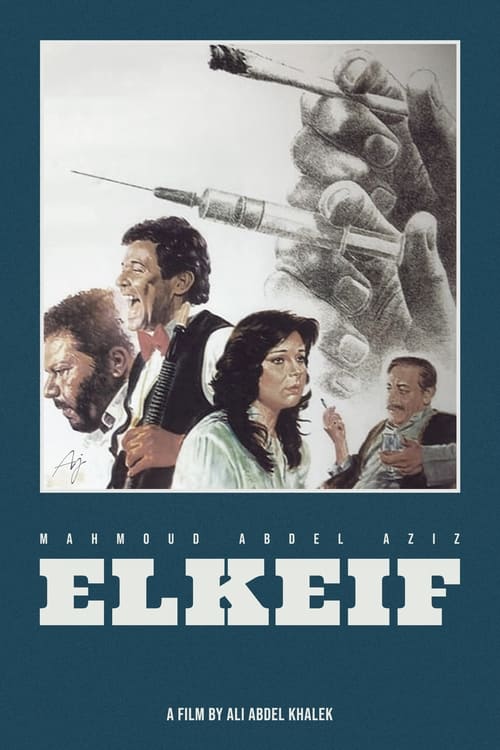
El Keif
1985 · Ali Abdel-Khalek
For when you want a crowd-pleaser with a conscience — something funny and musical that still leaves you arguing about right and wrong afterward. Comfort viewing with a sting in it.
What it's about
A genial wedding singer in Cairo is sliding into hashish dependency, and his brother, a straight-arrow chemist, hatches a scheme to save him: a harmless herbal blend that looks and smokes like the real thing, meant to prove the high is all in the head. Then a sharp-eyed dealer spots the commercial potential of a fake that costs nothing to make, and the chemist's good intentions collide with very real money. What starts as a family intervention becomes a tour through Egypt's drug economy, with two brothers caught between conscience and cash.
The experience
It moves like a popular comedy — songs, banter, big star charisma — but there's a moral drama tightening underneath, so the laughs come with a growing sense of consequence. Warm and lively on the surface, pointed and a little bitter at the core.
Performances
Mahmoud Abdel Aziz is magnetic as the easygoing singer whose charm keeps you rooting for him even as he drifts, and Yehia El-Fakharany plays the earnest chemist with just enough vanity to make his corruption believable — two of Egyptian cinema's biggest stars pulling in opposite moral directions.
The craft
Mahmoud Abu Zeid's script is the engine: a clean, almost fable-like premise — a fake drug that works because people believe in it — that keeps generating both comedy and social critique. Ali Abdel-Khalek keeps the tone nimble, letting wedding-band musical numbers and street-level texture carry the film between its moral turns.
Why it matters
A touchstone of 1980s Egyptian popular cinema, remembered for taking on drugs and easy money at a moment of social flux, and for pairing two beloved stars in one of their signature outings. Its title — the colloquial word for the hashish high — entered everyday shorthand.
Snapshot
El Keif (الكيف — roughly "The High" or "The Kif," the colloquial Egyptian word for a hashish-induced state of ease) is a 1985 Egyptian feature that fuses social-problem drama, crime narrative and popular comedy into a parable about drugs, money and the corruption of good intentions. Directed by Ali Abdel-Khalek from a script by Mahmoud Abu Zeid, it pairs two of the era's biggest male stars — Mahmoud Abdel Aziz as Gamal, a genial wedding singer sliding into hashish dependency, and Yehia El-Fakharany as his brother Salah, a respectable chemist. The film's premise is a moral experiment: to wean Gamal off drugs, Salah concocts a harmless herbal blend that looks and smokes like hashish, meaning to prove that the "high" is largely psychological. The scheme curdles when a canny dealer, Bahz Bey (Gamil Ratib), recognizes a cheap product to cut and market, drawing the chemist into the trade he set out to debunk. The picture is best remembered for its bitterly ironic reversal — the upright brother destroyed, the wastrel redeemed — and for a closing image, widely cited in Egyptian film writing, of the reformed Gamal tearfully preparing a fix for his now-addicted brother. It endures as a staple of television rebroadcast and a fixture on popular lists of the country's best comedies, even as critics note that it was made in a period when the visual craft of Egyptian cinema was at a low ebb.
Industry & production
El Keif was produced within the commercial mainstream of mid-1980s Egyptian cinema, an industry then caught between the collapse of the old studio system and the pressures of a booming home-video and Gulf-television market. Sources credit the production and distribution to a private commercial outfit (listed as Cinema Lights / Anwar el-Cinema), typical of the small independent producers who dominated the decade after the retreat of large public-sector financing. This was an economy driven by star vehicles and rapid shooting schedules, in which films were cheaply and quickly made to feed cinemas, video cassettes and the export appetite of Arab satellite and Gulf broadcasters.
The casting reflects that logic. Mahmoud Abdel Aziz and Yehia El-Fakharany were both A-list draws whose combined marquee value effectively guaranteed distribution; the veteran Gamil Ratib, a bilingual actor long associated with authority and villainy, anchored the antagonist role. The film opened on 16 September 1985 and runs roughly 115 minutes. Beyond these particulars, granular production records — budget, shooting schedule, exact locations, box-office receipts — are not reliably documented in accessible sources, and this dossier does not attempt to reconstruct them; the honest position is that the commercial data for a film of this tier is thin.
Technology
El Keif was produced on 35mm photochemical film for theatrical release, the standard format of the period, and mastered for the era's dominant secondary window: the VHS cassette and broadcast television. This technological context matters to the film's reputation. Critical writing on the picture repeatedly observes that Egyptian cinema in the mid-1980s was, in purely visual terms, near its nadir — a consequence of thin budgets, fast schedules and the industry's orientation toward the small, low-resolution home screen rather than the projected image. The look of El Keif, in other words, is partly a symptom of a production culture optimizing for television and video sale. No specialized or experimental technology is associated with the film; its interest lies in script and performance rather than in any technical innovation, and it should be read as a competent artifact of a lean, video-era commercial pipeline.
Technique
Cinematography
Photography is credited to Maamoun Atta (Mamoun Atta). The visual approach is functional and unshowy, in keeping with both the director's populist mode and the constrained economics described above. Coverage favors clear, legible staging of dialogue and comic business over expressive camerawork; the wedding-party settings that open the film allow for some warmth and movement, while the later scenes of the drug trade are handled more plainly. Critics who admire the film tend to do so despite its images rather than because of them — the frequently repeated verdict is that its power is dramatic and thematic, not painterly. Detailed accounts of lighting or lens choices are not part of the documented record, and it would be invention to supply them.
Editing
The cutting is credited to Hussein Afifi, one of the more prolific editors of Egyptian commercial cinema. The film's editorial task is essentially structural: to manage a tonal arc that begins as broad musical comedy and darkens, by degrees, into tragedy. The design tracks the inversion of the two brothers' fortunes, and the montage's chief burden is to make that slow crossover legible and, at the climax, devastating. The much-cited final beat depends on editorial timing — holding on the reversal long enough for its irony to register.
Mise-en-scène / staging
The staging organizes the film around a set of contrasting social spaces: the raucous, communal world of the wedding celebration where Gamal performs; the ordered, "respectable" milieu of Salah's chemistry and salaried employment; and the shadow economy of the dealer Bahz Bey. Costume and setting do a good deal of thematic work — most pointedly in Ratib's Bahz Bey, whom critics single out as a deliberately hybrid figure: a trafficker who keeps the traditional galabeya of the folkloric neighborhood tough while wielding the vocabulary and calculation of a modern entrepreneur. That single design choice compresses the film's argument about old vice wearing new, capitalist clothing.
Sound
Music is credited to the composer Hassan Abu El-Saud (with one source also naming Yahya al-Mougy in the musical credits). Sound is central rather than incidental here, because the protagonist is a professional singer: the wedding songs Gamal performs are diegetic set-pieces, performed on screen by Mahmoud Abdel Aziz, and they establish both his charm and the popular-festivity world the drama will corrupt. The songs function as characterization and as tonal anchor, marking the distance the film travels from communal celebration to private ruin. Specific song titles and lyric attributions are not securely documented in the sources consulted and are left unstated rather than guessed.
Performance
Performance is the film's acknowledged strength. Mahmoud Abdel Aziz — a star whose popular sobriquet was "the Magician" — modulates from ingratiating comic ease into the physical and moral degradation of addiction, and later into the chastened tenderness of the recovering brother; the role's demand that he both sing and disintegrate is central to the film's memory. Yehia El-Fakharany traces the opposite curve, from starched respectability to compromise and collapse, so that the two performances mirror and invert one another. Gamil Ratib's Bahz Bey supplies the film's most quoted characterization, a smiling, plausible predator. The ensemble around them — including Noura and a supporting cast of neighborhood and criminal types — fills out a recognizably popular Cairene social world.
Narrative & dramatic mode
The dramatic mode is the social-problem film crossed with tragic irony and leavened, at least early on, by broad comedy. Its engine is a moral hypothesis staged as plot: Salah's placebo hashish is meant to prove a thesis (that the addiction is in the mind), and the narrative is the systematic refutation of that thesis by the logic of money. The structure is built on symmetrical reversal — a chiasmus in which the saved becomes the damned. What lifts the film above the ordinary cautionary tale, in the estimation of its admirers, is that it declines to resolve the questions it raises: the closing does not offer the reassuring moral of an anti-drug tract but leaves the audience with an unhealed irony, implicating good intentions, greed and the market alike. It is didactic in subject but, at its best, ambivalent in effect.
Genre & cycle
El Keif sits at the intersection of three genres — drama, crime and comedy — and belongs specifically to the durable Egyptian cycle of drug-and-society films. Cinema in Egypt had treated hashish and the drug trade for decades, and the 1980s produced a concentrated run of such pictures amid heightened public anxiety about narcotics. Within that cycle, El Keif is notable for its economic framing: rather than dwell only on the addict's pathos, it anatomizes the drug as a business, with Bahz Bey as the emblem of an entrepreneurial vice. The film thus reads as much as a satire of profit-seeking as a temperance parable, which is what gives it a foothold in later discussions of how Egyptian cinema imagined the figure of the drug dealer.
Authorship & method
The film is the product of a recurring authorial partnership. Ali Abdel-Khalek (also transliterated Aly Abdel Khaleq), the director, built the most prolific and commercially successful stretch of his career in the 1980s as a leading maker of Egyptian social dramas — films that dramatize pressing public issues (the drug trade, poverty, greed, honor and moral conflict) through accessible, star-driven storytelling. Mahmoud Abu Zeid, credited with story and screenplay, was his frequent collaborator across a series of such socially engaged pictures; El Keif's combination of issue-driven plotting with a strong ironic reversal is characteristic of their joint method. On the craft side, the key collaborators were cinematographer Maamoun Atta, editor Hussein Afifi, and composer Hassan Abu El-Saud, the last especially important given the film's musical dimension. The method, on the whole, is that of mainstream engaged cinema: a clear social thesis, delivered through comedy and melodrama and carried by major stars, prioritizing narrative and performance over formal experiment.
Movement / national cinema
El Keif is a work of Egyptian popular cinema, the largest and most influential film industry in the Arab world. It appeared alongside — but should be distinguished from — the celebrated Egyptian "New Realism" of the 1980s associated with directors such as Mohamed Khan, Khairy Beshara, Atef El-Tayeb and Daoud Abdel Sayed, whose films pursued a grittier, more location-based aesthetic and a more austere authorial signature. Abdel-Khalek's picture shares that generation's appetite for social diagnosis and its street-level subject matter, but operates in a more frankly commercial, star-and-song register. It is best placed as mainstream socially conscious cinema running parallel to the art-realist wave, drawing on the same national anxieties while addressing the broadest possible audience.
Era / period
The film is very much a document of mid-1980s Egypt: the Mubarak-era decade of infitah-driven economic opening, widening inequality, labor migration to the Gulf, and acute public concern about drugs as a social scourge. Its narrative preoccupation with easy money, get-rich schemes and the moral costs of enrichment resonates with the period's felt tension between traditional propriety and new commercial appetites — a tension the film literalizes in Bahz Bey's galabeya-clad capitalism. Industrially, as noted, it belongs to the video-and-television era of Egyptian production, when output was high, budgets low, and the projected image often sacrificed to the economics of the small screen. Reading the film's modest visual polish requires holding that context in view.
Themes
The governing theme is the corruption of good intentions by money: Salah's virtuous experiment becomes the seed of his ruin because the market finds a use for it he never imagined. Around that spine cluster several others — addiction as both individual affliction and social system; the thin, permeable membrane between the "respectable" and the "criminal," dramatized by the brothers' exchange of fates; and greed as the true intoxicant, with the drug trade standing in for a broader entrepreneurial rapacity. The film also probes the limits of moralism, since its own anti-drug premise is complicated rather than confirmed by events, and it turns on questions of family loyalty and guilt, culminating in the terrible intimacy of one brother administering the other's addiction. Its refusal to tie these threads into a tidy lesson is, for its defenders, precisely its distinction.
Reception, canon & influence
Critically, El Keif has come to be regarded as a small classic of engaged Egyptian popular cinema — a film whose reputation rests on its screenplay, its central reversal and its performances rather than on its visual craft. Serious retrospective appraisal (notably in Arabic-language film writing and features such as MadaMasr's culture coverage) has praised it precisely for posing hard social questions and leaving them unresolved, contrasting that ambition with the modest, television-era image-making of its moment; the same writing highlights Gamil Ratib's Bahz Bey as an unusually rich portrait of the modern drug dealer. It has featured on popular rankings of Egypt's best comedies and musicals and remains a fixture of television rebroadcast, its ending among the more frequently invoked images in casual Egyptian film memory.
Looking backward, the film draws on a long-standing Egyptian cinematic and comic tradition of hashish-themed storytelling and on the 1980s cycle of drug-and-society dramas, as well as on the star personas its two leads brought with them — Abdel Aziz's charm-and-menace duality, El-Fakharany's everyman respectability. Looking forward, its most traceable legacy is thematic and iconographic: it is regularly cited in discussions of how Egyptian cinema has depicted the drug dealer and the economics of the drug trade, and Bahz Bey stands as a reference point in that lineage. Direct, documented influence on specific later filmmakers is harder to establish from the available record, and it would be an overstatement to claim a school of imitators; the film's enduring life is better described as that of a beloved, much-quoted touchstone than that of a formal model. Where the paper trail is thin, that limit is worth stating plainly rather than papering over.
Reception
A hit 1980s star vehicle about Egypt's drug problem that has only grown in stature — decades of TV reruns turned it from popular social drama into one of the most beloved and rewatched Egyptian films of its era.
How El Keif was received, from release to now →
Influences: the films it descends from and the films it influenced
- El Fetewa (1957) — Establishes the template El Keif runs on — a genre melodrama built around a menacing star-heavy who monopolizes an illicit economy, using the villain's exploitation of the poor as the engine of a social thesis, the direct precedent for Gamil Ratib's Bahz Bey.
- Shabab Emraa (1956) — Codifies the entrapment-and-moral-degradation arc — a decent man pulled step by step into ruin — that El Keif reuses as its dual-arc structure of corruption and collapse.
- Bidaya wa Nihaya (1960) — Abu Seif's Mahfouz adaptation supplies the tragic-irony machinery of symmetrical rise-and-fall, where a character's ascent is engineered to circle back to catastrophe — the reversal logic El Keif's ending depends on.
- Al-Zawga al-Thaniya (1967) — Perfects the schematic 'the schemer undone by his own scheme' reversal delivered through contrasting social spaces (mansion vs. peasant house), a staging and plotting device El Keif inherits wholesale.
- Al-Ard (1969) — Chahine's realist social-problem cinema legitimized the unresolved, didactic ending that refuses easy moral closure — the 'hard question left open' posture El Keif adopts over its melodrama.
- El-Aar (1982) — Abdel-Khalek's own prior drug drama — heirs discovering their fortune comes from hashish — is the direct authorial precedent: same director, same star-driven issue-melodrama method, same moral-conflict-over-drug-money thesis that El Keif refines into a cleaner ironic reversal.
- Kit Kat (1991) — Takes El Keif's hashish milieu and Mahmoud Abdel Aziz's persona but sublimates the didactic melodrama into auteur character-study realism, proving the drug-culture subject could carry art cinema rather than issue-thesis.
- Heena Maysara (2007) — Revives the unresolved-didactic social-problem melodrama for the slum-and-drugs milieu, keeping El Keif's method of ending on an unhealed social wound rather than moral resolution.
- Al-Farah (2009) — Uses a wedding and its diegetic songs as a compressed social microcosm for underclass economic desperation — the wedding-as-staging-device and diegetic-song texture El Keif deployed, now made the whole architecture.
- Ibrahim El Abyad (2009) — Modernizes the drug-lord iconography El Keif's Bahz Bey helped fix in Egyptian film memory, staging the dealer as tragic figure within the district's economy — the reference-point lineage the dossier names explicitly.
- El-Batniyya (1980) — Opens the 1980s drug-and-society cycle by dramatizing the economics and territory of the trade through a single kingpin figure (Nadia El-Guindy's baron), the milieu-and-iconography El Keif shares.
- El Ghoul (1983) — Same-cycle 'ordinary man vs. an untouchable corrupt magnate' construction, using a star comedian against a monstrous villain to carry a social-problem thesis through popular genre.
- Sawwaq al-Autobis (1983) — The New Realism film El Keif runs parallel to — dramatizing infitah-era moral and economic decay, greed corroding family and nation, though via location realism where El Keif stays with studio-bound star melodrama.
- El Saaleek (1985) — The same-year Mahmoud Abdel Aziz–Yehia El-Fakharany pairing built on the identical charm-and-menace / everyman-respectability duality, tracing a rise-through-greed-then-fall arc that mirrors El Keif's twin trajectories.
- Gary El Wohoush (1987) — Extends the cycle's portrait of the drug trade as predatory economy, again casting a leading man across the charm/menace line to anatomize how the trade consumes those inside it.
- Al-Kit Kat / Sonaa El Farah tradition (1991) — Shares El Keif's reliance on contrasting social spaces and hybrid galabeya-vs-modern costuming to map class and moral position visually, a staging grammar common to the engaged-popular register both work in.
Similar films
- Land of Fear (2000) — shared sensibility
- A Hero (2021) — shared sensibility
- The Night of Counting the Years (1969) — shared sensibility
- Cairo Station (1958) — shared sensibility
- Nadodikkattu (1987) — shared sensibility
- Close-Up (1990) — shared sensibility
- Le Havre (2011) — shared sensibility
- Paid in Full (2002) — shared sensibility