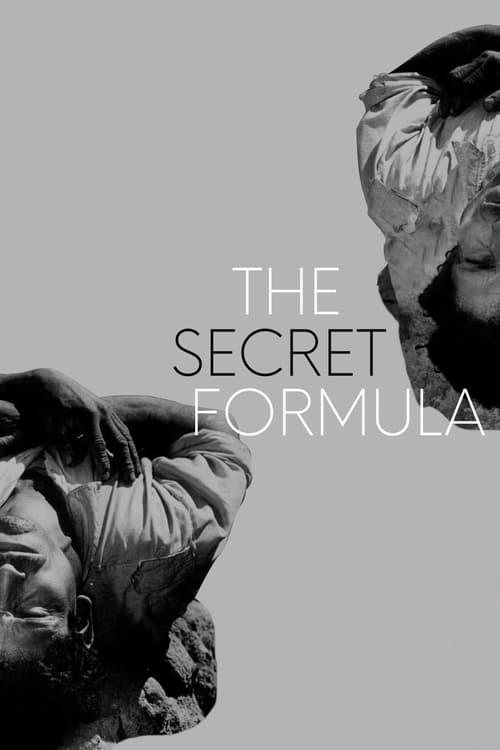
The Secret Formula
1965 · Rubén Gámez
For when you're curious rather than in the mood to be entertained — a forty-minute jolt for viewers who want cinema as provocation, best approached like a gallery piece with the lights off.
What it's about
A forty-minute experimental essay on what was being done to Mexico — no plot, just a chain of charged black-and-white tableaux: men receiving intravenous transfusions of Coca-Cola, carcasses swinging in a slaughterhouse, campesinos crossing bare fields under enormous skies. Over the images runs a text written by the novelist Juan Rulfo, a voice of dispossession set against pictures of a country being fed something from outside.
The experience
Blunt, surreal, and genuinely provocative — closer to a fever dream or a protest poem than a story. It's short, but its strongest images stick like burrs.
The craft
The black-and-white photography deliberately takes the heroic vocabulary of Mexico's Golden Age — the big skies, the noble campesino — and turns it sour, while the spoken text by Juan Rulfo, one of Mexico's greatest writers, gives the images a voice of quiet fury. Image and word never simply illustrate each other; the collision between them is the argument.
Why it matters
It won the top prize at Mexico's First Experimental Film Competition in 1965 and became a founding document of Mexican experimental cinema — the moment the national film culture publicly attacked its own official imagery.
Snapshot
La fórmula secreta — often carried with the subtitle Coca-Cola en la sangre ("Coca-Cola in the Blood") — is a roughly forty-minute black-and-white essay film that won the top prize at Mexico's First Experimental Film Competition in 1965. It has almost no story. It has instead a sequence of tableaux, some of them among the most reproduced images in Mexican cinema: men laid out in a row receiving intravenous transfusions of Coca-Cola; carcasses swinging in a slaughterhouse; campesinos crossing bare fields under the kind of enormous sky that the Golden Age had trained audiences to read as national pride. Over these images runs a spoken text written by Juan Rulfo, commonly credited as read by the poet Jaime Sabines — a voice of dispossession set against pictures of a country being fed something from outside.
Filed here as "Drama," the film is nothing of the kind in any conventional sense; it belongs to the essay-film lineage of Vigo, Buñuel's Las Hurdes, and Marker, and to the polemical collage cinema that Latin America was inventing at exactly this moment. Its importance is out of all proportion to its length and its circulation. It is the single most cited Mexican experimental film of the 1960s, the hinge between the exhausted studio system and everything that came after, and — because Gámez made only one other feature in his life — a body of work that is essentially one gesture, delivered once, with total conviction.
Industry & production
To understand the film you have to understand what it was allowed to exist inside. By 1965 Mexican cinema was institutionally sealed. The industry had passed through a genuine Golden Age in the 1940s, then calcified: production was routed through state finance via the Banco Nacional Cinematográfico, exhibition and distribution were effectively monopolized, and, decisively, entry into the profession was controlled by the STPC union, whose directors' section had been closed to new members for years. The result was a high volume of churros — formula pictures, wrestling serials, comedias rancheras, family melodramas — made by an aging roster of licensed directors. A young person with talent and no union card had essentially no route in.
The First Experimental Film Competition (Primer Concurso de Cine Experimental), organized in 1964–65 under union auspices, was the pressure valve. It invited outsiders and technicians to make features on modest terms and compete for prizes, and it produced, in one stroke, the founding texts of a new Mexican cinema: Gámez's film, Alberto Isaac's En este pueblo no hay ladrones (adapted from García Márquez and famous for its cameos by Buñuel, Rulfo, and other figures of the intellectual scene), Juan José Gurrola's Tajimara, and several others. La fórmula secreta took the top prize.
Beyond that institutional frame, the production record is genuinely thin. Budget figures, shooting schedule, and the full crew list are not securely documented in the accessible literature, and any specific number attached to this film should be treated with suspicion. What is clear is that it was made cheaply, largely on location, with non-professional performers, and that its formal freedom is inseparable from its lack of commercial obligation: no distributor was waiting for it, so no distributor had to be satisfied. It also runs well under normal feature length — a medium-length work in a competition nominally about features — which tells you something about how loosely the rules were being enforced and how much the organizers wanted results.
Technology
The film was shot on 35mm black-and-white, and that is a more consequential fact than it sounds. Elsewhere in the world, the new cinemas of the early 1960s were being enabled by lightweight 16mm gear — the Éclair NPR, the Arriflex, the Nagra recorder — which decoupled filmmaking from studio infrastructure. In Mexico, the gauge remained a gatekeeping mechanism: professional 35mm cameras, laboratory access, and Churubusco's facilities ran through the union. The competition granted access to that apparatus rather than routing around it. So La fórmula secreta is a paradox — an insurgent film made on the establishment's own equipment, with the establishment's own image quality. Its gleaming, high-contrast monochrome is not the grainy scruff of guerrilla 16mm; it is studio-grade photography turned against studio-grade subject matter.
The soundtrack is entirely post-synchronized, with no direct-sound dialogue. This was standard Mexican industry practice (dubbing stages were the norm) and it was also the cheap option, but Gámez converts a constraint into the film's central formal device: the sound is never the sound of the image. The optical laboratory supplies the rest of the toolkit — the manipulation of motion, superimposition, and the graphic punctuation between blocks — placing the film in the tradition of camera-and-printer effects rather than the observational fly-on-the-wall aesthetic that lighter equipment was producing elsewhere.
Technique
Cinematography
The photography is the film's argument. Gámez, who came to the film with a background in image-making rather than in the industry's directorial hierarchy, composes in the vocabulary of the "Mexican school" — the deep-focus, low-horizon, cloud-heavy landscape style codified by Gabriel Figueroa in his work with Emilio Fernández, itself descended from Eisenstein's Mexican footage and from the modernist photography of Manuel Álvarez Bravo and Paul Strand. Wide skies, silhouetted figures, agave, the noble face in three-quarter light: these are national-brand images.
Gámez shoots them impeccably and then poisons them. The same sculptural lighting that once ennobled the peasant now presents him supine on a gurney with a tube in his arm. The same monumental sky presides over nothing happening. Frontality is used aggressively — figures stare down the lens — and the framing tends toward the emblematic rather than the dramatic: each shot is built to be read as a sign, not to be joined to the next by continuity. This is the film's most durable formal idea, and the reason it still stings: it does not reject the beautiful national image, it demonstrates that the beautiful national image was always available for other uses.
Editing
There is no scene in La fórmula secreta in the ordinary sense — no space established, inhabited, and exited. The film proceeds by blocks of imagery joined on conceptual collision, the Eisensteinian montage of attractions rerouted through 1960s collage. Meaning is generated between shots rather than within them: transfusion cuts to slaughterhouse, ritual cuts to advertisement, and the viewer performs the equation. Because the associations are ideological rather than spatial, the cutting can be abrupt without being disorienting; you always know what argument you are inside, even when you cannot say where you are.
The rhythm alternates deliberately: long, static, almost photographic holds that dare you to keep looking, then bursts of rapid, percussive assembly. Specific credits for the editing are not reliably documented, and it is likely — though not certainly — that Gámez cut the film himself or worked in close collaboration; the assemblage bears the signature of a single sensibility rather than of an industrial cutting room.
Mise-en-scène / staging
Staging is tableau-based and unapologetically absurd. Props function as ideograms — the bottle, the IV line, the hanging meat, the cross, the tortilla, the gun — and are placed with the flatness of a political cartoon or a votive painting. Locations are found rather than built: fields, roads, an abattoir, clinical interiors, unglamorous urban edges. The film borrows the Catholic iconographic repertoire that saturates Mexican visual culture (the sacrificial body, the procession, the crucified figure) and reuses it for a secular argument about consumption and extraction. Nothing is naturalistic; nothing is quite surreal in the dream sense either. It is closer to the deadpan literalization Buñuel practiced in his Mexican period — take a metaphor and simply film it as a fact.
Sound
The soundtrack is the film's second author. Image and sound are systematically non-coincident: what you hear is commentary, counterpoint, or interference, never confirmation. The centerpiece is the spoken text by Juan Rulfo — the author of El Llano en llamas and Pedro Páramo, the writer who had already given Mexican literature its definitive account of rural abandonment — delivered, per the standard credit, in Jaime Sabines's voice. Rulfo's idiom, all understatement and grievance held very still, provides the film's human register against images that are otherwise cold and diagrammatic.
Around the voice, Gámez works with a compiled and appropriated audio field rather than a conventional dramatic score: passages of art music, popular Mexican song, environmental noise, and stretches of silence used as a weapon. Composer credits for the film are inconsistently reported and I would not state one as fact. What matters formally is the method — the soundtrack behaves like the image track, as a set of borrowed cultural signs placed in collision, so that a familiar melody becomes an indictment simply by being laid over the wrong picture.
Performance
There is essentially no acting. The cast is composed largely of non-professionals used for physiognomy, posture, and endurance — faces held long enough to become landscapes. This is Kuleshov-adjacent: expression is supplied by context, not by the performer. Where the film does invoke a "character," it is a national type rather than a person — the charro, the gringo, the campesino, the ranchero — deployed as costume-deep parody of the star personae the Golden Age had manufactured. The refusal of professional actors is also a refusal of the union's other closed shop, and it aligns the film with the neorealist and Cinema Novo practice of casting the represented population rather than performers hired to stand in for them.
Narrative & dramatic mode
The film has no protagonist, no causal chain, and no resolution. It is organized paratactically — this, then this, then this — and the connective tissue is thematic recurrence rather than plot. The dominant mode is the essay: a first-person argument advanced in images, of the kind Marker and Resnais had been developing in France since the early 1950s, crossed with the pamphlet and with a strain of ritual repetition that keeps pulling the film toward liturgy.
Two consequences follow. First, the film is legible in almost any order at the level of the sequence, which is part of why individual images from it have circulated so effectively as stills. Second, its emotional effect is cumulative and atmospheric rather than dramatic; it does not build tension, it builds pressure. Viewers arriving expecting the "Drama" label to mean anything conventional will find the film either bracing or impenetrable, and both reactions are documented in its reception history.
Genre & cycle
Generically, it belongs to the experimental essay film, with strong admixtures of political documentary, surrealist provocation, and the "city symphony"/place-portrait tradition turned sour. Its nearest cousins in the abattoir imagery are Franju's Le sang des bêtes (1949) and, further back, the shock ethnography of Buñuel's Las Hurdes (1933).
The cycle it actually belongs to, though, is institutional: the wave of Mexican independent and experimental filmmaking that runs from Jomí García Ascot's En el balcón vacío (1962) through the 1965 and 1967 experimental competitions and out into the 1970s, when the state under Echeverría briefly funded a more ambitious auteur cinema and directors like Paul Leduc, Felipe Cazals, and Arturo Ripstein came into their own. Gámez's own short Magueyes (1962) — agave photographed in manipulated motion against Shostakovich, the Figueroa landscape motif reorganized into a mass ballet — is the film's direct precursor and shows the method already fully formed in miniature.
Authorship & method
Rubén Gámez (1928–2002) is one of world cinema's great one-shot authors. His filmography is essentially two features separated by a quarter century — La fórmula secreta and Tequila (1991) — plus short work, of which Magueyes is the significant survivor. He came up outside the union's directorial track, and reporting on his background in commercial, advertising, and industrial filmmaking is plausible and often repeated, though the details are not firmly documented; if true, it would account a great deal for the film's fluency with the visual grammar of the advertisement, which it parodies from the inside.
His method, on the evidence of the film itself, was appropriative and graphic: take the existing image-bank of Mexican national identity — cinematic, religious, commercial — and rearrange it until the arrangement itself becomes the statement. He appears to have controlled the camera and the assembly closely; the surviving credits are sparse, and the film's coherence suggests concentrated rather than distributed authorship.
The one collaboration that is universally acknowledged is with Juan Rulfo, who supplied the spoken text. Rulfo's participation matters beyond the words: it certifies the film as part of the serious literary culture of Mexico rather than a student stunt, and it imports a specific moral seriousness about rural dispossession that the images alone might not have carried. Jaime Sabines, standardly credited with the delivery, brings a poet's cadence rather than an actor's — flat, unhurried, unpersuasive in the theatrical sense, and therefore credible. Cinematography, editing, and music credits are the weakest part of the documentary record; I would rather flag that gap than fill it with names I cannot verify.
Movement / national cinema
The film sits at the junction of two movements without belonging cleanly to either.
The first is Mexican: the Nuevo Cine circle, the critics and cinephiles — Emilio García Riera, José de la Colina, Salvador Elizondo, Carlos Monsiváis, García Ascot among them — whose short-lived early-1960s magazine attacked the closed union system and demanded a cinema of authors. La fórmula secreta is the most extreme realization of what that group was arguing for, even though Gámez was not its house director.
The second is continental: the New Latin American Cinema taking shape in the same years — Fernando Birri's documentary school in Santa Fe, the Cuban ICAIC and Santiago Álvarez's collage agitprop, Glauber Rocha's Brazilian Cinema Novo and its 1965 "Aesthetic of Hunger." Gámez's film shares that project's conviction that underdevelopment is a subject requiring its own form rather than a setting for imported forms. It notably precedes Solanas and Getino's La hora de los hornos (1968) by three years and anticipates a good deal of that film's method: the montage of appropriated commercial imagery, the voice-over indictment, the treatment of consumption as the visible face of dependency.
Era / period
1965 is a precise moment. Economically, Mexico is deep in the desarrollo estabilizador — the "Mexican Miracle" of sustained growth, industrialization, and rapidly increasing US commercial penetration, of which Coca-Cola was the most legible everyday emblem. Politically, PRI hegemony was intact but its costs were showing: the crushed railway workers' movement of 1958–59 was recent memory, the doctors' movement was underway, and the state violence of 1968 at Tlatelolco was three years off. The film's fury reads, in retrospect, as one of the more accurate pre-tremors.
Intellectually, the period is defined by the long argument over lo mexicano — Samuel Ramos's diagnosis of national inferiority in the 1930s, Octavio Paz's El laberinto de la soledad (1950), and the Hiperión philosophers' attempt to make Mexican identity a subject of rigorous inquiry. The TMDB description's reference to "intellectual debates about the Mexican national character" points exactly here. Gámez's contribution is to reframe the question materially: not who are we, but what are we being fed, and by whom.
Cinematically, the year belongs to the international new waves at full strength, and to Buñuel — long resident in Mexico, and in 1965 completing Simón del desierto. The surrealist current in Mexican art, energized since Breton's 1938 visit and the wartime arrival of exiles like Leonora Carrington and Remedios Varo, is part of the same air.
Themes
Ingestion and dependency. The film's founding conceit is a metaphor made literal: foreign capital enters the national bloodstream. The transfusion image works because it is both absurd and clinically plausible-looking, and because it locates imperialism not in treaties but in the body.
Hunger. Rulfo's text supplies the counter-theme to consumption — a population that is being filled with something while remaining unfed. The land in the images is not abundant.
Sacrifice. The slaughterhouse and the Christian iconography rhyme: the butchered animal, the martyred body, the ritual killing that a culture organizes itself around. The film implies continuity between pre-Hispanic sacrifice, Catholic sacrifice, and the ordinary attrition of the poor.
The betrayed revolution. Revolutionary imagery is present as costume and citation, an official past that has become decor while its promises — land above all — went unkept.
Manufactured identity. Machismo, the charro, the noble campesino, the beautiful sky: the film treats national character as a product line rather than an essence, and the "secret formula" of the title cuts both ways — the trade secret in the bottle, and the recipe by which a nationality is compounded.
Reception, canon & influence
Influences on the film (backward). Four currents converge. From Eisenstein's unfinished ¡Que viva México! (1931–32) come both the iconography — the campesino face, the agave, the sacrificial peon — and the montage principle of collision. From Figueroa and Fernández comes the polished national landscape style that Gámez appropriates in order to dismantle. From Buñuel — the surrealist provocations of the late 1920s and the Mexican features of the 1950s and early 1960s — comes the deadpan literalization of metaphor and the willingness to be blasphemous in the service of an argument, with Las Hurdes standing behind the film's use of documentary surfaces for polemical ends. From the European essay film and its documentary cousins — Vigo's À propos de Nice, Franju's abattoir, Marker and Resnais's commentary-driven works — comes the structural permission to make a film that argues rather than narrates. Domestically, García Ascot's En el balcón vacío had already demonstrated that a serious Mexican film could be made outside the industry; the Nuevo Cine critics supplied the polemical frame; Rulfo supplied the literary authority.
Contemporary reception. The immediate verdict was the competition's top prize, which functioned as an institutional endorsement of the most anti-institutional film in the field. Beyond that, the reception record is thin and should be described honestly: the film had little conventional commercial exhibition, and its early life ran through cinephile screenings, cultural institutions, and university circuits rather than theatrical runs. Reports of it being found scandalous or baffling by some audiences are consistent with the work, but I have not seen figures for its distribution and would not invent any. For years it was more talked about than seen — a condition that shaped its reputation as much as its content did.
Canon. Over subsequent decades it consolidated into the standard Mexican canon, appearing in critics' polls of the country's finest films and in retrospectives of Latin American experimental cinema, and it is preserved and circulated through Mexican film-archival institutions; specific restoration histories vary in the telling. It is now the routine first citation whenever the phrase "Mexican experimental cinema" is used, and its images — above all the Coca-Cola transfusion — have escaped the film entirely into the general iconography of Latin American anti-imperialism.
Legacy (forward). Three lines run out of it. The first is institutional: the 1965 competition and its 1967 successor cracked the closed union system and made possible the state-supported auteur cinema of the 1970s — Leduc, Cazals, Ripstein, Jodorowsky's parallel eruption — and, further downstream, the internationally visible Mexican cinema of the 1990s onward. The second is formal: the film is a foundational text of the Latin American political essay film, and its montage of appropriated commercial imagery against a literary voice-over prefigures the method that La hora de los hornos would carry across the continent in 1968. The third is a permission: it established, for Mexican filmmakers, that the national image-bank was available for critique rather than only for celebration, a stance visible in later Mexican documentary and experimental work.
Gámez himself did not build on it. Tequila arrived in 1991 to modest attention, and his career remains a near-silence around a single detonation. That is part of the film's mythology and probably part of its power: La fórmula secreta has no follow-up to dilute it, no mature phase to be measured against. It says one thing, in forty minutes, with a clarity that its country has not entirely stopped arguing with.
A Deleuzian reading
Six men lie in a row on gurneys, each with a tube in his arm.
The full Deleuzian reading of The Secret Formula →
Reception
It won Mexico's first-ever Experimental Film Competition in 1965 and then spent decades as a barely-screened legend, with Gámez sidelined by the industry it critiqued; today critics rank it among the ten greatest Mexican films ever made — a 2020 poll of Mexican critics placed it at #9 of all time.
How The Secret Formula was received, from release to now →
How to watch The Secret Formula: what to notice on a first viewing
- Watch how long the camera holds on a single posed figure. Gámez stages non-actors and objects like a bottle, a tube, hanging meat as tableaux, each shot built to be read on its own rather than joined to the next by story. Nothing here is drama; each pose is placed on screen to be read like a sign, not felt as a scene.
- Notice how bluntly one block of images cuts to the next. Gámez joins shots by conceptual collision rather than by space or time, so a transfusion can cut straight to a slaughterhouse with no transition to soften it. You supply the connection yourself; the meaning sits in the gap between the two shots, not inside either one.
- Listen for the voice never matching what you're watching. The spoken text runs as commentary or counterpoint, never as confirmation of the image; sound and picture behave like two separate tracks laid side by side. The country described in the voice is not the country shown on screen, and neither one explains the other.
- Notice figures staring straight down the lens. Gámez shoots in the grand deep-focus, low-horizon landscape style of the Mexican studio era, then aims his subjects directly at the camera instead of past it. The same beautiful national imagery you expect gets redirected at you, not staged for you to admire from a distance.
- Watch faces held still long enough to read as portraits. The cast is mostly non-professionals used for posture and physical presence rather than for acting, so a held face works like a landscape you study. Context alone supplies whatever the face is made to carry; nothing here is performed for you.
The whole guide to watching The Secret Formula, with the keys for a rewatch →
Influences: the films it descends from and the films it influenced
- ¡Que viva México! (1932) — Supplies both the icon set Gámez reuses — the campesino head framed low against a filtered black sky, the maguey, the buried/sacrificial peon — and the governing edit principle of collision, cutting for ideological shock rather than spatial continuity.
- Un chien andalou (1929) — Establishes the deadpan literalization of metaphor that the Coca-Cola transfusion executes: an outrageous image asserted flatly in a single unglossed shot, with no narrative causality offered to soften or explain it.
- Las Hurdes (1933) — The prototype of documentary surfaces conscripted for polemic — real bodies and real terrain photographed straight, then detonated by a post-synchronized commentary track deliberately mismatched in tone to what it describes.
- À propos de Nice (1930) — Vigo's 'documented point of view' — satirical cross-cutting between the consuming class and laboring bodies, frontal tableau framing used as accusation rather than description — is the essay structure that lets a film argue instead of narrate.
- Le sang des bêtes (1949) — Franju's abattoir sequences — slaughter rendered in cool high-contrast monochrome beneath an unhurried lyrical narration — model both the carcass/butchery motif and the tonal split between atrocity onscreen and calm literary voice.
- Redes (1936) — Paul Strand's still-photographer frontality — non-professional fishermen monumentalized in low-angle profile against open sky, cut rhythmically to a composed score — is the exact compositional vocabulary Gámez re-applies to his campesinos.
- María Candelaria (1944) — The Figueroa house style Gámez quotes in order to break: infrared-darkened skies, low horizons, sculpted indigenous faces lit as national statuary — reproduced accurately enough that its nationalist glaze can be turned against itself.
- Los olvidados (1950) — Figueroa's camera serving an anti-picturesque argument proves the industrial apparatus can be turned on the poor without ennobling them, and the film's non sequitur dream insert models the paratactic image-block that interrupts rather than advances.
- Nuit et brouillard (1956) — Cayrol's literary text spoken against images it never literally describes fixes the asynchronous word/image contract that Gámez runs with Rulfo's prose in Jaime Sabines's voice.
- Lettre de Sibérie (1957) — Marker's demonstration that identical footage inverts meaning under a rewritten commentary is the operating principle behind Gámez's appropriated imagery and detached post-synchronized narration.
- En el balcón vacío (1962) — The immediate domestic precedent for production outside the STPC union — tiny crew, non-professional cast, wholly post-synchronized sound, and a literary text carrying the structural load in place of industrial dramaturgy.
- La hora de los hornos (1968) — Carries Gámez's central device across the continent: appropriated advertising and commercial imagery hammered against a declamatory literary voice-over, with consumer-brand iconography promoted into an explicit rhetorical unit of the montage.
- Fando y Lis (1968) — Extends the plotless paratactic procession across Mexican wasteland, staging blasphemous Catholic tableaux frontally with non-professionals, in the parallel-cinema space the 1965 concurso had just pried open.
- Reed: México insurgente (1973) — The state-backed auteur cinema the concurso made possible, and a direct formal answer to Gámez: Leduc degrades the image — grainy sepia-toned 16mm blown up — precisely to refuse the Figueroa monumentalism La fórmula secreta had dismantled.
- Canoa (1976) — Assembles a political argument out of documentary surfaces — a peasant chorus addressing the lens directly, non-professional locals, dated-report intertitles — applying essayistic direct address to a dramatic reconstruction.
- Tequila (1991) — Gámez's own late restatement: near-wordless paratactic tableaux of rural bodies set against industrial machinery, cut to appropriated music, with the same refusal of narrative connective tissue between blocks.
- Japón (2002) — Non-professional casting, a plotless drift, and frontal widescreen tableaux of the Mexican countryside in which Catholic iconography is treated as landscape rather than plot — the inherited permission to shoot the national image-bank critically.
- Now! (1965) — Built the same year from pure appropriation — found stills and newsreel cut to a borrowed Lena Horne recording — proving that montage plus an appropriated score can sustain an anti-imperialist argument with no originally shot footage at all.
Similar films
- The Young and the Damned (1950) — influence & lineage
- Macario (1960) — often watched together
- Entranced Earth (1967) — often watched together
- Black God, White Devil (1964) — often watched together
- Brazil (1985) — often watched together
- The Hypothesis of the Stolen Painting (1978) — shared sensibility
- The Secret Agent (2025) — shared sensibility
- I Am Cuba (1964) — shared sensibility