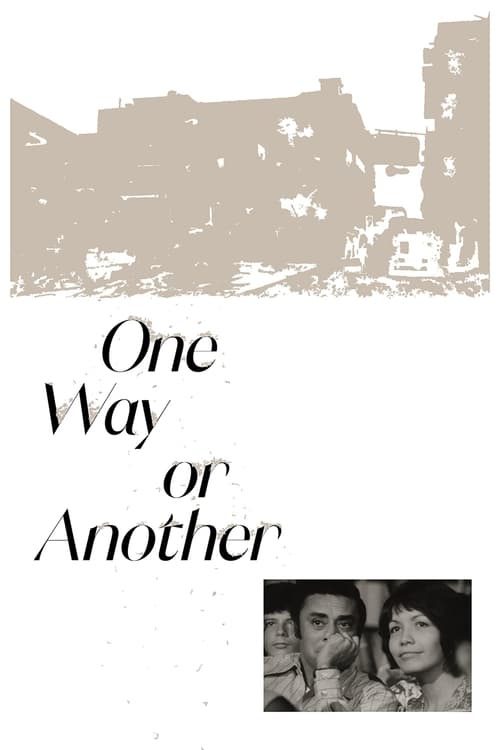
One Way or Another
1977 · Sara Gómez
For when you want a film to argue with — something short, sharp, and formally daring that makes you think about how societies actually change. A discovery, not a comfort watch.
What it's about
In Havana's Miraflores district, as wrecking balls clear the old slums to build the new society, a factory worker raised on the old codes of machismo falls for a schoolteacher committed to the revolution. Their romance keeps snagging on everything the new Cuba hasn't yet changed — loyalty to old friends, old ideas about men and women, old habits of the street.
The experience
Bracing and alive: fiction scenes suddenly give way to documentary footage, voiceover, and music, and real neighborhood residents share the frame with actors. It keeps you slightly off balance in the best way — a love story that keeps stopping to ask hard questions, and honest enough to leave them open.
The craft
Sara Gómez welds fiction and documentary into a single fabric — sociological narration, musical numbers, demolition footage, and neighborhood life all feeding one story. Rough-edged black-and-white filmmaking where the seams are the point: you're always aware you're watching a society examine itself in real time.
Why it matters
The only feature Sara Gómez lived to complete — she was the first Cuban woman to direct one — and it stands as a landmark of political cinema that critiques the revolution from inside it, made by a Black woman working within the state film institute.
Revolutionary Cuba examines itself with startling candor in the only feature Sara Gómez lived to make. A romance between a factory worker shaped by the old codes of machismo and marginality and a schoolteacher committed to the new society becomes the armature for something far stranger and richer: fiction scenes interleaved with documentary footage, sociological voiceover, musical performance, and real residents of Havana's Miraflores district playing versions of themselves, as wrecking balls swing through the old slums on screen. Gómez — the first Cuban woman to direct a feature, a Black filmmaker trained inside the state institute ICAIC under Tomás Gutiérrez Alea — asks whether a revolution can rebuild consciousness as readily as housing, and lets the question stand open. She died of an asthma attack in 1974, at thirty-one, before finishing post-production; Alea and Julio García Espinosa completed the film, released in 1977. Its collage of document and drama anticipates decades of hybrid cinema, and its portrait of a couple arguing their way toward equality still feels ahead of most love stories. One film, and a whole possible career legible inside it.
Reception
Barely seen outside Cuba and academic circles for decades, it circulated mostly through feminist film theory syllabi — now it's steadily climbing the cinephile canon as a landmark of hybrid documentary-fiction and of women's cinema.
How One Way or Another was received, from release to now →
Influences: the films it descends from and the films it influenced
- Memories of Underdevelopment (1968) — Alea's essayistic intercutting of ICAIC newsreel and archival footage into a staged fiction is the exact collage method Gómez adopts — and he helped complete her film after her death.
- The Adventures of Juan Quin Quin (1967) — Espinosa's deliberately rough, self-parodying form embodies the 'imperfect cinema' manifesto that licenses Gómez's unpolished, means-over-finish aesthetic; he too co-finished her picture.
- The Hour of the Furnaces (1968) — Third Cinema agitprop that welds essay title-cards, statistics, and interviews into a montage argument, modeling the didactic collage architecture Gómez uses to indict machismo.
- Now! (1965) — Álvarez's music-driven montage documentary — cutting stills and footage to the rhythm of a song — prefigures Gómez's fusion of musical performance (Abakuá chant, rumba) with sociological editing.
- Chronicle of a Summer (1961) — The founding cinéma-vérité experiment in which real people perform and debate their own lives on camera supplies Gómez's core hybrid device of staged scenes framed by sociological inquiry.
- Moi, un noir (1958) — Rouch's ethnofiction — non-professionals playing dramatized versions of themselves under a commentary track — is the direct precedent for Gómez casting Yolanda and Mario as fictionalized versions of real Miraflores residents.
- Land Without Bread (1933) — Buñuel's ironic, authoritative voiceover laid over ethnographic footage establishes the sociological-narrator device Gómez deploys to analyze marginality from above.
- La Terra Trema (1948) — Visconti's neorealist casting of actual Sicilian fishermen in a sociological drama of labor and location shooting is the non-professional, on-location method Gómez inherits.
- Salt of the Earth (1954) — Real miners and their wives play themselves in a strike drama where women's demand for equality is inseparable from the class struggle — the same braiding of gender equality into a proletarian narrative Gómez performs.
- Portrait of Teresa (1979) — A Cuban social-realist drama that extends Gómez's critique of machismo and the unfinished revolution in the home, dramatizing a working woman's fight for equality against a resistant husband.
- Y tu mamá también (2001) — Cuarón's omniscient sociological voiceover that interrupts intimate fiction to report the wider social reality of the characters is precisely Gómez's device of a documentary narrator cutting across the story.
- The Act of Killing (2012) — Real subjects re-enact and perform dramatized versions of their own social roles for the camera, carrying Gómez's non-professionals-playing-themselves hybrid into contemporary documentary.
- Blood of the Condor (1969) — Sanjinés builds his political drama from indigenous non-professionals and community-collaborative staging, the same New Latin American Cinema practice of filming the marginalized as co-authors of their own portrayal.
- Chircales (1972) — A years-long participatory sociological study of brickmaking families whose method — observation braided with the subjects' own testimony — parallels Gómez's ethnographic engagement with a single Havana barrio.
- Medium Cool (1969) — Wexler runs a scripted fiction straight into unstaged real events (the 1968 Chicago riots), blurring documentary and drama in the same seam Gómez works.
- Killer of Sheep (1978) — Burnett's non-professional cast, location shooting in a marginalized community, and music-scored vignettes of working-class life share Gómez's social-realist observational grain.
Similar films
- Memories of Underdevelopment (1968) — influence & lineage
- Y Tu Mamá También (2001) — influence & lineage
- Sambizanga (1973) — shared sensibility
- I Am Cuba (1964) — shared sensibility
- Sing, Lola, Sing! (2023) — shared sensibility
- The Watermelon Woman (1997) — shared sensibility
- Born in Flames (1983) — shared sensibility
- The Red and the White (1967) — shared sensibility