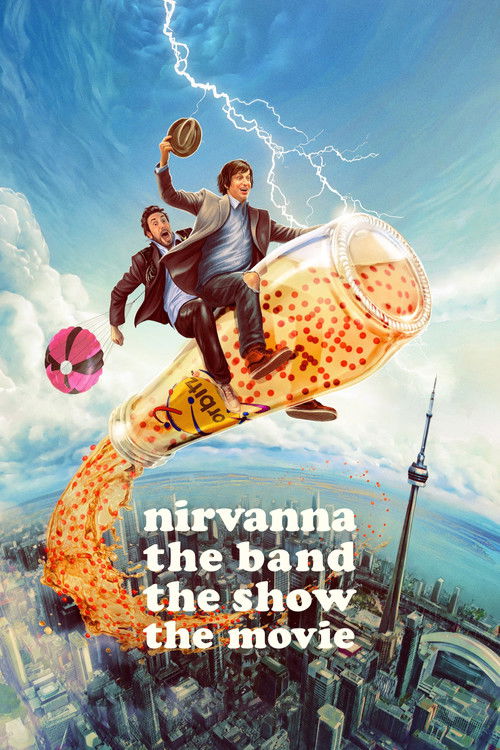
Nirvanna the Band the Show the Movie
2026 · Matt Johnson
For when you want to laugh hard at something scrappy and inventive rather than polished — a hangout comedy with real mischief in it. Great with friends, zero homework required even if you've never seen the series.
What it's about
Matt and Jay are two Toronto roommates who have spent their entire adult lives on one scheme: getting their band booked at the Rivoli. When the latest plan goes sideways, they're flung back to 2008 — and the film turns their time-travel misadventure into a road trip through their own younger selves, a changed city, and a friendship that never quite grew up.
The experience
Anarchic, fast, and frequently laugh-out-loud, with the giddy tension of watching real unscripted chaos unfold — and then, when you least expect it, genuinely tender about nostalgia and arrested development. It feels like a prank that sneaks up on you with feelings.
The craft
Matt Johnson stages scenes with hidden cameras among unsuspecting real Torontonians, infiltrating civic institutions rather than asking permission, so the fiction keeps colliding with actual reality on screen. The 2008 setting becomes a playground for period gags and lo-fi time-travel invention, all held together by guerrilla editing energy.
Why it matters
The feature-length payoff of a bit Johnson and Jay McCarrol have sustained since a 2007 web series, and a flag planted for Canadian guerrilla filmmaking — proof that hidden-camera anarchy can carry a real movie.
Matt Johnson and Jay McCarrol have played fictionalized versions of themselves — two Toronto roommates forever scheming to book their band a show at the Rivoli — since a 2007 web series, through a beloved Viceland run, and now into a feature that sends the bit through time itself. A botched scheme strands them in 2008, and the film mines the gap between then and now for both comedy and an unexpectedly tender meditation on friendship, arrested development, and the city that changed around them. Johnson, who broke out with the found-footage chiller The Dirties and reached a wider audience with BlackBerry, remains Canadian cinema's great guerrilla: scenes are staged with hidden cameras among unsuspecting real Torontonians, civic institutions are infiltrated rather than permitted, and the border between fiction and prank stays deliriously porous. The time-travel conceit lets the production weaponize its own archive — footage the pair actually shot in the late 2000s sits alongside new material, so the past isn't recreated, it's raided. Few films about nostalgia have this much documentary evidence on hand.
Reception
The Viceland show died in 2018 as a semi-secret Toronto cult object — its wall-to-wall unlicensed music kept it half-buried for years. The movie flipped that overnight: a euphoric TIFF 2025 Midnight Madness premiere, 'instant cult classic' reviews, and a Best Motion Picture win at the Canadian Screen Awards.
How Nirvanna the Band the Show the Movie was received, from release to now →
Influences: the films it descends from and the films it influenced
- The Dirties (2013) — Johnson's own debut established his signature of playing a version of himself named 'Matt' inside a diegetic camera the characters operate, blurring the crew shooting the movie with the friends inside it.
- Operation Avalanche (2016) — Perfected his guerrilla method of smuggling a small crew into real institutional locations (NASA) undercover and capturing genuine unsuspecting bystanders as unwitting scene partners for a fictional narrative.
- Zelig (1983) — Pioneered seamlessly compositing a fictional protagonist into real archival newsreel so the invented character appears to have lived inside documented history — the archival-integration gag Johnson deploys.
- The Blair Witch Project (1999) — Codified the found-footage grammar where the shaky diegetic camera is a character-operated object whose limitations and battery-life dictate what the audience is allowed to see.
- Borat (2006) — Model of a scripted fictionalized-self persona turned loose among unsuspecting real members of the public, harvesting their authentic reactions as the film's comedy engine.
- This Is Spinal Tap (1984) — Founding template of the deadpan mockumentary in which self-serious, deluded man-children are interviewed and followed by an ostensibly neutral doc crew.
- Man Bites Dog (1992) — Implicates the filming crew itself in the action, dissolving the line between documentarian and participant that Johnson foregrounds by making the show-within-the-show the plot.
- Real Life (1979) — Early metafiction of a filmmaker-character obsessively documenting his own life and sabotaging it for the camera, the reflexive 'making the thing is the thing' structure Johnson inherits.
- F for Fake (1973) — Essay-film that toys with authorship, forgery and the trustworthiness of edited footage, licensing the playful archival-and-trickery editing register Johnson works in.
- BlackBerry (2023) — Carries over the restless handheld, zoom-driven vérité shooting and improvisational ensemble energy Johnson developed for his fake-doc work into a scripted period biopic.
- Forrest Gump (1994) — Advanced the technique of digitally inserting a fictionalized everyman into authentic historical footage and altering archival figures to interact with him.
- Bad Grandpa (2013) — Threads a scripted narrative through genuine hidden-camera prank encounters with real bystanders, the same reality-ambush staging Johnson builds set-pieces around.
- Primer (2004) — Proof that micro-budget DIY filmmaking can stage a rigorous, self-serious time-travel mechanism without effects money — the low-fi time-travel conceit Johnson adapts to comedy.
- Bill & Ted's Excellent Adventure (1989) — Fuses arrested-development slacker buddies with a time-travel plot where friendship and a shared dumb quest override any hard sci-fi logic.
- Waiting for Guffman (1996) — Mockumentary built entirely on improvised performances by small-town dreamers whose earnest overreach the camera observes without mocking commentary.
- Trailer Park Boys: The Movie (2006) — Canadian transmedia mockumentary that graduated a fictionalized-self ensemble of arrested-development friends from a long-running series to a feature while keeping the vérité doc-crew conceit and regional specificity.
Similar films
- Linda Linda Linda (2005) — same viewing thread
- Weekend (1967) — often watched together
- Rap World (2024) — shared sensibility
- Gary (2026) — shared sensibility
- Superboys of Malegaon (2025) — shared sensibility
- Jim Queen and the Quest for Chloroqueer (2026) — shared sensibility
- American Honey (2016) — shared sensibility
- The Cabin in the Woods (2012) — shared sensibility
All the films related to Nirvanna the Band the Show the Movie →
Watch it with: curated runs of related films
- Learning to Play — Watch these together for the same tender charge — kids and drifters teaching themselves a song, a band, or a whole life from absolute zero, one clumsy try at a time.