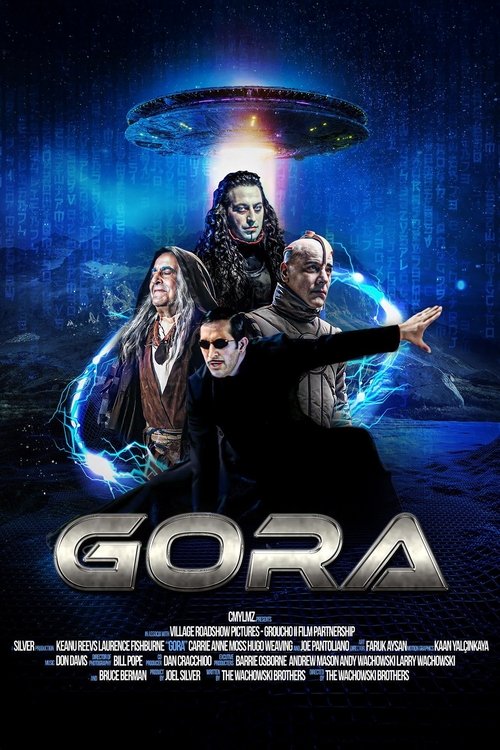
G.O.R.A.
2004 · Ömer Faruk Sorak
When you want to switch your brain off and laugh at something gleefully absurd — great with a group, zero emotional homework required.
What it's about
Arif, a Turkish carpet dealer who makes side money forging UFO photographs, gets abducted by the real thing and hauled off to the planet G.O.R.A., where he has to outwit an evil galactic commander to get home. It's a wall-to-wall spoof of blockbuster science fiction — the bullet-time, the chosen ones, the space operas — run through the rhythms of Turkish stand-up comedy and pure Anatolian cunning.
The experience
Loud, fast, and relentlessly silly — a gag-a-minute parody that mixes broad slapstick with sly national in-jokes about tea service and bureaucratic fatalism. You don't need to catch every reference to laugh; the timing carries it.
Performances
Cem Yılmaz, then at the peak of his fame as Turkey's biggest comedian, wrote the script and plays three roles, and his stand-up timing powers the whole film.
The craft
On release the most expensive film ever made in Turkey, and the money is on screen: director Ömer Faruk Sorak, a veteran cinematographer, gives the nonsense a genuine widescreen sci-fi sheen — which is itself part of the joke, playing spoof material completely straight.
Why it matters
A colossal domestic hit that proved Turkish popular cinema could mount blockbuster-scale comedy on its own terms, and cemented Cem Yılmaz as a national institution.
A carpet hustler who forges UFO photographs is abducted by the real thing — the premise announces the cheerful self-mockery at work. G.O.R.A. was, on release, the most expensive film ever produced in Turkey, and it spends the money on a wall-to-wall spoof of The Matrix, The Fifth Element and Star Wars filtered through the rhythms of Turkish stand-up. Cem Yılmaz, then at the summit of his national fame as a comedian, wrote the script and plays three roles, threading in gags about tea service, arabesque ballads and bureaucratic fatalism that make the picture a national in-joke with universal timing. Director Ömer Faruk Sorak, a veteran cinematographer, gives the nonsense a genuine widescreen sheen, which is itself part of the joke: the hero defeats an evil galactic commander with pure Anatolian cunning. A colossal domestic hit that launched a franchise (A.R.O.G., Arif V 216), it also completes a circle begun by 1982's gloriously threadbare cult object The Man Who Saved the World, which pirated Star Wars footage out of necessity — here Turkish cinema finally builds its own spaceship, and flies it for laughs.
Reception
A record-smashing blockbuster in Turkey on release in 2004, it has since settled into something even bigger: the defining Turkish comedy of its era, endlessly rewatched and quoted two decades on.
How G.O.R.A. was received, from release to now →
Influences: the films it descends from and the films it influenced
- The Man Who Saved the World (1982) — The whole comic premise is a knowing inversion of 'Turkish Star Wars' — where İnanç literally spliced pirated Star Wars footage into a no-budget Yeşilçam space movie, G.O.R.A. spends a record Turkish budget to lovingly mock exactly that make-do sci-fi tradition.
- Star Wars (1977) — Borrows the space-opera grammar wholesale — hyperspace jumps, a throne-room villain, laser-sword duels, desert-planet iconography — as the target template its production design imitates and then punctures.
- The Matrix (1999) — Directly spoofs bullet-time — the frozen, camera-orbiting slow-motion dodge — and the black-clad messianic 'chosen one' wire-fight choreography as set-piece parody.
- Spaceballs (1987) — Supplies the structural template for a feature-length sci-fi spoof that parodies a specific blockbuster's iconography while still sustaining its own coherent adventure plot and hero arc.
- Airplane! (1980) — Model for the deadpan gag-per-second density and literalized-idiom visual jokes that drive Cem Yılmaz's script pacing.
- Dr. Strangelove (1964) — Precedent for one comic lead playing multiple roles across the story's divide — as Sellers did — with Cem Yılmaz splitting himself into Arif, the villain Logar, the robot commander, and 'himself.'
- Vizontele (2001) — Sorak's earlier Anatolian comedy established his glossy anamorphic-widescreen look and the 'modern technology dropped among rural Anatolian naïfs' comic engine that G.O.R.A. relaunches into outer space.
- Hababam Sınıfı (1975) — Codifies the Yeşilçam 'Anatolian cunning' archetype — the seemingly simple provincial who outwits sophisticated authority — that Arif the carpet-shop everyman carries onto an alien planet.
- Tosun Paşa (1976) — Kemal Sunal's Şaban persona — the guileless underdog whose folk shrewdness topples the powerful — is the direct comic bloodline for Cem Yılmaz's underestimated hero.
- A.R.O.G (2008) — The direct sequel that carries Arif's exact character and the same big-budget-VFX-meets-Anatolian-wit formula backward into prehistory.
- Yahşi Batı (2009) — Applies G.O.R.A.'s identical craft — a Turkish comic hero parachuted into a wholesale Hollywood genre (here the Western) with national in-jokes and pastiche — to a new template with Sorak again behind the camera.
- Arif V 216 (2018) — Revives the Arif persona in an explicitly heavy-VFX sci-fi robot comedy, the most literal continuation of G.O.R.A.'s effects-driven spoof craft and franchise ambition.
- The Nutty Professor (1996) — Uses prosthetics, makeup and split-frame performance to let a single star inhabit several broadly-drawn comic characters at once, the multi-role technique G.O.R.A. leans on throughout.
- Galaxy Quest (1999) — Shares the affectionate-rather-than-cruel mode of genre parody, in which cheap effects and fan-culture clichés become both the joke and the emotional core.
- Hokkabaz (2006) — Yılmaz's immediate follow-up strips away the effects but keeps the stand-up-derived character comedy and road-movie structure, isolating the authorial voice that G.O.R.A. wrapped in genre spectacle.
Similar films
- Galaxy Quest (1999) — influence & lineage
- Star Wars (1977) — influence & lineage
- The Matrix (1999) — influence & lineage
- The Chaos Class (1975) — influence & lineage
- Guardians of the Galaxy (2014) — shared sensibility
- Gintama: The Final Chapter - Be Forever Yorozuya (2013) — shared sensibility
- Coyote vs. Acme (2026) — shared sensibility
- Independence Day (1996) — shared sensibility