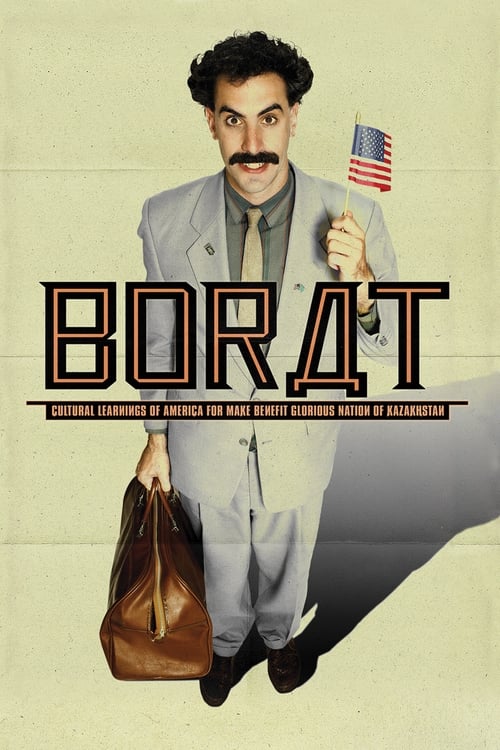
Borat: Cultural Learnings of America for Make Benefit Glorious Nation of Kazakhstan
2006 · Larry Charles
For when you want to laugh yourself breathless and don't mind squirming — ideal with friends and a thick skin, wrong for a delicate evening.
What it's about
A fictional Kazakh TV journalist, gloriously wrong about everything, road-trips across America to make a documentary about its culture. The people he meets — etiquette coaches, rodeo crowds, frat boys, dinner-party hosts — are real and unscripted, and their unguarded reactions to his cheerful outrageousness are the actual subject.
The experience
Cringe comedy at maximum voltage: you laugh until it hurts while watching half of it through your fingers. Underneath the shock gags is a running horror-show of what people will agree with when they think no one's judging.
Performances
Sacha Baron Cohen's commitment is the whole machine: he never breaks character through genuinely volatile, unscripted confrontations, a feat of nerve as much as comic timing.
The craft
The scrappy documentary look is the engine of the joke — hidden setups, real locations, and editing that shapes ambush encounters into an actual road-movie arc. The craft hides itself so completely that the seams between script and reality stay invisible.
Why it matters
A cultural detonation of the 2000s — lawsuits, catchphrases, imitators — that redefined how far mainstream comedy could push unscripted provocation as social satire.
Snapshot
Borat is a hybrid mockumentary that fuses a fictional frame — the Kazakh television journalist Borat Sagdiyev, played by Sacha Baron Cohen, road-tripping across the United States — with unscripted ambush encounters staged among unwitting real Americans. Developed from a character Baron Cohen had honed on British television's Da Ali G Show, the film weaponizes the documentary's claim to truth: its comedy depends on the gap between Borat's grotesque, performed naïveté and the genuine reactions he elicits from etiquette coaches, rodeo crowds, frat boys, and dinner-party hosts. Directed by Larry Charles and produced through a relatively modest budget, it became one of the most commercially and culturally outsized comedies of its decade, provoking lawsuits, a diplomatic complaint from the government of Kazakhstan, and a durable catchphrase culture. As a piece of film history it sits at the intersection of guerrilla documentary, prank cinema, and satirical performance art, and it reframed what a studio-distributed comedy could risk.
Industry & production
The film was produced for Twentieth Century Fox, with Baron Cohen and producer Jay Roach (the Austin Powers and Meet the Parents director) among the central creative architects who shepherded the project from television sketch to feature. Baron Cohen co-wrote and produced as well as starred, making this fundamentally an author-driven star vehicle rather than a director's project in the conventional sense. The production model was unusual for a studio comedy: rather than shooting on controlled sets, the crew traveled the United States capturing real encounters under pretextual cover stories, frequently representing the shoot as a foreign documentary to secure participation. This created an extraordinary legal and logistical apparatus — release forms, waivers, and later litigation when participants felt deceived. Several subjects sued after the film's release; the suits largely failed, in part because of the consent documents signed on location, a fact that has become part of the film's production legend. The reported budget was modest by studio-comedy standards, and the eventual worldwide gross dwarfed it many times over, making Borat one of the most profitable comedies of its era. I should flag that precise budget and gross figures circulate widely but inconsistently in secondary sources; the safe historical claim is the order-of-magnitude one — a small outlay returning a very large multiple. The film's marketing leaned into Baron Cohen's relentless in-character public appearances, blurring promotion and performance in a way that prefigured later experiential comedy campaigns.
Technology
Borat was shot largely on the run with lightweight, portable equipment suited to vérité capture and to the deception at the film's core — cameras small and mobile enough to read as a low-budget foreign news crew rather than a Hollywood production. The technological choices are inseparable from the ethical and comic method: the apparatus had to be unobtrusive enough that subjects forgot or discounted it. This places the film within the early-2000s wave of digital and small-gauge filmmaking that made guerrilla documentary economically and practically feasible, where a compact rig could go where a full crew could not. The aesthetic deliberately courts the imperfections of that technology — exposure shifts, handheld instability, the grain and compromise of grabbed footage — because those imperfections authenticate the footage as real. Where a polished image would betray the artifice, the rougher digital-era look sells the conceit. The post-production task was correspondingly enormous: an immense volume of captured material, much of it unusable, had to be mined for the moments where reality delivered comedy on its own.
Technique
Cinematography
The visual grammar is functional vérité — handheld, reactive, often grabbing focus and reframing on the fly as encounters unfold unpredictably. Because so much of the film is unstaged, the camera operates as a documentary instrument first and a comic one second: it must keep both Borat and his unwitting scene partners in frame while remaining inconspicuous. The framing privileges the human face and the social reaction, holding on bystanders long enough for discomfort, complicity, or revelation to register. Interstitial material — the fictional Kazakhstan sequences and travel footage — is shot in a deliberately degraded, faux-provincial register that parodies the look of state television and ethnographic documentary. The cinematography's achievement is one of discipline rather than display: it disappears so that the social experiment can be believed.
Editing
Editing is where Borat is most authored. The film's comedy is fundamentally constructed in the cut — selecting, from a vast quantity of raw encounters, the precise beats where a real person's prejudice, kindness, or bafflement crystallizes. The edit shapes the loose road-movie spine, intercutting the thin fictional plot (Borat's quixotic pursuit of Pamela Anderson across the country) with the documentary set pieces. Pacing is engineered for escalation and release, and the construction of a narrative arc out of non-narrative material is itself a feat of editorial authorship. The cut also performs the ethical sleight of hand on which the film stands accused: context can be compressed, juxtaposition can imply, and the moral weight of any given scene rests heavily on editorial choice — a point critics and aggrieved subjects alike have pressed.
Mise-en-scène / staging
The staging is paradoxical: much of the film's "mise-en-scène" is the uncontrolled American real world, while the controlled elements are Borat himself and the situations engineered to provoke. The famous set pieces — a formal Southern dinner party, a rodeo, an antique shop, a Pentecostal gathering, a bed-and-breakfast — are chosen as social pressure chambers, environments with strong codes of decorum that Borat's transgressions can rupture. Costume and prop work hard: the gray suit, the mustache, the mankini, the live chicken, the battered suitcase all function as character-defining signifiers that travel from scene to scene. The genius of the staging is curatorial — selecting which American spaces will most legibly expose what the film wants to expose.
Sound
Sound is dominated by location audio with all its roughness — overlapping speech, ambient noise, the texture of real rooms — which, like the image, authenticates the footage. Borat's heavily accented, broken-English voiceover threads the episodes together and supplies much of the verbal comedy, its malapropisms and non-sequiturs scripted against the unscripted visuals. The pseudo–Eastern European and Romani-inflected musical cues frame the fictional Kazakhstan and lend the travelogue its mock-exotic flavor. Music supervision elsewhere underscores the road-movie structure. The sound design's job, throughout, is to hold together a film stitched from disparate real-world acoustics into something that reads as a single journey.
Performance
Baron Cohen's performance is the film's engine and arguably one of the most sustained feats of improvisational character acting in modern comedy. He must remain entirely in character through unscripted, sometimes physically dangerous encounters, never breaking, improvising in a constructed dialect against people who do not know they are in a comedy. The performance is total and high-risk: it requires reading strangers in real time, steering them toward revelation, and absorbing hostility without flinching. Ken Davitian, as the producer Azamat, provides the few sustained scripted scene partnerships, including the notorious nude fight sequence — a piece of pure staged farce that punctuates the documentary material. The supporting "performers," crucially, are the unwitting Americans, whose authentic responses the film harvests as performance.
Narrative & dramatic mode
The dramatic mode is satire delivered through documentary masquerade. A gossamer fictional plot — Borat is dispatched to make a documentary, becomes infatuated with Pamela Anderson, and drives west to find her — supplies just enough narrative momentum to string together the unscripted encounters and give the film the shape of a road movie and a picaresque. This frame is structurally minimal by design; its purpose is to license a journey through American social space. The deeper dramatic action is not plot but exposure: each episode is a small experiment in which a transgressive outsider tests an American institution or individual and the film records what surfaces. The mode is ironic at two levels — we laugh at Borat, and we are invited to laugh at, or recoil from, what Borat draws out of others. The ethical ambiguity of that second level is the film's central dramatic tension.
Genre & cycle
Borat belongs to the mockumentary lineage but pushes past it into something more confrontational. Where classic mockumentary (Rob Reiner's This Is Spinal Tap, the work of Christopher Guest) builds entirely fictional worlds with consenting actors, Borat imports real, non-consenting subjects into a fictional frame, aligning it equally with the prank and hidden-camera tradition (the Jackass and Candid Camera lineage) and with provocation documentary. It is the cinematic extension of the television character-comedy cycle Baron Cohen launched on Da Ali G Show, and it helped define a 2000s cycle of cringe and embarrassment comedy. Its DNA also runs back to satirical travel writing and the trickster-outsider tradition, in which a naïf's foreign eyes are used to defamiliarize and indict the host society.
Authorship & method
Authorship here is shared but star-centered. Sacha Baron Cohen is the dominant creative force — co-writer, producer, and performer — and the film is unimaginable as anyone else's vision; the Borat character is his decade-long project. Larry Charles, a veteran of Seinfeld and a director attuned to comedy of discomfort, directs and is the on-the-ground craftsman who managed the impossible logistics of shooting real encounters. The screenplay credit is collaborative, reflecting a writers'-room development typical of character comedy translated to film. Behind the camera, the achievement is a collective of operators and field producers improvising coverage of unrepeatable events; in the cutting room, editors authored the film's narrative and comic shape from raw material. I should note that, because the production deliberately obscured its own methods and because credits on such a collaboratively assembled film distribute responsibility broadly, the precise division of creative labor among writers and editors is harder to attribute cleanly than on a conventional fiction feature — the honest historical statement is that this is auteur-by-star authorship executed through a documentary craft apparatus.
Movement / national cinema
The film is a British-American hybrid in authorship — the product of a British satirist working within and against the American studio system and the American social landscape. It does not belong to a formal film movement, but it descends from the vérité and direct-cinema traditions whose techniques it appropriates and inverts, and from the British tradition of satirical, class-conscious character comedy. Its true "national cinema" is its subject: it is a film about the United States made by an outsider's deliberately distorting eye, and the imagined Kazakhstan is not an ethnographic claim but a satirical mirror held up to Western prejudice. The real Kazakhstan, notably, objected to its depiction — a reminder that the film's "national" content is invention, not representation.
Era / period
Borat is a deeply mid-2000s artifact. It arrives in a post-9/11, mid–Iraq War United States preoccupied with foreigners, security, religion, and national identity, and it exploits the period's anxieties — about immigrants, about the "other," about who counts as American — as comic and critical raw material. Technologically it sits at the threshold of the viral internet age: its catchphrases and clips circulated in the early YouTube era, and its release predated and arguably anticipated the meme economy that later comedy would be built for. It also belongs to a brief window in which a major studio would still distribute a project this legally and ethically exposed; the litigation and consent controversies that trailed it both reflected and helped close that window.
Themes
The film's governing theme is the exposure of latent prejudice — antisemitism, racism, sexism, homophobia, xenophobia — drawn out of people who believe themselves to be among friendly company. Borat functions as a provocateur whose own performed bigotry gives others permission to reveal theirs; the comedy is also an indictment. Closely related is the theme of American hospitality and its limits: again and again the film tests how far politeness and tolerance extend before they break. There is a sustained critique of media and documentary truth — the film is about the manipulability of the real even as it manipulates it. And there is a melancholy strain beneath the provocation: the fish-out-of-water loneliness of the outsider, the absurd pathos of Borat's quest, and a recurring question about whether the joke is finally on Borat, on his marks, or on the audience that laughs.
Reception, canon & influence
Critically, Borat was received as a landmark comedy — widely praised for its audacity, for Baron Cohen's commitment, and for its satirical bite, while simultaneously generating serious ethical debate about consent, humiliation, and whether the film exploited its subjects more than it exposed them. That double reception — celebrated and contested in the same breath — is itself the historical record, and it earned the film a level of critical attention rare for a studio comedy, including significant awards-season recognition for its screenplay.
Looking backward, the film's influences are clear: the mockumentary craft of Spinal Tap and Christopher Guest; the hidden-camera and prank traditions; direct cinema's vérité aesthetics; the trickster-outsider device of satirical literature; and, most directly, Baron Cohen's own television apprenticeship on Da Ali G Show, where the method of ambushing real people in character was perfected.
Looking forward, Borat reshaped comedy's sense of the possible. It cemented the gross-out-cringe register that defined much late-2000s comedy, validated the feature-length character mockumentary as a commercial form, and influenced a wave of prank and provocation media on television and online. Its DNA is visible in Baron Cohen's own later work (Brüno, Who Is America?, and the 2020 sequel that reactivated Borat for the social-media age) and more broadly in the genre of comedy-as-social-experiment. Perhaps its most lasting legacy is to have demonstrated, at scale, that a comedy could double as investigative cultural critique — that you could make people laugh and, in the same gesture, make them confront what their laughter revealed.
A Deleuzian reading
Watch the camera at the formal Southern dinner party.
Reception
A massive hit and critical darling in 2006 — Cohen won the Golden Globe and the film scored an Oscar screenplay nomination — it's now revisited more warily, with ongoing debate about its prank ethics and its use of Kazakhstan, even as its status as a defining 2000s comedy holds firm.
Influences: the films it descends from and the films it influenced
- This Is Spinal Tap (1984) — Established the feature-length mockumentary grammar Borat runs on — a straight-faced documentary crew framing fictional subjects in vérité long-take coverage, with comedy emerging from deadpan interview blocking rather than gags.
- Real Life (1979) — Pioneered the filmmaker-as-invasive-character conceit, with Brooks playing a documentarian whose presence corrupts the 'real' lives he records — the documentary-truth-critique Borat weaponizes on unwitting subjects.
- David Holzman's Diary (1967) — First-person fake-vérité that exposes the camera's complicity in fabricating truth, modeling the false-documentary apparatus Borat hides behind to disarm its marks.
- Salesman (1969) — Direct-cinema handheld observation of a traveling pitchman moving door to door supplies both Borat's vérité texture and its picaresque road-movie spine built from unscripted encounters.
- Medium Cool (1969) — Inserted scripted characters into genuinely unstaged real events (the 1968 DNC unrest), pioneering the narrative-from-nonfiction assembly where fiction is cut against captured reality.
- What Do You Say to a Naked Lady? (1970) — Brought the Candid Camera hidden-rig prank to feature length, harvesting real people's unguarded reactions to a planted provocation — the social-pressure-chamber method Borat scales up.
- Roger & Me (1989) — Built a satirical first-person quest by ambushing real authority figures on camera and editing the resulting confrontations into a comic provocateur-narrator arc, the template for Borat's accented-voiceover journey.
- Zelig (1983) — Mock-documentary organized around a chameleon outsider, assembling pseudo-archival and staged footage into a faux-biography — the trickster-outsider device anchoring Borat's masquerade.
- Ali G Indahouse (2002) — Baron Cohen's first feature translation of a fully sustained TV in-character persona to film, the immediate proof-of-concept for star-auteur authorship through a single committed disguise.
- Brüno (2009) — Directly re-runs the Borat machine — Baron Cohen's hidden-encounter in-character improv ambushing real subjects, with editors authoring narrative shape from unrepeatable provocations.
- Jackass Presents: Bad Grandpa (2013) — Explicitly Borat-modeled: a hidden-camera character disguise threaded through a fictional road-movie plot, generating story beats from real strangers' reactions to a planted persona.
- Catfish (2010) — Extends comedy-as-social-experiment into documentary suspense, using guerrilla-digital handheld to build a narrative around exposing latent deception in real, non-consenting subjects.
- Borat Subsequent Moviefilm (2020) — Reactivates the exact character-infiltration method for the social-media age, sustaining in-character improv against real subjects now primed by the original's fame, refreshing the satirical-masquerade form.
- The Yes Men (2003) — Contemporary guerrilla-masquerade cinema where impostors infiltrate real corporate and media events in character, capturing authentic institutional reactions — the same satirical-infiltration documentary engine.
- Jackass: The Movie (2002) — Feature-length prank cinema assembling real bystander reactions to staged provocations into comedy, sharing Borat's guerrilla-digital capture and editing-from-nonfiction logic.
- Religulous (2008) — Same director's ambush-interview comic documentary, structuring social-pressure conversations with real believers into an argumentative narrative cut from field footage.
Similar films
- The Big Lebowski (1998) — shared sensibility
- The Big Short (2015) — shared sensibility
- The Trial of the Chicago 7 (2020) — shared sensibility
- Bowling for Columbine (2002) — shared sensibility
- Bamboozled (2000) — shared sensibility
- Best in Show (2000) — shared sensibility
- BlacKkKlansman (2018) — shared sensibility
- Chronicle of a Summer (1961) — shared sensibility