Sightlines · a mini film course
There's a certain kind of movie where the hero sees a problem and fixes it — sees the villain, chases the villain, catches the villain. The cut hurries you from cause to effect, and the story closes like a fist. The twelve films on this list belong to a different tradition. In each one, something breaks between seeing and doing. Characters watch — a burning landscape, a dying town, an injustice too large to answer — and the film watches with them, refusing to cut away, refusing to hurry, refusing the release of a clean resolution. The camera watches rather than chases. Time is allowed to stretch. Space becomes a trap. What you'll find, moving through them, is that this apparent passivity is anything but: when a film stops rushing toward the next event, everything in the frame — a hand, a faucet, a coal bucket, a grey wall — starts to mean more. These are films about people condemned to look, made by directors who want to teach you how to look.
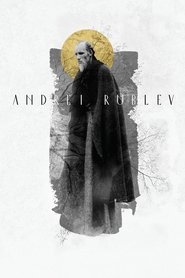
Andrei Rublev (1966)
Tarkovsky opens his film about a medieval icon painter with a man strapped to a homemade balloon, briefly airborne over a river — a maker whose making costs him everything. Watch how Vadim Yusov's camera handles catastrophe: extremely long takes that refuse to cut away from discomfort or to punctuate revelation with an edit. The camera tracks, pans, cranes — but it never rescues you. Rublev himself spends much of the film simply witnessing his violent century, and the film asks whether art can be made in good conscience amid historical disaster — a question it poses through duration, not dialogue.
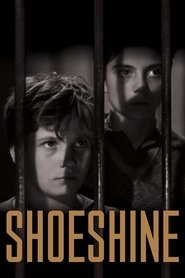
Shoeshine (1946)
The founding neorealist move: shoot in the actual war-scarred streets of Rome, with real crowds and black markets, and watch two shoeshine boys pool their earnings toward a single gleaming white horse. Notice how the film sets up the classic loop — want the thing, act, get the thing — and then very quietly refuses to let it close, as the boys are swept into an adult swindle they can neither understand nor fight. The drama isn't that they lose a battle; it's that no battle is available to them. This is where the "child's-eye" film begins: catastrophe registered on an uncomprehending young face.
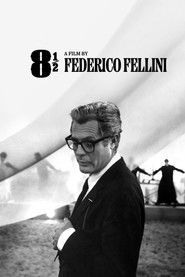
8½ (1963)
Fellini removes the seam between the world and the head. Ordinarily a film warns you when it slips into memory or fantasy — a dissolve, a change of texture. Here, Gianni Di Venanzo shoots present, memory, and daydream on one continuous silver, and Leo Catozzo cuts between them with the same hard, matter-of-fact join he'd use between two rooms of the same house. Watch for the moments you realize — a beat too late — that you've crossed over. A blocked film director wanders a spa unable to commit to his film, his wife, or any version of himself, and the film makes his indecision into its very architecture.
Red Desert (1964)
Antonioni had the grass painted grey — actually painted, by hand — so nothing along the refinery road could look alive. The whole landscape of industrial Ravenna is authored to match the inside of one woman's head. Monica Vitti plays Giuliana not as numb but as flooded: registering steam, sound, the throb of engines, unable to convert any of it into action. Watch what Carlo Di Palma's telephoto lenses do to space — and notice that her anxiety is presented not as pathology but as an accurate response to a world that genuinely doesn't fit human nerves.

Salò, or the 120 Days of Sodom (1976)
Approach with care — this is the most demanding film here — but notice its method: Tonino Delli Colli lights the fascist libertines' rationalist villa cool and even, like an official document, and Pasolini frames atrocity in measured medium and wide shots, replacing narrative with a graded descent structured on Dante's circles. The most chilling image is a man at a window with opera glasses: the film is finally about watching, and about the civilized distances people arrange between themselves and what they permit. Power, here, is appetite given chairs to sit in.
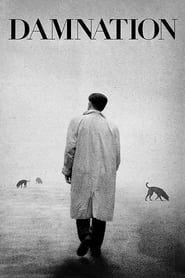
Damnation (1988)
The founding statement of Béla Tarr's long-take style opens on coal-conveyor buckets crawling across a ruined grey sky — then the camera reverses to find a man at his window, watching the same buckets we were. Rain falls almost cosmologically; everything — buildings, machines, relationships — seems to be returning to mud. Watch how the long takes convert emptiness itself into the subject. This is where "slow cinema" gets one of its cornerstones: a film in which the buckets move and the man stays at the glass.
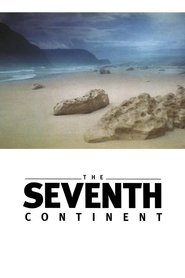
The Seventh Continent (1989)
You can watch Haneke's first feature for a long stretch before noticing you haven't seen a full face. The camera looks at hands, a faucet, a cereal bowl, banknotes at a teller's window, a car passing through a car wash — the world as an inventory of objects and transactions. A comfortable Austrian family's routine is rendered with such clinical fragmentation that affluence itself starts to feel like a sealed box. Watch what the film withholds, and how that withholding builds dread out of breakfast.
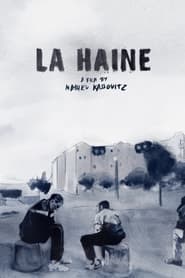
La Haine (1995)
Twenty-four hours, clocked off in inter-titles like a countdown, in the life of three friends from the Paris estates while a fourth lies in hospital after a police beating. Pierre Aïm's black-and-white photography makes the concrete towers monumental and harsh at once. The film opens with a joke about a man falling past windows — "so far, so good" — and everything happens in that suspended interval. Watch how the boys see everything and can change nothing, and how a gun circulates through the story like violence the system generated and keeps recirculating.
Funny Games (1997)
Haneke's adversarial home-invasion film denies you every pleasure the genre exists to provide: no chiaroscuro, no shock cuts, everything terrible happening offscreen. Watch for the shot that holds on an ordinary living room — a TV burbling, nothing advancing — far past the point of comfort, into a duration that feels like an accusation. The film's real subject is you, the viewer of screen violence, and the question of what exactly you came here hoping to see. It's built as a direct rebuttal to the siege thrillers it resembles.
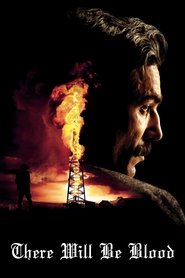
There Will Be Blood (2007)
Fifteen nearly wordless minutes open the film: a prospector alone in the desert, breaking his leg in a hole he dug himself, hauling his body across rock. We learn Daniel Plainview the way you learn an animal — by watching what it does to survive. Watch how Anderson keeps the social surface (leases, handshakes, church socials) and something older and feral in the same frame at once: the American epic of the self-made man, with the myth peeled back to raw appetite. Oilman and preacher emerge as doubles — two confidence systems competing for the same territory.

You Were Never Really Here (2017)
On paper this is the vigilante thriller — a damaged man, a rotten city, a rescue. Ramsay keeps the engine's shape and quietly pulls its spark plugs. Fragments flare up — a child's hand at a grate, a soldier's feet in dust — and you keep waiting for them to assemble into the explanatory backstory the genre owes you. They never do; they arrive the way a smell arrives. Watch how Thomas Townend's camera works in extremes — hands and eyes in enormous close-up, figures lost in wide shots — and how violence is rendered through aftermath rather than spectacle.
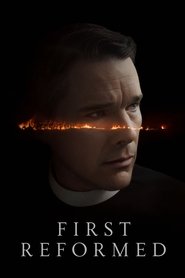
First Reformed (2018)
A pastor of a historic church writes by hand in a journal he has sworn to burn in a year, and Alexander Dynan's camera holds him head-on and does not move. Stillness is the rule here, so rigorously kept that when the camera finally does move, it lands like an event. Watch the long counseling scene between the pastor and a despairing young environmentalist: two figures in a fixed frame, the film trusting the conversation to carry everything. Schrader distills a whole European tradition of clerical-doubt cinema into an American present of ecological dread — despair and grace, and the narrow distance between them.
Watched together, these films train a muscle most movies let atrophy. Because none of them will hurry you to the next event, you start doing the work the characters do: looking harder, holding longer, noticing the faucet, the grass, the frame's edge. You'll see the lineages emerge — Bresson's hands passing into Ramsay's, Antonioni's empty spaces into Tarr's rain, neorealism's streets into Haneke's sealed rooms, Tarkovsky's patience into Schrader's stillness. And you'll discover the paradox at the heart of this whole tradition: films about people who cannot act turn out to be the most active viewing experiences in cinema. When the movie refuses to look away, neither can you — and what you see, in that refusal, is the point.