Sightlines · a mini film course
There's an old promise most movies make: a person sees trouble, does something about it, and the world changes. The films on this list quietly break that promise — and become extraordinary in the breaking. Here, characters see everything and can fix almost nothing. Neighborhoods, economies, families, and towns press in like weather. So these filmmakers turn the camera toward what's left: the body that endures, the posture that reveals, the wait that stretches. The camera watches rather than chases. Violence, when it comes, is refused its usual spotlight. What emerges instead is a cinema of throats swallowing, hands dancing in gutted rooms, chalk lines standing in for walls — small physical facts asked to carry everything. Watch these twelve together and you'll start seeing how a filmmaker's choices — where the camera stands, what it lingers on, what it declines to dramatize — become the argument itself.
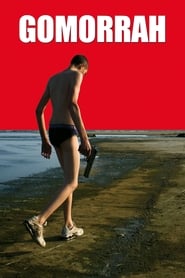
Gomorrah (2008)
Notice how Marco Onorato's handheld camera keeps its distance even in violent moments — no swelling music, no slow motion, no cut that grants a death its drama. Garrone treats violence the way the concrete housing projects treat it: as weather. Watch also the two teenagers imitating Scarface in the surf; Garrone stages their Hollywood fantasy precisely to puncture it. The film's five braided stories, descended from Rossellini's Paisan, refuse a single hero — because in this world, the system is the protagonist.

Dancer in the Dark (2000)
The great Robby Müller shoots the everyday scenes deliberately ugly — jittery, washed-out, snap-zooming — so that when factory noise suddenly finds a beat and the grey floor becomes a stage, the switch hits like oxygen. Listen for it: the stamp of a press becoming rhythm. Von Trier casts Catherine Deneuve specifically to summon your memory of the candy-colored French musical, then inverts it. This is a musical built to ask what songs are for when the world won't sing back.

I Am Cuba (1964)
Watch the rooftop party shot: the camera drifts past bathers, descends, and slides under the water of the swimming pool without a cut — a seeing that belongs to no body and obeys no gravity. Cinematographer Sergei Urusevsky rigged custom pulleys and waterproof housings by hand, a decade before the Steadicam existed. This is the camera as free-floating participant in the tradition of Man with a Movie Camera, and it's the reason the film was canonized. Let the images wash over you like the currents they imitate.
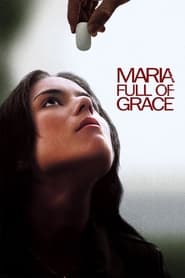
Maria Full of Grace (2004)
Watch her throat. Marston takes the most action-hungry genre there is — the drug-trafficking film — and drains the action out until only a body carrying its cargo remains. Jim Denault's camera stays close to faces in tight rooms: greenhouse rows, an airplane cabin, a fluorescent customs hold. Smuggling is filmed as labor, in the tradition of the Dardenne brothers, and the suspense comes not from plot but from muscular endurance — swallowing, sitting still, staying quiet.
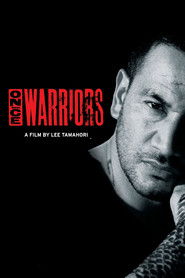
Once Were Warriors (1994)
The opening image is the whole film in ten seconds: postcard mountains that turn out to be a billboard bolted above a roaring motorway. Everything lives in the gap between painted paradise and the concrete beneath it. Stuart Dryburgh — fresh off the lyrical Piano — shoots the pubs and parties in glowing amber and neon, and Temuera Morrison channels Brando's Stanley Kowalski: magnetic and terrifying in the same breath. Watch for a warrior energy with no battlefield left, pressing up through kitchens and living rooms.
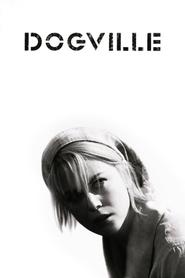
Dogville (2003)
A woman knocks on air; we hear the latch click without a door. Von Trier strips the town to chalk outlines and hand-lettered labels on a black floor — borrowed from Thornton Wilder's bare stage — so every image becomes something you must actively read. The genius is the tension: Anthony Dod Mantle's restless handheld camera hunts among the actors, refusing the composed stillness the theatrical set invites. With the world subtracted, gesture and posture carry everything. You can't hide behind the furniture, because there isn't any.
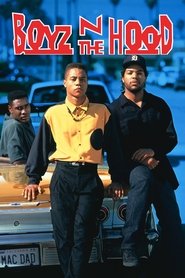
Boyz n the Hood (1991)
Listen for the helicopter — its rotor drones under barbecues, porch talk, everything. In Singleton's South Central the sky itself is policed. Charles Mills's camera is steady and legible, lending weight to ordinary domestic moments and refusing to turn violence into spectacle; warm sunlight for daytime blocks, dread for night. Watch how bodies are framed inside the architecture of the neighborhood — yards, fences, corners — until the geography becomes a character pressing down on the people inside it.

Moonlight (2016)
Start with the water: a man holds a boy afloat in the ocean, and the camera stays, and stays, until the holding is the meaning. Jenkins takes the 1990s hood film's raw material — the drug corner, the addicted parent — and removes its motor, replacing spectacle with quiet. James Laxton's Steadicam orbits bodies rather than cutting between them, and the film's yearning color and withheld touch come straight from Wong Kar-wai. Time is allowed to pool. Watch what faces do when nothing is being decided.
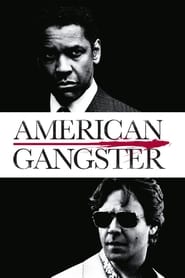
American Gangster (2007)
Read the whole film through the wardrobe. Frank Lucas dresses in grey, forgettable suits — invisibility as business principle — until a chinchilla coat at a prizefight changes everything, and Scott stages the moment not as a fall but as a clerical error. Harris Savides builds the film on a chromatic opposition: the amber warmth of Lucas's world against the institutional grey of the detective's. Notice how posture and costume expose the whole system — the Thanksgiving table, crime rendered domestic, the gangster as patriarch.

Fish Tank (2009)
The boxy, nearly square frame is the governing decision: Robbie Ryan crops the wide world away, sealing fifteen-year-old Mia inside tall, narrow compositions — the fish tank of the title. And watch the dancing. Mia has no words for her situation and no moves that will change it, so her body keeps trying to say what she can't: alone in a gutted flat, drilling eight counts into concrete. Arnold trusts dance over dialogue, and the camera trails Mia with the moral patience of the Dardennes — close, unjudging, never cutting away.

Amores Perros (2000)
Iñárritu shot on 16mm and blew it up to 35, so the image arrives already roughed up — grain forward, contrast crushed. The texture is the argument: a refusal to look at Mexico City from a clean distance. Three stories, borrowed structurally from Altman's Short Cuts, meet at a single car crash — but watch how the film declines to let the collision pay off as connection. Rodrigo Prieto's body-close handheld camera keeps the frame in a state of arrested decision, as if always about to bolt.
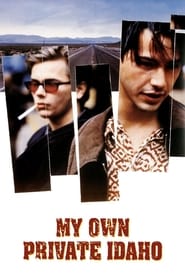
My Own Private Idaho (1991)
A man looks down a dead-straight highway, says it looks like a face he knows, and his knees buckle. Mike's narcolepsy is the film's engine: when sleep takes him, the film goes under too — hard cuts to time-lapse clouds, a barn falling from the sky. Van Sant holds documentary grain and painterly Idaho vistas in the same movie, and grafts Shakespeare's Henry IV onto street hustlers via Welles's Chimes at Midnight. Watch the campfire scene: a confession of love where nothing is done, only felt — and it's the most powerful scene in the film.
Why watch these together? Because they teach you a different way of looking. Once Gomorrah has shown you violence filmed as weather, you'll feel what Singleton's helicopter is doing to a barbecue. Once you've watched Maria's throat, you'll understand why Arnold films Mia's dancing and Jenkins films a boy floating. These twelve films — from Havana rooftops to Essex estates, from chalk-line towns to Idaho highways — share a conviction: when characters can't act their way out, the filmmaker's attention becomes the drama. The camera stops chasing and starts witnessing. Your attention, in turn, is what completes the circuit. Bring it, and these films give back more than most thrillers ever promise.