Sightlines · a mini film course
The Distance Between Two People: Love at Arm's Length
There is a kind of love story that runs on kisses withheld rather than kisses given — where the drama isn't will they act? but what does it look like to feel everything and do almost nothing? The twelve films in this set, made across seventy years and five countries, share that sensibility. In each of them, the camera watches rather than chases. Rooms, corridors, deserts, and mirrors become the true co-stars: spaces that hold people apart, or hold them in place, while feeling accumulates like weather. Watch for how these filmmakers make looking itself the event — how a held shot, a slowed second, or a cut that skips over the crucial moment can carry more charge than any embrace.
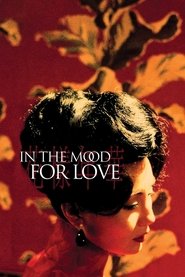
In the Mood for Love (2000)
Watch the stairwell. A woman descends for noodles, a string waltz in three-quarter time comes in, and the image drops to a quarter of its speed — the same narrow passage, different dresses, different hours of the night. Nothing "happens," and that is precisely the event. Wong builds the film out of thresholds — corridors, doorways, stairs — borrowed from a grammar of blocked desire going back to Spring in a Small Town and Ophüls's circling camera, and lets two people who understand their situation completely simply watch and endure where another film would supply action. Notice how a plot you could summarize in one sentence feels bottomless.
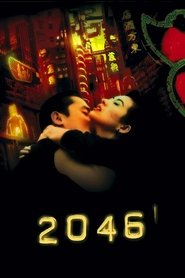
2046 (2004)
This is a film about lag — the beat of delay between feeling something and being able to say it. Watch the step-printing: individual frames printed two or three times, so a single second of hesitation swells into something you can almost climb inside. And watch the two worlds — the amber hotel corridors of 1960s Hong Kong and the cold blue train of a science-fiction serial — which aren't neatly divided into "real" and "imagined." They're two faces of one turning stone, and the slatted partitions and reflections keep you deliciously unsure which side you're on.
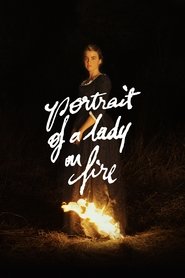
Portrait of a Lady on Fire (2019)
Here, looking goes both ways — and that reversal reorganizes the whole film. A painter studies her subject in stolen glances; then the subject climbs onto the stool and turns her eyes directly back. Claire Mathon's camera repeatedly frames people in the act of looking, held long enough that you feel yourself watching someone watch. In the lineage of Dreyer's unblinking close-ups and Akerman's patient long takes, Sciamma makes the gaze a circuit rather than a one-way authority. Watch for the moment you realize the model has been studying the painter all along.
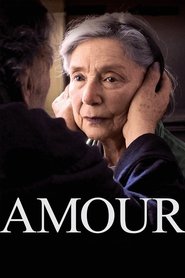
Amour (2012)
The camera faces the wrong way. At a concert early on, Haneke films the audience instead of the stage — and in hunting for the two protagonists in that crowd, you've already accepted the film's only assignment: to watch. Khondji's camera is mostly static, at a respectful middle distance, and shots run long enough that a meal prepared or a body lifted happens in something close to real time. In the tradition of Tokyo Story and Umberto D., this is a portrait built from small daily gestures rather than incidents. Let the duration work on you; it's the point.

Happy Together (1997)
A cheap table lamp with a photograph of the Iguazú Falls on its shade, kept in a Buenos Aires apartment half a world from home: a destination you can hold in your hands and never reach. Watch how Christopher Doyle's wide-angle lenses constrict space until an apartment, a kitchen, a bar corridor feel like they're closing in — Wong's most claustrophobically intimate film. And notice that the protagonist's great verb is not do but wait: he watches, cleans wounds, listens at doors. Made entirely outside Hong Kong in the year before the handover, its very displacement is part of its meaning.

The Grandmaster (2013)
Rain, and a man in a hat. Wong shoots the opening street fight the way you'd remember it rather than the way it happened: a droplet hangs, a hatbrim sheds a thread of water before the blow lands. Where a conventional kung-fu film runs on challenge-fight-win, Wong's fights resolve nothing — the world slows until combat becomes something held and beheld, all snapping cloth and steam and wet stone. Philippe Le Sourd's dense, textured lamplit images turn action into elegy, scored to the same waltzing melancholy Wong carried over from his earlier films.
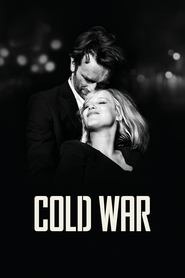
Cold War (2018)
A scene ends. Black. When the picture returns, a year has passed, a border has been crossed, and the lovers are older and more damaged — and you were never shown the leaving. Eighty-eight minutes covers fifteen years, Warsaw to Berlin to Paris, and every rupture happens in the dark between two shots. Watch what Łukasz Żal's frame does too: figures placed low in a tall black-and-white frame beneath looming skies and ceilings, dwarfed by the architecture of their era. And listen to the folk song that keeps returning, re-orchestrated each time — a melody carrying the whole history of the film on its back, as in The Umbrellas of Cherbourg.
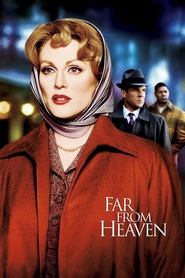
Far from Heaven (2002)
Haynes didn't set this in the 1950s — he set it inside a 1950s film. He and Edward Lachman meticulously rebuilt the look of Douglas Sirk's Technicolor melodramas — unmotivated lavenders and teals, colored light through windows, an autumn-to-snow palette ticking off an emotional calendar — using modern equipment, since the original dye process no longer exists. Watch the light: it's too warm and too orange to be real, and that faint seam is the subject. The film uses a vanished visual language to express feelings the original movies weren't allowed to have.
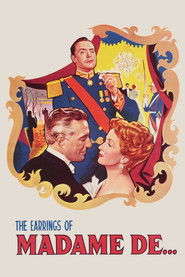
The Earrings of Madame de... (1953)
We meet her not as a face but as a reflection: a woman at her mirror, appraising the surface she has been taught to be, while the camera glides with her through the glass. Christian Matras's camera is in nearly perpetual, purposeful motion — following characters through doorways, around corners, across ballrooms — as a pair of earrings begins circulating through a closed, mirror-lined world. Watch how performance and genuine feeling slowly fuse until they can't be told apart, and how a small lie sets an enormous machinery spinning.
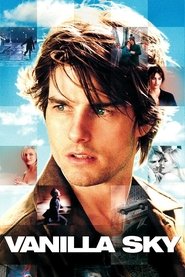
Vanilla Sky (2001)
A man wakes and finds Times Square scrubbed of every other human being — and Crowe shows you this gorgeous, depopulated image before telling you anything is wrong. That's the trick in miniature: the picture is too beautiful to trust. John Toll's lush, high-gloss photography isn't decoration; the excessive surface beauty is itself a clue. Part of a turn-of-the-millennium wave of reality-bending puzzle films, and adapted from Amenábar's Spanish original, it asks you to stay alert to glitches, seams, and the fissures in a perfect surface. Say no more.
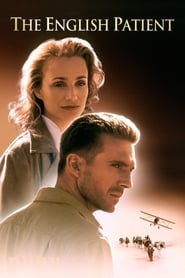
The English Patient (1996)
A biplane crosses the Sahara, and the dunes below are not quite dunes — the wind has worked them into a hip, the furrow of a back, a sheet pulled to one shoulder. John Seale lit sand and skin so they would rhyme, and the film never lets the rhyme go. Its present tense belongs to a man who can barely move or speak, for whom all that remains is memory; small sounds — a dressing changed, wind in stone rooms, a remembered engine — open doors into time rather than advancing plot. It inherits Lean's desert grammar and Welles's fragmentary, retrospective architecture, reconstructing a life from pieces.
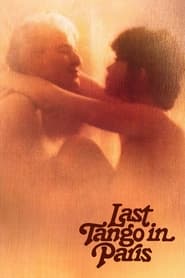
Last Tango in Paris (1972)
Start with the room: an unfurnished Paris flat the color of a bruise — amber, ochre, old varnish — its palette lifted straight from two Francis Bacon canvases that hang over the opening credits like an instruction. Two strangers agree to meet there and, as a condition of meeting, exchange no names. Watch how Bertolucci strips the space of furniture, history, and biography so the relationship can exist outside society entirely — a cell, not a home, full of warm light and yet deprived. The scandal was never really the sex; it's that the room declines to mean anything at all.
Why watch these together? Because they teach each other. Wong's slowed stairwell and Sciamma's held gaze train you to read Haneke's static rooms; Ophüls's gliding mirrors prepare you for Wong's turning crystal of hotel and train; Pawlikowski's cuts-in-the-dark sharpen your eye for what every one of these films leaves offscreen. Together they map the full range of a single conviction: that the most powerful thing a camera can do with love is not dramatize it but witness it — in a corridor, across a fence, through a mirror, over a stretch of lawn no one is allowed to cross. Watch slowly. These films reward the same patient attention their characters give one another.