Sightlines · a mini film course
The Cinema of Watching: When Looking Becomes the Event
Most movies are engines. Someone wants something, acts to get it, and the story hurtles forward on that motion. The twelve films on your list run on a different fuel entirely. Their protagonists — a pastor at a bare desk, a wife walking through Milan, a postman arranging drunks into a solar system — see their worlds with almost unbearable clarity, and can do very little about any of it. So these films slow down, hold their shots, and let time itself become the drama. The camera watches rather than chases. Waiting becomes the story. A potato cooling on a plate, a candle guarded against a draft, grain bending in wind: these become events, if you let them. This is a cinema that trains your eye before it tells you anything — and once trained, you'll never watch the other kind of movie quite the same way.
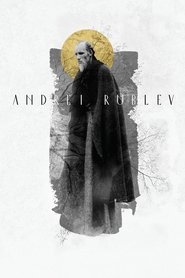
Andrei Rublev (1966)
Tarkovsky opens his film about a medieval icon painter with a man strapped to a crude balloon, and the camera refuses to cut away from what happens next. That refusal is the film's whole method: extremely long takes that won't punctuate revelation with an edit or spare you discomfort. Watch how the painter himself spends most of three-plus hours not painting but witnessing — and notice how the film quietly turns that witnessing into its central question: what does it cost to make art in a catastrophic time?
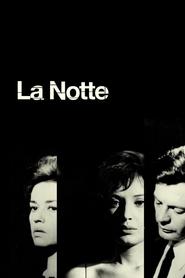
La Notte (1961)
Watch what holds the center of the frame. Antonioni and cinematographer Di Venanzo photograph Milan's glass towers and half-built walls as active presences, while the human beings — a celebrated novelist with nothing left to say, the wife who loves him — drift to the edges, small and almost incidental. Follow Lidia's long walk through the city and resist the urge to ask where it's going. The walk is the destination; the buildings are doing the talking.
Red Desert (1964)
Antonioni had the grass painted gray — by hand, along a refinery road, so nothing growing could look alive. The entire industrial landscape of Ravenna is authored to match the inside of Giuliana's head, and Monica Vitti plays her not as numb but as flooded: a face in constant micro-attention, registering steam, engine-throb, color, unable to convert any of it into action. Watch the film as a portrait of a nervous system, painted in chemicals and fog.
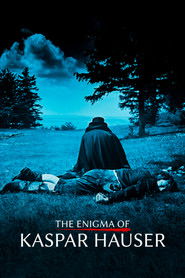
The Enigma of Kaspar Hauser (1974)
Before anyone speaks, Herzog holds on a field of wheat swaying in wind — long enough that you stop waiting for the story and simply look. That's the instruction for the whole film: Kaspar arrives in Nuremberg without language, and Herzog films the world the way it must appear to someone for whom nothing yet means anything. Watch how the townspeople keep trying to sort Kaspar into usefulness — walking, speaking, table manners — and ask whether what he's being given is freedom or a new kind of enclosure.
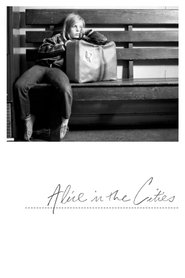
Alice in the Cities (1974)
Watch the Polaroids. Philip Winter, a journalist who can't write, keeps shooting instant photos of America and complaining that they never show what he actually saw — a glove compartment full of images that arrive already orphaned from meaning. Robby Müller's black-and-white photography (the start of one of the great director-cinematographer partnerships) turns the American road movie inside out: slower, emptier, tender rather than violent, more interested in motel TVs and highway strips than in destinations.
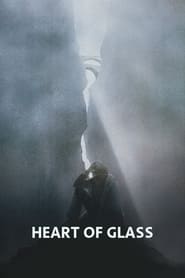
Heart of Glass (1976)
Herzog put nearly his entire cast under clinical hypnosis and filmed them in trance — making this less a story performed than an event that happened to its actors. Watch how the villagers occupy a room: bodies present, persons somewhere behind them, never cheating toward the lens. The premise is a village whose glassworks foreman dies with the secret of its ruby glass, leaving a hole where a piece of shared knowledge used to be — and the one warm color in a world of grey, brown, and mist is that arterial red glow.
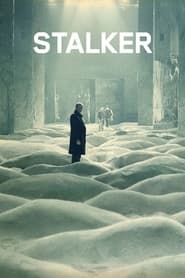
Stalker (1979)
Three men risk prison to enter a forbidden Zone — and then, mostly, they stop. They sit in wet grass, argue, lie down. Tarkovsky keeps the genre's premise and evacuates all its usual pleasures, replacing spectacle with tracking shots that glide through flooded corridors at the pace of geological time. Watch especially for the shot where the camera lies down in shallow water and drifts over submerged objects: it refuses to become a clue or a symbol, and the looking itself becomes the film's substance.
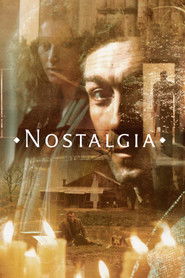
Nostalgia (1983)
A Russian poet in Italy, unable to work, unable to love, unable to go home: Tarkovsky's film about exile treats homesickness not as sentiment but as a condition of the soul. Watch the famous sequence in a drained thermal pool — one shot, nine minutes, a man trying to carry a small flame across it while the steam keeps snuffing it out. Real precariousness, not a simulation of it. Nothing is "happening"; everything is at stake.
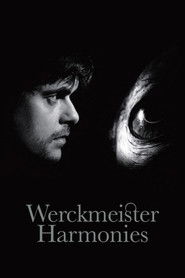
Werckmeister Harmonies (2001)
The opening take runs close to ten minutes: at last call, the gentle postman Valuska arranges drunken men into a working model of a solar eclipse — you be the sun, you the earth — and sets them orbiting across a sticky bar floor until the light goes out. That's the whole film in miniature: bodies set in motion, time allowed to pass, meaning arriving through movement rather than plot. Watch Lars Rudolph's face — transparent, unguarded — as a surface on which events register rather than a mind that schemes.
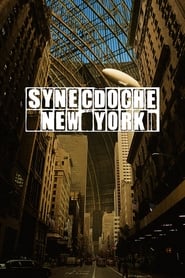
Synecdoche, New York (2008)
Watch how calmly the impossible is filmed. A woman buys a house that is actively on fire and simply lives in it; nobody flags this as strange, and cinematographer Frederick Elmes (who shot Eraserhead) gives the uncanny the same autumnal naturalism he'd give a kitchen sink. A theater director rents a warehouse and builds a full-scale replica of New York and of his own life, hiring an actor to play himself — then an actor to play that actor — and watch how the model stops representing the life and starts absorbing it.
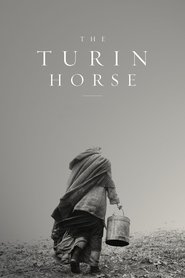
The Turin Horse (2011)
Watch them eat the potato. A father tears at it fast and angry with his one good hand; his daughter eats hers slowly; nothing is explained, and the camera holds. Tarr and cinematographer Fred Kelemen build the film from long black-and-white takes across a six-day structure, so that you don't receive information about a world running down — you inhabit it, feeling the wind, the well, the failing lamp in your own body as duration. The waiting is the film.
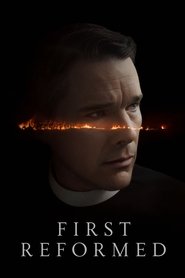
First Reformed (2018)
Schrader brings this whole European tradition home to America. Alexander Dynan's camera is locked-off, frontal, almost liturgical in its symmetry — which means that when it finally moves, the movement lands like an event. Watch the long counseling conversation between the pastor and a despairing young activist: two figures held in a fixed frame, no cutting away for reactions, the stillness forcing you to weigh every word. The film teaches you a posture before it shows you a single act: sit still, look, endure.
Watch these together and something cumulative happens. You'll notice the same DNA passing between them — Tarkovsky's flooded corridors flowing into Tarr's windswept plain, Bresson's blank-faced grace behind Herzog's entranced villagers and Schrader's journaling pastor, Antonioni's expressive architecture echoing in Wenders's motel rooms. But the deeper reward is what the films do to your attention. Each one asks you to stop waiting for the story to start and discover that it already has — in a held shot, a cooling potato, a gray-painted weed. These are films about people who can only watch, made for viewers willing to do the same. Give them your patience, and they'll return it as something rarer: the feeling of time passing through you, made visible.