Sightlines · a mini film course
When Action Fails: War Films About Watching, Waiting, and Enduring
The war film is supposed to be cinema's most muscular genre: see the threat, take the hill, turn the battle. But the twelve films on this list — spanning eight decades and half a dozen national cinemas — keep discovering something stranger. Again and again they build the classic war-movie engine and then let it stall, misfire, or run on empty. A man frozen at a periscope. A boy jolted between dream and mission. A pianist at a window above a burning city. Orders issued to armies that no longer exist. These are films about the gap between doing and seeing — about what fills the screen when characters can't act, and about how the camera itself must choose between chasing the action and simply bearing witness. Watch them together and you'll see the genre argue with itself, gorgeously, across generations.

Rome, Open City (1945)
Start here, at the hinge. Rossellini shot in the actual streets of newly liberated Rome, with off-center framings and refocusings that feel like discovery rather than design — as if the camera is finding the story in real time. Watch for the moment the film breaks its own rules: a death that arrives without warning, without the story's permission, midway through. Movies made after this one had to reckon with what it proved — that the world can simply refuse a character's action, and the film can keep going.
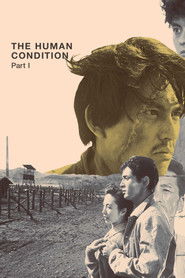
The Human Condition I: No Greater Love (1959)
Kobayashi gives you a decent man handed exactly what he asked for — a chance to run a Manchurian labor camp humanely — and then lets the widescreen frame quietly disagree with him. Watch Yoshio Miyajima's compositions: fence lines, watchtowers, rows of laborers organizing the enormous image into grids of confinement. The frame is always too wide for one man to fill, and that visual fact does the film's moral arguing before anyone speaks. Notice how social pressure is built into the depth of the shot itself — foreground and background bearing down together.
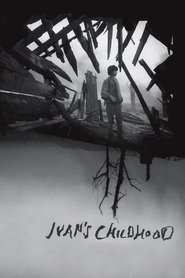
Ivan's Childhood (1962)
Tarkovsky's first feature is built across a fault line, and he wants you to feel the seam. The war scenes are all forward motion — deep-focus night photography, low angles pressing a small boy against vast threatening skies, river crossings rowed in near-silence. The dreams are shot in a diametrically opposite register: light through birch leaves, water, a mother's face. Watch how he cuts between the two worlds — flat, hard, no dissolve, no consoling music. The dreams explain nothing about the plot; they exist to show you everything the war has stolen.
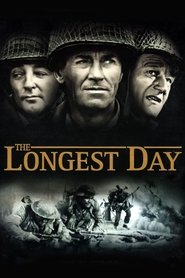
The Longest Day (1962)
The counterexample, and the reason to include it: this is the war film's classic engine running at full power, an all-star ensemble in which men decide and then act, across a hundred coordinated fronts. The Oscar-winning black-and-white CinemaScope photography favors deep, populated frames — masses of men and machines — echoing combat photojournalism. But watch for one image: a paratrooper snagged on a church steeple, deafened by the bells, forced to hang there and only look while the battle proceeds without him. He's the exception that names the rule — and the crack the rest of this list climbs through.
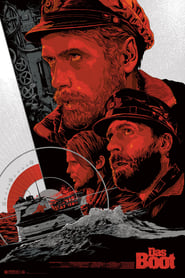
Das Boot (1981)
Petersen mounted the most expensive German film of its day and built it around men who cannot move. Watch what happens during "silent running": engines dead, a sonar ping crawling along the hull, every face tilted up at a sound. Stillness becomes the only available action — which is to say, no action at all. Jost Vacano's camera squeezes through the boat in available-feeling low light — sickly instrument-panel green, amber bunk gloom — so the submarine reads as a lived-in machine, not a lit set. Listen as much as you watch; the film's terror is largely acoustic.
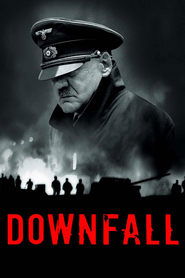
Downfall (2004)
The whole film lives in one gap: in the map room, a hand moves and armies move with it — except the armies aren't there. Hirschbiegel stages the machinery of command grinding on in a vacuum, orders issued to phantoms, generals reporting wishes instead of facts. Watch Rainer Klausmann's handheld camera stay punishingly close to faces, trapping characters in shallow focus and narrow corridors — a technique Hirschbiegel developed in Das Experiment and that owes a debt to Come and See's refusal to let the lens pull back. Proximity becomes the film's argument: ideology examined at skin distance.
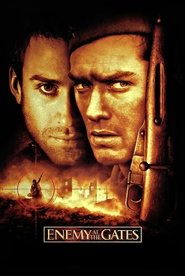
Enemy at the Gates (2001)
A war movie whose central act is holding still. Two snipers lie in rubble for hours, each waiting for the other to move first; the film's engine is the wait, not the shot. Watch how Robert Fraisse's camera keeps returning to a man whose entire being has narrowed to an eye at a lens — a film obsessed with looking at looking. The opening river-crossing assault, all handheld chaos in steel blues and ash grays, shows the Saving Private Ryan influence; but also notice the pressure from behind as well as ahead — a story of individuals caught between the enemy in front and their own state at their backs, and of how heroes are manufactured for morale.
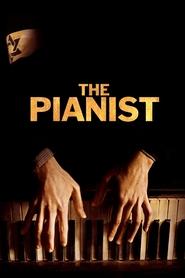
The Pianist (2002)
Start with the windows. Polanski organizes the entire film around a body in a dark room, looking down at a street it cannot enter — a survivor whose true vocation is witness. Watch how Paweł Edelman's steady, observing camera and cool ash-gray palette refuse both nostalgia and melodrama; the framing stays clean and legible even as the world outside decomposes. And notice how Polanski imports the architecture of his apartment thrillers — Repulsion, Rosemary's Baby, The Tenant — into history: the room as trap, the watcher at the window, survival as something that happens to a person rather than something he does.
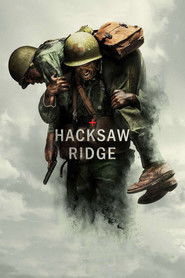
Hacksaw Ridge (2016)
Gibson builds the most classical war-movie machine imaginable — a massive situation bearing down until men act — and then plants something inside it the machine can't digest: an unarmed medic whose decisive act is a rope, a prayer, and the next body. Watch the film's clean visual split: golden pastoral light in the Virginia half, then a register of concussive chaos on the ridge, with sound design (in the lineage of Come and See) doing the psychological damage. The structure descends from Sergeant York — moral formation first, combat second — but the question is fresher: what does an institution do with a conscience it cannot accommodate?
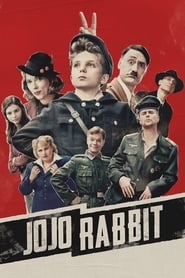
Jojo Rabbit (2019)
Waititi's gambit descends from Chaplin and Lubitsch: shrink the tyrant into a buffoon. But watch how the film builds its imaginary Hitler — out of posters, radio, playground rumor, and a fatherless boy's ache — so that fascism appears not as an argument but as an imaginary friend. Mihai Mălaimare Jr. shoots the boy's world in bright, symmetrical, picture-book frames, orderly as a toy set; notice the very first cut, archival rally footage laid over the Beatles, indoctrination presented as fandom. The comedy is the delivery system; the subject is how an interior voice gets manufactured in a child.
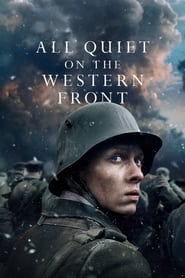
All Quiet on the Western Front (2022)
Watch the opening minutes closely: after a soldier dies in a charge, the film follows his coat — stripped, laundered, stitched, folded, and reissued to a boy still excited to wear it. No music; observational cuts; the rhythm of inventory. Before a word of disillusionment is spoken, Berger has shown you the whole war as a machine that consumes bodies and recycles the packaging. This is also the first German-language adaptation of Remarque's novel — a correction of a long historical absence — and watch for the cross-cutting between comfortable rooms where the war is administered and the mud where it is paid for, a structure borrowed from Paths of Glory.
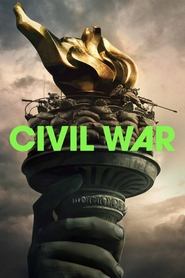
Civil War (2024)
Garland ends the course by making the whole question literal: his protagonists are photographers, people whose job is to stand inside violence and take pictures rather than act. Watch your own body the first time the film freezes — a firefight in motion, then one still, perfectly composed, and the click of a shutter before motion resumes. Rob Hardy's camera behaves like a fifth member of the press team, handheld and sometimes caught flat-footed by violence erupting at the frame's edge. The film's real subject is the cost of the click: what documentation does to the person holding the camera, and to us.
Watch these together and something remarkable happens: the films start annotating each other. The Longest Day's steeple-hung paratrooper becomes Szpilman at his window becomes Garland's photographers, frozen mid-battle by choice. The map room in Downfall and the laundered uniform in All Quiet are the same image at different scales — systems grinding on after meaning has left them. And the formal choices rhyme across decades: Kobayashi's imprisoning widescreen grids, Vacano's claustrophobic corridors, Edelman's patient window-frames — again and again, space becomes a trap and the camera learns to watch rather than chase. This is a course in what the war film does when heroic action stops being an honest answer, and every one of these films finds a different, indelible way to keep looking anyway.