Sightlines · a mini film course
Watching Is Not the Same as Doing: A Course in the American Thriller's Beautiful Stall
Here is the secret these eleven films share: they all take the most propulsive machinery American cinema ever built — the chase, the heist, the investigation, the revenge plot — and quietly ask what happens when the machine's driver can see everything and change almost nothing. These are films about watchers, listeners, readers, and recorders: people whose talent is perception in a world where perception no longer guarantees power. Notice how often the camera itself becomes one of these watchers — patient, curious, sometimes predatory — observing rather than chasing. Notice how often the real drama is played out in blocking and wardrobe and light rather than in dialogue. And notice how often the space around a character becomes the story: a corridor as a trap, an apartment as contested territory, a desert as a witness. Watch these in any order, but watch them with your eyes on the frame, not just the plot.
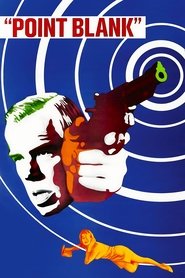
Point Blank (1967)
The strangest film here, and a good place to start. Boorman took a pulp revenge novel and shot it with the grammar of European art cinema: memories intrude mid-scene with no dissolve, no warning, no frame around them, so past and present become impossible to peel apart. Listen for the footsteps in the opening — hard, echoing, metronomic — cut against images from elsewhere so that a man's stride becomes the rhythm of both his vengeance and his memory. And watch the compositions: Lee Marvin as a small hard figure dwarfed by brutalist concrete and glass, a lone body up against an organization that deals in ledgers rather than cash.
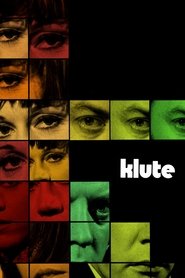
Klute (1971)
Before you see the man hunting Bree Daniels, you hear him — breathing on a tape, intimacy converted into a weapon. Gordon Willis lights her apartment so that corners and doorways hold impenetrable shadow; the frame itself feels like it's watching her. The detective's name is on the title, but pay attention to where your investment actually goes: the mystery machinery works fine, yet the film's heart is the woman who can only wait inside the frame, and the question of what her guardedness costs her.
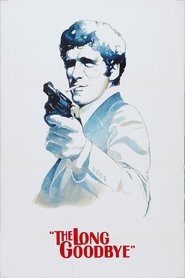
The Long Goodbye (1973)
Altman opens a murder mystery with a man trying to fool his cat with the wrong brand of cat food — and that errand is the whole film folded small. Watch the camera: it never sits still, always drifting, zooming, repositioning, like an alert but passive witness with its own curiosity, catching the margins rather than the center. Elliott Gould's Marlowe still believes effort means something; watch how the film — co-written by Leigh Brackett, who also co-wrote Bogart's The Big Sleep — systematically dismantles every guarantee that older detective picture delivered.
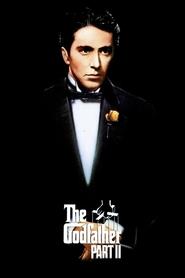
The Godfather Part II (1974)
Two timelines braided together: a young father's rise in sun-harsh Sicily and amber-shadowed tenement New York, and a son's reign in gathering darkness. Gordon Willis (him again) splits his famous low-key palette into two distinct visual registers, one for each era — watch how shadow and enclosure creep in gradually, as if the buildings themselves are closing over the family. And notice the Visconti inheritance: powerful men framed small against grand architecture. The great gamble is patience — the film lets you sit with faces long after most movies would cut away.
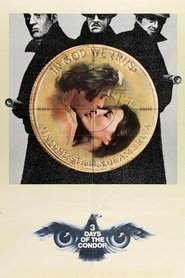
Three Days of the Condor (1975)
A junior analyst — a reader, whose whole job is noticing anomalies — steps out the back door for lunch and returns to a rearranged world. Pollack shoots Manhattan as a labyrinth: brownstone staircases, phone booths, narrow sightlines. Watch the gap between what Robert Redford's Turner can perceive (beautifully, professionally) and what he can actually do about it. Every handhold of the thriller — call your handler, trust the badge — is tested. Watch also for the assassin Joubert, built on the template of Melville's ritualistic professionals: geometry in a suit.
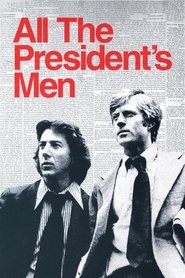
All the President's Men (1976)
Willis's "Prince of Darkness" reputation earns its keep in the parking garage — a voice, a cigarette, a face the frame refuses to hand over — set against the merciless greenish fluorescence of the newsroom, which he deliberately left uncorrected. This is a thriller made almost entirely of approach and refusal: phone calls that go nowhere, doors that open a crack and close. The heroes never confront the villain; they knock, they ask, they cross-check. Watch how the film makes the slow accumulation of knowledge feel more dangerous than any gunfight.
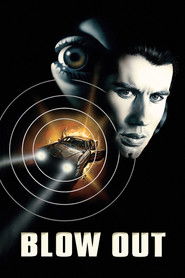
Blow Out (1981)
A movie sound man, taping wind and crickets by a creek, records something his trained ear can't file away as an accident. De Palma opens with a deliberate joke — a prowling tracking shot revealed as footage from a cheap slasher-within-the-film — announcing that this is a movie about recorded images and sounds and what they can and cannot prove. Watch Jack Terry practice his craft: syncing audio to stolen frames, building evidence piece by piece. The film's whole ache lives in the gap between what was captured and what can be proven.
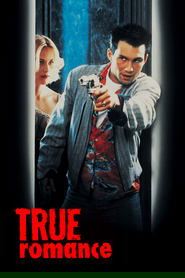
True Romance (1993)
Tony Scott shoots a lovers-on-the-run crime picture in bruised blues and molten ambers, saturated to the edge of abstraction — image as pure sensation, no apologies. Watch for Val Kilmer's Elvis in the bathroom mirror, dispensing advice with no dream-signal, no soft dissolve: shot dead literal. Clarence is a man assembled entirely out of pop culture — comic books, kung-fu films, a self built from borrowed screens, descended straight from Godard's Bogart-worshipping hero in Breathless — and the film's wager is that a love built from movies can be real anyway.
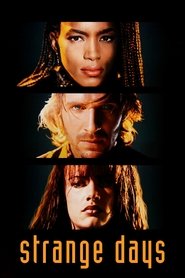
Strange Days (1995)
You don't watch the opening; you wear it — a robbery through someone else's borrowed eyes, ending where his life does. Bigelow built custom rigs to sustain two distinct kinds of image: the grimy neon noir of near-future Los Angeles, and the seamless first-person clips of the film's black-market sensory recordings. Watch how the film implicates you in every playback — it asks what it means to be hooked on someone else's experience, years before bodycams and VR made first-person vision an everyday commodity.
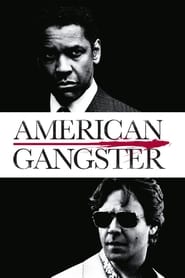
American Gangster (2007)
Watch the wardrobe like a hawk. A grey suit is the uniform of a man whose business depends on not being looked at; a chinchilla coat is the announcement of a man who has decided he needs to be seen — and the camera finds the watchers before he knows he's been watched. Savides builds the film on a chromatic argument: the amber warmth of self-made luxury against the institutional grey of the detective's world. Notice how relentlessly entrepreneurial the language is — branding, product quality, market share — the film analyzing the American Dream with the informed outsider's eye of a British director.
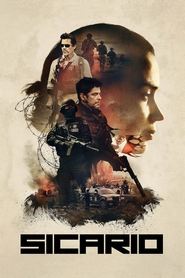
Sicario (2015)
Watch where Villeneuve keeps putting Emily Blunt's Kate Macer: in doorways, in back seats, at the edges of briefings where the real decisions happen elsewhere. Her position in the frame is the film's argument — she is the person things happen near. Deakins shoots the border landscape geologically rather than picturesquely, long lenses compressing tiny figures against featureless desert. Feel how the film keeps converting what should be action sequences into things you can only watch, dread pooling where release should be.
Why watch them together? Because seen in sequence, they form a fifty-year conversation. Willis lights three of these films; Zsigmond shoots two; the same handful of ancestors — The Big Sleep, Blow-Up, Le Samouraï, The Conversation — keep resurfacing like recurring dreams. You'll watch the detective story pass its tools down the decades: the tape recorder becomes the sensory rig, the shadowed apartment becomes the desert convoy, the private eye becomes the analyst, the journalist, the FBI agent. And you'll start to feel the deeper pattern: American genre cinema learning, film by film, that its most powerful move might not be the punch or the chase but the held gaze — the camera that watches rather than resolves, and trusts you to sit inside the tension with it. That trust is the gift. Bring your full attention, and these films will repay it in ways plot summaries never could.