Sightlines · a mini film course
When Seeing Outruns Doing: Eleven War Films About the Gap Between the Eye and the Hand
War movies are supposed to run on a simple engine: a soldier sees a problem, acts, and the world changes. Objective taken. Line held. What connects the eleven films on your list is that every one of them, in its own way, tampers with that engine — slows it, jams it, or runs it in a vacuum. Again and again you'll meet characters who can see everything and change almost nothing: the photographer who can only frame the violence, the boy sent crawling through enemy lines, the veterans riding home with nothing left to aim at. Watch these films for how the camera behaves when action stops working — when it stops chasing and starts watching, when space closes in like a trap, when time is allowed to stretch until you feel it on your skin. This is a course in the war film turned inside out.
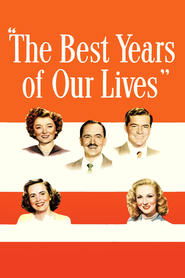
The Best Years of Our Lives (1946) — dir. William Wyler
Start here, at the source. Gregg Toland's deep-focus photography keeps foreground and background sharp at once, so a whole room can hold two dramas simultaneously — watch the famous drugstore scene, where one story plays close to the lens while another unfolds far across the store, no cutting required. The opening image is the film's thesis: three veterans riding home in the glass nose of a bomber, men trained to convert seeing into doing, now asked only to look. Everything the later films do, this one does first, quietly, in 1946.
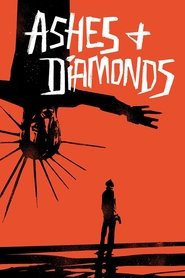
Ashes and Diamonds (1958) — dir. Andrzej Wajda
A young assassin wears dark glasses indoors, at night — the actor's own, kept because they looked right. Jerzy Wójcik's high-contrast black-and-white photography pools shadow across faces like film noir imported into history, with deep-focus staging inherited straight from Citizen Kane. Watch how the hotel becomes a compressed world, a single building holding a whole divided country over one night. The signature film of the Polish Film School, and one of the great portraits of a soldier whose war has ended before he has.
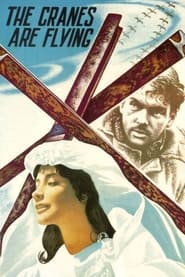
The Cranes Are Flying (1957) — dir. Mikheil Kalatozishvili
Sergei Urusevsky's camera is the star: unchained, athletic, built on custom rigs and circular tracks, spiraling up staircases and into the crowns of birch trees. This is the film that cracked open the Soviet war picture — away from monuments and toward one grieving woman on the home front. Watch for the moments when a human body falls still and the camera takes over the motion, the world itself turning where the person no longer can. Cutting here works on emotion, not plot — a direct inheritance from the 1920s Soviet avant-garde, redirected toward private feeling.
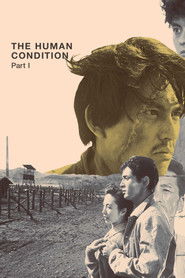
The Human Condition I: No Greater Love (1959) — dir. Masaki Kobayashi
Yoshio Miyajima's widescreen frame is so vast that a single man looks like a comma in a long, indifferent sentence — and that's the point. Watch how fence lines, watchtowers, and rows of laborers organize the wide image into grids of confinement: the labor camp composed as geometry. The first movement of a ten-hour epic about whether decency can survive inside a coercive system, it puts a man of conscience into an institution built to grind him down and simply lets the frame's scale tell you the odds.
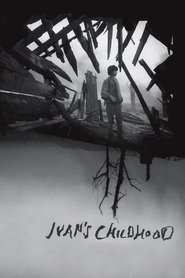
Ivan's Childhood (1962) — dir. Andrei Tarkovsky
Tarkovsky's debut is built across a fault line, and he wants you to feel the seam. The wartime scenes are deep-focus night photography — low angles pressing a small boy against vast threatening skies, horizontal bands of reeds, water, and mist. The dream scenes look like another planet: light falling through birch leaves like water. Watch the cuts between them — hard, flat, no dissolve, no consoling music. The dreams aren't flashbacks and don't explain the plot; they're the childhood the war has confiscated, kept alive only in sleep.
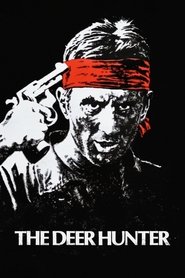
The Deer Hunter (1978) — dir. Michael Cimino
"One shot" — a hunter's creed, the whole man in two words, and the film spends three hours examining what it costs. Vilmos Zsigmond photographs the Pennsylvania steel town in burnished, smoky, golden backlight and dwarfs his hunters against monumental mountains, a frontier idiom carried over from The Searchers. Watch the rhythm between vast landscape and small human figure, and notice how much time the film spends on ritual — the wedding, the hunt, the Mass — before war ever arrives. The patience of that long first act is the design, not a flaw.
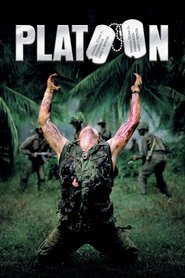
Platoon (1986) — dir. Oliver Stone
The first Stone–Richardson collaboration plants the camera inside the infantry experience: handheld, embedded among the grunts, with partial sightlines and geography that dissolves into flares and muzzle-flash. Stone called his narrator "a partly passive vessel" — a young man who sees more clearly than he can act — and the film's most reproduced image is a death watched from a helicopter lifting away, visible in full and unstoppable. Watch how confusion itself becomes the film's grammar: you're rarely shown more than a soldier on the ground could know.
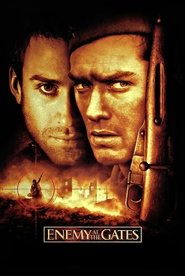
Enemy at the Gates (2001) — dir. Jean-Jacques Annaud
A war film whose central weapon is stillness. Robert Fraisse shoots the ruined city in steel blues and ash grays, punctuated by muzzle flash, and the opening river-crossing assault is pure chaos-camera in the post-Saving Private Ryan mode. But the heart of the film is two men lying motionless for hours, each waiting for the other to move first. Watch how often the camera studies a man reduced entirely to an eye at a lens — a film about looking as combat, staged on a massive, tactile, full-scale ruined-city set built the old way.
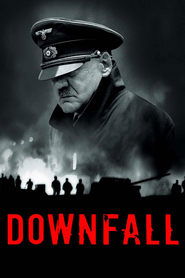
Downfall (2004) — dir. Oliver Hirschbiegel
A chamber piece in a bunker. Rainer Klausmann's handheld camera stays close to faces, trapping characters in shallow focus and narrow corridors — pressure built through proximity, a technique Hirschbiegel developed in his earlier enclosed-space work. Watch the map room: hands moving pins across a table, orders issued in measured tones, the machinery of command grinding on while the street above tells a different story. A landmark of German cinema's reckoning with its past — the first major German film willing to bring this history into the room, at close range.
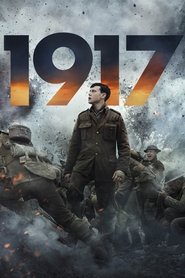
1917 (2019) — dir. Sam Mendes
The most classical structure imaginable — a message must reach the front by dawn, a race against a deadline — delivered through a radical technique: the entire film presented as one continuous, unbroken movement. Roger Deakins keeps the camera a single stride behind the running man, never catching him, never letting go. Watch for what the refusal to cut does to your nerves: normally the long take is how cinema slows down and contemplates; here it's welded to pure urgency, and the tension between the two is the whole experiment. Note also the light — overcast daylight, practical sources, a grey-green palette drawn from archival WWI photography.
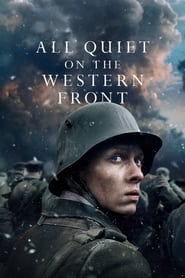
All Quiet on the Western Front (2022) — dir. Edward Berger
Watch the first ten minutes with total attention. A soldier falls in a charge — and instead of following the battle, the film follows his uniform: stripped, laundered, stitched, folded, reissued to a boy still young enough to be excited to wear it. No music. Observational cuts. The rhythm of an inventory. Before a word is spoken, you've been shown the whole war as a machine that consumes bodies and recycles the packaging. The first German-language adaptation of Remarque's novel — a historic correction, since the book was banned in Nazi Germany — and it borrows a structural trick from Paths of Glory: cutting between comfortable rooms where decisions are made and the mud where they're paid for.
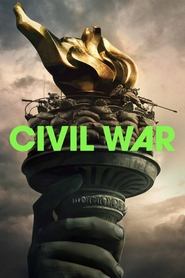
Civil War (2024) — dir. Alex Garland
The most recent film on the list, and the one that makes the whole course's question literal. Rob Hardy's camera behaves like a fifth member of a press team — handheld, searching, sometimes caught flat-footed by violence erupting at the edge of frame. Then, mid-firefight, motion stops: one still photograph, perfectly composed, a shutter click — and motion resumes. Watch your own body when it happens. This is a film about what it means to make images of suffering, whether documenting is moral seriousness or a sublimated thrill — an outsider's detached eye turned on an imagined American catastrophe.
Why watch these together? Because in sequence they teach you to see the war film's hidden subject: not combat, but witness. Wyler's veterans looking down through the bomber glass, Tarkovsky's boy dreaming of birches, Annaud's sniper frozen at his scope, Garland's photographer freezing the world with a click — they're all versions of the same figure, the person for whom seeing and doing have come apart. Once you notice it, you'll see how each film stages that gap differently: through depth of frame, through the camera's freedom or confinement, through stillness, through the refusal to cut. Watch them in any order, but watch them for how they watch — and by the end, the click of a shutter, the width of a frame, and the length of a shot will all feel like moral decisions. Which, in these films, they are.