Sightlines · a mini film course
The Camera That Watches: Faith, Doubt, and the Art of Holding Still
Most movies are engines of doing: someone sees a problem, acts, and the world changes. The twelve films on your list belong to another lineage entirely — one that runs from a Danish silent masterpiece through postwar France, Sweden, Spain, and the Soviet Union, into Hungary, Mexico, and upstate New York. In these films, the people at the center mostly cannot act. They watch, they endure, and the camera endures with them — holding on a face after the scene's business is done, letting light change in real time, refusing to cut away from discomfort. Nearly all of them circle questions of faith and doubt, but none of them preach. Instead they build belief and its absence into the form: grey light, long takes, bare rooms, faces stripped of performance. Watch them together and you'll start to feel how stillness itself can become the drama.
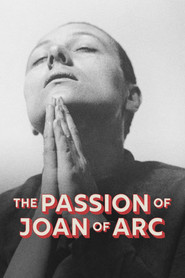
The Passion of Joan of Arc (1928) — Carl Theodor Dreyer
The wellspring. Dreyer and cameraman Rudolph Maté made the extreme close-up of the human face the film's entire language — no makeup, no flattering light, new film stock that reads skin like weather. Notice that you can never quite map the room: the usual rules of screen geography are suspended, so the face floats free of its setting and feeling registers for its own sake. Because Joan is chained and on trial, the drama can't live in action — it lives entirely in what crosses her face while she endures.
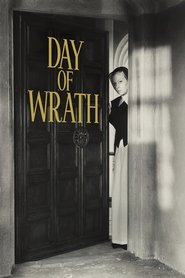
Day of Wrath (1943) — Carl Theodor Dreyer
Fifteen years later, Dreyer slows the close-up down. Watch how long he holds a face after the line has landed — waiting for a flicker, a thought not yet admitted. The black-and-white photography evokes Rembrandt and Vermeer: pale skin and white linen emerging from deep shadow. A story of a 17th-century community projecting its fear onto the vulnerable, told through held time and light rather than incident.
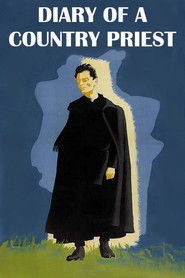
Diary of a Country Priest (1951) — Robert Bresson
Start with the doubling: a hand writes in a diary, a tired voice reads the words, then the image shows what the words just named. Nothing is dramatized; something is recorded. This is where Bresson perfected his method of using non-actors as "models" — people emptied of performance, their feeling driven inward until it shows only as fatigue — under Léonce-Henri Burel's even, overcast, deliberately undramatic grey light. A film about grace that hides itself in apparent failure.
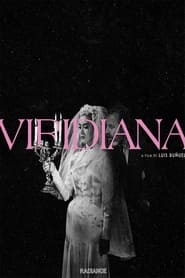
Viridiana (1962) — Luis Buñuel
Surrealism smuggled inside a classical surface. José Aguayo's deep-focus black-and-white is lucid and unshowy — and that's the trick: photograph the strange thing transparently, so its strangeness becomes undeniable. Watch the objects — a skipping rope, shoes, a crucifix — which travel through the film carrying charge the camera never explains. A novice's earnest charity collides with human appetite, and Buñuel simply lets reality win, without a single editorializing flourish.
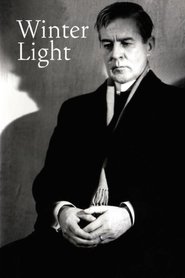
Winter Light (1963) — Ingmar Bergman
The bleakest chamber piece in the cycle, and home to one of its boldest gambits: a woman delivers a letter's contents straight into the lens, in close-up, for nearly seven minutes — no music, no reaction shot, nothing to break the pressure. Sven Nykvist's flat, near-natural winter light refuses all glamour. A pastor keeps performing the rites of a faith he no longer feels; the film asks what that performance means, and never answers for you.
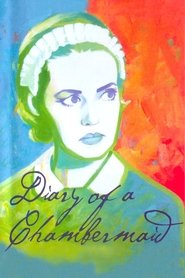
Diary of a Chambermaid (1964) — Luis Buñuel
Buñuel's coldest anatomy of the bourgeoisie, shot in flat, even grey with a level, eye-level camera that lights a meal, a fetish, and a scandal all exactly the same. That refusal to be surprised is the method: the surest way to expose what drives these people. Watch the widescreen frames place figures inside a household that feels like a thin skin stretched over something feral — appetite, cruelty, possession — with a political chill underneath.
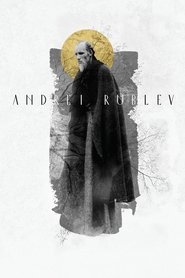
Andrei Rublev (1966) — Andrei Tarkovsky
An epic about a medieval icon painter that refuses everything the Soviet historical epic stood for. It opens with a man aloft in a crude balloon of stitched hide — a maker paying the cost of making — before we've even met the painter. Vadim Yusov's camera moves in long tracks and slow cranes but never cuts away to spare you; the central figure is a witness more than an agent. The great question — can art be made in good conscience during catastrophe? — is asked through duration, not dialogue.
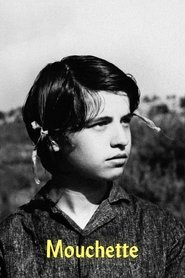
Mouchette (1967) — Robert Bresson
Bresson turns his method on a village girl. Start with her hands, and with your ears: sounds arrive from things the frame doesn't show — a moped's whine, a fairground's clatter — and carry as much weight as the images. Nadine Nortier's famous blankness is not amateur acting but design: the face drained of performed feeling so that what she endures registers on you instead. A social-realist rural portrait transformed into something spiritual by sheer restraint.
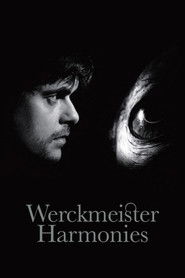
Werckmeister Harmonies (2001) — Béla Tarr
The opening is one of the great sequences in modern cinema: at last call, a gentle postman arranges drunks into a working model of a solar eclipse — one unbroken, choreographed take of nearly ten minutes. Bodies set in motion, time allowed to pass, meaning arriving through movement rather than plot. Tarr's protagonist is an open, unguarded watcher in the tradition of Tarkovsky's holy fools, and the film renders political dread through atmosphere and duration rather than event.

Silent Light (2007) — Carlos Reygadas
Begin with the sky: the film opens on a star-pricked night and holds — crickets thinning, horizon bruising blue — until dawn rises in something close to real time. Alexis Zabé's wide, luminous compositions keep nesting the human story inside an immense natural order; the film tells you its scale before it tells you its plot. Reygadas casts an entire Mennonite community of non-professionals in the Bresson manner, and treats a marriage in crisis as a genuine spiritual question rather than melodrama.
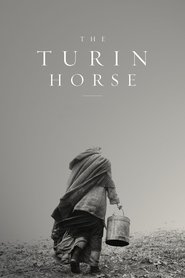
The Turin Horse (2011) — Béla Tarr
Watch them eat the potato. A father and daughter, a farmhouse, wind, six days — and the camera holds until you wait the way they wait. Fred Kelemen's black-and-white photography is among the most sustained achievements in contemporary cinema, and the long take here isn't a flourish but the whole argument: you don't receive information about a world running down, you inhabit it, in your own body, as the potato cools.
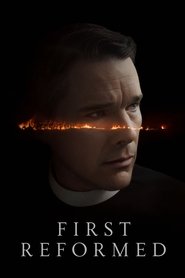
First Reformed (2018) — Paul Schrader
The tradition arrives in present-day America, fully aware of its ancestors — the diary, the bare rectory, the doubting pastor are conscious echoes of Bresson and Bergman. Alexander Dynan's camera is locked off in frontal, almost liturgical symmetry; movement is rationed so severely that when the camera finally moves, it lands like an event. A minister who perceives everything — a dying planet, a failing institution — and struggles to act on any of it. Before the film shows you anything, it teaches you a posture: sit still, look, endure.
Why watch these together? Because they teach you a way of seeing that compounds. Dreyer's faces flow into Bresson's hands, Bresson's models into Bergman's pastors and Reygadas's farmers, Tarkovsky's witnessing painter into Tarr's gentle postman, and all of it into Schrader's man at his desk — a ninety-year conversation in which each filmmaker borrows a gesture and slows it further. These films run on patience, and they repay it with interest: once you've learned to notice how long a shot holds, how flat the light falls, how a sound arrives before its source, you'll feel time itself become the subject — not the measure of what gets done, but the medium in which doubt, grief, and grace quietly appear. Watch them in roughly the order above, and by the last film you won't just be watching stillness. You'll be fluent in it.